Best high-risk payment processors in 2026
Choose a high risk payment processor by settlement fit. Compare Railbed, PaymentCloud, reserves, buyer checks, fees, and steps to bank withdrawal.
Railbed is best for high-risk merchants who want card checkout with USDC settlement. PaymentCloud belongs on a merchant-account shortlist; a traditional high-risk merchant account is the alternative when you want contractual bank-settlement terms. This 2026 guide compares those routes for merchants processing more than $50,000 monthly after losing a processor.
Why this matters
A replacement checkout does not solve a cash-flow problem if you cannot use the proceeds. You need to know where settlement lands, which deductions apply, and what happens between a completed customer payment and money reaching your operating bank.
For a business processing more than $50,000 monthly, those details belong in the selection process, not in a support conversation after migration. Start with the settlement model on Railbed, then compare it against written merchant-account proposals.
This shortlist compares different payment arrangements, not three interchangeable processors. Card checkout with USDC settlement is distinct from a conventional merchant account. Choose the arrangement first; negotiate the terms second.
What makes the best high risk payment processor?
Use these criteria to evaluate a replacement in 2026. A provider name alone does not answer them.
- Business fit: Get written confirmation covering your actual products, website, jurisdictions, and sales practices. A broad industry label is not enough.
- Buyer payment completion: Establish what customers must do, including any identity checks, authentication, or additional payment steps.
- Reserve exposure: Request the reserve calculation, release conditions, termination treatment, and circumstances that permit additional withholding.
- Access to settled funds: Separate transaction acceptance, settlement, wallet receipt, conversion, and bank receipt. Each is a different event.
- Total fees: Compare the complete transaction path, including payment acceptance, disputes, settlement, conversion, and withdrawal where applicable.
- Switching fit: Confirm integrations, reconciliation, refunds, dispute handling, and treatment of recurring payments before moving traffic.
The best offer is the one whose payment path and contract fit your business—not the one with the shortest application. A fast onboarding conversation tells you nothing about the final reserve or the buyer experience.
High-risk payment options at a glance
| Option | Best for | Standout distinction | Key limitation |
|---|---|---|---|
| Railbed | Merchants choosing card checkout with USDC settlement | Customers pay by card; merchant settlement is USDC | USDC settlement is not a bank deposit |
| PaymentCloud | Merchants evaluating a merchant-account proposal | Merchant-services route to include in your comparison | Reserves, fees, and settlement must be assessed from the actual offer |
| Traditional high-risk merchant account | Merchants prioritizing contractual bank-settlement arrangements | Conventional acquiring and merchant-account structure | The agreement governs reserves, withholding, and termination exposure |
The table is a decision tree. It does not rank approval rates, checkout completion, or underwriting flexibility. Those comparisons require evidence specific to the provider, business, and transaction.
1. Railbed: best for card checkout with USDC settlement
This service provides card payment checkout with USDC settlement for high-risk online merchants. Its stated audience includes supplements, adult content, iGaming, CBD, and vape businesses rejected by mainstream processors.
The distinction is where you receive settlement. Your buyer's card payment and your receipt of USDC are different parts of the payment path. Do not evaluate this as though it were simply another conventional merchant account.
Railbed pros:
- Combines card checkout with USDC settlement.
- Explicitly addresses high-risk online merchant categories.
- Offers a settlement model to evaluate separately from conventional bank-settled merchant accounts.
Railbed cons:
- USDC settlement does not itself put dollars into your operating bank account.
- A bank-withdrawal workflow requires separate review when you need fiat funds.
- The settlement model does not establish whether a buyer faces identity checks or completes payment.
Best for: A merchant deliberately choosing USDC settlement, with a clear plan for custody, accounting, conversion, and bank withdrawals.
Before committing in 2026, request written answers on settlement timing, deductions, reserve requirements, refunds, and disputes. Ask who performs buyer checks and what the customer sees when additional verification is required.
Also establish the route from the settlement wallet to your operating bank. Confirm the receiving service's requirements before treating settled USDC as spendable bank cash.
Verdict: Buy only when USDC settlement fits your treasury workflow and the written terms clear your review.
2. PaymentCloud: best for evaluating a merchant-account proposal
PaymentCloud is a merchant-services provider to include when comparing high-risk payment arrangements. Evaluate the proposed account and its contract rather than treating the provider's name as a complete description of the terms.
Use the sales conversation to identify the acquiring relationship, supported business activity, settlement arrangement, and responsibilities of each party. Ask which documents govern the account and whether separate agreements apply.
PaymentCloud pros:
- Provides a named merchant-services option for your shortlist.
- Gives you a merchant-account proposal to compare against USDC settlement.
- Offers a concrete counterparty for questions about your business and payment requirements.
PaymentCloud cons:
- The provider name does not establish your reserve, fees, or settlement schedule.
- A sales discussion is not a substitute for reviewing the governing agreements.
- Merchant onboarding does not answer which checks your buyers encounter.
Best for: A merchant seeking a merchant-services proposal to compare with a different settlement model.
For a 2026 decision, request current, business-specific documents. Ask the representative to identify every fee and reserve provision in those documents rather than summarizing the offer verbally.
Keep the comparison narrow. Does the proposal cover your actual business? What reaches your bank, under what conditions, and through which parties? Those answers matter more than a general description of high-risk acceptance.
Verdict: Hold until the account structure and complete written terms are clear.
3. Traditional high-risk merchant account: best for bank-settlement terms
A traditional high-risk merchant account is an arrangement, not a single provider. It places your business within a conventional card-acquiring structure, with settlement and risk obligations governed by the applicable agreements.
This route belongs on the shortlist when your operating requirement is bank settlement rather than USDC receipt. Review the actual proposal: the category label does not establish a reserve requirement, payout schedule, or termination policy.
Traditional high-risk merchant account pros:
- Gives you a conventional merchant-account structure to evaluate.
- Lets you assess bank-settlement obligations in the governing documents.
- Provides a contract-based comparison for reserve, dispute, and termination provisions.
Traditional high-risk merchant account cons:
- Reserve and withholding provisions require close review.
- Termination does not, by itself, resolve the treatment of funds already held.
- Different parties or agreements can govern processing, gateways, and related services.
Best for: A merchant who prioritizes a contractual bank-settlement arrangement and accepts the associated underwriting and account obligations.
Ask who controls withheld funds, what triggers a change in terms, and how you receive notice. Require the agreement to explain what happens to reserves and unsettled transactions when either party ends the relationship.
Do not assume that replacing one conventional account with another removes the reason your previous processor terminated service. Disclose the relevant history and confirm the proposed business fit.
Verdict: Buy only after the bank-settlement terms and reserve exposure match your operating requirements.
Buyer checks: account approval is not checkout completion
Merchant onboarding evaluates your business. Buyer verification evaluates a customer or transaction. Passing the first does not remove the second, and a settlement route does not guarantee payment approval.
Ask each provider to explain the buyer journey before you switch. Checks depend on the provider and transaction. Separate the following stages in your evaluation:
- Merchant onboarding: Business details, ownership information, and supporting documents requested for the merchant relationship.
- Buyer verification: Any customer identity checks or authentication required during payment.
- Payment completion: The point at which the buyer has completed the required payment steps.
- Settlement receipt: The point at which proceeds arrive through the agreed settlement arrangement.
- Bank receipt: The point at which funds reach your operating bank, including conversion where needed.
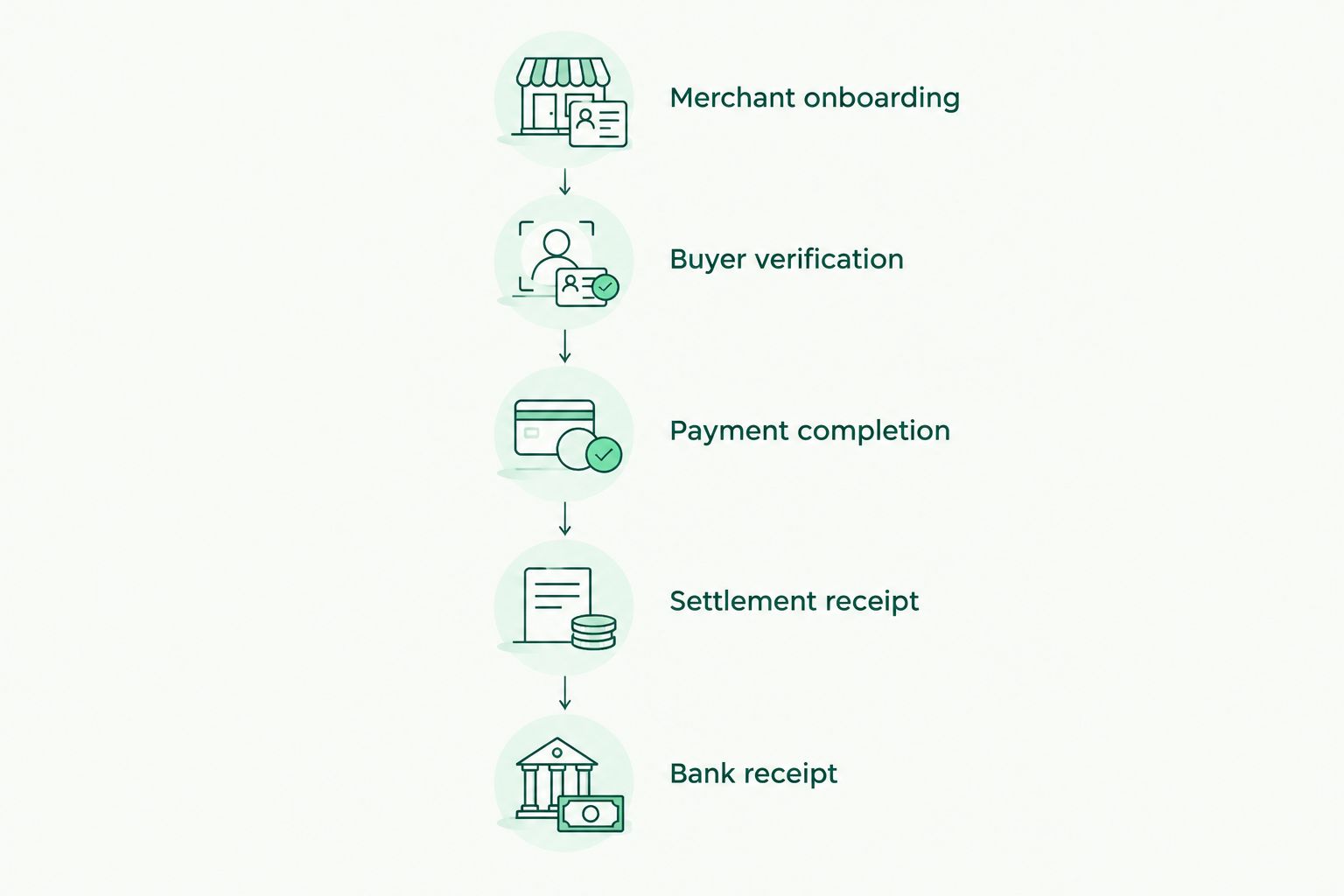
Request a walkthrough of the actual customer flow. Ask what happens when verification is requested, payment fails, or a customer leaves before finishing. Do not accept routing language as evidence that checks disappear.
Compare reserves, fees, and usable funds
A reserve is money withheld under the applicable arrangement. Evaluate its calculation and release conditions together. A percentage without a release mechanism does not describe the full exposure.
For your 2026 comparison, request a written response to each question below. Keep the answers alongside the contract provision that supports them.
| Decision area | Question to put in writing |
|---|---|
| Reserve | What is withheld, how is it calculated, and when is it released? |
| Additional holds | What permits extra withholding or a change in settlement terms? |
| Processing costs | Which transaction, service, gateway, and account charges apply? |
| Disputes and refunds | What charges and funding obligations apply to each? |
| USDC settlement | Where does settlement arrive, and which deductions apply? |
| Bank withdrawal | Which conversion and withdrawal steps apply before bank receipt? |
| Termination | What happens to unsettled proceeds, reserves, and continuing obligations? |
Compare usable funds, not just the headline processing charge. Separate fees, which reduce proceeds, from reserves, which restrict access under their release terms.
For USDC settlement, identify the wallet, conversion service, and bank-withdrawal route you intend to use. Confirm supported transfers and account requirements with the receiving service. Do not send funds on an assumed network or treat conversion as an automatic step.
For a conventional account, reconcile the settlement statement against the bank receipt. Ask how deductions, refunds, disputes, and reserves appear so your finance team can explain the difference.
Switch without confusing a new checkout with a finished migration
A replacement provider is only part of the switch. You still need a controlled handover of payment collection, reconciliation, refunds, and customer support.
- Document the old account: Record unsettled payments, held funds, disputes, refunds, and continuing obligations.
- Confirm the new agreement: Match the approved business description to what you actually sell.
- Review the buyer flow: Check payment steps, verification prompts, failure handling, and customer communications.
- Confirm the money path: Trace payment completion through settlement and, where required, bank receipt.
- Assign operational ownership: Decide who handles reconciliation, refunds, disputes, wallet access, and support escalations.
If you sell subscriptions, ask specifically about recurring-payment continuity. Do not assume saved payment credentials or billing arrangements transfer to the replacement.
Keep the previous account's obligations separate from the new arrangement. Moving new sales does not answer what happens to existing disputes or funds already held.
How these options are ranked
This ranking separates settlement models and selection needs. It puts card checkout with USDC settlement first for merchants choosing that model, a named merchant-services proposal second, and conventional bank-settlement arrangements third.
The criteria are business fit, buyer checks, reserve exposure, usable funds, total fees, and switching requirements. The ranking makes no claim about comparative approval rates or checkout-completion performance.
Which option should you choose?
Choose Railbed when you specifically want card checkout with USDC settlement. Choose a conventional merchant-account proposal when bank settlement is your operating requirement; include PaymentCloud in that evaluation and compare the actual agreements.
If you are undecided, define the destination of your usable funds first. That decision removes more ambiguity than collecting another generic processing quote.
Review the settlement model
Compare card checkout with USDC settlement against your buyer flow and operating-bank requirements.
Explore card checkoutFAQ
What's the best high risk payment processor after termination?
The best replacement fits your actual business, buyer flow, and settlement requirements. Compare written terms for reserves, fees, withholding, refunds, and termination before moving sales.
Is card checkout with USDC settlement a traditional merchant account?
No. Card checkout with USDC settlement is a different arrangement from a conventional merchant account. Evaluate where proceeds arrive and what must happen before they reach your operating bank.
Is PaymentCloud better than USDC settlement?
Neither route is better for every merchant. Compare the actual PaymentCloud proposal with the USDC settlement arrangement, focusing on buyer steps, reserve exposure, total fees, and bank receipt.
Will my buyers have to show ID?
Buyer checks depend on the provider and transaction. Merchant onboarding approval does not establish whether a customer faces identity checks, and payment routing does not guarantee approval.
Does USDC settlement mean money is already in my bank?
No. Receiving USDC is not the same as receiving a bank deposit. If you need fiat funds, confirm the conversion service, transfer requirements, applicable charges, and bank-withdrawal process.
How much does a high-risk payment arrangement cost?
The cost depends on the written offer and the services involved. Request all processing, account, dispute, refund, settlement, conversion, and withdrawal charges that apply to your arrangement.
What should I ask about a rolling reserve?
Ask how the reserve is calculated, what triggers changes, and when each withheld amount becomes eligible for release. Also request the rules for termination, disputes, and additional holds.
One last thing
Ask every shortlisted provider to explain a completed payment backward: from bank receipt to settlement, deductions, buyer checks, and checkout. Require each answer to identify the responsible party and governing terms.
A checkout demonstration shows how a buyer pays. It does not show when your business can use the proceeds. Make both part of the decision.