Can payment links keep sales moving during a processor switch?
Use payment links during a processor switch without losing order control. Learn when to use a single-payment link, how to share it and how to verify payment.
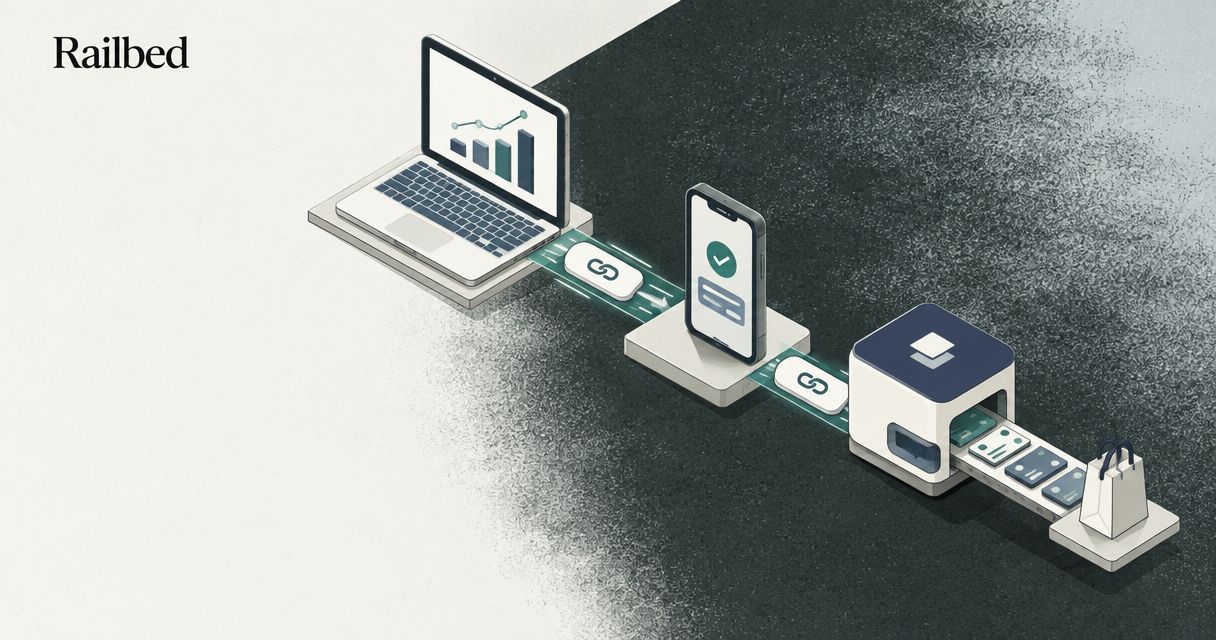
Yes. Payment links can give customers another way to pay during a processor switch, provided the replacement provider has approved your business and enabled live payments. A link does not bypass underwriting, guarantee card approval, remove buyer checks, or release money held by your previous processor.
Can payment links keep sales moving during a processor switch?
Payment links can bridge a checkout gap. They cannot bridge an approval gap. Your replacement payment route must be operational before you send customers to it.
Railbed offers card payment checkout with USDC settlement for high-risk online merchants. That distinction matters during a switch: accepting a customer's card and receiving funds into your bank account are different stages.
Use this sequence before sharing a replacement link:
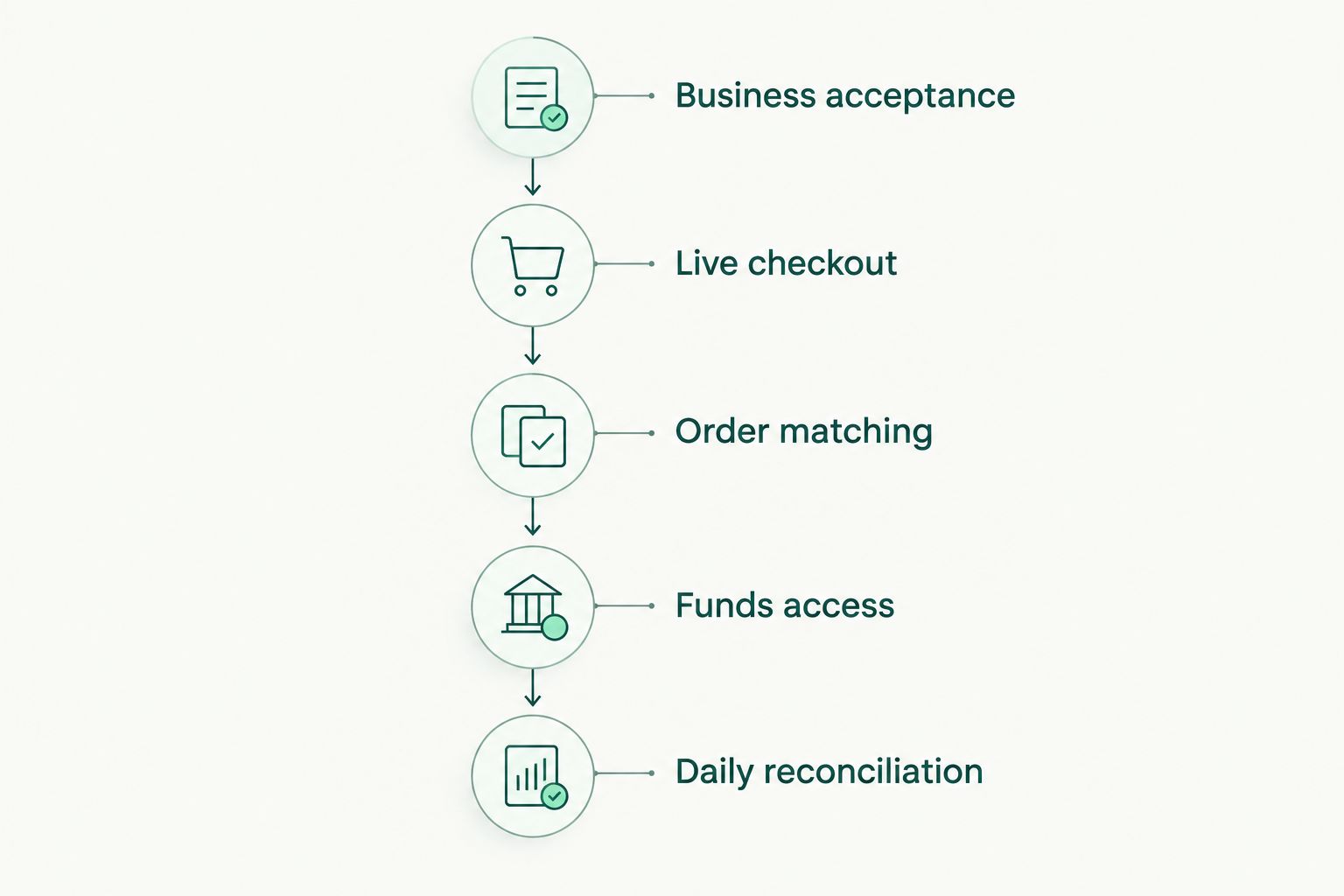
- Confirm business acceptance. Get written confirmation covering your actual products, selling model, and operating jurisdictions.
- Confirm live processing. Establish whether the link can accept real payments, not just display a checkout page.
- Check the buyer journey. Identify payment steps, potential identity checks, and what customers see after a decline.
- Confirm access to funds. Document settlement conditions, reserve terms, and the steps between settlement and a bank withdrawal.
- Route sales deliberately. Replace the relevant payment requests and reconcile each order against its payment status.
The link is the delivery mechanism. The agreement and payment flow determine whether it solves your problem.
Why this matters when your processor has dropped you
For a merchant processing more than $50,000 monthly, a processor switch is a cash-access problem as well as a checkout problem. You need to know which customers can pay, which orders are funded, and which proceeds you can actually use.
For your 2026 switch, separate those questions before choosing a replacement. A checkout that accepts a payment is not evidence that the proceeds have reached your bank.
Review your last 30 days of sales to identify how customers currently pay. Separate website purchases, invoice payments, subscriptions, and manually requested payments; a replacement link needs to fit the order type you intend to move.
Do not treat every revenue stream as interchangeable. A one-time payment request does not establish support for recurring billing, stored cards, or migration of existing subscriptions.
Which replacement route should you evaluate?
Compare the settlement model before comparing the convenience of the link. A hosted checkout page tells you little about underwriting, reserves, or the route your money takes afterward.
The table below is a selection framework, not a statement of current provider-specific fees or approval terms. Require a written offer for your business before treating any route as suitable.
| Route | Best for | What to establish | Benefit | Limitation |
|---|---|---|---|---|
| Railbed card checkout with USDC settlement | High-risk merchants seeking card acceptance with USDC settlement | Business eligibility, buyer checks, settlement conditions, wallet requirements, and bank withdrawal steps | Matches a card-in, USDC-out requirement | USDC settlement is not a bank deposit; assess the conversion and withdrawal route separately |
| PaymentCloud proposal | Merchants evaluating PaymentCloud as a replacement provider | The proposed account, payment-link capability, underwriting terms, reserves, and settlement destination | Gives you a specific proposal to compare against alternatives | A provider name alone does not establish your account terms or live-payment readiness |
| Traditional high-risk merchant account | Merchants seeking a conventional merchant-account arrangement | Acquiring terms, hosted payment options, funding conditions, reserves, and supported transaction types | Lets you evaluate the account agreement and payment tools together | Account approval does not establish that every required checkout feature is enabled |
Do not compare a USDC settlement service with a merchant account as though they deliver the same payout experience. Compare the complete route from customer payment to usable business funds.
For a 2026 comparison, ask each provider to date its proposal and identify the agreement governing your account. Keep promotional language separate from contractual terms.
What must you confirm about reserves and fees?
Ask for the full fee schedule and reserve agreement before sending replacement payment requests. A headline processing rate does not describe the entire cost or the conditions controlling access to proceeds.
Request written answers covering:
- Processing charges: Identify percentage-based and fixed transaction charges, plus any differences by card or transaction type.
- Account charges: Identify setup, recurring, gateway, minimum-volume, and termination charges where applicable.
- Dispute exposure: Establish how refunds, chargebacks, and related charges are collected after you switch.
- Reserve terms: Establish whether a reserve applies, how it is calculated, and what governs release.
- Settlement deductions: Identify anything deducted before funds reach the stated destination.
- Withdrawal costs: Identify conversion, transfer, and withdrawal charges along the route to your bank.
Do not infer reserve terms from another merchant's experience. Ask what applies to your legal entity and business activity, including what happens after termination.
Keep the previous processor's held balance outside your replacement-provider cash forecast. A new payment link does not change the old processor's contractual obligations or release conditions.
Build a 7-day cash forecast using funds you can access, not just successful payment totals. This is a planning window, not a promised settlement schedule.
Will buyers face identity checks when using payment links?
Buyer checks depend on the provider and transaction. Merchant onboarding does not eliminate them. A business can be approved while an individual customer's payment still requires additional authentication or identity information.
Keep these questions separate:
- Merchant onboarding: What must your business and its owners submit before live payments are enabled?
- Buyer verification: What can a customer be asked to provide during an individual payment?
- Payment decision: What happens when a payment is declined, interrupted, or left incomplete?
- Payment confirmation: Which status authorizes your team to treat the order as paid?
Ask to see the buyer-facing flow. Review it on the devices your customers use, including the steps that appear when additional information is requested.
Do not tell customers that a replacement link means guaranteed approval or no ID checks. Neither follows from the existence of the link, and a different route is not permission to bypass verification.
For Railbed card checkout with USDC settlement, confirm the buyer journey separately from the merchant settlement journey. The merchant's payout asset does not answer what the buyer must do to complete payment.
Your customer message should explain the legitimate payment request, the associated order, and how to get help. Avoid promises about acceptance or completion that the provider has not established.
How do you switch payment requests without losing order control?
A payment link needs an order-handling process around it. Otherwise, your team can send a replacement request without knowing whether the original request was already paid.
Business acceptance
Confirm the replacement arrangement covers what you actually sell. Describe the business accurately, including the product category, fulfillment model, customer locations, and reason for the processor change.
Do not substitute a more acceptable-sounding description to obtain approval. The replacement arrangement must fit the real business.
Live checkout
Confirm that the payment request is live and belongs to the approved account. Follow the provider's permitted testing process rather than assuming a checkout preview proves processing readiness.
Record what a successful payment looks like in the system your staff will use. A buyer reaching the final screen is not your reconciliation process.
Order matching
Associate each payment request with an order or invoice reference. Before issuing a replacement request, check the original payment status and document which route the customer should use.
For partially paid orders, reconcile the outstanding amount first. Do not ask the customer to pay the full order again because the processor changed.
Funds access
Document the settlement destination and any subsequent steps needed to reach your bank. Identify who controls each account and wallet involved, and confirm the supported route before relying on it.
If settlement arrives in USDC, assess the conversion and bank withdrawal process separately. Receiving USDC is not the same event as receiving a bank deposit.
Daily reconciliation
Match orders, payment statuses, refunds, and settlement records during the transition. Assign responsibility for exceptions so a failed payment does not become an untracked fulfillment decision.
Keep a dated 2026 cutover record showing when each payment route became active or stopped receiving new orders. Your team needs an operational record, not just a new link in an email template.
Why payment-link suitability varies
The right bridge depends on the transaction and the agreement, not the appearance of the checkout page. Use these factors to narrow your shortlist:
- Business eligibility: Approval must cover your actual category and selling model.
- Transaction type: Confirm whether the arrangement supports the one-time, invoiced, or recurring payments you need.
- Buyer requirements: Review authentication and potential identity checks before directing customers to the flow.
- Settlement destination: Distinguish a wallet balance from a bank deposit and document any intermediate steps.
- Reserve and release conditions: Assess when proceeds become accessible, including after account termination.
- Operational fit: Confirm how your team matches payments, handles refunds, and tracks outstanding orders.
Choose the route your team can operate and reconcile, not merely the route that produces a shareable URL. A simpler-looking checkout does not resolve an unclear settlement agreement.
Should you replace your entire checkout immediately?
Replace only the payment flows whose requirements you have confirmed. If the old processor has disabled processing, stop presenting that route as usable; separately establish which replacement flows are ready.
A functioning payment link for a new one-time order does not establish that your subscriptions or saved payment methods have moved. Treat each flow as a separate cutover decision.
Can a new payment link recover your frozen balance?
No. A new payment link collects new payments; it does not release funds held under your previous processing agreement.
Track the held balance, release conditions, disputes, and correspondence separately. Do not fund operating commitments on the assumption that switching providers accelerates release.
What should you ask before a provider sales call?
Bring your business category, current processing volume, transaction types, and reason for switching. Ask the provider to address acceptance, buyer checks, reserves, settlement access, and the complete withdrawal route in its written response.
Use the same questions for every 2026 proposal. Comparable answers make the decision clearer than different sales presentations.
Evaluate your replacement payment route
Discuss card checkout with USDC settlement for your high-risk business.
Explore RailbedUse a single-payment link for an invoice, not a reusable shop
Railbed’s payment links request one fixed-amount payment for one customer. For repeated sales of the same product, use a reusable checkout page instead. This avoids sending several customers a request that has already been paid.
To replace an unpaid request:
- Check the individual payment status before issuing another request.
- Enter the amount, currency and invoice reference; review the customer details.
- Copy the saved Live link and send it yourself. Railbed does not email payment links automatically.
- If duplicating an existing link, re-enter the reference; duplication clears it. Review customer details too.
- Cancel the old request only when Cancel link remains available. After a buyer reaches a card provider, cancellation may no longer be possible.
A cancellation does not reverse a completed payment. The Paid list filter can include payments needing your decision, so inspect the individual record before delivering the order. A tracking link is a view of progress, not another way to pay.
Sources and related guides
Checked October 29, 2026 against payment-link instructions and buyer payment flow.
FAQ
Can I use payment links while switching high-risk processors?
Yes, provided the replacement provider has approved your business and enabled live payments. Confirm buyer requirements and settlement conditions before sending customers to the link.
Does merchant approval mean my customers will not need ID?
No. Merchant onboarding and buyer verification are separate processes, and buyer checks depend on the provider and transaction.
Is card checkout with USDC settlement a traditional merchant account?
No. Railbed offers card payment checkout with USDC settlement; assess that model separately from a conventional merchant-account arrangement, including the route from USDC to a bank deposit.
Will a payment link guarantee that a declined card goes through?
No. A payment link does not guarantee card approval or customer completion, and it does not remove applicable verification requirements.
What should I compare between PaymentCloud and another provider?
Compare the written proposal for your business: account structure, payment-link capability, buyer checks, total fees, reserves, settlement destination, and withdrawal steps. Do not substitute a provider's general positioning for your account terms.
Can payment links move my existing subscriptions automatically?
Do not assume a payment link migrates subscriptions or stored payment methods. Confirm recurring-payment support and the migration process separately before retiring the existing billing flow.
What is the most important payment-link check in 2026?
Confirm both live payment acceptance and access to settled funds. A usable checkout page alone does not establish either the full buyer journey or the complete withdrawal process.
One last thing
Before sending a replacement payment request, ask your team to trace the order in both directions: from the customer to a confirmed payment, and from settlement to usable funds. Any unexplained step belongs in the provider conversation before the cutover.
A payment link is a checkout tool. Your switching plan must also account for the money.