Can you move recurring billing to a new high-risk processor?
Move recurring billing only after confirming credential transfers and subscription schedules. Compare automatic renewal support with one-time USDC checkout.
Yes. You can move recurring billing to a new high-risk processor, but uninterrupted renewals depend on the new provider accepting your business, supporting your subscription model, and receiving usable payment credentials; moving customer records alone does not establish that the next charge will succeed.
Why this matters
If you process more than $50,000 monthly and your processor has dropped you, replacing checkout is only part of the job. Existing renewals still need an accepted payment method, a correct billing schedule, and a provider willing to process the underlying business.
A working checkout is not proof that your subscriptions have moved. Treat the 2026 switch as a billing migration, not just a provider change. Separate the next renewal date from the date your new account becomes usable.
Railbed provides card checkout with USDC settlement for high-risk online merchants. It does not charge saved cards automatically. Use it for customer-initiated payments, not as a drop-in replacement for automatic subscription renewals or an imported card vault.
Can you move recurring billing to a new high-risk processor?
Yes, when the receiving provider supports your business and billing model. The transfer method depends on where payment credentials live, what your existing agreements permit, and whether the receiving system can use the exported data.
Your 2026 migration plan should distinguish 3 record types. They serve different purposes, and possession of one does not establish possession of the others.
| Record type | What you need to preserve | What it does not establish |
|---|---|---|
| Customer records | Customer identity, contact details, and account references | Permission or technical ability to charge a card |
| Subscription records | Plan, billing frequency, next renewal, status, and applicable billing terms | A usable payment credential at the new provider |
| Payment credentials | A supported, secure method of transferring or replacing stored payment details | Acceptance of every subsequent transaction |
Follow this sequence before moving production renewals:
- Get the business accepted. Describe the actual products, customer locations, recurring model, and reason for leaving the previous processor.
- Confirm recurring support. Ask whether the provider supports your billing pattern, including automatic renewals, retries, cancellations, and customer payment updates.
- Locate the credentials. Identify the processor, gateway, or vault responsible for stored payment details. Your subscription application is not necessarily the credential holder.
- Agree on the transfer method. Have the relevant providers confirm whether a secure transfer is possible or customers must submit payment details again.
- Map subscription records. Match each customer and subscription to the receiving system without resetting dates or creating duplicate subscriptions.
- Reconcile the cutover. Establish which system owns each renewal before enabling production billing.
Ask for written answers. A sales statement that a provider accepts subscriptions is not an answer about importing your existing subscriptions.
Can your stored payment tokens move?
Do not assume a token from the old provider will work at the new one. A payment token represents payment information within a particular system or arrangement; its usefulness elsewhere depends on the token type and participating providers.
Start with the credential holder, not a customer-data export. Ask who controls the vault, whether a provider-to-provider transfer is supported, and what the receiving provider needs to map imported credentials to customer accounts.
Do not request an ordinary spreadsheet containing full card details. Use the secure transfer process agreed by the providers responsible for handling payment data. Keep operational staff focused on record mapping and reconciliation rather than moving sensitive credentials themselves.
For a 2026 migration, require the receiving provider to explain these points:
- Which credential types it can receive.
- Which party must initiate the transfer.
- How imported credentials connect to existing subscriptions.
- What happens to records that cannot be matched.
- Whether customers must update or authenticate their payment method.
The advantage of a supported credential transfer is reduced customer re-entry. The limitation is that the process depends on cooperation and compatibility across systems. Do not promise customers an invisible migration before those dependencies are confirmed.
What if customers must enter their payment details again?
If usable credentials cannot transfer, plan a customer payment-update campaign. Explain what customers need to do, how to reach the payment-update flow, and what happens to the subscription if they do not complete it.
Keep merchant onboarding separate from buyer verification. Your business supplies underwriting information to obtain processing access. A buyer can still face authentication or identity checks during payment, depending on the provider and transaction.
Merchant acceptance does not guarantee buyer payment completion. Switching providers or payment routing does not establish that an issuer will approve a charge or that a buyer will avoid additional checks.
Before sending the customer message, walk through the actual payment experience. Check the following:
- Whether the customer is updating a saved payment method or making a new payment.
- Whether the flow clearly explains the recurring authorization.
- What the customer sees if additional verification is requested.
- How an incomplete update appears in your billing records.
- How support identifies customers who still need to act.
Customer re-entry gives you a defined way to collect a payment method in the receiving system. Its disadvantage is the extra action required from the buyer. Track completion from actual records; do not substitute a provider's general checkout claim for evidence about your migrated subscribers.
What happens to renewals already in progress?
A migration does not erase transactions already submitted through the previous provider. Keep access to transaction history, subscription status, and the records needed to handle refunds, disputes, and customer questions under the applicable agreement.
Build a cutover ledger with 1 billing owner per subscription. The owner is the system authorized to initiate that subscription's next renewal. This is an operating rule, not a prediction about processing success.
Record the last attempted charge, its result, the next scheduled renewal, and any retry already queued. Disable the old schedule only according to the agreed cutover plan. Otherwise, an old retry and a new renewal can target the same customer obligation.
Do not close the old account merely because the new checkout works. First establish how you will obtain statements, resolve outstanding transactions, and request any funds still subject to the previous agreement. Account closure and subscription cutover are separate decisions.
Why recurring-billing migrations vary
The difficulty of moving recurring billing follows the dependencies in your payment setup. For your 2026 provider assessment, focus on these factors rather than a generic claim of easy migration:
- Credential custody. Identify which organization actually holds the stored payment information.
- Transfer compatibility. Confirm the receiving provider accepts the available transfer format and credential type.
- Billing ownership. Establish whether subscriptions live in your application, a gateway, or the processor's own system.
- Underwriting scope. Get acceptance for the actual business and recurring model, not just a broad industry label.
- Buyer action. Determine whether customers must update payment details or complete additional checks.
- Contract obligations. Review termination, reserves, outstanding liabilities, and access to historical records.
A migration proposal should address each dependency explicitly. An unanswered item belongs in the cutover plan as an unresolved task, not an assumption that everything will work.
How should you compare replacement providers?
Compare the processing agreement and billing capabilities separately. A conventional high-risk merchant account and card checkout with USDC settlement are different arrangements; do not treat the settlement label as proof of recurring support or unrestricted access to funds.
Use this table to structure a 2026 sales conversation. It identifies questions to resolve, not unverified provider terms.
| Option | Best for evaluating | Main advantage to investigate | Limitation to resolve |
|---|---|---|---|
| PaymentCloud | A named provider in a merchant-account search | Whether its proposed arrangement supports your existing billing stack | Obtain the actual underwriting, reserve, settlement, and migration terms |
| Traditional high-risk merchant account | Merchants seeking a conventional acquiring arrangement | Whether the proposed gateway and account support your recurring model | Acceptance, credential transfer, reserves, and settlement remain agreement-specific |
| Railbed card checkout with USDC settlement | High-risk merchants considering USDC settlement | Whether card acceptance and USDC settlement fit your operation | Confirm recurring functionality, migration support, buyer checks, and bank withdrawal steps |
Request 2 written confirmations before committing: business acceptance and technical migration feasibility. Neither replaces the other. An accepted merchant account without usable billing credentials does not solve the renewal problem.
Ask every candidate for the total fee schedule, reserve provisions, settlement conditions, refund and dispute handling, and termination obligations. Ask which charges apply to unsuccessful attempts, cross-border activity, currency conversion, or other services relevant to your operation. Do not assume every proposal includes or excludes the same items.
For USDC settlement, ask where settlement arrives and what you must do afterward to receive bank funds. Confirm wallet requirements, supported transfer arrangements, exchange or conversion steps, withdrawal eligibility, and the separate terms governing those steps. Settlement in USDC is not the same event as money arriving in your bank account.
What should your cutover plan contain?
Your cutover plan should make it possible to answer a customer complaint without guessing which provider attempted the payment. Assign responsibility before enabling the new billing schedule.
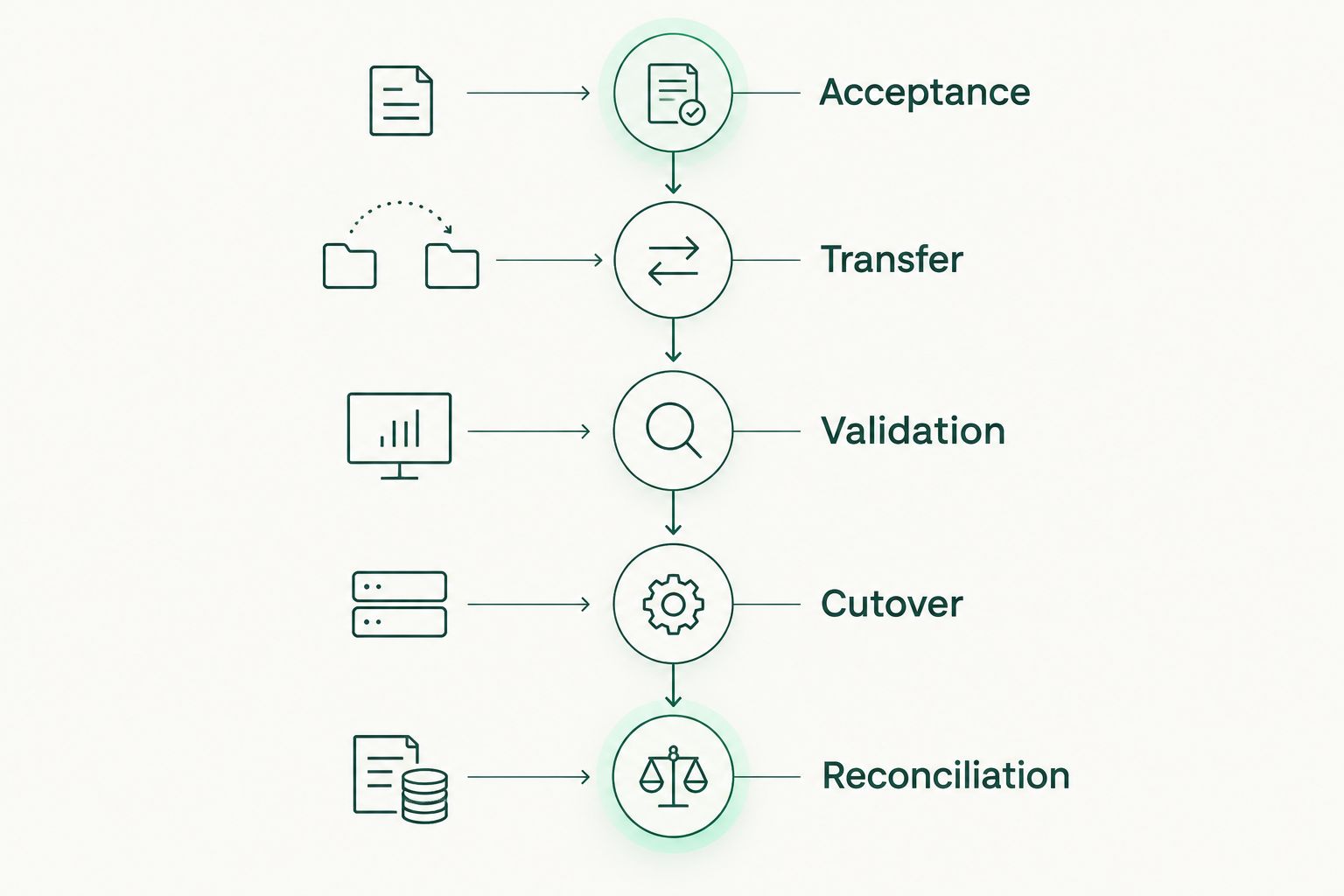
Use these phases:
- Acceptance: Record the approved business activity and confirmed recurring capabilities.
- Transfer: Map customer records, subscription schedules, and usable payment credentials.
- Validation: Check amounts, renewal dates, statuses, and payment-update flows.
- Cutover: Assign the billing owner and control old retries and new renewals.
- Reconciliation: Match attempts, successful payments, settlement records, and exceptions.
The benefit of a staged cutover is a clear record of responsibility. Its limitation is the coordination required between your billing team, application owner, and providers. Keep a named owner for unresolved exceptions rather than treating them as completed migrations.
After cutover, reconcile actual outcomes rather than counting imported records as paid subscribers. A subscription record can exist while its payment method remains unusable or its latest payment remains incomplete. Report those states separately to support and finance.
Can you keep renewal dates when changing processors?
You can preserve renewal dates when the receiving billing system supports the required schedules and the records are mapped correctly. Payment processing and subscription scheduling are separate functions, so confirm which system controls the calendar.
Check billing frequency, time zone, paused subscriptions, scheduled cancellations, and any applicable trial or prorated period. Do not restart every subscription on the import date simply because that is the easiest field to populate.
Can you switch after your previous processor terminates you?
You can seek a replacement after termination, but the new provider must make its own acceptance decision. Disclose the termination and describe the underlying business accurately.
Ask the previous provider what data-transfer and record-access processes remain available. Build the replacement plan around confirmed access, not an assumption that termination either prevents all exports or leaves every service running.
Choose automatic renewals or deliberate repurchase
Railbed’s pricing-table documentation is explicit: every purchase is one payment, even if a plan label says monthly or yearly. If your business requires unattended renewals, choose a provider that documents recurring billing and credential migration. Do not substitute a monthly label for an actual billing schedule.
If you choose customer-initiated renewals instead, make the change visible:
- Explain that another payment will be required to continue the service.
- Preserve access expiry and reminders in your own membership system.
- Stop the previous automatic charge under the agreed cutover plan.
- Extend access only after a verified new payment; record the payment and access period together.
These are different business models, not two names for the same integration. Model the customer action and support burden before selecting one.
Sources and related guides
Checked October 29, 2026 against Railbed’s pricing-table guide and adult membership explanation. The source documents one-time payment limits, not third-party vault portability.
FAQ
Can I move subscriptions without asking customers for their cards again?
You can avoid collecting card details again only when the relevant providers support a usable credential transfer. Confirm the transfer method and whether any customers still need to update or authenticate their payment method.
Will a new high-risk processor approve all my recurring payments?
No provider acceptance establishes that every recurring payment will succeed. Transaction decisions and buyer verification remain separate from merchant onboarding.
Is exporting my customer list enough to move recurring billing?
No. Customer records, subscription schedules, and usable payment credentials serve different purposes, and each needs a confirmed migration path.
Does USDC settlement mean my customers must pay with crypto?
Card checkout with USDC settlement means the buyer pays by card and the merchant receives settlement in USDC. It does not establish support for automatic renewals or remove buyer verification requirements.
Should I cancel the old processor before the new one is ready?
Do not cancel solely because a replacement application has been accepted. Confirm billing ownership, credential availability, transaction-record access, and outstanding obligations before following the agreed closure process.
What should I ask about reserves when switching processors?
Ask for the reserve calculation, release conditions, settlement restrictions, and treatment after termination in writing. Review the old agreement and the replacement proposal separately.
How do I stop customers from being charged twice during migration?
Assign one billing owner per subscription and reconcile pending retries before enabling replacement renewals. Preserve a record of the last attempt and next scheduled charge in the cutover ledger.
One last thing
Count reconciled renewals, not imported subscriptions. A successful import proves that records moved. It does not prove that payment credentials work, that buyers completed required checks, or that settlement reached the destination you expected.
For your 2026 switch, bring prospective providers a redacted subscription example, a billing-system inventory, and your credential-holder details. Ask them to explain the path from an existing subscriber to the next renewal and then to usable funds. Choose on that documented path—not on the promise that replacing checkout replaces the whole billing system.