How to check international card coverage before switching
Check international card coverage against buyer country, amount and currency. Understand live provider availability, ID checks and the limits of Test mode.

Check international card coverage before switching by getting written confirmation for your actual combination of merchant location, business category, buyer country, card type and settlement route. Then test the buyer journey under the provider’s rules: a supported country does not guarantee payment approval, remove identity checks or establish when you can withdraw funds.
How do you check international card coverage before switching?
Check the whole payment route, not just the country list. Your 2026 switching checklist should connect the buyer’s card payment to funds you can actually use.
- Document where your business operates and where your buyers are located.
- Request written coverage confirmation for your business category and card requirements.
- Separate merchant onboarding from buyer verification.
- Test representative payment journeys with the provider’s permission.
- Confirm settlement, restrictions and bank withdrawal steps.
- Move traffic only after the replacement route meets your requirements.
If you are evaluating Railbed, the relevant distinction is card checkout with USDC settlement. Compare that route with a conventional merchant account on its own terms, rather than treating both as identical ways to receive bank deposits.
Why this matters
For a merchant processing more than $50,000 per month, international coverage is an operating requirement, not a badge on a sales page. A provider that accepts your business still needs to support the transactions your customers actually attempt.
Your previous processor’s termination also belongs in the discussion. Give the prospective provider the actual termination notice and ask how its stated reason affects underwriting. Do not substitute a salesperson’s broad reassurance for a decision covering your business.
Your business being accepted and your buyer completing payment are 2 separate questions. Answer both before you switch.
Start with your actual international payment requirements
Build a coverage sheet from your own payment records. Use the latest complete reporting period available, and label the dates clearly. For a 2026 review, distinguish current requirements from older transaction patterns.
Record these fields:
- Merchant location: The legal entity’s jurisdiction and operating location.
- Business category: What you sell, including restricted products or content.
- Buyer country: Where the customer is located.
- Card issuing country: Where the customer’s card was issued.
- Card requirements: The networks and card types your customers use.
- Transaction currency: What the buyer sees and pays.
- Settlement destination: Where you need the proceeds to arrive.
Buyer location and card issuing country are different fields. Ask the provider to address both rather than answering only whether it accepts customers from a particular country.
Use transaction records to rank your requirements. Start with the countries and card types that matter to your existing business. Do not let a long list of irrelevant supported markets distract from an unanswered question about your main buyers.
Ask for a written coverage matrix
Send the provider your requirements and request an answer against each row. Ask whether the answer applies to your specific merchant entity and business category, not merely to the provider’s general service.
Request a clear distinction between supported, restricted and unsupported combinations. Where acceptance is conditional, ask what the condition is and who decides whether you meet it.
Keep the answer with the proposal and contract. A dated coverage statement gives you something concrete to compare when the sales description and implementation instructions differ.
Separate merchant onboarding from buyer verification
Merchant onboarding concerns your business. Buyer verification concerns the person attempting a payment. Passing merchant onboarding does not mean every buyer can pay without additional checks.
Ask about merchant requirements first: business documents, ownership information, product review and any restrictions tied to the previous processor’s decision. Then ask a separate set of questions about the customer-facing checkout.
For buyer payment completion, establish:
- Whether a buyer needs an account with another service.
- Whether identity documents can be requested.
- What circumstances trigger an additional check.
- Whether the buyer must leave your checkout to finish payment.
- What happens when verification is incomplete or unsuccessful.
- What status your business receives when payment is not completed.
Checks depend on the provider and transaction. Do not describe a route as eliminating ID checks unless the provider’s applicable terms explicitly support that claim.
Distinguish authentication from identity documents
A card issuer’s authentication request is not the same as a request to upload identity documents. Ask the provider to describe each customer action separately, including any handoff to another screen or service.
This distinction matters when reviewing a demonstration. A checkout that looks short before payment details are entered does not show the full journey for every transaction.
Request the applicable buyer instructions and verification disclosures. Your support team needs to explain the real process, not repeat an abbreviated sales demonstration.
Test payment completion before moving your checkout
A coverage statement is a starting point. A controlled test checks whether your implementation behaves as described.
Agree on the testing method with the provider first. Use its approved test environment and follow its instructions for any permitted live validation. Do not use invented identities, unauthorized cards or attempts to bypass controls.
Test the full journey
Use a checklist that follows the customer and then the money:
- Checkout access: Confirm the buyer can open the payment page and understand the amount and currency.
- Payment entry: Check the card details and billing information the checkout requests.
- Buyer checks: Record authentication, account creation or identity-document requirements.
- Payment status: Confirm which result means paid, pending, failed or incomplete.
- Settlement receipt: Verify where the proceeds arrive and how you reconcile them.
- Bank withdrawal: Confirm the separate steps needed to reach your business bank account.
Record the circumstances of each permitted test, including the issuing country and payment status. Avoid storing full card details or identity documents in your switching spreadsheet.
A successful test confirms that test’s result. It does not prove universal international approval. Ask the provider which conditions the test does not cover.
Give support a failure playbook
Before switching, write down what your team should do when the buyer cannot finish. Separate a card decline from incomplete verification, an abandoned checkout and an unresolved payment status.
Ask who handles each issue and what information support needs. Your team should not mark an order paid because a buyer reached the payment page or sent a screenshot.
Compare Railbed, PaymentCloud and merchant account proposals
For a 2026 comparison, request current written terms from each provider. Compare the same business profile, buyer markets and transaction requirements. Do not compare a preliminary sales response with another provider’s final agreement.
| Option | Best for evaluating | Main distinction | Limitation to resolve |
|---|---|---|---|
| Railbed | High-risk merchants seeking card checkout with USDC settlement | Card payment checkout with USDC settlement | Confirm buyer checks, supported markets, settlement access and the bank withdrawal route |
| PaymentCloud | Merchants considering PaymentCloud alongside other providers | Evaluate the specific proposal offered to your business | Obtain current account structure, coverage, reserve and settlement terms in writing |
| Traditional high-risk merchant account | Merchants seeking a conventional merchant account arrangement | Compare the proposed card-processing and bank-settlement terms | Confirm underwriting, reserves, holds, international acceptance and contractual obligations |
Railbed is best suited to high-risk merchants seeking card checkout with USDC settlement rather than a conventional merchant account. That distinction identifies the model. It does not establish approval, reserve terms or checkout completion for your business.
The benefit of a conventional account comparison is that you can assess the proposed bank-settlement arrangement directly. The limitation is that an account label alone tells you nothing about its actual restrictions. PaymentCloud also needs a proposal-level assessment; its name is not a substitute for the agreement you would sign.
Check access to funds, not just payment acceptance
For a USDC settlement proposal, examine 3 stages: card payment, USDC settlement and bank withdrawal. Ask which party handles each stage and which agreement governs it.
Card payment
Confirm what the buyer purchases and what appears at checkout. Ask about the displayed currency, payment confirmation and any required third-party interaction.
Also establish who answers a payment dispute and who communicates with the buyer. Those responsibilities should be clear before your support team receives its first case.
USDC settlement
Request the supported network, wallet requirements, settlement conditions and reconciliation instructions. Ask when funds count as settled and what restrictions apply after settlement.
Do not treat a dashboard balance as proof that funds are ready to move. Ask which status confirms receipt at the agreed destination and how adjustments are recorded.
Bank withdrawal
If you need money in a bank account, document the route from USDC to that account. Confirm the exchange or service involved, its business-account requirements and any verification steps it imposes.
Ask about conversion, transfer and withdrawal charges at each stage. The card-processing fee alone does not describe the full route. Obtain applicable charges in the current proposal rather than relying on an undated comparison.
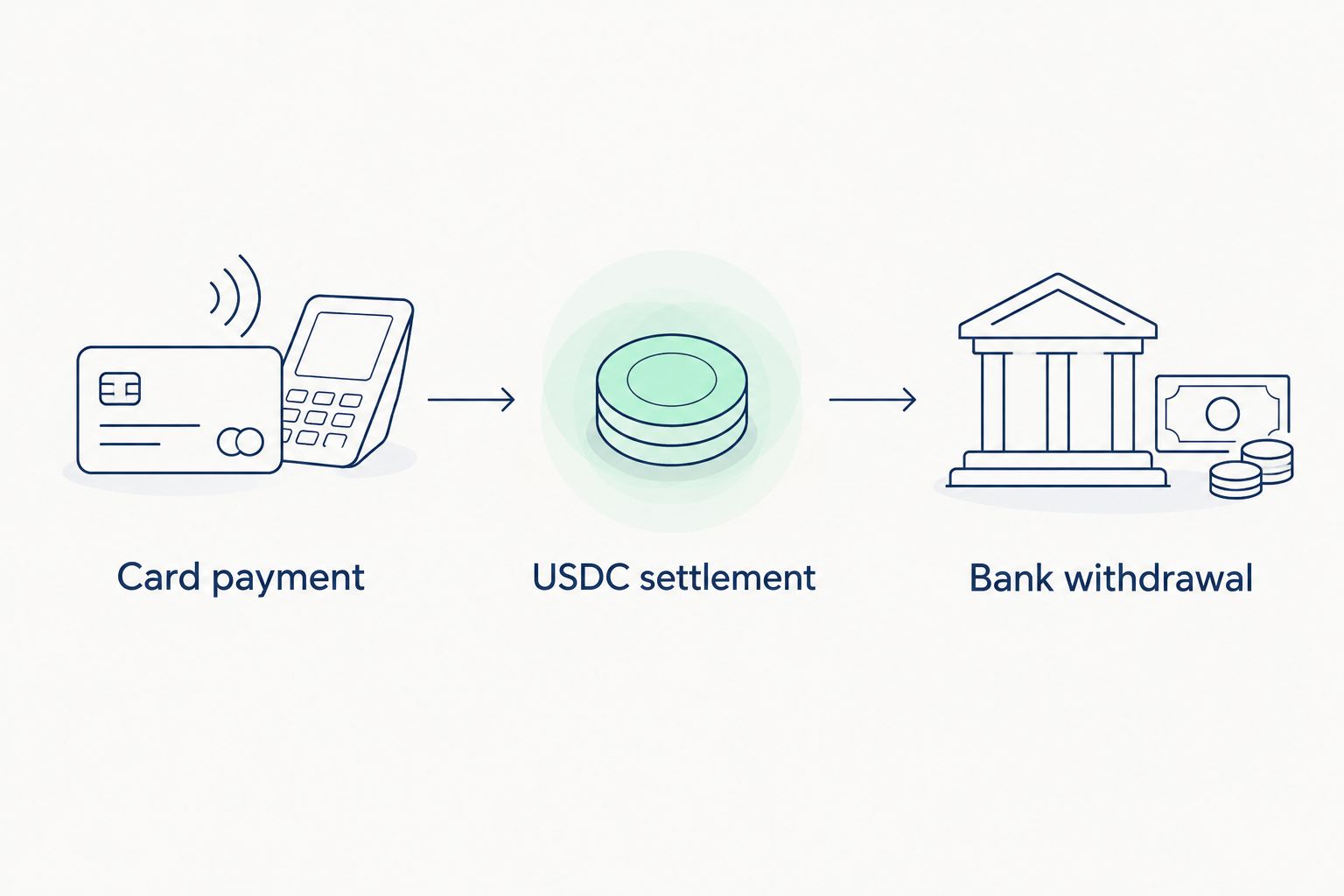
The switching decision should account for the whole route. A different settlement asset changes the operational checklist; it does not remove the need to verify counterparties, restrictions and withdrawal procedures.
Why international card coverage varies
Ask providers to explain coverage against these factors instead of giving a single worldwide yes or no:
- Merchant jurisdiction: Confirm whether the provider supports your legal entity and operating location.
- Business category: Get an answer for the products or services you actually sell.
- Card issuing country: Check the issuer markets represented in your payment records.
- Card network and type: Request explicit coverage for your required combinations.
- Buyer verification: Establish the applicable authentication and identity-check requirements.
- Settlement destination: Confirm the permitted payout route and any separate withdrawal requirements.
These are questions to resolve, not reasons to assume rejection. The useful answer identifies the supported combination and its conditions.
Keep your 2026 coverage matrix versioned. If your product category, legal entity or target markets change, request an updated answer before sending the new traffic.
Does international coverage mean every card will work?
No. International coverage does not guarantee approval for every transaction. Ask the provider to distinguish general eligibility from the decision on an individual payment.
A country list also does not explain what a buyer must do to finish checkout. Review coverage and payment completion separately.
Can buyers face ID checks after the merchant is approved?
Yes. Merchant approval and buyer verification are separate processes, and buyer checks depend on the provider and transaction.
Ask what buyers see, who collects any requested information and how incomplete verification affects the order. Do not promise customers a document-free checkout without applicable written confirmation.
What should you confirm about reserves before switching?
Confirm whether the proposed arrangement includes reserves, holds or other restrictions on access to funds. Request the calculation method, release conditions and treatment of funds after termination.
A statement about settlement does not answer those questions. Have the provider identify the relevant contract clauses and explain how they apply to your business.
Railbed coverage depends on the live buyer and payment
Railbed’s Smart Routing considers buyer country, currency, amount, provider minimums and current availability. It filters eligible card methods and recommends a route; it does not prove that every card from a supported country will be accepted.
The provider list in Test mode is fixed for practice. Do not use a successful simulated payment as evidence of coverage in a real buyer market. A small amount can have no eligible provider even though your product price was accepted by the checkout form.
When a card is declined in Live mode, the provider displays the decline. Railbed does not receive a direct decline signal, so Open or In progress is not proof of a charge. Check the payment before asking a buyer to submit another one. Choose another way to pay returns the buyer to available providers while the payment remains valid.
Sources and related guides
Checked October 29, 2026 against the buyer-experience guide, which documents routing inputs, provider minimums and decline handling.
FAQ
How do I check whether an international card processor supports my business?
Request written confirmation for your legal entity, business category, buyer countries and card issuing countries. Match the answer to your actual transaction requirements before switching.
Does accepting international cards mean buyers will not need ID?
No. International card acceptance does not establish whether buyer identity checks apply. Ask about authentication, account creation and document requests separately.
Is merchant onboarding the same as buyer verification?
No. Merchant onboarding evaluates your business, while buyer verification concerns the customer attempting payment. Completing one does not remove the other.
Is USDC settlement the same as receiving a bank deposit?
No. USDC settlement and bank withdrawal are separate stages. Confirm the wallet, network, conversion route, verification requirements and applicable charges before relying on bank access.
What should I compare in a PaymentCloud proposal?
Compare the current proposal's international coverage, buyer checks, reserves, settlement access, fees and contract obligations. Use terms offered to your business rather than assuming a general description applies.
Can I switch immediately after a successful checkout test?
A successful test alone is not enough to establish your full coverage and settlement requirements. Confirm the written terms, reconciliation process, support responsibilities and permitted cutover plan first.
What should I ask Railbed before switching?
Ask Railbed to confirm your business eligibility, buyer-country and card coverage, buyer verification requirements and USDC settlement process. Also establish the separate steps needed to move settled funds to your business bank account.
One last thing
Do not replace an uncertain processor with an undocumented payment route. Before the 2026 cutover, put the coverage confirmation, buyer-check instructions, reserve terms and settlement responsibilities into one decision file.
Then ask the prospective provider to resolve every contradiction between the proposal, contract and checkout demonstration. Switch against written requirements—not a promise that international cards are supported.