How to prepare a backup high-risk payment processor
Prepare a backup high-risk payment route before a shutdown. Test checkout, order confirmation and wallet receipt, then document who can activate the switch.
Prepare a backup high-risk payment processor by getting your business reviewed, documenting settlement and reserve terms, and testing the buyer-to-bank payment path before you need to switch. Keep merchant approval separate from buyer payment completion: neither an approved account nor a different payment route guarantees that a customer’s card payment will succeed or avoid identity checks.
How do you prepare a backup high-risk payment processor?
Prepare the backup as an operating payment route, not a saved provider name. Your 2026 readiness checklist should cover business review, buyer checkout, settlement, withdrawal, and the decision to activate it.
For merchants processing more than $50,000 monthly, the question is not whether another provider accepts applications. It is whether that provider has reviewed your actual business and whether you understand every step between a customer paying and money reaching your bank.
Railbed offers card payment checkout with USDC settlement for high-risk online merchants. That is a different settlement model from a conventional merchant account; evaluate the wallet and bank withdrawal steps alongside the checkout itself.
- Disclose the actual business. Submit the products, sales channels, operating jurisdictions, and prior processing problems the provider requests. Do not describe a restricted product as something else.
- Get the decision in writing. Ask what the review covers, what remains conditional, and what would trigger another review.
- Document the money path. Record the settlement asset, destination, reserve conditions, withdrawal requirements, and applicable charges.
- Test buyer payment completion. Follow the provider’s permitted testing process, including the customer-facing verification experience.
- Assign switching authority. Name who changes checkout, checks transaction status, reconciles orders, and communicates with customers.
A backup is ready only when you can explain how a buyer pays and how you access the resulting funds. An account login does not answer either question.
Why this matters
Losing a processor creates separate problems: taking the next payment and recovering access to money already held elsewhere. A replacement checkout addresses the first problem. It does not, by itself, resolve the second.
Keep those workstreams separate. Ask your existing provider about outstanding settlements, reserves, disputes, and release conditions while you evaluate the replacement’s terms.
A useful 2026 backup plan also distinguishes an emergency stopgap from a lasting replacement. If a provider approves only part of your catalog, your switching instructions must identify that limit before anyone sends customers to the new checkout.
Compare the settlement model before the provider name
Compare a PaymentCloud proposal, a traditional high-risk merchant account proposal, and a card checkout with USDC settlement against the same written checklist. Do not assume that a provider name establishes your reserve, payout schedule, or eligibility.
Railbed is a card-checkout option for high-risk merchants seeking USDC settlement. Its fit depends on whether that settlement model meets your business’s operating needs.
The table below identifies what to investigate. It does not assign unverified fees, approval promises, or reserve policies to any provider.
| Option | Best for | What to establish | Trade-off to examine |
|---|---|---|---|
| Railbed card checkout with USDC settlement | High-risk merchants specifically seeking card acceptance with USDC settlement | Business eligibility, buyer checks, wallet requirements, reserve terms, and total charges | USDC settlement still needs a documented route to bank funds when your business needs bank currency |
| PaymentCloud proposal | Merchants considering PaymentCloud as a backup candidate | The proposed account structure, actual underwriting decision, settlement terms, and contractual responsibilities | The proposal needs a transaction-level comparison; the provider name alone does not establish your terms |
| Traditional high-risk merchant account proposal | Merchants seeking a conventional merchant-account arrangement | Acquiring relationship, permitted activity, reserve conditions, settlement timing, and termination provisions | Contractual restrictions and funds-access conditions need review before activation |
Ask each candidate to answer the same questions against the same business description. Otherwise, you are comparing different assumptions rather than different payment arrangements.
Do not rank proposals by the headline processing fee alone. Include the costs and operational requirements of getting settled funds into the form your business actually uses.
Check buyer payment completion before calling the backup ready
Merchant onboarding reviews your business. Buyer verification concerns the person making a payment. Passing merchant onboarding does not remove transaction-level checks.
Buyer checks depend on the provider and transaction. Ask what the customer sees, what information the customer must supply when a check occurs, and how your team distinguishes an incomplete verification from a declined or successful payment.
Use the provider’s approved testing process to examine these three checkpoints:
- Checkout entry: Can the buyer reach the correct payment request with the right product, amount, and order reference?
- Verification handling: What happens when the buyer is asked for additional information or does not finish a check?
- Payment confirmation: Which status authorizes fulfillment, and where does your team verify it?
Request a demonstration of exception states as well as the successful path. Your team needs to know what to do when a customer closes the page, retries, or reports a charge without a completed order.
Do not promise customers that a new route guarantees approval. Do not advertise the checkout as eliminating ID checks unless the provider’s documented terms support that exact statement.
For your 2026 operating instructions, write down the status your team must see before releasing goods or access. Customer screenshots are not a substitute for the provider’s authoritative payment record.
Trace settled funds all the way to the bank
A successful card payment and usable bank funds are different checkpoints. Document the handoffs instead of compressing them into a single promise about getting paid.
For any proposed arrangement, identify who controls the funds at each stage and what must happen next. With USDC settlement, that includes the destination wallet and the conversion and withdrawal route your business intends to use.
- Card payment: Establish where the definitive payment status appears.
- Settlement: Identify the settlement asset, destination, and applicable conditions.
- Wallet access: If settlement uses a wallet, establish authorized access and the supported transfer requirements.
- Bank withdrawal: Document the service used for conversion and withdrawal, its eligibility requirements, and the destination bank account.
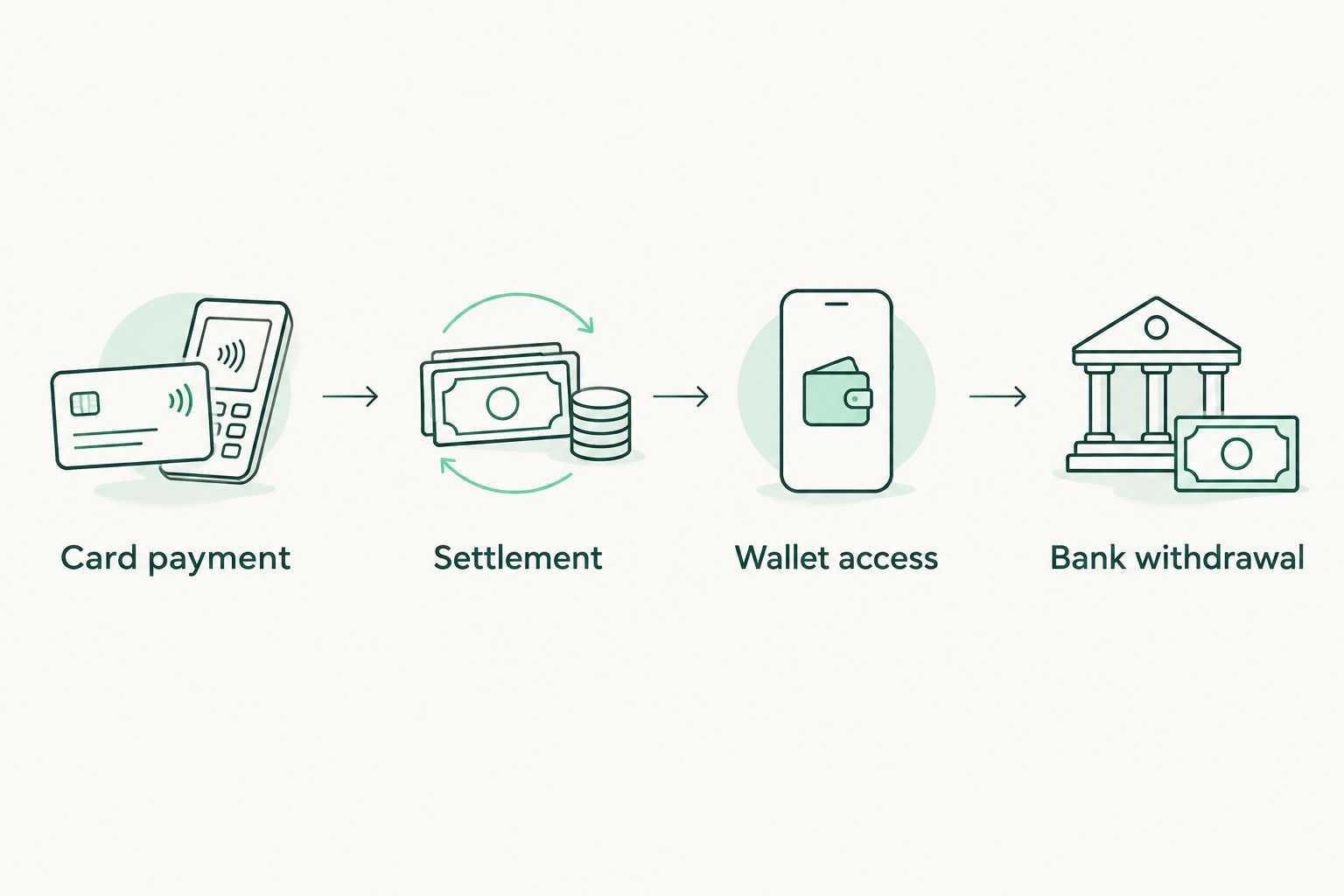
Access to a settlement wallet is not the same as completion of a bank withdrawal. If you need bank currency for operating expenses, verify that final step before treating the arrangement as ready.
Ask the relevant services about supported assets and networks, account ownership requirements, conversion charges, withdrawal conditions, and compliance checks. Do not send funds based on an assumed network match or an untested destination.
Keep access instructions secure. The switching document should identify authorized people and escalation contacts, not expose wallet credentials or recovery material.
Why backup readiness varies
The right preparation depends on the business and the proposed arrangement. These factors belong in the decision record:
- Business activity: Get a decision for what you actually sell, including the relevant product categories and sales channels.
- Existing processing history: Disclose a prior termination or other requested history accurately. Ask what supporting records the provider needs.
- Reserve and hold conditions: Establish whether funds can be retained, what triggers retention, and what governs release.
- Buyer verification: Document the customer-facing checks and how incomplete transactions appear to your team.
- Settlement model: Compare conventional settlement with USDC settlement, including the route from settled funds to your bank.
- Operating integration: Confirm how payment status connects to order fulfillment, customer support, and reconciliation.
Do not reduce this assessment to an approval email. A backup that cannot support your actual catalog or fulfillment process is not ready for that workload.
Get reserves, fees, and release conditions in writing
Ask for a complete fee schedule and the controlling agreement. Keep the proposal, approval conditions, and contract together so your team can spot conflicts before activating checkout.
Your 2026 comparison sheet should separate payment charges from settlement, conversion, withdrawal, dispute, and account-related charges. Ask which apply to your proposed arrangement rather than assuming every category exists.
For any reserve, request the calculation method, collection conditions, release conditions, and treatment after termination. If a provider describes a release schedule, ask what circumstances change it.
For holds, ask what triggers review, who handles the case, what evidence is required, and how a decision is communicated. A sales explanation is not a replacement for the written terms governing access to funds.
Compare total obligations, not an isolated rate. A proposal remains incomplete until you understand both the charges and the restrictions attached to settlement.
Write the switching plan before changing checkout
Assign two named owners: one for checkout and order operations, and one for settlement and reconciliation. In a small business, one person can hold both roles, but the responsibilities still need separate checklists.
Define an activation trigger. Examples include a termination notice, a documented processing interruption, or a provider instruction to stop submitting payments. Your plan should specify who confirms the trigger and authorizes the change.
Then document the switch:
- Identify which products and sales channels the backup is approved to handle.
- Record the customer-facing checkout changes and who publishes them.
- State which payment status permits fulfillment.
- Explain how support handles failed attempts and uncertain payment status.
- Keep the previous provider’s outstanding settlements and disputes in a separate reconciliation queue.
- Define the checks required before restoring or changing a payment route again.
For the 2026 activation rehearsal, walk through an interrupted order as well as a completed payment. A useful rehearsal proves that staff can resolve uncertainty without asking a customer to pay again blindly.
If your existing processor has already dropped the business, use the same checklist under time pressure. Do not replace verification with urgency or send live customers into an unreviewed flow.
Can I keep a backup ready without sending it every payment?
Ask the proposed provider whether an approved arrangement can remain inactive and what conditions govern continued readiness. Do not assume approval remains valid indefinitely or survives changes to your products, ownership, or operating model.
Record any activity requirements and re-review triggers in the switching plan. Confirm the arrangement remains valid before activating it after a period of inactivity.
Does backup approval mean my buyers will be approved?
No. Backup merchant approval and buyer payment approval are separate decisions, and buyer checks depend on the provider and transaction.
Request the buyer flow and exception-handling instructions before launch. Routing a payment differently does not establish that it will succeed or avoid identity verification.
Should I test withdrawal before switching customers?
Yes. Verify the withdrawal route using the relevant providers’ permitted process before relying on it for operating funds.
Record the transaction reference, settlement record, conversion record where applicable, and bank receipt. That evidence checks the full money path rather than just the checkout screen.
Rehearse a Railbed backup with its real exception states
Railbed’s Test mode supports simulated successful payments, declined cards and underpayments. A decline can leave the payment open; an underpayment can need your decision. Neither state permits automatic delivery.
Use this rehearsal checklist:
- Create a Test checkout and simulate a successful payment.
- Create a separate Test payment and simulate an underpayment. Confirm staff can find Needs your decision.
- Simulate a declined card and use Choose another way to pay instead of creating an untracked second order.
- Close the buyer tab and check that your server can still confirm the payment.
- Repeat the notification and verify the order is delivered only once.
Before activation, create the corresponding Live checkout with the Live key and notification endpoint. Test and Live records are separate; switching the dashboard mode does not convert a Test link into a real payment link.
Railbed’s acceptable use policy says it does not underwrite businesses. A conventional acquiring application and its approval conditions are therefore a different track from configuring this backup. The buyer’s card provider still makes transaction-level decisions.
Sources and related guides
Checked October 29, 2026 against Test and Live instructions and the acceptable use policy.
FAQ
What makes a high-risk payment processor backup ready to use?
A ready backup has a documented business review, understood contractual terms, a checked buyer flow, and a verified route to usable funds. Assign switching authority and payment-reconciliation responsibilities before activation.
Can I use a backup processor after my existing provider drops me?
You can activate a backup only within its approval conditions and operating requirements. Disclose the prior termination accurately and confirm that the replacement has reviewed your actual business.
Is card checkout with USDC settlement the same as a merchant account?
No. Card checkout with USDC settlement and a conventional merchant account are different arrangements. Compare settlement destinations, contractual responsibilities, buyer checks, and the steps needed to reach your bank.
Will a backup processor remove buyer ID checks?
Do not assume that a backup removes buyer ID checks. Checks depend on the provider and transaction, and merchant onboarding does not establish what every buyer will experience.
How should I compare PaymentCloud with another backup candidate?
Compare the written PaymentCloud proposal with the other candidate’s written terms for the same business activity. Review eligibility, reserves, settlement, total charges, buyer verification, and termination conditions without assigning unverified terms to either provider.
What reserve questions should I ask before switching?
Ask whether a reserve applies, how it is calculated, what triggers collection, and what governs release. Also establish what happens to retained funds after termination and which written terms control that outcome.
Should I close my old processing account immediately?
Do not treat a checkout switch as completion of the old account’s obligations. Review outstanding settlements, refunds, disputes, retained funds, and termination requirements before deciding how to close the relationship.
One last thing
Your backup rehearsal should end at the bank, not at the payment confirmation screen. Keep a transaction reference that connects the order, successful payment, settlement, and final withdrawal; that record makes the money path inspectable when someone needs an answer fast.