How to test an iGaming deposit flow before switching providers
Test iGaming card deposits from checkout to player credit and settlement. Check duplicate events, underpayments, refunds and your separate withdrawal route.

Test an iGaming deposit flow from the buyer’s card payment through player-balance credit, settlement, and bank withdrawal before switching providers. Keep merchant onboarding separate from buyer verification, test unsuccessful payments as well as successful ones, and require written acceptance criteria before moving live traffic.
How do you test an iGaming deposit flow before switching providers?
Use an end-to-end acceptance test. A successful checkout screen is not enough. Your evidence must connect the payment, the player account, the settlement record, and the final withdrawal destination.
For merchants processing more than $50,000 monthly, the selection question is not whether a provider can demonstrate a payment. It is whether the proposed arrangement supports your actual business and produces records your operations team can reconcile.
Railbed provides card checkout with USDC settlement for high-risk online merchants, including iGaming. Evaluate that settlement model separately from a conventional merchant account; do not treat the two as interchangeable.
Use this sequence:
- Confirm eligibility. Get written confirmation covering your legal entity, activity, customer locations, and proposed payment flow.
- Define acceptance criteria. Agree what counts as completed, failed, pending, credited, settled, and withdrawn.
- Exercise buyer checks. Test the supported verification paths without bypassing required controls.
- Reconcile the deposit. Match the payment outcome to the correct player account and ledger entry.
- Verify access to funds. Follow the agreed settlement route through to the intended bank destination.
Treat your 2026 test record as a switching decision document. Every result needs an owner, supporting evidence, and a clear pass or fail.
Why this matters after your processor drops you
A replacement checkout does not resolve every problem created by a termination. Old balances, unresolved disputes, refunds, and access to historical records need their own workstream. Do not let the urgency of restoring deposits hide those obligations.
Keep 2 workstreams separate: replacing new-payment processing and resolving the previous provider’s outstanding obligations. Ask who handles each open issue and which agreement governs it.
Your new provider’s sales answer is not an acceptance result. Neither is a demonstration using a different business, customer geography, or settlement setup. The test must reflect the arrangement you are being asked to sign.
Choose evidence over an approval promise. A merchant can be accepted while an individual buyer’s payment still requires checks or fails. Provider routing does not guarantee issuer approval, remove verification requirements, or establish that every player can complete a deposit.
Compare the payment arrangement before comparing the checkout
Start your 2026 comparison with the contract and the funds path. Ask PaymentCloud and any traditional high-risk merchant account provider for current, written terms specific to your business. Do not transfer a fee, reserve, or settlement claim from another merchant’s offer into your decision.
Railbed is best considered by high-risk merchants seeking card checkout with USDC settlement, not a conventional merchant account. That distinction defines what you need to test, not an automatic winner.
| Option | Best for | What supports selection | Limitation to resolve |
|---|---|---|---|
| Railbed card checkout with USDC settlement | Merchants specifically evaluating card acceptance with USDC settlement | The stated model matches that settlement requirement | Validate wallet receipt, conversion, bank withdrawal, and the complete buyer-check flow |
| PaymentCloud proposal | Merchants evaluating a provider-specific high-risk processing proposal | A written proposal gives you terms to assess against your business | Confirm the actual processing arrangement, reserves, verification requirements, and settlement terms |
| Traditional high-risk merchant account proposal | Merchants seeking a conventional merchant-account arrangement | The proposed account structure can be evaluated against banking and operational needs | Inspect underwriting conditions, fund-access restrictions, total charges, and termination obligations |
A useful comparison names both the benefit and the operational burden. USDC settlement requires you to examine the wallet-to-bank route. A conventional account requires you to examine the applicable settlement and reserve provisions. Neither label proves better access to funds.
What must pass in the buyer deposit test?
Write a test matrix before opening the checkout. Give each case an expected buyer message, expected payment state, expected player-balance effect, and a responsible support owner. Use provider-authorized test methods; do not manufacture live declines or bypass controls.
| Test case | Buyer-facing check | Operational acceptance criterion |
|---|---|---|
| Completed payment | The buyer receives an unambiguous outcome | The correct player account receives the intended credit |
| Declined payment | The buyer sees a useful failure message | No completed deposit is recorded |
| Abandoned verification | The buyer understands that payment remains incomplete | The account is not credited as though payment completed |
| Pending payment | The status does not falsely promise completion | The pending state remains traceable until resolution |
| Repeated submission | The checkout handles a repeat attempt clearly | The ledger does not create duplicate credit for the same payment |
| Interrupted return | The buyer can recover the payment status | A closed browser does not become the sole source of payment truth |
| Refund request | Support can identify the original payment | The payment record and player ledger remain reconcilable |
Use this matrix for the 2026 proposal you are considering, not a generic demonstration account. Ask the provider which cases the test environment supports and which require an authorized live validation.
A case is not passed because someone can fix it manually. Record any manual intervention, who performs it, and whether your team accepts that operating burden.
Keep merchant onboarding separate from buyer verification
Merchant onboarding assesses your business. Buyer verification applies to the person or transaction at checkout. Approval of the first does not establish completion of the second.
Ask when a buyer encounters an identity request, who presents it, where the buyer returns afterward, and what support can see if the buyer stops. Checks depend on the provider and transaction. Do not accept a blanket promise that customers will never need identification.
Also distinguish payment-provider verification from your own player identity, age, and location controls. Confirm the applicable responsibilities with compliance counsel. Do not assume a payment integration replaces the controls required for your operation.
Test failure recovery, not just the success page
Close the browser during an authorized test. Exercise the supported timeout and interrupted-return cases. Check how your system retrieves the final payment state without relying on the buyer to return successfully.
Then test a repeated notification or repeated submission through the provider’s supported methods. The acceptance requirement is consistent state, not a persuasive checkout animation. Your team must distinguish a new payment from another message about an existing payment.
How do you test settlement and bank withdrawal?
Use 3 checkpoints: payment completion, settlement receipt, and bank receipt. Define the evidence required at each checkpoint before testing. A completed card payment does not itself prove that the merchant has received usable funds in the intended destination.
For a USDC arrangement, document the wallet destination and supported network with the provider. Then verify the intended conversion and bank-withdrawal route with the service handling those steps. Do not assume those steps belong to the checkout provider.
Follow this funds path:
- Card payment: Record the payment identifier, final status, and customer reference.
- Buyer checks: Record whether required checks completed and how an incomplete check affects payment status.
- Deposit credit: Match the completed payment to the correct player account and ledger entry.
- Settlement receipt: Match the settlement record to the agreed destination and payment records.
- Bank withdrawal: Verify the receiving route, required checks, applicable charges, and final bank receipt.
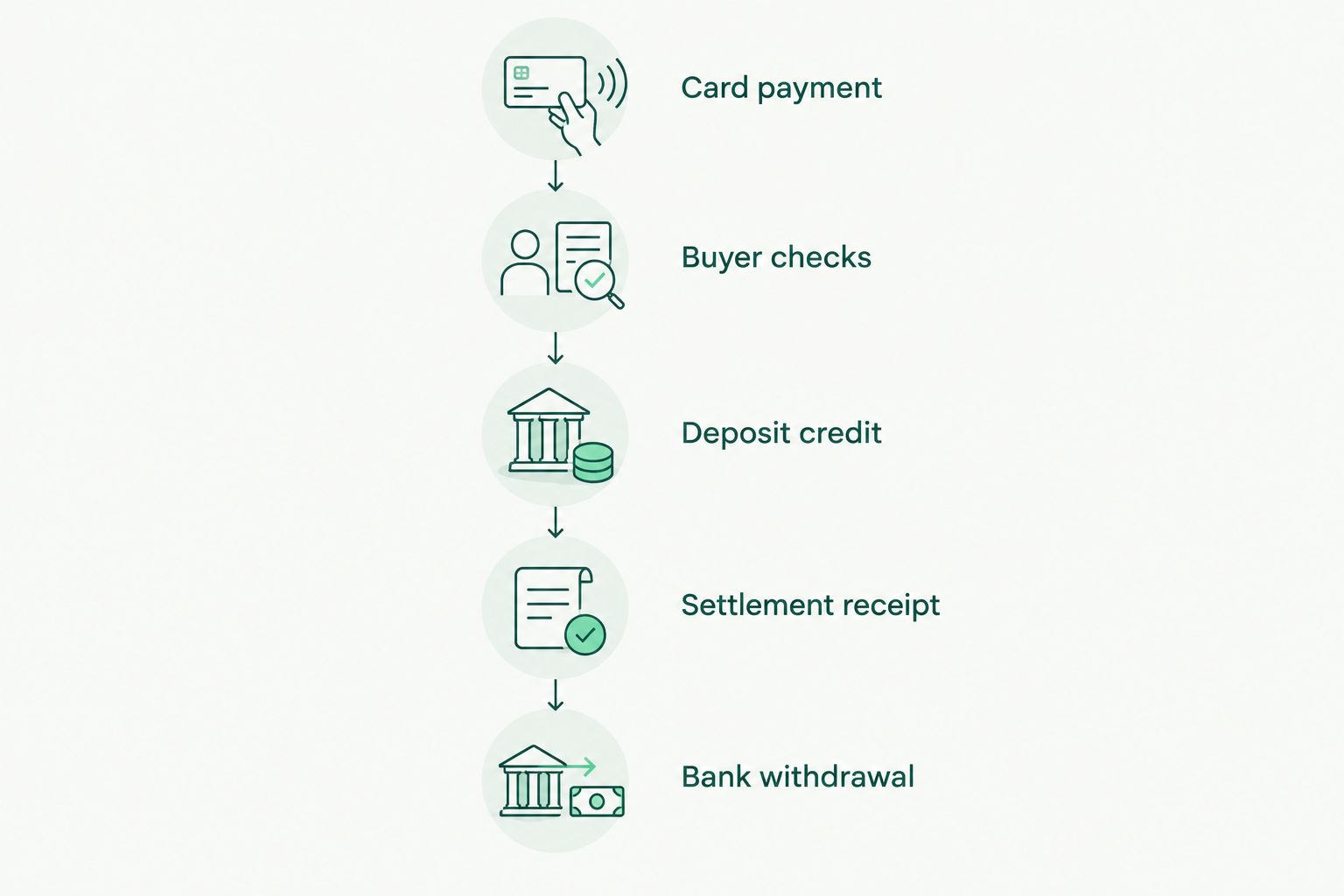
For your 2026 acceptance record, save the evidence linking each stage. Record exceptions as exceptions. Do not describe a wallet receipt as a completed bank withdrawal, or a pending settlement as accessible funds.
Why do deposit-flow results vary?
Results depend on the arrangement being tested. Keep these factors visible in your decision record rather than reducing everything to an overall checkout impression.
- Business scope. Confirm that the proposal covers your actual iGaming activity and legal entity.
- Buyer verification. Establish which checks apply, who performs them, and what happens when buyers stop.
- Transaction outcome. Separate completed, declined, pending, and interrupted payments in your reporting.
- Integration behavior. Test status updates, repeated messages, and the mapping between payments and player balances.
- Settlement structure. Identify the destination, conditions, and evidence that establish receipt.
- Withdrawal arrangements. Confirm the conversion and bank-transfer steps separately from checkout and settlement.
Do not generalize from a narrow test. Record the buyer geography, payment method, environment, and relevant configuration for each authorized case. That makes the result interpretable when the production setup differs.
What reserve and fee terms should you verify before switching?
Request the current contract, fee schedule, reserve provisions, and settlement conditions together. A headline processing charge does not describe the complete commercial arrangement. Your comparison needs every applicable charge and every contractual restriction on access to funds.
Ask these questions in writing:
- Does a reserve apply, and how is it calculated and released?
- What permits the provider to delay or restrict settlement?
- Which processing, refund, dispute, settlement, conversion, and withdrawal charges apply?
- Which charges belong to another service in the funds path?
- What happens to unsettled funds when the agreement ends?
- Who owns refund and dispute handling after termination?
For a 2026 switching decision, use the terms attached to your proposal. Do not use a competitor’s general marketing statement as evidence of your contractual position.
Separate fees from restrictions. A charge reduces the amount you retain. A reserve or hold affects access to funds under its governing terms. Your decision needs both, even when the sales conversation emphasizes only one.
When is the deposit flow ready for live traffic?
The flow is ready for your internal approval when each critical acceptance case passes, unresolved issues have named owners, and the commercial terms match the tested arrangement. Provider acceptance alone is not your launch sign-off.
Create a switching packet with the agreed business scope, test matrix, payment-to-ledger evidence, settlement records, withdrawal evidence, and support escalation route. Include the current agreement and the conditions for stopping the rollout.
Make rollout limits your own risk decision. Do not borrow an arbitrary transaction count or deposit amount from another merchant. Set the permitted exposure with your finance, payments, and compliance owners, then obtain the provider’s agreement on the validation method.
Before directing live traffic, decide how support will handle an unresolved payment. The buyer should not be sent back and forth between the operator, payment provider, and withdrawal service while each points elsewhere.
Review the settlement model before switching
Evaluate card checkout with USDC settlement against your deposit-flow acceptance criteria.
Explore RailbedRailbed deposit tests that change the launch decision
Railbed handles card deposits, not player withdrawals. Your own cashier remains responsible for payouts, player identity and age checks, permitted markets and responsible-gambling controls. A successful card deposit does not establish compliance with those obligations.
For automated crediting, verify Railbed’s signed payment notification or make an authenticated status check. Match the stored player order, currency and amount, then credit once per order. An email entered at checkout must not decide which player receives the balance.
Add these cases to the test matrix:
- Underpaid: no automatic credit while the payment needs a decision.
- Duplicate event: no duplicate player credit.
- Expired then paid: review and credit or arrange reimbursement under your policy; do not ignore the late money.
- Live decline: Railbed can remain open or in progress because it does not receive a direct provider decline signal.
- Player withdrawal request: handle in your own cashier, not through a nonexistent Railbed withdrawal function.
Sources and related guides
Checked October 29, 2026 against the iGaming product guide and safe fulfilment documentation. This checklist validates payment handling, not gambling licensing or legal eligibility.
FAQ
What should I test before switching my iGaming payment provider?
Test buyer verification, completed and unsuccessful payments, player-balance credit, settlement, and bank withdrawal. Keep evidence connecting each payment to its ledger entry and final funds destination.
Does merchant approval mean every player can complete a deposit?
No. Merchant onboarding and buyer payment approval are separate. Verification depends on the provider and transaction, and an accepted merchant can still receive declined or incomplete payments.
Can payment routing eliminate buyer ID checks?
No routing arrangement should be treated as a guarantee that buyer ID checks disappear. Ask the provider which checks apply and test the buyer experience when verification is requested or abandoned.
Is Railbed a conventional high-risk merchant account?
Railbed provides card checkout with USDC settlement for high-risk online merchants. Evaluate that model separately from a conventional merchant account, including wallet receipt, conversion, and bank withdrawal.
How should I compare PaymentCloud with a USDC settlement provider?
Compare current written proposals against the same business scope and acceptance tests. Examine buyer checks, reserve provisions, settlement conditions, applicable charges, refund handling, and the route to your bank.
Does a successful card payment prove the funds reached my bank?
No. Payment completion, settlement receipt, and bank receipt are separate checkpoints. Verify the records and responsibilities connecting each stage.
Can I rely on test mode before switching live traffic?
Test mode establishes behavior only within its supported scope. Ask which requirements need authorized live validation, and keep those requirements open until the agreed evidence exists.
One last thing
Make the payment reference your switching control. Before approving the rollout, choose a completed test payment and ask your team to trace it from checkout to player credit, settlement, and bank receipt without relying on the salesperson’s explanation.
If that trace breaks, the test is unfinished. Fix the missing record or unclear responsibility before increasing exposure. A checkout that accepts a card is only the beginning; your acceptance test ends when your team can account for the money.