Switching supplement processors: check subscriptions first
Before switching supplement processors, check saved-card portability and billing ownership. Understand Railbed’s one-time payment model and renewal limits.

Check subscription portability before switching your supplement payment processor. Confirm whether recurring payment credentials can move, whether the replacement supports your billing model, and which customers must authorize payment again; a working checkout does not prove that existing subscriptions will renew.
Why this matters
A processor replacement has two jobs: accept new orders and preserve existing billing. Treat them as separate acceptance tests. Your replacement can pass the first and fail the second.
For a supplement business processing more than $50,000 monthly, subscription continuity belongs in the provider-selection conversation, not in a support ticket after launch. Compare the next renewal run with the cash you can actually access, rather than judging the switch by a successful test purchase.
Railbed fits supplement merchants seeking card checkout with USDC settlement for one-time purchases. It does not automatically rebill cards or replace a subscription vault. If automatic renewals are essential, that requirement rules out treating a Railbed checkout as a like-for-like subscription migration.
Switching supplement processors: what should you check first?
Start with the subscriptions already scheduled to bill. Identify where payment credentials live, who controls their transfer, and what the replacement needs to charge customers with valid authorization.
Use this sequence before choosing a cutover date:
- Map existing subscriptions. Record active status, next billing date, billing interval, payment reference, and the system responsible for renewal attempts.
- Identify credential ownership. Ask your current platform and processor who controls the vault and who can authorize a secure transfer.
- Confirm destination acceptance. Get written confirmation that the proposed destination can receive the relevant credentials and support the intended recurring transactions.
- Separate transfer from reauthorization. Identify customers whose credentials cannot move and who must complete a new payment authorization.
- Test the renewal workflow. Validate scheduling, customer notices, payment results, retries, cancellations, and reconciliation before moving the remaining subscriptions.
A subscription record is not a payment credential. Exporting customer names, order histories, and renewal dates does not establish that the replacement can charge those customers.
For your 2026 migration plan, ask both providers to describe their responsibilities in writing. A promise from the destination does not answer whether the current custodian will release the credentials.
Compare the payment model before comparing providers
Railbed's card checkout with USDC settlement differs from a conventional merchant account. Keep the buyer's payment method, the merchant's settlement asset, and recurring billing support in separate columns during evaluation.
PaymentCloud belongs in the comparison as a provider proposal to verify. Assess its current written offer against the same requirements; do not treat a provider name as proof of a particular reserve, settlement schedule, or migration arrangement.
| Option | Best for | Useful distinction | Limitation to resolve |
|---|---|---|---|
| Railbed card checkout with USDC settlement | Merchants seeking card acceptance with USDC settlement | Customers pay by card; the settlement model uses USDC | Confirm subscription support, credential migration, buyer checks, and the route to bank funds |
| PaymentCloud proposal | Merchants evaluating its written offer against an existing billing workflow | Compare the actual proposed arrangement, not general provider descriptions | Require current terms for recurring billing, reserves, funds access, and account exit |
| Conventional high-risk merchant account | Merchants seeking a conventional acquiring arrangement | Evaluate the proposed account alongside the billing platform and gateway | Confirm credential custody, renewal support, restrictions, and settlement terms |
Choose the arrangement that supports your billing obligations, not the one with the shortest application. A provider comparison is incomplete until it covers both new purchases and existing renewals.
Use dated 2026 proposals for the final decision. Published descriptions help you build a shortlist; the proposed agreement must answer what happens to your business.
Merchant onboarding is not buyer verification
Merchant onboarding assesses your business. Buyer verification concerns the person making a payment or the transaction itself. Passing one does not establish that the other is complete.
Ask the proposed provider what a supplement buyer sees during checkout. Confirm whether the flow includes an authentication challenge, a redirect, or a request for identity information, and which circumstances trigger additional steps.
Checks depend on the provider and transaction. Do not describe alternative routing as guaranteed approval, guaranteed completion, or a way to eliminate identity checks.
For subscriptions, distinguish the first customer-authorized payment from later recurring charges. Ask how the provider handles a renewal that requires customer action and how that result reaches your billing system.
Your acceptance test should cover these outcomes:
- Completed payment: The order and subscription show the correct paid status.
- Required customer action: The buyer receives a clear next step, and the subscription does not appear paid prematurely.
- Declined payment: The billing system records the failure without creating a duplicate charge attempt.
- Abandoned checkout: The customer can understand whether a payment completed before trying again.
Test only with the provider's permitted methods. A staged checkout demonstration is not evidence of live approval or completion rates.
Why subscription migrations vary
The work depends on your existing billing arrangement and the proposed destination. These are the factors to resolve before promising customers an uninterrupted switch:
- Credential custody. The party storing payment credentials controls the relevant export process; your storefront export is a separate matter.
- Destination compatibility. The receiving system must support the credential-transfer method and your recurring billing requirements.
- Customer authorization. Review whether existing authorization covers the intended billing arrangement or whether fresh customer action is required.
- Subscription logic. Billing intervals, retries, cancellation rules, and scheduled changes need a defined home after the switch.
- Product acceptance. Obtain written acceptance for the actual supplements, sales claims, and recurring purchase model you use.
- Old-account obligations. Refunds, disputes, reserves, and records can require attention after new payment collection moves elsewhere.
Assign an owner to each unresolved item. Sales approval, technical acceptance, and contractual permission are different answers; collect all that apply.
Reserves and settled funds need separate answers
A reserve question asks what money is withheld and under which conditions. A settlement question asks when a payment becomes settled funds. A withdrawal question asks how those funds reach the account where you pay business expenses.
Ask for each answer separately. A settlement description alone does not establish unrestricted access, a bank deposit date, or the treatment of a later refund.
Your written comparison should cover:
- The reserve requirement, if any, and the conditions for changing it.
- The schedule and conditions for reserve release, including after termination.
- Settlement timing, cutoffs, and events that interrupt access.
- Every applicable transaction, recurring billing, refund, dispute, conversion, and withdrawal charge.
- Responsibility for refunds and disputes after the old checkout stops accepting orders.
- The process for retrieving statements and transaction records after account closure.
Do not offset an old reserve against expected proceeds from the new provider. Track withheld funds and new settlements separately until the money is accessible.
For a 2026 switch, request a written example using your own transaction mix. The example should distinguish amounts withheld, charges incurred, and funds available to withdraw without presenting any of them as interchangeable.
USDC settlement adds a bank-withdrawal decision
Card checkout with USDC settlement changes what the merchant receives. It does not mean bank funds have arrived. Evaluate the path from settlement to usable bank balance before deciding that the arrangement fits your operating needs.
Map these stages separately: Card checkout, USDC settlement, Conversion, and Bank withdrawal. At each stage, identify the responsible party, required account, supported transfer method, applicable checks, and transaction record.
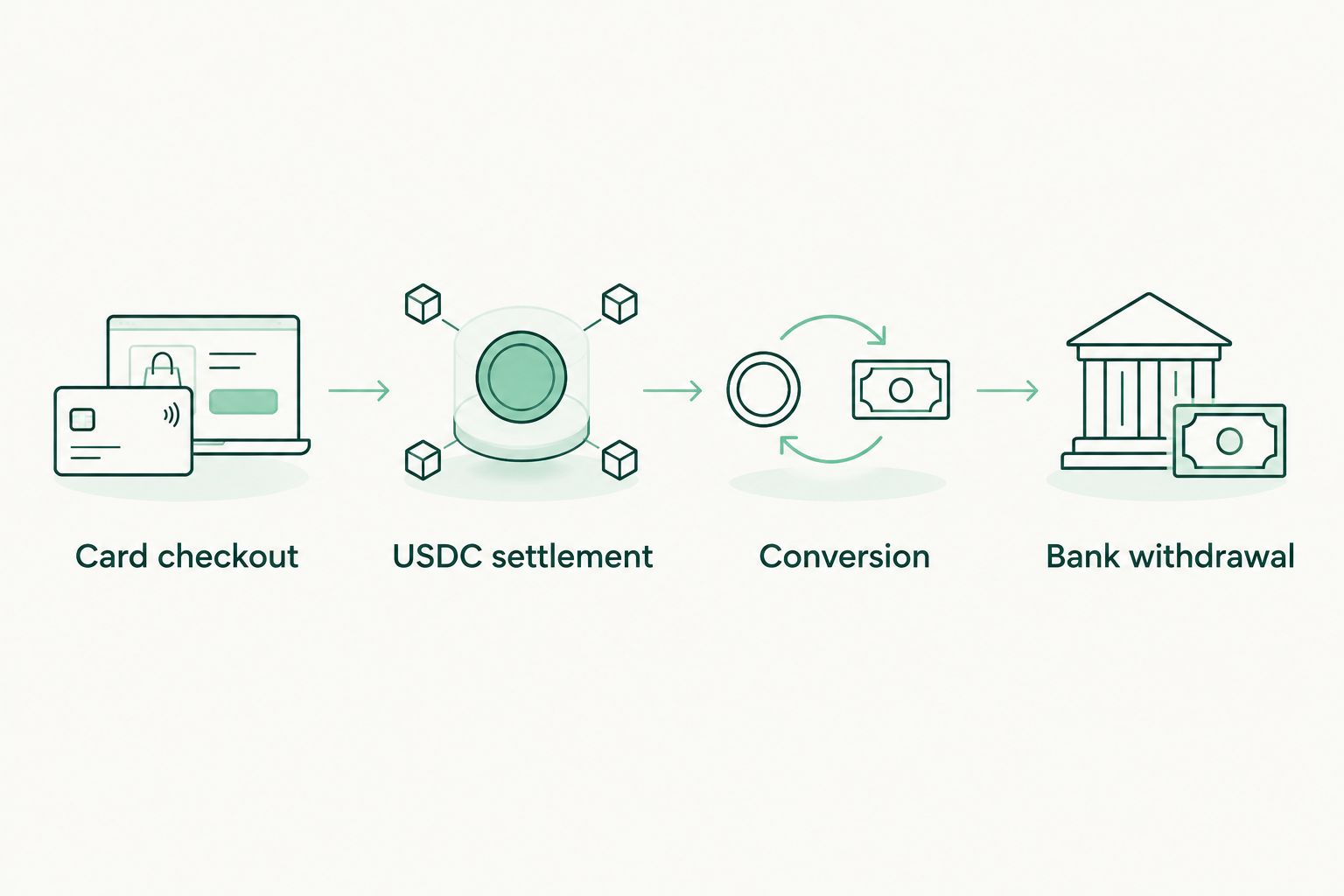
Confirm the supported network and destination before arranging any transfer. Then verify the conversion provider's requirements and the receiving bank's requirements rather than assuming acceptance across the entire route.
This model fits a merchant prepared to manage a wallet and a separate bank-withdrawal route. It adds an operational step for a merchant whose requirement is direct bank settlement. Neither point answers whether subscription migration is supported.
How do you switch without losing track of renewals?
Build the cutover around scheduled charges, not the date the replacement account opens. Your billing system needs an explicit boundary between old and new processing.
Review the next 30 days of scheduled renewals as a planning window. Also inspect the last 30 days of failed payments, refunds, and disputes so that unresolved activity has an owner. These are working review windows, not processing or settlement timelines.
For every subscription, assign a migration state: ready to transfer, awaiting confirmation, customer action required, or remaining temporarily on the existing arrangement. Do not treat an unconfirmed credential as ready.
Before enabling replacement billing, document which system may attempt each renewal. Disable overlapping schedules through your supported billing controls, and reconcile payment results before retrying an uncertain transaction.
Keep the old account's statements and transaction references accessible. Closing checkout access and closing the financial relationship are separate decisions; follow the agreement governing each.
Your 2026 cutover record should identify the responsible person, effective billing boundary, unresolved subscriptions, and procedure for stopping the migration. A pause procedure matters when a payment result is unclear.
What should you send a provider before a sales call?
Send a short operating brief that lets the provider assess your real use case. Include your supplement categories, storefront, monthly processing volume, subscription model, existing platform, and the reason for the switch.
Describe the processor termination accurately. Keep the termination notice and any stated restrictions available, but do not assume another provider interprets them the same way.
Ask the provider to respond to three decisions: whether the business and products are accepted, whether existing subscriptions can continue, and how settled funds reach your bank. Request the supporting agreement or technical documentation for each answer.
Do not send raw card details or customer identity documents in an ordinary sales email. Use the provider's approved secure process for sensitive information.
Railbed’s recurring-payment limit is explicit
Railbed’s pricing-table guide states that every purchase is one payment. A monthly or yearly label describes the period being sold, not a future automatic charge. Keep existing automatic renewals on an eligible recurring provider, or deliberately move to customer-initiated purchases with clear consent and reminders.
For a mixed supplement store, separate the two flows:
- One-time product orders can use a separately tested checkout.
- Automatic replenishment needs a provider that supports your recurring billing model and saved credentials.
- Changing the payment button must not silently cancel or duplicate the replenishment schedule.
Test the order sync independently. Railbed’s WooCommerce plugin can create and verify payment sessions; that is not evidence that the plugin supports automatic subscription rebilling.
Sources and related guides
Checked October 29, 2026 against pricing-table limits and WooCommerce documentation. This guide does not promise credential portability between third parties.
FAQ
What's the first thing to check when switching supplement processors?
Check whether existing subscription payment credentials can transfer and whether the destination supports your recurring billing model. A customer-data export alone does not establish that renewals can continue.
Can I move subscriptions without asking customers to enter their cards again?
That depends on credential custody, transfer support, destination compatibility, and authorization requirements. Get written confirmation from the current custodian and the destination before telling customers that no action is required.
Is Railbed the same as a high-risk merchant account?
Railbed offers card payment checkout with USDC settlement, which is distinct from a conventional merchant account. Evaluate recurring billing support and the bank-withdrawal route separately.
Does merchant approval mean my customers won't face ID checks?
No. Merchant onboarding and buyer verification are separate, and buyer checks depend on the provider and transaction. Approval of your business does not guarantee individual payment completion.
How should I compare PaymentCloud with another supplement processor?
Compare PaymentCloud's current written proposal against the same subscription, reserve, settlement, buyer-check, and exit requirements used for every alternative. Do not assume a particular term without confirmation in the proposed arrangement.
Does receiving USDC mean the money is already in my bank?
No. USDC settlement and bank withdrawal are separate stages. Confirm the transfer, conversion, verification, and withdrawal requirements for your intended route.
Should I close my old processor as soon as the new checkout works?
Do not use a successful new checkout as the sole reason to close the old relationship. First resolve subscription ownership, records access, refunds, disputes, reserve release, and contractual closure requirements.
One last thing
The most revealing test is the next renewal, not the first new sale. A new customer can complete checkout while an existing subscriber still lacks a usable payment credential in the replacement system.
Before approving your 2026 switch, ask the proposed provider to walk through an actual subscription record without exposing sensitive payment data. Identify who initiates the next charge, which authorization supports it, where the result appears, and what happens if customer action is required. If that chain is unclear, keep the migration decision open.