What CBD merchants should prepare after a processor shutdown
Prepare after a CBD processor shutdown. Preserve statements and product records, compare replacement payment models and keep held funds separate from new sales.
After a processor shutdown, CBD merchants should prepare the termination notice, processing history, product documentation, refund exposure and a written replacement-provider checklist before applying elsewhere. Separate merchant approval from buyer payment completion, and compare access to funds—not just the ability to accept another card.
Why this matters
A replacement checkout does not resolve money still held by your previous processor. You need separate plans for recovering existing balances, handling customer obligations and accepting new payments.
For CBD businesses processing more than $50,000 monthly, the selection question is not simply who accepts an application. It is who accepts your actual products and sales model, under terms your cash flow can support.
Railbed offers card payment checkout with USDC settlement for high-risk online merchants, including CBD merchants. That is a different settlement model from a conventional merchant account. Compare the full route from customer payment to money in your bank.
What should CBD merchants prepare after a processor shutdown?
Prepare one evidence pack before submitting replacement applications. In a 2026 provider review, the pack should explain what happened, what you sell and what obligations remain. Consistent records give each provider the same business to assess.
| Prepare | What to include | What it helps establish |
|---|---|---|
| Shutdown record | Termination notice, notices about held funds and correspondence | The stated reason for closure and unresolved conditions |
| Processing history | Statements, transaction exports, refunds and disputes | Your actual payment activity and customer obligations |
| Product evidence | Product list, labels and relevant laboratory reports | What you sell and the evidence supporting product descriptions |
| Business records | Ownership details, entity documents and requested identity records | Who operates and controls the business |
| Customer policies | Shipping, cancellation, return and refund terms | What customers were promised |
| Settlement plan | Receiving account or wallet details and reconciliation responsibilities | How settled proceeds reach your operating funds |
Keep original exports. A spreadsheet summary is useful, but it should not replace the underlying statements or notices.
As a preparation baseline, gather your latest 3 monthly processing statements. Ask each candidate whether it needs a longer period; this is a working checklist, not a universal underwriting requirement.
Preserve the shutdown notice and balance records
Save the exact closure language. Distinguish termination from a temporary restriction, an information request or a payout delay. Those events require different responses.
Record the balance shown, pending transactions, scheduled settlements and any stated release conditions. Ask the former provider to confirm unresolved questions in writing. Do not turn an estimated release date into money already committed to payroll or suppliers.
If a notice mentions a MATCH listing, retain it and disclose it accurately when asked. Do not claim a listing exists—or has been removed—without supporting documentation.
Match product evidence to the products you sell
Organize labels, ingredient information and relevant laboratory reports by product. Where reports identify batches or lots, preserve that connection. A folder of unrelated certificates does not explain the current catalog.
Include the claims customers see on product pages and advertisements. Ask the replacement provider to assess the actual catalog, destinations and sales practices, rather than approving only the broad description “CBD.”
Which replacement model should a CBD merchant compare?
Compare the written offer, not the provider category. A CBD-friendly label does not establish your reserve requirement, settlement schedule or permitted product scope.
Use the same questions for Railbed, PaymentCloud and any traditional high-risk merchant-account offer. For a 2026 decision, request a dated proposal covering the specific business being moved.
| Option | Best for | What to establish | Main limitation to evaluate |
|---|---|---|---|
| Railbed | Merchants specifically seeking card checkout with USDC settlement | Product eligibility, buyer checks, settlement conditions and the bank-conversion route | USDC settlement requires a separate plan for conversion and bank withdrawal |
| PaymentCloud | Merchants including PaymentCloud in a written-offer comparison | The proposed account structure, underwriting requirements, fees, reserves and payout conditions | Provider selection remains incomplete until the specific offer is documented |
| Traditional high-risk merchant account | Merchants seeking a conventional card-processing account | Acquiring arrangement, permitted products, reserves, settlement and termination terms | Account approval does not remove contractual restrictions or future review |
The benefit of card checkout with USDC settlement is the settlement format itself: your business receives USDC rather than treating the arrangement as a conventional merchant account. The trade-off is the additional wallet, conversion and reconciliation work you must evaluate.
A conventional merchant account suits a business seeking that account structure. Its suitability still depends on the contract. PaymentCloud belongs in the same disciplined comparison: assess the offer you receive, not assumptions attached to the name.
Ask for product-specific acceptance
Send the provider your actual catalog before committing implementation resources. Ask whether acceptance covers the product types, customer locations and recurring-payment practices you intend to use.
Get exceptions in writing. An answer about CBD generally is not an answer about every CBD product, claim or destination.
Separate settled funds from withdrawable bank funds
A successful card payment, settlement to a wallet and a bank deposit are different events. Your operating plan must identify each handoff.
For a USDC settlement model, document the receiving wallet, supported network, conversion service, identity requirements and withdrawal destination. Confirm these details with the relevant services before moving funds. Do not assume a wallet balance is already available in your business bank account.
Why replacement-provider terms vary
A useful high risk payment processor cbd comparison explains the business behind the application. Ask each candidate how these factors affect its proposed terms:
- Product scope. Provide the actual catalog, ingredients and claims. Ask which items are accepted, excluded or subject to additional review.
- Processing history. Submit statements and dispute records. Ask what history the provider uses and which additional records it requires.
- Fulfillment model. Explain delivery practices, recurring billing and refund handling. Ask how the proposed arrangement treats outstanding customer obligations.
- Shutdown circumstances. Supply the termination notice and relevant correspondence. Ask whether the stated issue changes eligibility or documentation requirements.
- Settlement structure. Identify whether you need conventional bank settlement or USDC settlement. Ask where holds, checks and conversion steps apply.
Do not guess the provider's decision from these factors. Use them to obtain a specific answer and a contract you can evaluate.
What should you ask about reserves, holds and total fees?
Ask what reduces usable proceeds, when it happens and what releases the money. A headline processing rate cannot answer those questions alone.
For every 2026 proposal, request a complete fee schedule and a settlement example based on your own sales pattern. Keep processing charges separate from reserves: a reserve restricts access to funds, while a fee is a charge.
Your written comparison should answer:
- What processing, gateway, account, dispute and other charges apply?
- Is there a reserve, and how is it calculated?
- What events permit an additional hold or delayed settlement?
- What conditions govern reserve release after termination?
- Which conversion, network and bank-withdrawal charges sit outside processing?
- What happens to refunds and disputes after the account closes?
Do not compare one provider's complete cost schedule with another provider's headline rate. Request the missing components before choosing.
Build a 30-day cash-flow forecast using your own obligations and the settlement conditions in the proposed agreement. Treat that period as a planning window, not a prediction that held funds will return within it. Model the old balance separately from new proceeds.
Will customers need ID after the merchant is approved?
Merchant onboarding and buyer verification are separate checks. Merchant onboarding assesses your business and its owners. Buyer verification concerns the person making a payment and the transaction being attempted.
Checks depend on the provider and transaction. Ask whether a buyer can encounter identity-document requests, authentication steps or another verification process. Establish what the buyer sees before you describe the checkout to customers.
Routing does not guarantee approval. Nor does merchant approval mean every buyer will pass verification, satisfy an issuer or complete payment.
Ask the provider to demonstrate the buyer journey, including an unsuccessful or interrupted payment. Your support team needs to distinguish a decline from an incomplete verification step and explain what happens next without promising approval.
What should you tell customers during the switch?
Tell customers only what is operationally true. Explain whether the payment method has changed, whether an existing order remains valid and how they can reach support.
Do not announce that ID checks have disappeared or that every card will work. If verification is part of a transaction, explain the requirement accurately and direct the buyer through the provider's approved process.
How should you switch without confusing orders and payouts?
Use a controlled handoff. For a 2026 migration, assign an owner to each stage and record which provider handles each transaction, refund and dispute.
- Preserve records. Export transactions, customer references, disputes and settlement records before losing account access. Retain access instructions and support correspondence securely.
- Confirm acceptance. Obtain written product eligibility and the proposed commercial terms. Resolve exclusions before connecting the replacement checkout.
- Test checkout. Use the provider's authorized testing process to review the buyer experience, payment status and failed-payment handling.
- Trace settlement. Reconcile the payment record with the settlement record. For USDC settlement, verify the wallet and network before any transfer.
- Confirm withdrawal. Establish the conversion and bank-withdrawal process, including required checks and applicable conditions, before depending on those proceeds.
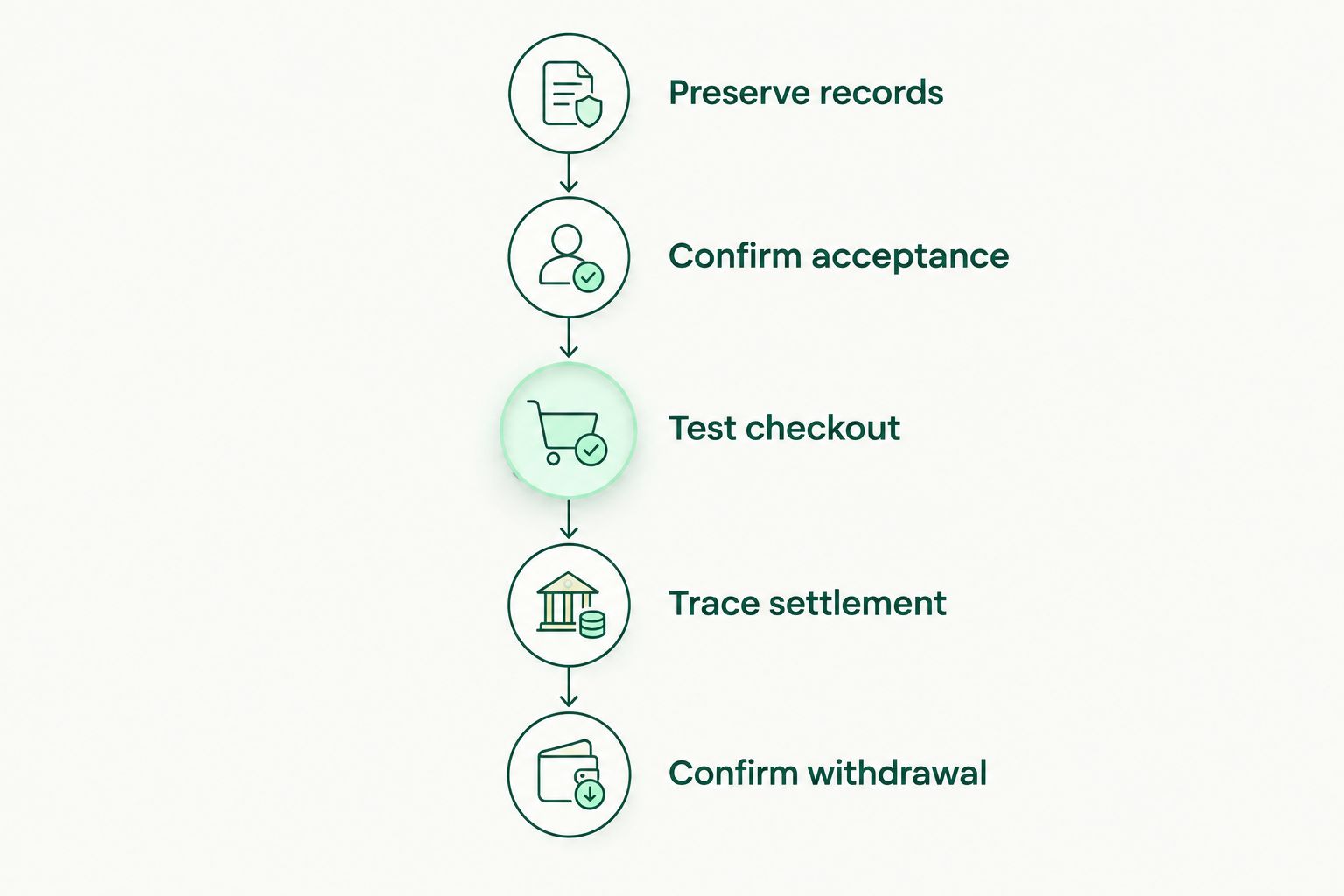
After the authorized testing process, agree with the provider how to validate 1 live transaction without creating artificial activity or violating its rules. Treat that transaction as a reconciliation check, not evidence that all future payments will succeed.
Keep the old provider's obligations visible. Changing checkout does not transfer its existing refunds, disputes or held balances to the replacement arrangement.
What should you bring to a provider conversation?
Bring the evidence pack, your product list and the decision checklist. State the shutdown reason exactly as documented. Explain your current volume, customer locations and required settlement route using your own records.
Ask the provider to return a written response covering eligibility, buyer verification, reserves, total fees and access to settled funds. A sales conversation should resolve those questions, not replace them with a promise of approval.
Product evidence and payment access are separate decisions
Do not treat a laboratory report as a universal approval certificate. Connect each report to the product and batch it actually covers, preserve the advertised claims, and ask qualified advisers about the markets where you sell. Payment access does not override product, advertising or shipping law.
Railbed’s acceptable use policy says it does not underwrite businesses or require an industry-approval application. That differs from a conventional CBD merchant-account proposal. Your legal obligations remain yours, and the independent card provider still decides the buyer’s payment and any verification.
Before routing new orders, identify who verifies payment, who releases the shipment and who handles a refund. Railbed sends proceeds to the saved Polygon wallet and cannot reverse settled funds; a return or reimbursement policy therefore needs an executable payment method, not just a support promise.
Sources and related guides
Checked October 29, 2026 against Railbed’s acceptable use policy and wallet and refund documentation. This is a payment-switching checklist, not a determination that a CBD product is lawful.
FAQ
What should I prepare before applying to another CBD payment processor?
Prepare the termination notice, processing statements, product evidence, ownership records and outstanding refund or dispute details. Keep the underlying documents alongside any summary you send.
What should I look for in a high risk payment processor cbd search?
Prioritize written acceptance of your actual CBD products, clear reserve terms and a documented settlement route. Compare buyer verification and the full fee schedule before choosing.
Is Railbed a conventional high-risk merchant account?
Railbed offers card payment checkout with USDC settlement, which is different from a conventional merchant account. Evaluate wallet receipt, conversion and bank withdrawal as separate operational steps.
Is PaymentCloud better than a traditional high-risk merchant account?
The decision depends on the specific written offer, not the comparison label. Evaluate the proposed account structure, product acceptance, reserves, fees and settlement conditions against the other offers you receive.
Will customers need to show ID at checkout?
Buyer ID checks depend on the provider and transaction. Merchant onboarding does not eliminate buyer verification, and routing does not guarantee payment approval.
Can I use my old processor balance to fund the switch?
Do not commit a held balance to operating expenses before confirming its release conditions. Keep the old balance separate from new-payment proceeds in your cash-flow plan.
Does USDC settlement mean the money is already in my bank?
USDC settlement is not a bank deposit. Confirm the receiving wallet, supported network, conversion process and bank-withdrawal requirements before relying on the funds.
One last thing
The most useful replacement-provider question is: what happens after a successful payment? Request a written walkthrough from buyer completion through settlement, any hold, conversion and bank receipt.
For your 2026 decision, reject comparisons that stop at card acceptance. Your business needs a documented path from a completed order to usable operating funds.