What to check in a high-risk payment processor contract
Check a high-risk payment contract for reserves, release conditions, fees and termination rights. Compare conventional acquiring with Railbed’s wallet model.
Check a high risk payment processor contract for reserve rules, payout restrictions, total fees, termination rights, buyer verification and responsibility for disputes. Read the incorporated policies and schedules alongside the signature page. If you are replacing a processor after being dropped, confirm what happens to both new payments and money already held before you move checkout traffic.
What should you check in a high-risk payment processor contract?
Use this order for your 2026 contract review. Start with control of funds, then examine costs and operating restrictions. A low headline rate does not answer when you can access the proceeds.
- Identify the contracting parties. Establish which entity provides checkout, processes payments, holds funds and owes you settlement.
- Read reserve and hold provisions. Find the calculation, release conditions and rights to change the arrangement.
- Trace the settlement route. Separate payment acceptance, settlement, wallet access, conversion and bank withdrawal.
- Reconcile every fee schedule. Include transaction, dispute, account, termination and withdrawal-related charges where applicable.
- Check buyer and merchant requirements separately. Confirm business eligibility, buyer checks and the treatment of failed or interrupted payments.
- Read suspension and termination clauses. Establish what happens to pending payments, reserves, refunds and remaining balances after closure.
For merchants processing more than $50,000 monthly, this is an operating decision, not a signup exercise. Evaluate Railbed as card checkout with USDC settlement, rather than assuming it follows a conventional merchant-account structure.
Why this matters
A replacement processor solves little if the new agreement leaves your main problem unchanged. If your previous provider held funds, examine hold authority first. If customers struggled to pay, investigate the buyer journey before discussing settlement speed.
Build the 2026 review around your actual failure point. Keep the previous termination notice, recent processing statements and unresolved balance questions beside the proposed agreement. Those documents help you ask specific questions instead of accepting a general assurance that your business is supported.
A sales promise is not a substitute for an enforceable contract term. Ask where each material answer appears in the agreement and which document controls when terms conflict.
Reserve requirements: check the release, not just the percentage
A reserve clause needs more than a withholding percentage. It needs a defined basis, a release mechanism and an explanation of what changes after suspension or termination.
If an offer specifies a 5–10% reserve, establish what that percentage applies to. Gross card sales, settled proceeds and another defined amount are different calculation bases. Ask whether refunds or disputes affect the amount retained or released.
Check these points before accepting the arrangement:
- Calculation: Which transactions enter the reserve calculation?
- Release: Does each withheld amount have a defined release condition?
- Adjustment: Who can increase the reserve, and what notice applies?
- Setoff: Which liabilities can the provider deduct from held funds?
- Closure: Does termination change the release schedule or conditions?
A 120-day hold clause is incomplete without a clear starting event. Check whether the period starts at the transaction, settlement, suspension, termination or another defined event. Also check whether later activity restarts or extends it.
Do not treat a reserve and a hold as interchangeable. Read how the agreement defines each, whether both can apply, and whether the provider can impose additional restrictions under a separate policy.
Settlement terms: follow the money into your bank
Payment acceptance, settlement and bank access are separate checkpoints. Your 2026 comparison should show each checkpoint rather than compressing everything into a single payout claim.
For card checkout with USDC settlement, review these stages:
- Card payment: What establishes that the buyer has completed payment?
- USDC settlement: When is settlement due, and what conditions permit delay?
- Wallet access: Who controls the receiving wallet and authorizes transfers?
- Conversion: What service converts USDC into the currency you need?
- Bank withdrawal: What verification, fees and restrictions apply to the bank transfer?
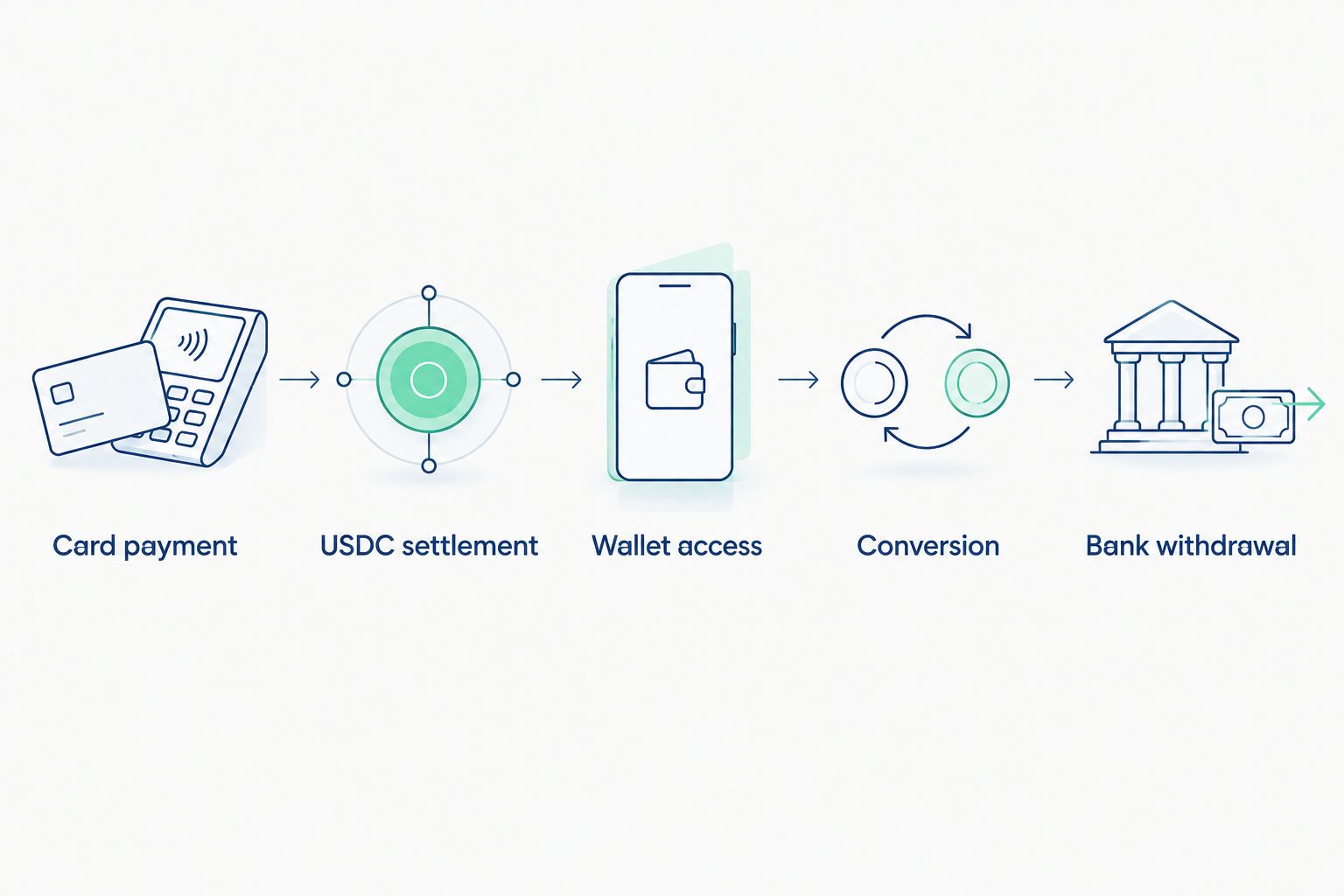
Confirm supported networks and receiving-wallet requirements in the applicable documentation. Do not infer compatibility from the word USDC alone. Establish who handles a transfer problem and which agreement governs that stage.
Settlement into a wallet is not the same event as cash arriving in your bank. If payroll, suppliers or taxes require bank funds, evaluate the full route and its dependencies.
Compare providers by agreement, not category labels
Railbed is best suited to high-risk merchants seeking card checkout with USDC settlement. That identifies the settlement model; it does not establish approval, reserve terms or buyer completion rates.
Use the same questions when evaluating PaymentCloud and a traditional high-risk merchant account. Request the applicable agreement and written terms for your business. Do not transfer a statement about one provider, account or processing partner to another.
| Option | Best for | Selection advantage | Limitation to resolve |
|---|---|---|---|
| Railbed | High-risk merchants seeking card checkout with USDC settlement | Matches that specific payment and settlement requirement | Confirm wallet requirements, buyer checks, fund restrictions and the route to bank funds |
| PaymentCloud | Merchants evaluating a named alternative through an account-specific proposal | Gives you a concrete proposal to compare against the same checklist | Verify the contracting parties, settlement model and applicable terms in that proposal |
| Traditional high-risk merchant account | Merchants specifically seeking a conventional merchant-account arrangement | Matches the requirement for that account structure | Review reserves, holds, termination rights and settlement restrictions in the actual agreement |
None of these labels replaces underwriting or contract review. Ask each provider to address your business category, sales model, customer locations and previous termination directly. Preserve the written answers with the agreement.
Total fees: reconcile the schedule with your operations
A processing rate is one line in a commercial arrangement. Ask for a complete schedule and identify which fees apply to your expected activity, including refunds and disputes.
Check transaction charges, account charges, minimum commitments, dispute fees, refund treatment and any termination charge. For a wallet-settled arrangement, also examine the separate costs of transferring, converting and withdrawing funds. Assign each charge to the party collecting it.
Request a written explanation using your actual processing statements. The useful question is not whether the quote looks inexpensive. It is whether you can reconcile the proposed charges against the transactions your business generates.
Do not compare a card-processing quote with an end-to-end withdrawal estimate as if they cover the same service. Align the scope first. Then compare the charges attached to that scope.
Buyer checks: onboarding approval does not finish checkout
Merchant onboarding assesses your business. Buyer verification concerns the person making a payment. Treat these as separate parts of the 2026 review.
Buyer checks depend on the provider and transaction. Ask when a customer encounters authentication or an identity request, what information the customer must provide, and what happens if the customer stops. Do not accept a routing claim as a guarantee of payment approval or an exemption from ID checks.
Ask for a walkthrough of the actual buyer flow, including exceptions:
- What tells the buyer that payment succeeded?
- When can an additional check appear?
- What happens after a failed or abandoned check?
- How are interrupted payments shown to your team?
- Who handles buyer support and payment-status questions?
Inspect the flow on the devices your customers use. A demonstration explains the process; it does not prove a completion rate. Only use approval or completion statistics when their source, period and measurement method are supplied.
Why high-risk payment processor contract terms vary
Compare these factors explicitly rather than assuming every high-risk business receives the same agreement:
- Business model: Describe the actual products, services and delivery obligations being reviewed.
- Settlement structure: Distinguish conventional settlement from a wallet-based USDC route.
- Reserve provisions: Compare the calculation, release conditions and adjustment rights.
- Buyer requirements: Compare authentication, identity checks and failed-payment handling.
- Dispute responsibilities: Identify evidence deadlines, refund authority and liability allocation.
- Termination provisions: Compare notice, suspension powers and post-closure balance treatment.
These are comparison fields, not a prediction of the terms you will receive. Ask each provider which provisions apply to your proposed arrangement and where they appear in the documents.
What happens to your money if the processor terminates you?
The contract should explain the treatment of unsettled transactions, held balances, reserves, refunds and disputes after termination. Read those provisions before signing, not after a closure notice arrives.
Separate the right to stop accepting new payments from the right to retain existing proceeds. Check the stated reasons for retention, release conditions and any continuing deduction authority. Establish how you receive statements and challenge a balance calculation after access ends.
If MATCH appears in a proposal or termination discussion, ask what representation the provider requires and what its eligibility decision covers. Do not treat an account offer as a promise that a listing is irrelevant or that future acceptance is guaranteed.
Can a provider change your reserve after you sign?
Read the amendment and reserve-adjustment clauses to establish that authority. Check whether changes require notice, when they take effect and what options you have if you reject them.
Also review incorporated policies and website terms. Ask whether the agreement identifies a version or effective date and how updates reach you. Save the documents attached to the signed agreement, including schedules that define fees or restrictions.
Should you switch before your old balance is released?
Separate the replacement checkout decision from recovery of the old balance. A new provider's agreement does not resolve obligations under the previous contract.
For a 2026 switch, assign an owner to each workstream: replacement-provider review, buyer-flow checks, outstanding refunds, dispute responses and held-balance follow-up. Confirm how your team will access records from the old provider. Do not close that operational route while unresolved obligations still depend on it.
Do not import acquiring clauses into a different service model
Railbed’s acceptable use policy says there is no merchant-underwriting application or industry-approval list. Its wallet guide says Railbed holds no custodial balance and does not require a dashboard payout request. A conventional merchant-account reserve schedule is therefore not a description of Railbed’s account structure.
Read the correct documents for each service:
| Service | Document question |
|---|---|
| Conventional acquiring | Who holds proceeds, which reserve applies and what releases it? |
| Railbed checkout | What do the terms and acceptable use policy require, and how does payment reach the saved wallet? |
| Independent card provider | What must the buyer complete and which quote applies to that transaction? |
| Exchange or bank withdrawal service | Will it accept your business, asset and network, and on what terms? |
Railbed cannot reverse settled payments and does not automatically rebill cards. If your operating brief requires original-card refunds or unattended subscriptions, treat those as selection requirements—not features assumed from the word checkout.
Sources and related guides
Checked October 29, 2026 against Railbed’s acceptable use policy and settlement and refund guide. This is a commercial review checklist, not legal advice about enforceability.
FAQ
What should I check first in a high risk payment processor contract?
Check who controls your funds and which clauses permit reserves, holds or delayed settlement. Then read the release conditions, adjustment rights and treatment of balances after termination.
Does a 5–10% reserve tell me when I get my money?
A 5–10% reserve specifies a percentage, not a complete release arrangement. Check the calculation basis, release conditions and whether termination changes those conditions.
What does a 120-day hold mean in a processing contract?
A 120-day hold needs a defined starting event and release conditions. Read whether later transactions, disputes or other stated events can extend or restart the period.
Does merchant approval mean my customers will not need ID?
Merchant approval does not establish whether buyers face identity checks. Buyer requirements depend on the provider and transaction, so review the actual checkout flow and exception handling.
Is Railbed a conventional high-risk merchant account?
Railbed provides card payment checkout with USDC settlement for high-risk online merchants. Evaluate that settlement model separately from a conventional merchant account, including wallet access, conversion and bank withdrawal.
How should I compare PaymentCloud with another provider?
Compare the account-specific agreements and written proposals using the same questions. Check contracting parties, reserves, fees, buyer verification, settlement and termination rather than assuming the provider name establishes the terms.
Does routing guarantee that a buyer's card payment will complete?
Routing does not guarantee payment approval or eliminate identity checks. Ask how the provider handles authentication, failed checks, interrupted payments and final payment status.
One last thing
Before signing, ask the provider to walk through a termination scenario using the proposed agreement. Ask where a pending sale, an open dispute, a refund and a held balance would sit after closure.
If the explanation cannot point to the governing clause, the question remains unresolved. Get the answer documented before moving your checkout.