When should a digital-goods store release a paid order?
Release digital goods only after verified payment and order checks. Handle held payments, late arrivals and duplicate notifications without delivering twice.
Release a paid digital-goods order only after your provider confirms the payment state required for fulfillment, any required buyer checks are complete, and your own order review passes. A success screen, authorization, or settlement notification alone does not prove that an order is safe to deliver or protected from a later dispute.
When should a digital-goods store release a paid order?
Use a written release rule, not a visual cue from checkout. For a store processing more than $50,000 monthly, one ambiguous payment status should not decide whether a customer receives an irreversible download or license key.
Railbed offers card checkout with USDC settlement for high-risk online merchants. That settlement model is relevant to provider selection, but your fulfillment decision still needs an explicit connection between the payment record and the order.
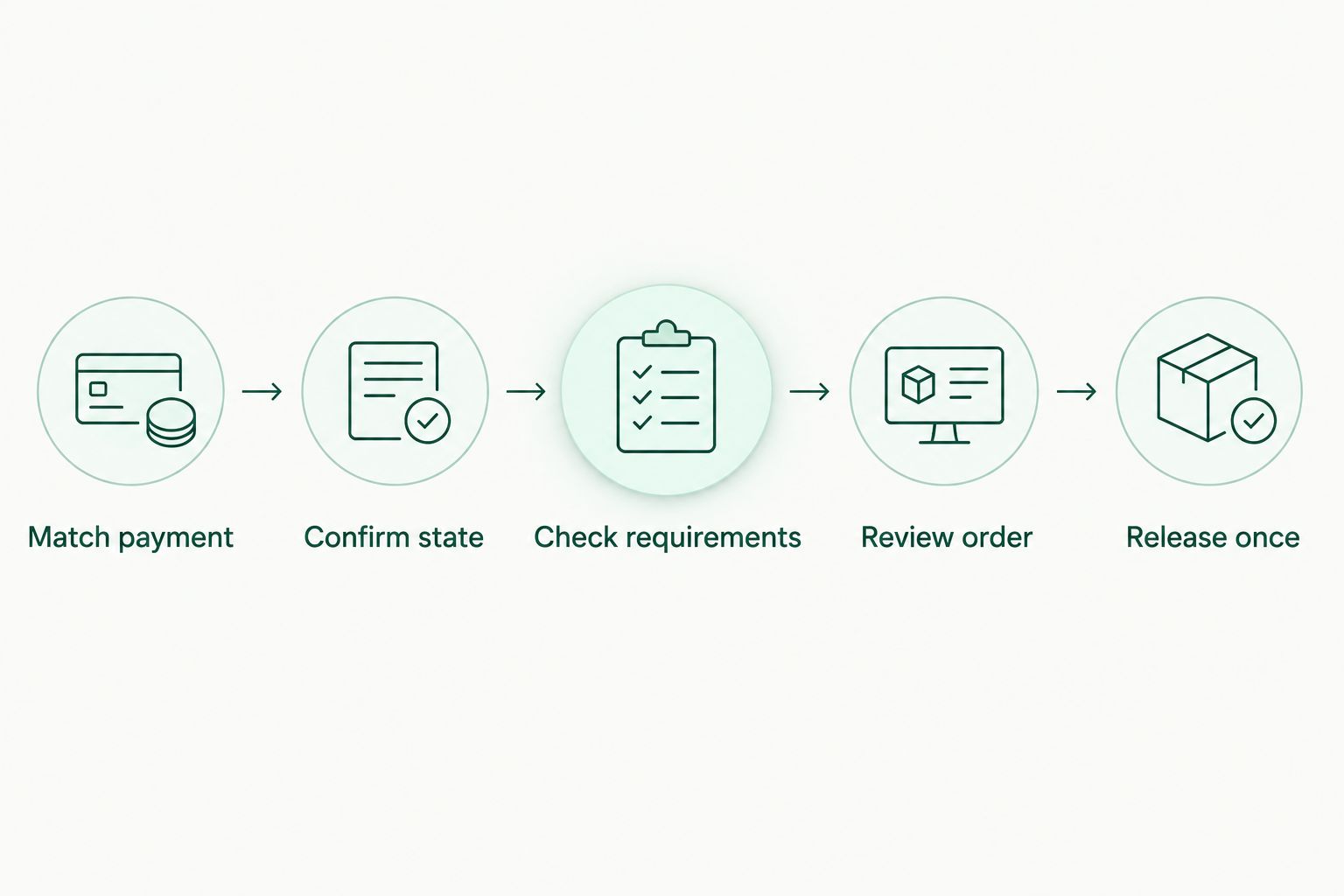
Use this sequence for your 2026 release policy:
- Match the payment to the order. Confirm the order reference, amount, currency, and intended purchase. Do not release a different order because the same customer has another successful payment.
- Confirm the provider's release-ready state. Get the exact status and its meaning in writing. Do not assume that an authorization, capture, or settlement label means the same thing across providers.
- Check for unfinished buyer requirements. Hold delivery while a required identity check or transaction review remains unresolved.
- Apply your own order review. Resolve conflicting account details, duplicate requests, or delivery instructions that do not match the purchase.
- Release once and record the result. Tie the access grant, download entitlement, or license assignment to the payment and order records.
Your release rule needs both a payment condition and a delivery condition. Payment confirmation tells you what happened to the transaction. Your delivery record tells you what you gave the customer.
Why this matters for digital-goods stores
Digital delivery can be difficult to reverse. Once you reveal a license key, expose a file, or activate access, a later cancellation does not undo what the customer already received.
That creates two separate questions: whether the payment reached the required state, and whether the order meets your release policy. Neither question disappears because the checkout displays a confirmation message.
For your 2026 operating policy, define who owns each decision. The provider explains its payment states and review requirements. Your store decides which confirmed state triggers delivery and which exceptions require a hold.
Do not make customer support reconstruct that policy during a complaint. Put the release conditions beside the order record so staff can explain why access was granted or withheld.
What each payment signal means for release
Different signals answer different questions. Treating them as interchangeable creates gaps between checkout, your order system, and customer support.
| Signal or record | What it establishes | Release decision |
|---|---|---|
| Customer success screen | The customer reached a confirmation screen | Verify the payment through the provider before delivery |
| Card authorization | The issuer authorized the transaction at that stage | Do not confuse authorization with completed collection |
| Provider-confirmed payment state | The transaction reached a defined state in the provider's system | Release only if that state meets your documented rule |
| Pending buyer check | A required buyer process remains unfinished | Hold delivery until the requirement is resolved |
| Settlement record | Funds reached a specified settlement stage or destination | Check the applicable dispute, refund, and restriction terms separately |
| Delivery record | Your store granted access or supplied the digital item | Preserve it alongside the payment record |
The practical question is not whether a status sounds positive. Ask the provider: Which exact event should trigger fulfillment, and which later events require us to stop or review delivery?
Have your technical team use the provider's documented confirmation method. A browser redirect is customer-facing navigation, not a substitute for checking the authoritative transaction record.
Why order-release timing varies
There is no universal waiting period that resolves every digital-goods payment. An unexplained delay also creates a support problem: the customer sees a successful checkout but cannot use the purchase.
Build your release rules around these factors:
- Payment state. The provider's documented transaction status determines whether the payment condition has been met.
- Buyer verification. Required checks depend on the provider and transaction. An unfinished check is different from a completed payment.
- Product delivery. A revealed license key and an account entitlement need different delivery records and reversal procedures.
- Order consistency. Conflicting purchase, account, or delivery details need resolution before release.
- Settlement and dispute terms. Access to settled funds does not answer every question about later refunds or disputes.
- Internal review. Your own exception rules determine when staff must intervene instead of allowing automatic delivery.
Do not replace these conditions with an arbitrary timer. Waiting without checking the transaction adds delay without establishing that the release requirements were met.
Keep merchant onboarding separate from buyer verification
Merchant onboarding reviews your business. Buyer verification concerns the person or transaction at checkout. Passing merchant onboarding does not mean every buyer payment will complete without additional checks.
Ask each prospective provider to describe both processes separately. For onboarding, request the business documents, product restrictions, and underwriting requirements. For buyers, request the checkout steps, possible verification requests, and the status your store receives when a check remains incomplete.
A provider's routing approach does not guarantee issuer approval. It also does not establish that buyers will never encounter an identity check.
For a 2026 checkout review, walk through successful, declined, abandoned, and verification-pending paths. Your fulfillment system needs an explicit outcome for each path, not just a working success page.
When a buyer stops during verification, do not classify the order as delivered or ready for delivery. Keep the payment attempt and the order status distinct so support can explain the unfinished step accurately.
Compare settlement models before switching providers
Railbed is a fit for high-risk online merchants seeking card checkout with USDC settlement. It is not the same product category as a conventional merchant account, and that distinction belongs in the provider comparison.
Compare Railbed with PaymentCloud and traditional high-risk merchant accounts using written, current proposals. Do not substitute a category assumption for an account-specific term.
| Option | Best for evaluating | Practical advantage to assess | Limitation or condition to resolve |
|---|---|---|---|
| Railbed | High-risk merchants seeking card checkout with USDC settlement | Whether the stated settlement model fits your treasury workflow | Confirm digital-goods eligibility, buyer checks, release events, fees, and bank withdrawal steps |
| PaymentCloud | Merchants considering it alongside other high-risk payment options | Whether its current proposal fits your business and delivery model | Obtain the actual account structure, reserve terms, settlement conditions, and fulfillment guidance |
| Traditional high-risk merchant account | Merchants seeking a conventional merchant-account arrangement | Whether the proposed account fits existing banking and reconciliation processes | Confirm underwriting, reserves, funding restrictions, dispute obligations, and termination terms |
The USDC model creates a separate operational question: how will your business move from settled USDC to funds in its bank account? Do not treat a wallet settlement event as confirmation of a completed bank withdrawal.
A conventional account needs the same scrutiny at the bank-funding stage. Ask when funds become accessible, what deductions apply, and what contractual conditions permit restrictions. Compare the written answers rather than the sales language.
Ask for the full money path, not just the processing rate
Before switching, request a written breakdown of total fees, reserve requirements, access to settled funds, and withdrawal steps. Keep that commercial review separate from the rule that tells your store when to deliver.
A transaction can satisfy your fulfillment rule while its proceeds follow a different funding schedule. Conversely, receiving settlement does not prove that the buyer received the correct product.
Use these questions in your 2026 provider discussion:
- What charges apply across payment acceptance, settlement, conversion, and withdrawal?
- Is there a reserve, and what determines its amount, release conditions, and treatment after termination?
- What can restrict access to settled funds?
- Who handles refunds and disputes, and how are the associated obligations collected?
- Which services or accounts are needed to move settlement proceeds to your business bank account?
- What records reconcile the customer payment, settlement, deductions, and bank receipt?
Do not approve a switch based only on a headline rate. The useful comparison is the complete money path and its written conditions.
Keep settlement records and bank receipt records separate. That prevents your finance team from treating a completed stage as proof that the entire withdrawal process has finished.
Build an order-release record your team can use
Keep 1 order identifier across the payment reference and delivery record wherever your systems allow it. If the systems use different identifiers, store the mapping rather than expecting support staff to match transactions by memory.
Record 2 separate timestamps: payment confirmation and fulfillment. These timestamps answer different questions and help identify whether a delay happened before or after your store approved delivery.
Your release record should also include:
- The provider transaction reference and confirmed payment state.
- The result of any required buyer check, without unnecessarily copying identity documents into the order system.
- The product or entitlement purchased.
- The release decision and any manual reviewer.
- The delivery destination, access grant, or license assignment.
- Later cancellation, refund, dispute, or access-revocation actions.
Make the release action safe to repeat without creating duplicate delivery. If the same confirmation arrives again, your system should recognize an already fulfilled order rather than assign another license or entitlement.
Test that behavior before moving live traffic. Payment notifications and fulfillment actions need to agree about which order has already been completed.
The same record should support customer communication. Tell the buyer whether payment confirmation, a required check, or delivery itself remains unfinished. Avoid a generic paid label that hides the actual blocker.
Should you wait for settlement before sending a download?
Wait for settlement only when your provider terms or documented release policy require it. Otherwise, use the provider-confirmed fulfillment condition rather than assuming that settlement is the universal trigger.
Ask what settlement means in the proposed arrangement. A wallet receipt, provider balance, and bank receipt describe different stages; none should silently replace the event your fulfillment system was designed to use.
Can you release an order while a buyer ID check is pending?
Do not release an order while a required buyer ID check remains pending. Merchant approval does not complete that buyer requirement.
Tell the buyer which step remains unfinished using the provider's actual instructions. Do not promise approval after document submission or describe routing as a way around verification.
Does USDC settlement remove card-payment disputes?
Do not treat USDC settlement as proof that a card payment cannot be disputed. Require written terms explaining refunds, disputes, liability, and the treatment of settled proceeds.
Your customer paid by card even when your settlement asset differs. Base your release policy on the actual arrangement, not the assumption that crypto settlement makes the underlying purchase final.
Railbed’s release condition is verified paid, matched to your order
For Railbed, the fulfilment event is not left undefined: your server must see paid from a signature-verified notification or an authenticated payment lookup. Match mode, amount, currency and the stored order reference. Use your own order’s account identity, not an email a buyer typed.
Do not request identity documents again after Railbed confirms paid merely because this guide discusses buyer checks. Provider verification takes place during payment. Your separate order review can still flag mismatches, but it needs its own disclosed purpose and support path.
Held payments need a decision. Eligible underpayments can be accepted by a merchant, after which they become paid and enter the same fulfilment path. Expired payments can arrive late; recheck the order and either fulfil or arrange reimbursement under your policy.
Protect the order as well as the payment ID from duplicates. If several paid attempts map to the same order, deliver once and review the extra money instead of issuing another key automatically.
Sources and related guides
Checked October 29, 2026 against Railbed’s fulfilment guide, which defines authoritative paid checks, order matching and late-payment handling.
- Verify payment notifications
- Handle payments needing a decision
- Practice fulfilment without moving money
FAQ
What's the best release rule for a high-risk digital-goods store?
Release only after the provider confirms the payment state required for fulfillment, required buyer checks are complete, and your order review passes. Record the delivery against the same order.
Is a checkout success page enough to send a license key?
No. Verify the transaction through the provider's documented confirmation method before revealing the license key.
Does merchant onboarding mean my customers won't need ID checks?
No. Merchant onboarding and buyer verification are separate processes, and buyer checks depend on the provider and transaction.
Is Railbed a conventional high-risk merchant account?
Railbed offers card checkout with USDC settlement. Compare that model separately from a conventional merchant account, including buyer checks, reserve terms, and bank withdrawal steps.
What should I request from PaymentCloud before switching?
Request a current written proposal covering the account structure, digital-goods eligibility, total fees, reserves, funding conditions, buyer checks, and fulfillment events. Use those terms for the comparison rather than assuming a standard arrangement.
Should a payment notification trigger delivery twice if it arrives again?
No. Your fulfillment system should recognize the completed order and avoid issuing duplicate access, licenses, or entitlements.
What should I tell a customer whose paid order is on hold?
Explain the actual unfinished step: payment confirmation, a required buyer check, or order review. Do not describe a pending requirement as completed or promise an approval outcome.
One last thing
A paid label is not a release policy. Your 2026 switching brief should name the exact provider event that authorizes delivery, the checks that block it, and the record that proves fulfillment.
Take a real digital-goods order through that discussion before agreeing to a new provider. Ask the provider to explain every transition from card entry to delivery and from settlement to bank receipt. If those answers remain vague, the release rule is not ready.