Best high-volume merchant account providers in 2026
Choose a high volume merchant account by settlement fit, not approval promises. Compare Railbed, PaymentCloud, reserves, buyer checks and exit terms.
Best fit for card checkout with USDC settlement: Railbed. Best named provider to evaluate for conventional merchant processing: PaymentCloud. Best route when you want to negotiate directly with the account provider: a traditional high-risk merchant account. This 2026 high volume merchant account guide focuses on merchants processing more than $50,000 monthly after a processor termination—not businesses choosing their first checkout.
Why this matters
A replacement processor needs to solve more than card acceptance. You need to know when proceeds become usable, what remains withheld, and what happens if the new relationship ends.
For a business processing more than $50,000 monthly, those contract details belong in the selection decision. An approved merchant application is not proof that buyers will complete checkout or that settled funds are immediately withdrawable.
The options below represent different payment arrangements. Compare the arrangement first. Compare the provider second.
What makes the best high volume merchant account
Use these criteria before reviewing a proposal:
- Business fit: Get written acceptance of your products, markets, sales model and expected processing volume.
- Reserve terms: Identify how money is withheld, what triggers changes, and how release works after termination.
- Usable funds: Separate payment authorization, settlement, reserve release and bank receipt.
- Total charges: Compare processing, account, dispute, refund, conversion and withdrawal charges together.
- Buyer completion: Establish checkout steps, possible identity checks, decline handling and support ownership.
- Exit terms: Check cancellation obligations, transaction records, recurring billing portability and continuing dispute exposure.
For your 2026 shortlist, treat an unanswered question as an unresolved contract term. Do not replace it with a salesperson's general reassurance.
High-volume payment options at a glance
| Option | Best for | Distinguishing feature | Key limitation |
|---|---|---|---|
| Railbed | Merchants specifically seeking card checkout with USDC settlement | Card payment checkout with crypto settlement for high-risk online merchants | USDC settlement is not the same as receiving a bank deposit |
| PaymentCloud | Merchants evaluating a named provider for conventional merchant processing | A provider-specific proposal to compare against other account offers | Reserve, payout and account conditions require review of the proposed agreement |
| Traditional high-risk merchant account | Merchants seeking a direct account relationship with a suitable provider | Conventional merchant-account structure | Suitability depends on the actual provider, underwriting and contract |
These are use-case rankings, not claims about universal approval, lowest charges or checkout performance. PaymentCloud and the traditional-account route overlap; the distinction is whether you evaluate a named provider or conduct a broader direct-account search.
1. Railbed: best for card checkout with USDC settlement
Railbed is best for high-risk online merchants that want card checkout with USDC settlement rather than a conventional merchant account. Its stated scope includes supplements, adult content, iGaming, CBD and vape businesses rejected by mainstream processors.
That is a different settlement choice. Your buyer pays by card, while your business receives USDC settlement. Evaluate both the buyer-facing checkout and the merchant-side path from settlement to usable bank funds.
Pros
- The stated offering addresses high-risk online merchants rejected by mainstream processors.
- Card checkout and USDC settlement are part of the same offering.
- The settlement model gives you a specific alternative to evaluate against conventional processing proposals.
Cons
- USDC receipt does not itself complete a bank withdrawal.
- Wallet management and the withdrawal route become part of your operating process.
- Crypto settlement does not establish that buyer checks, disputes or restrictions disappear.
Best for: An established high-risk merchant prepared to assess wallet-based settlement and bank conversion alongside checkout acceptance.
Ask for written answers about supported settlement arrangements, merchant checks, buyer verification, applicable charges, refunds and disputes. If your business needs bank funds to cover suppliers or payroll, trace that entire route before committing.
Use the checkout and settlement comparison to structure the discussion. Do not treat a different settlement asset as proof of unrestricted access or guaranteed acceptance.
Verdict: Buy only after confirming category eligibility, buyer requirements and the complete withdrawal process.
2. PaymentCloud: best for a named conventional-processing shortlist
PaymentCloud belongs on the shortlist when you want to evaluate a named merchant-services provider rather than change settlement models immediately. The useful comparison is the account proposal offered to your business—not a presumed set of terms shared by every merchant.
Request the complete agreement and identify every organization responsible for underwriting, processing, settlement and support. A provider name alone does not tell you how the proposed account handles reserves or termination.
Pros
- A named provider gives you a concrete proposal to request and compare.
- You can assess the proposed account against your existing processing records and replacement requirements.
- You can negotiate around documented business needs rather than generic high-risk labels.
Cons
- The provider name does not establish your approved products, markets or volume limits.
- General descriptions do not replace account-specific reserve and settlement clauses.
- Merchant approval does not establish buyer approval or checkout completion.
Best for: A merchant that wants to evaluate conventional processing through a specific provider and will review the actual account documents.
For a 2026 proposal, ask which terms are fixed, which can change, and what events permit changes. Have the provider identify the controlling clauses. An email summary helps organize the discussion, but it does not replace the agreement.
Do not assume that an account offered through PaymentCloud has the same reserve policy, payout schedule or termination terms as another merchant's account.
Verdict: Hold until the proposed account, responsible parties and controlling terms are clear.
3. Traditional high-risk merchant account: best for direct negotiation
A traditional high-risk merchant account is a route, not a single product. Compare individual providers willing to review your actual business, including the reason your previous account ended.
This route fits merchants that want to discuss account structure directly with the proposed provider. It does not remove underwriting or guarantee that your requested conditions will be accepted.
Pros
- You can compare account agreements against a consistent set of requirements.
- You can ask the proposed provider to explain settlement, reserves and dispute responsibilities together.
- You can make recurring billing, reporting and exit requirements part of the negotiation.
Cons
- A high-risk label does not establish acceptance of your specific products or markets.
- Reserve and termination provisions require close review.
- A new account does not automatically resolve restrictions affecting the old account's funds or records.
Best for: A merchant prioritizing a conventional account relationship and prepared to compare multiple written proposals.
Ask who can change your reserve, restrict processing or terminate the account. Then ask what happens to unsettled transactions, refunds and disputes after that decision. Those answers determine your operating exposure more directly than an account's marketing description.
Verdict: Buy only when the written agreement matches your business and cash-access requirements.
Compare buyer completion before switching
Merchant onboarding checks your business. Buyer verification concerns the person attempting a payment. Keep those conversations separate.
A merchant can pass onboarding while an individual buyer still faces an identity check, authentication request or decline. Requirements depend on the provider and transaction. No routing arrangement guarantees approval or eliminates buyer verification.
Ask each candidate to explain:
- What the buyer sees before submitting payment.
- When additional identity or authentication steps apply.
- What happens after a failed or interrupted attempt.
- Whether retrying creates another payment attempt.
- Which event confirms that an order should be fulfilled.
- Who helps when a buyer cannot complete the process.
Do not accept a merchant dashboard demonstration as a substitute for reviewing the buyer journey. For your 2026 switch, include representative purchase flows and interrupted payments in the acceptance plan. Agree on permitted testing with the provider before using live transactions.
Follow the money through every stage
Use the same sequence for every proposal: Card payment, Settlement, Available funds, Bank receipt. Ask the provider to identify the evidence and restrictions at each stage.
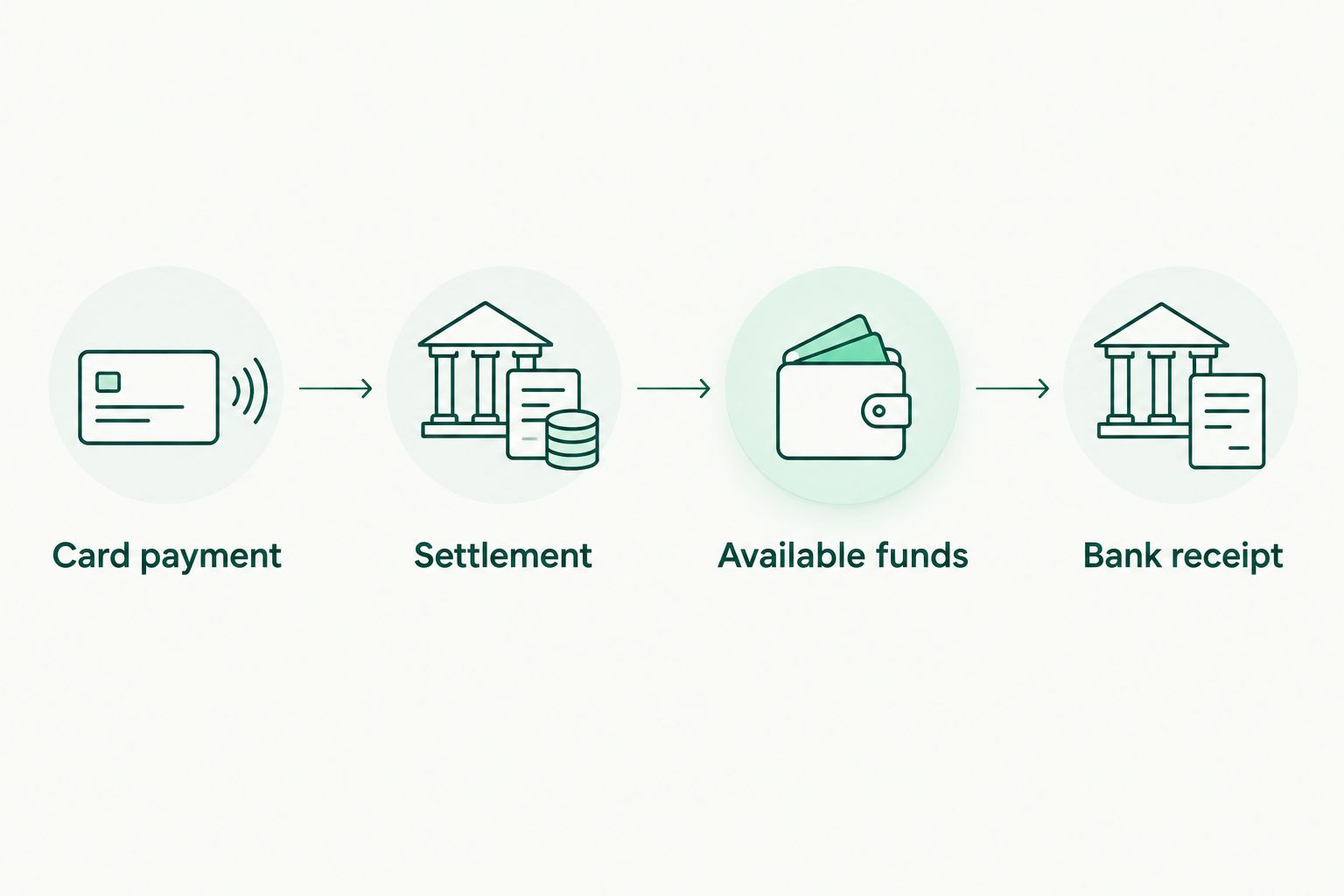
Card payment
Confirm what the reported status means. An authorization, captured transaction and completed settlement are different processing events. Your fulfillment rules should use the event the provider documents as appropriate for the transaction.
Settlement
Identify the settlement asset and destination. For a conventional account proposal, ask how settlement connects to bank payouts. For USDC settlement, confirm the wallet arrangement and supported transfer route.
Available funds
Ask what remains withheld or restricted after settlement. Request the reserve calculation, release conditions and any contractual rights to change access. Do not equate a displayed balance with spendable proceeds.
Bank receipt
Document the remaining steps to reach your business bank account. For USDC, that includes the chosen conversion and withdrawal provider's requirements, applicable charges and supported banking route. Confirm those terms separately from checkout terms.
This distinction matters throughout 2026 provider selection: a fast event at one stage does not establish the timing of the next.
Compare total charges without hiding the reserve
Ask every candidate to quote against the same transaction profile. Include your processing history, typical purchase patterns, customer markets, refund activity and dispute records.
Keep these categories separate:
- Processing charges: The charges attached to accepting and handling payments.
- Account charges: Recurring account, gateway or service charges specified in the proposal.
- Exception charges: Refund, dispute, failed-payment or other event-based charges.
- Withdrawal charges: Conversion, transfer and bank-withdrawal charges where applicable.
- Reserve withholding: Proceeds held under the agreement, with separate release conditions.
A reserve affects cash access even when it is not described as a processing charge. Ask for a worked settlement statement showing which deductions are charges and which amounts remain withheld. Use your own processing profile, not an unrelated merchant's example.
How the options are ranked
The ranking follows settlement fit, contract clarity, buyer completion and access to proceeds. It does not award points for unsupported approval claims or unpublished commercial terms.
The first option serves merchants intentionally considering USDC settlement. The second gives conventional-processing buyers a named provider to evaluate. The third broadens that search to direct account proposals. Choose the arrangement your business can operate, then judge the written offer.
Which high-volume payment option should you choose?
Choose Railbed when card checkout with USDC settlement is the arrangement you want to assess. Choose the conventional-account route when your priority is a merchant-account agreement and its bank-payout structure; PaymentCloud is a named candidate for that comparison.
Before a sales conversation, prepare your termination notice, recent processing statements, product details, customer markets and recurring-payment requirements. State your monthly volume accurately. Ask each provider to respond to the same requirements so differences remain visible.
Discuss your replacement checkout
Bring your processing history, termination details and settlement requirements to the conversation.
Discuss your requirementsFAQ
What's the best high volume merchant account after a processor drops my business?
The best choice is the written offer that accepts your business and matches your settlement, reserve and buyer-checkout requirements. Compare the actual agreement before treating any provider as your replacement.
Is Railbed a conventional high-risk merchant account?
Railbed's stated offering is card payment checkout with USDC settlement for high-risk online merchants. Evaluate it as that settlement model, not as an interchangeable conventional merchant account.
Is PaymentCloud better than a direct high-risk merchant account?
The better option depends on the specific proposed agreements. Compare responsible parties, reserves, access to proceeds, charges and termination provisions rather than assuming the provider name determines those terms.
Will buyers still need to show ID after my merchant account is approved?
Buyer identity checks depend on the provider and transaction, separately from merchant onboarding. Merchant approval does not guarantee that every buyer completes payment without additional checks.
Does USDC settlement mean money is already in my bank?
No. USDC settlement and bank receipt are separate events. Confirm wallet access, the conversion route, withdrawal requirements and applicable charges before relying on proceeds for bank expenses.
What should a merchant processing more than $50,000 monthly request before switching?
Request written category eligibility, reserve terms, settlement conditions, total charges, buyer-checkout requirements and exit obligations. Also confirm the treatment of existing subscriptions, refunds and disputes before moving traffic.
One last thing
Ask a prospective provider to explain what happens if the relationship ends immediately after settlement. Who holds the money? Which obligations survive? What records can you export?
A provider-selection decision is incomplete until the exit is understood. Put that question in your 2026 comparison before signing, not after another termination notice.