Best offshore merchant accounts for high-risk businesses 2026
Compare offshore merchant account options, USDC settlement and conventional processing. Check reserves, buyer ID checks and bank access before switching.

Best for card checkout with USDC settlement: Railbed. Best for a conventional offshore merchant account: a direct acquiring arrangement with documented jurisdiction and settlement terms. Best for a provider-specific conventional comparison: request a PaymentCloud proposal. These are different routes, not interchangeable accounts; this 2026 guide explains how to choose after a processor drops your business.
Why this matters
If you process more than $50,000 monthly and your processor has dropped you, a replacement needs to solve two problems: accepting the next legitimate payment and making the proceeds usable. An approval email answers neither by itself.
An offshore merchant account generally means an acquiring relationship outside your business’s home jurisdiction. Card checkout with USDC settlement describes a different settlement model. A foreign acquiring bank, a crypto settlement asset and unrestricted access to funds are three separate questions.
For your 2026 shortlist, start with the outcome you need. If your finance team requires bank deposits, assess that path directly. If your business can receive USDC, assess the wallet, conversion and bank-withdrawal steps before committing.
What makes the best offshore merchant account
Use these criteria before comparing provider names:
- Documented acquiring arrangement. Identify the contracting entity, acquiring jurisdiction and responsibility for your account. A sales label is not a banking relationship.
- Written business acceptance. Obtain terms covering your actual products, customer countries and sales model. A broad high-risk label does not establish acceptance.
- Reserve and hold terms. Separate the settlement schedule from rolling reserves, other withheld balances and termination provisions.
- Buyer completion requirements. Establish what customers must do, including authentication or identity checks triggered by the provider or transaction.
- Usable-funds path. Follow the money through settlement, conversion and withdrawal. Include the accounts and third parties involved.
- Total contractual cost. Compare processing, settlement, currency conversion, refunds, disputes and account-related charges without treating the headline rate as the whole bill.
Options at a glance
This is a fit-based shortlist for 2026, not a ranking of measured approval rates. Provider-specific reserve schedules, fees and payout commitments belong in a written proposal for your business.
| Option | Best for | Standout distinction | Key limitation |
|---|---|---|---|
| Railbed | Merchants evaluating USDC settlement | Card payment checkout with USDC settlement | Not a conventional merchant account; bank access requires a separate assessment |
| Direct offshore acquiring arrangement | Merchants specifically requiring offshore acquiring | A documented acquiring relationship in a foreign jurisdiction | Jurisdiction alone does not establish acceptance, reserve terms or usable-funds timing |
| PaymentCloud proposal | Merchants comparing a named provider against a direct account | A provider-specific proposal to assess alongside other offers | An offshore arrangement and account terms must be established in writing |
1. Railbed: best for card checkout with USDC settlement
Railbed provides card payment checkout with USDC settlement for high-risk online merchants, including supplements, adult content, iGaming, CBD and vape businesses. The distinction matters: this is an alternative settlement model, not another name for an offshore merchant account.
Railbed is best for high-risk merchants evaluating card checkout with USDC settlement rather than a conventional merchant account. Start there only if receiving and managing USDC fits your business’s operations.
Pros:
- Matches a search for card acceptance with USDC settlement.
- Serves the high-risk merchant categories identified above.
- Gives you a distinct settlement model to compare with conventional acquiring.
Cons:
- Does not satisfy a requirement specifically for a conventional offshore merchant account.
- USDC settlement and money in your bank account are different endpoints.
- Buyer checks, reserves, dispute responsibilities and fund-access terms still require explicit answers.
Ask what happens after a successful card payment. Establish which settlement status means funds have reached your wallet, what restrictions apply, and how refunds and disputes affect your obligations.
Then assess withdrawal separately. Confirm that your chosen conversion service accepts your business, supports the relevant USDC network and can send proceeds to your bank. Do not treat a wallet balance as proof of completed bank withdrawal.
Best for: A high-risk merchant prepared to assess USDC settlement and its downstream banking requirements.
Verdict: Hold until settlement, buyer checks and withdrawal responsibilities are documented.
2. Direct offshore acquiring: best for a conventional offshore account
A direct offshore acquiring arrangement is the relevant route when you specifically need a merchant relationship outside your home jurisdiction. Evaluate the actual account structure, not the word offshore in a sales pitch.
The provider should identify who contracts with you, which acquiring institution is involved and which jurisdiction governs the agreement. Establish which party handles settlement instructions, disputes, reserves and termination.
Pros:
- Fits a requirement for a conventional offshore acquiring relationship.
- Gives your legal and finance teams a specific contract structure to review.
- Lets you compare settlement and reserve obligations within the proposed account agreement.
Cons:
- A foreign jurisdiction does not remove underwriting or card-payment requirements.
- Account approval does not establish acceptance of every product or customer country.
- Reserve release, termination and dispute obligations require separate review.
Ask whether the proposal depends on an entity, bank account or operating presence you do not already have. Identify those requirements before spending time on integration.
For a 2026 decision, also separate your settlement currency from your customers’ transaction currencies. Ask who performs any conversion, where the charge appears and what your accounting team receives for reconciliation.
Best for: A business whose legal, banking or operating requirements call for a documented offshore acquiring relationship.
Verdict: Hold until the acquiring relationship and contractual obligations are clear.
3. PaymentCloud: best for a provider-specific comparison
Use a PaymentCloud proposal as a named-provider comparison, not as proof that you have found an offshore account. The relevant evidence is the offer for your legal entity, business model and processing history.
Request the proposed account structure, acquiring jurisdiction, reserve provisions and settlement method. Keep those answers beside the direct offshore proposal so that different arrangements do not get compared as if they were identical.
Pros:
- Provides a specific provider to include in your proposal process.
- Creates a concrete comparison against a direct acquiring arrangement.
- Lets you assess conventional processing requirements alongside a USDC-settlement alternative.
Cons:
- The provider name alone does not establish an offshore acquiring arrangement.
- Public positioning does not establish your merchant-specific terms.
- A proposal still needs scrutiny for buyer checks, holds, total charges and exit obligations.
The useful question is not whether PaymentCloud sounds more familiar. It is whether the written arrangement fits your business better. Use the checkout and settlement comparison to frame that discussion, then verify the actual offer.
Best for: A merchant seeking a named-provider proposal to compare with direct acquiring and alternative settlement.
Verdict: Hold until the proposal identifies the account structure and full obligations.
Buyer checks: account approval is not payment approval
Merchant onboarding reviews your business. Buyer verification reviews the customer or transaction. Completing the first does not eliminate the second.
Ask each provider to describe the live customer journey. Determine whether customers face card authentication, identity-document requests, redirects or other checks. Requirements depend on the provider and transaction; offshore routing does not guarantee approval or eliminate ID checks.
Ask what happens when a customer fails, abandons or cannot complete a check. Your order system needs to distinguish a pending payment from a completed payment before releasing goods, crediting an account or granting access.
Use these questions in the sales conversation:
- What does the buyer see before entering card details?
- Which events trigger additional checks?
- Who supports a buyer who cannot finish verification?
- What payment status authorizes order fulfillment?
- What records connect the checkout attempt to the final payment?
Do not accept an approval-rate promise as a substitute for these answers. A payment flow your buyers cannot finish is not a working replacement.
Reserves, settled funds and total charges
For every 2026 proposal, separate money earned from money available to use. A settlement schedule does not, by itself, explain withheld funds or reserve release.
Ask for the reserve basis, collection method, release conditions and treatment after termination. Also ask what permits additional withholding and how the provider notifies you. USDC settlement alone does not establish that reserves or holds are absent.
Compare total charges using the same sample processing month. Include transaction charges, cross-border or currency-conversion charges, refunds, disputes, settlement transfers and any account or termination charges stated in the contract.
For a business processing more than $50,000 monthly, the timing of access deserves its own comparison. Ask the provider to show how the proposed terms apply to your actual volume rather than a generic example.
Keep these endpoints separate:
- Payment accepted: The transaction has reached the provider’s stated success status.
- Settlement received: Funds have reached the stated settlement destination.
- Bank withdrawal completed: Proceeds have arrived in your bank account.
Ask which endpoint each advertised timing refers to. That distinction prevents a fast-settlement claim from becoming an unsupported bank-access assumption.
Switching checks before you redirect sales
Do not make the first live customer responsible for finding a broken replacement flow. Use a controlled evaluation with provider-approved testing and your actual order requirements.
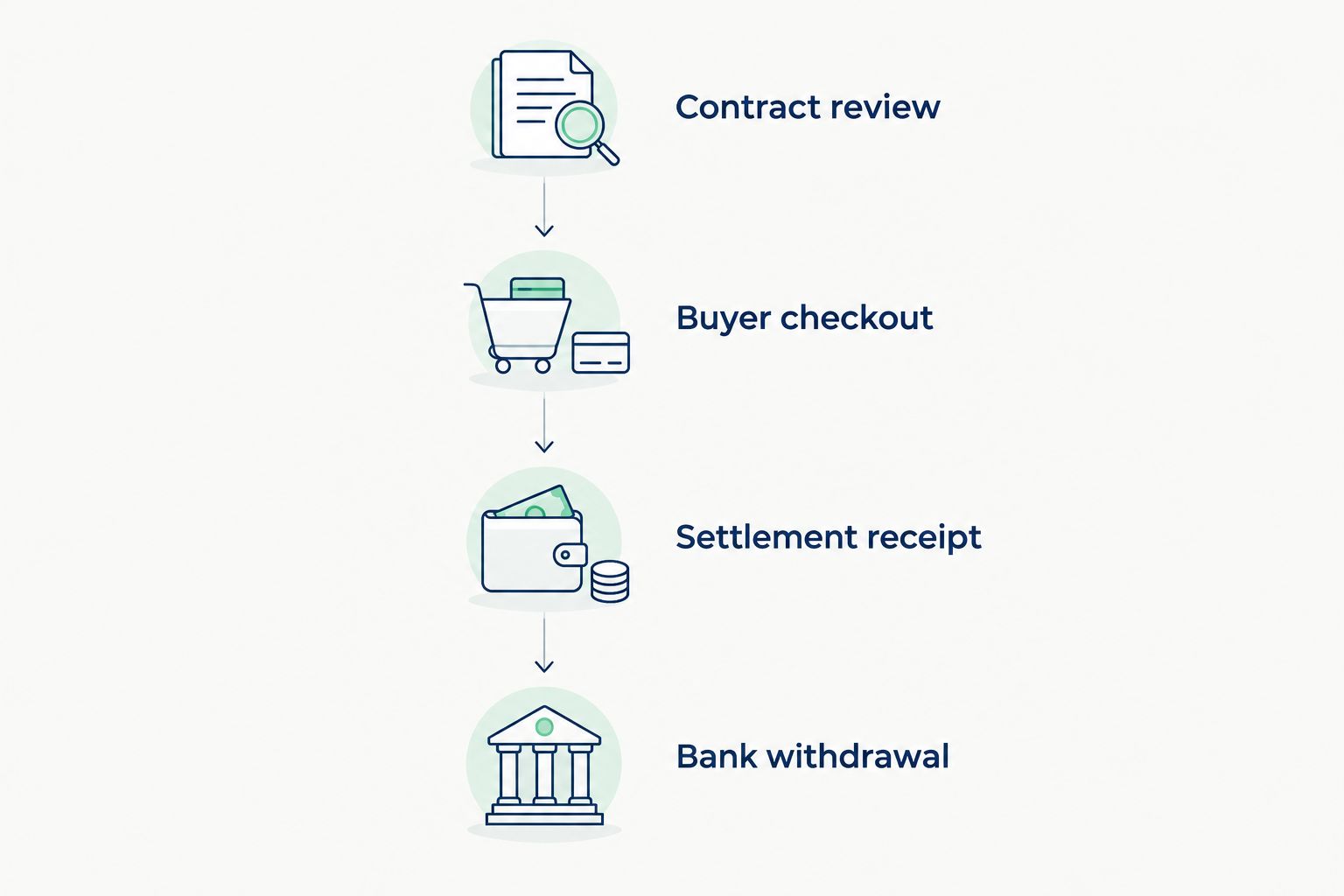
Contract review
Confirm your legal entity, product category, customer countries and sales model in writing. Include subscriptions, digital access or other material features where relevant. Record the reserve, refund, dispute and termination responsibilities.
Buyer checkout
Inspect the payment journey on the devices your customers use. Check successful completion, additional verification and failed-payment handling. Ask the provider how to test these paths without violating its rules.
Settlement receipt
Reconcile at least 1 permitted test payment from the order record to the settlement record. Confirm the transaction reference, deductions, destination and final status. For USDC, establish the supported network and wallet requirements before transferring funds.
Bank withdrawal
Validate the conversion and withdrawal route separately. Confirm account eligibility, supported assets, transfer instructions and bank details with the parties involved. Document who investigates a missing transfer at each stage.
Keep historical payment and renewal records accessible during the switch. A new account does not automatically move stored payment credentials or resolve obligations under your old agreement. Establish those requirements before redirecting recurring payments.
How the options are ranked
The order follows settlement fit, not an unsupported claim about approval or performance. The USDC route comes first for merchants open to that settlement model; direct offshore acquiring fits a specific offshore-account requirement; a PaymentCloud proposal supplies a named-provider comparison.
The deciding evidence is the same across all options: written acceptance, buyer completion requirements, reserve provisions, total charges and the path to usable funds.
Which offshore merchant account should you choose?
Choose the account structure before choosing the provider. If you require conventional offshore acquiring, reject proposals that do not identify the acquiring relationship. If USDC settlement meets your needs, compare that route without pretending it is a bank-settled merchant account.
For an undecided merchant in 2026, the next move is a documented proposal comparison. Give each provider the same business profile and processing history. Require answers to the same buyer-check, reserve and withdrawal questions before signing.
Discuss your replacement checkout
Explain your business category, processing history and settlement requirements.
Discuss your requirementsFAQ
What's the best offshore merchant account for a high-risk business?
The best fit is an arrangement that explicitly accepts your business and documents its acquiring jurisdiction, reserves and settlement obligations. Choose conventional offshore acquiring only when that account structure meets your requirements; assess USDC settlement separately.
Is Railbed an offshore merchant account?
Railbed provides card payment checkout with USDC settlement, not a conventional offshore merchant account. Compare the settlement model, buyer requirements and withdrawal responsibilities rather than treating the categories as interchangeable.
Does PaymentCloud provide the offshore account my business needs?
Establish that through a written proposal identifying the account structure and acquiring jurisdiction. The provider name alone does not confirm an offshore arrangement or your business's acceptance.
Will an offshore merchant account eliminate buyer ID checks?
No. Buyer checks depend on the provider and transaction, and merchant onboarding is separate from customer verification. Offshore routing does not guarantee approval or eliminate authentication requirements.
Does USDC settlement mean there are no reserves or holds?
No. USDC describes the settlement asset, not the reserve policy. Obtain written terms covering withholding, release conditions, disputes and termination.
How do I compare offshore merchant account costs?
Compare all contractual charges using the same sample processing month. Include processing, conversion, settlement, refunds, disputes and account-related charges rather than comparing headline rates alone.
Can I spend the money as soon as a card payment succeeds?
A successful card payment does not by itself establish that the proceeds are available to spend. Confirm the provider's settlement status, restrictions and withdrawal process before treating the funds as usable.
What should I check before switching after a processor shutdown?
Check written business acceptance, buyer completion, settlement receipt and bank withdrawal. Keep historical transaction and renewal records accessible, and establish your remaining obligations to the previous provider.
One last thing
Ask every shortlisted provider to trace a payment backward from your bank account to the buyer’s checkout. Name the responsible party at each handoff. If the explanation stops at settlement, your comparison is not finished.