How to compare bank payouts with USDC settlement
Compare bank payouts with USDC settlement by the full route to usable funds. Review wallet control, fees, reserves, refunds and separate bank withdrawals.
Compare bank payouts with USDC settlement by tracing a card payment from checkout to money you can actually use. Check buyer verification, reserves, settlement conditions, conversion, and bank withdrawal—not just the advertised processing fee. USDC settlement changes what you receive; it does not by itself guarantee payment approval, remove ID checks, or make a bank withdrawal immediate.
How do you compare bank payouts with USDC settlement?
Start with the destination your business needs. If suppliers, payroll, and taxes require bank money, compare both options through the final bank credit. A wallet receipt is an intermediate step, not the end of that comparison.
Use this table to structure your 2026 provider review. It identifies the questions each option must answer; it does not substitute for a written offer.
| Option | Best for | Main advantage to evaluate | Limitation to evaluate | Written evidence to request |
|---|---|---|---|---|
| Railbed card checkout with USDC settlement | Merchants specifically seeking card acceptance with USDC settlement | Customers pay by card while the merchant receives USDC | Bank withdrawal requires a separate conversion and withdrawal path | Buyer checks, deductions, reserve terms, settlement conditions, supported wallet requirements |
| PaymentCloud proposal | Merchants evaluating a provider alongside direct merchant-account offers | A proposal provides terms you can compare against your operating needs | The provider name alone does not establish your account terms | Proposed account structure, underwriting requirements, fees, reserves, payout conditions |
| Conventional high-risk merchant account | Merchants whose operations require bank-denominated payouts | A bank-payout structure aligns with bank-based expenses | Holds, reserves, and contractual restrictions need review | Acquiring arrangement, payout schedule, reserve agreement, termination provisions |
Railbed is best for high-risk merchants seeking card checkout with USDC settlement rather than a conventional bank-payout account. That is a settlement-model fit, not a promise of approval or unrestricted access to funds.
Why this matters
If you process more than $50,000 monthly and your processor has dropped your business, replacing checkout is only part of the job. You also need a usable route from a successful customer payment to the account that pays your bills.
A provider can look attractive at the checkout stage while creating work at the withdrawal stage. Another can offer bank payouts but attach reserve or release conditions that conflict with your cash needs. Choose the complete payment path, not the most attractive individual feature.
For your 2026 comparison, keep customer payment completion separate from merchant settlement. A successful merchant application does not establish what every buyer will experience.
Bank payouts: evaluate the account agreement
A conventional high-risk merchant account and card checkout with USDC settlement are different arrangements. Do not treat them as interchangeable products with different payout buttons.
For a bank-payout proposal, identify the parties responsible for processing, settlement, reserves, and support. Ask which agreement governs each responsibility. A sales explanation is not a replacement for the terms that apply when funds are delayed or the relationship ends.
Request a payout example that starts with a completed card sale and ends with a bank credit. It should identify deductions, any reserve allocation, the payout trigger, and the conditions that interrupt the schedule.
The practical advantage is alignment with bank-based expenses. The trade-off is that a stated payout schedule must be read alongside hold, reserve, and termination provisions. Review those provisions together, not on separate calls.
USDC settlement: evaluate the route back to your bank
With Railbed card checkout and USDC settlement, the buyer payment method and the merchant settlement asset are different. The customer pays by card; the merchant receives USDC. That distinction belongs at the center of your comparison.
Receiving USDC is not the same event as receiving money in your business bank account. If you need bank money, establish the conversion and withdrawal route before selecting the settlement model.
Ask the settlement provider to identify its requirements. Separately, ask the exchange or conversion service about business verification, supported transfers, conversion deductions, withdrawal conditions, and account restrictions. Approval by one party does not establish acceptance by another.
The advantage is receiving the settlement asset you want to hold or use. The limitation is the additional operational responsibility when your business ultimately needs bank funds. Assign responsibility for wallet access, transfers, reconciliation, and withdrawal before processing live payments.
Check buyer payment completion before settlement speed
Merchant onboarding answers whether a provider will work with your business. Buyer verification answers what a customer must do to complete a particular payment. These are separate checks.
Ask for the actual customer-facing flow. Establish whether the buyer stays on your checkout or moves to another page, what information the buyer supplies, and how the buyer returns to the order confirmation.
Make potential ID checks explicit. Buyer checks depend on the provider and transaction; routing does not guarantee approval or eliminate verification. Do not describe checkout as frictionless unless the statement is supported by the actual flow—and do not convert that description into an approval promise.
Request answers to these questions:
- What can trigger additional buyer verification?
- Who requests and handles identity documents?
- What does the buyer see while verification is pending?
- What status does your store receive after a failed or abandoned payment?
- How do support staff distinguish a verification issue from a card decline?
Use a walkthrough to inspect the experience, not to predict completion rates. A demonstration shows the steps; it does not establish how your customer base will perform.
Compare the full route to usable funds
For your 2026 review, ask every provider to explain the same sequence. Keep each event separate so a fast early step does not conceal a restricted later one.
- Buyer payment. Establish what confirms payment completion and what your order system receives.
- Provider settlement. Identify the event that makes funds eligible for payout and any conditions that interrupt it.
- Funds access. Determine what you can transfer or use after deductions, reserves, and restrictions.
- Bank withdrawal. If settlement is USDC, document conversion and withdrawal through to bank credit.
These stages belong in the same operating plan. Your finance team needs to know which event supports order fulfillment and which event supports paying a bank-based obligation.
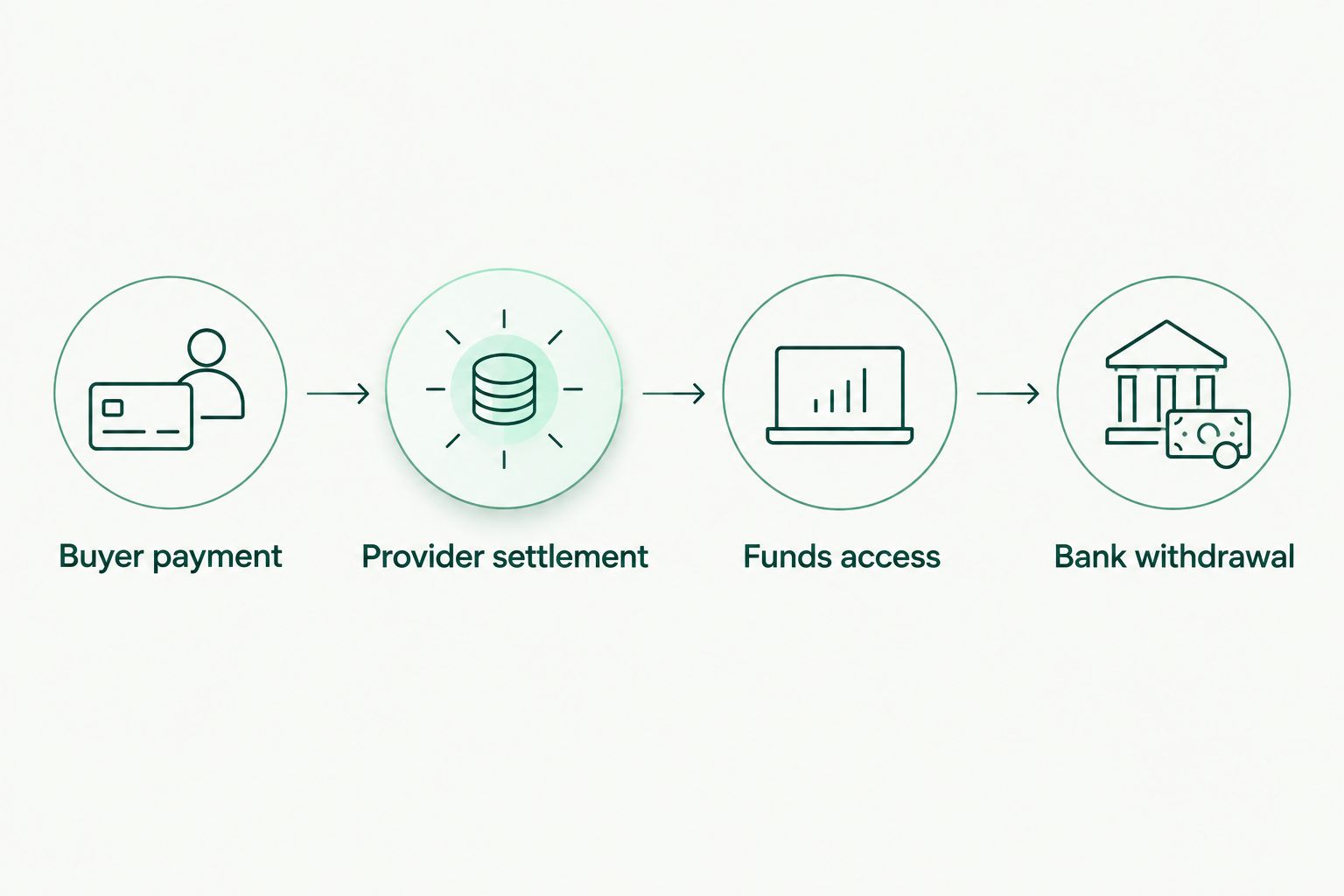
Ask what evidence confirms each stage: a payment status, settlement record, wallet transaction, or bank entry. Do not let the same dashboard label stand in for several different events.
What counts as access to settled funds?
Access means you can perform the action your business needs, subject to the applicable terms. Seeing a balance is not the same as being able to transfer it, convert it, or withdraw it.
For a bank-payout arrangement, ask when a payout becomes available and what can delay it. For USDC settlement, ask when a transfer is completed and then verify the receiving service's separate requirements.
Compare reserves without assuming they disappear
Do not infer reserve policy from the settlement asset. Ask every provider whether it requires a reserve, how it calculates that reserve, who controls it, and what governs release.
Distinguish a reserve from a temporary hold or an account restriction. The names matter less than the contractual effect: how much of your revenue you cannot use, under what conditions, and until what release event.
Request written answers covering:
- Calculation: Which transactions or balances form the reserve basis?
- Control: Which party holds the funds and authorizes release?
- Release: What event makes withheld funds eligible for return?
- Termination: What happens to withheld funds after processing stops?
- Disputes: How do refunds and chargebacks affect the remaining balance?
For the 2026 decision, evaluate reserve release alongside your existing processor exit. A new checkout does not resolve the old provider's withheld balance. Keep recovery of existing funds and replacement processing as separate workstreams.
Compare total fees without stopping at the headline
Request an itemized schedule for your actual business category and expected payment activity. Do not compare a generic advertised rate with a negotiated proposal that includes additional services or restrictions.
For both settlement models, ask about processing deductions, account charges, refund handling, disputes, and termination obligations. For USDC settlement, also identify transfer, conversion, and withdrawal deductions wherever they apply.
Use the same transaction history for each proposal. Give providers your actual monthly volume, transaction sizes, customer locations, and dispute history through an appropriate business channel. Ask each provider to distinguish fixed charges from transaction-dependent charges.
Then compare the result at the same endpoint. If one estimate stops at wallet receipt and the other stops at bank credit, the comparison is unfinished.
The relevant question is what reaches the destination you need, under the restrictions you accept. A lower processing deduction does not answer that question on its own.
Why the comparison varies
There is no useful provider ranking without your operating requirements. The following factors change what you need to compare:
- Business category. Require written acceptance of your actual products and sales model, not just a broad industry label.
- Buyer verification. Customer-facing checks affect the payment journey separately from merchant onboarding.
- Reserve conditions. Calculation and release terms determine which settled funds remain unavailable.
- Expense destination. Bank-based obligations make conversion and withdrawal part of a USDC comparison.
- Account responsibilities. Wallet handling, reconciliation, and support ownership determine the work your team must perform.
These are selection criteria, not predictions about a provider's decision. Keep your business description consistent across applications so the offers address the same operation.
How should you compare PaymentCloud with USDC settlement?
Compare a current written PaymentCloud proposal with the complete USDC settlement route. Ask for the account structure, buyer experience, reserve agreement, payout conditions, and deductions before making a provider-level judgment.
Do not assign either option a fee, reserve policy, approval timeline, or checkout result based on its name. Date each proposal and confirm that the terms apply to your business category and processing profile.
Can you switch without disrupting existing orders?
Plan the switch around order status, refunds, disputes, subscriptions where applicable, and reconciliation. Do not assume replacing a checkout transfers the obligations attached to earlier transactions.
Before your 2026 cutover, identify which provider handles each existing transaction and which system records the outcome. Keep access to the records needed to resolve customer questions after new payments move elsewhere.
What should you bring to a provider conversation?
Bring your actual product description, processing history, termination notice, dispute records, and required payout destination. Explain whether you want to retain USDC or convert settlement into bank money.
Ask Railbed to address the full route: buyer payment, potential verification, settlement conditions, funds access, and any separate bank-withdrawal steps. Request written terms rather than an assurance that your category is supported.
A useful conversation ends with a defined payment flow, named responsibilities, and terms you can review. It does not end with a blanket approval promise.
Review your settlement requirements
Compare card checkout, buyer checks, settlement conditions, and the route to usable funds.
Explore card checkoutRailbed’s actual payout model
Railbed’s wallet guide says it sends settlement to the payment’s saved Polygon wallet, keeps no custodial merchant balance and requires no dashboard payout request. That is the practical contrast with an acquiring agreement that pays to a bank on its funding schedule.
| Requirement | Better fit to assess |
|---|---|
| Receive proceeds directly in a self-custody wallet | Railbed’s USDC settlement model |
| Receive conventional acquiring payouts to a bank | A bank-settling merchant-account proposal |
| Charge saved cards automatically at renewal | A provider with documented recurring billing; Railbed does not auto-rebill |
| Reverse a payment from a refund button | A provider with that supported function; Railbed requires separate reimbursement |
A wallet removes Railbed custody from settled funds. It does not remove wallet-key security, the risk of sending to the wrong network, conversion-service eligibility or your obligations to customers. Compare those operational costs honestly.
Sources and related guides
Checked October 29, 2026. Wallet and settlement documents noncustodial settlement; bank withdrawal guidance covers conversion outside Railbed. No provider-specific bank-arrival deadline is assumed here.
FAQ
What's the best way to compare a high risk payment processor usdc option?
Compare the complete path from buyer payment to usable funds. Request written terms for buyer checks, deductions, reserves, settlement, conversion, and bank withdrawal.
Is Railbed a conventional high-risk merchant account?
Railbed offers card payment checkout with USDC settlement. Compare that settlement model separately from a conventional merchant account with bank payouts.
Does USDC settlement mean customers pay with crypto?
USDC settlement does not by itself mean customers pay with crypto. A card-checkout model takes the buyer's card payment and settles to the merchant in USDC.
Will buyers have to provide ID?
Buyer ID checks depend on the provider and transaction. Merchant onboarding is separate, and routing does not guarantee approval or eliminate buyer verification.
Does USDC settlement remove rolling reserves?
Do not assume USDC settlement removes reserves. Require written reserve, hold, release, and termination terms from the provider.
Is PaymentCloud better than a USDC settlement provider?
Choose between a PaymentCloud proposal and USDC settlement using business-specific written terms. Compare buyer checks, total deductions, reserve conditions, and the destination where you need funds.
Can I use USDC settlement to pay expenses from my bank?
Paying bank-based expenses requires a conversion and bank-withdrawal route when your settlement arrives in USDC. Verify that route's business requirements, deductions, and restrictions separately.
One last thing
Ask a provider to walk through what happens after the relationship ends. Cover pending payments, withheld funds, refunds, disputes, records, and support access. That conversation tests the agreement more directly than another explanation of the standard payout schedule.
Choose the exit terms as carefully as the checkout. If your last processor dropped your business, you already know why access after termination belongs in the buying decision—not in a support ticket afterward.