How to reconcile USDC settlements with your bank withdrawals
Match card payments to USDC receipts, conversion records and bank credits. Keep fees, missing receipt details and transfers between reporting periods clear.
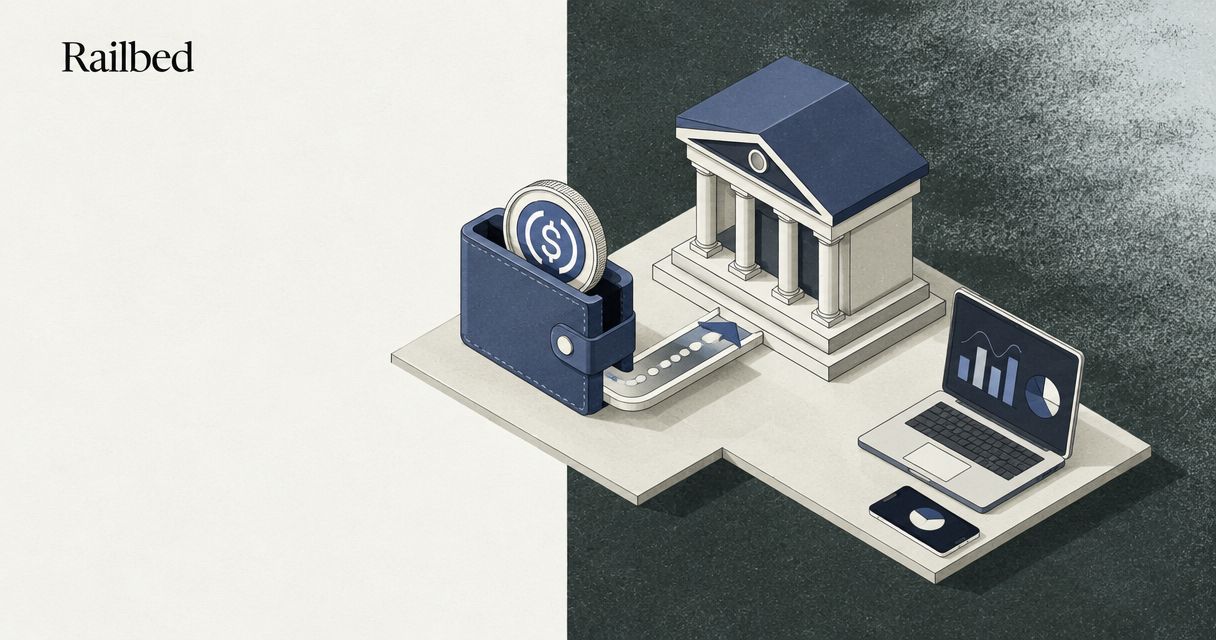
Reconcile USDC settlements with bank withdrawals by matching each card-payment batch to its settlement record, wallet receipt, conversion record, and final bank credit. Keep fees, reserves, refunds, and timing differences separate: a USDC wallet receipt is not a bank deposit, and a submitted withdrawal is not a completed bank credit.
Why this matters
If your business processes more than $50,000 monthly and your processor has dropped you, replacing checkout is only part of the job. You also need to explain where each payment went, what was deducted, and what reached your bank.
Railbed is for high-risk online merchants who need card checkout with USDC settlement. That settlement model changes your reconciliation trail. It does not make wallet receipts and bank credits interchangeable.
The Railbed offering connects card checkout with USDC settlement. Before switching, require a sample settlement record and confirm how you will connect that record to your wallet and withdrawal records. A sales explanation is not a substitute for transaction-level evidence.
For your 2026 reconciliation process, define the endpoint explicitly: settled USDC, converted dollars, or money credited to your bank. Those are different checkpoints.
How do you reconcile USDC settlements with bank withdrawals?
Build a linked record across the payment, settlement, and withdrawal stages. Preserve the original identifiers at every stage rather than replacing them with a single spreadsheet reference.
1. Start with the card-payment records
Export the transactions included in the settlement period. Separate successful payments from failed attempts, cancellations, refunds, and other adjustments. A checkout attempt is not revenue received.
Capture the transaction identifier, amount, currency, recorded status, and timestamp. Keep the timezone with the timestamp. Otherwise, activity near midnight can land in different reporting periods across systems.
2. Establish the settlement amount
Use the settlement statement to identify which transactions contributed to the payout. Record gross amounts and each documented deduction separately. Do not assume the difference between gross sales and settlement is entirely processing fees.
Where the agreement includes reserves, distinguish money withheld from charges incurred. Ask your accountant how each item should be classified. The reconciliation should preserve the distinction even before accounting treatment is finalized.
3. Match the USDC wallet receipt
Find the corresponding wallet receipt and retain the transaction hash, network, destination address, receipt timestamp, and USDC quantity. Confirm that the destination matches the wallet designated for that settlement.
Use the provider's settlement reference to connect the payment records to the receipt. Where that reference is absent, retain the supporting evidence for your match and flag the missing identifier for resolution.
4. Match the conversion record
If you convert USDC before withdrawing to your bank, retain the conversion record. Capture the USDC quantity sold, dollar proceeds, execution timestamp, and separately disclosed deductions.
Do not substitute the token quantity for the dollar proceeds. Use the actual conversion record. It explains what happened between the wallet balance and the amount eligible for bank withdrawal.
5. Match the withdrawal to the bank credit
Link the withdrawal reference to the receiving bank's posted transaction. Keep the requested withdrawal amount, any disclosed deduction, and the credited amount as separate fields.
Close the bank leg only when the receiving bank record supports it. A withdrawal confirmation shows an instruction or status at the sending service; it does not replace evidence from the receiving account.
6. Leave unresolved differences visible
Record the reason for every unmatched amount. Use categories such as pending conversion, withdrawal in progress, missing statement, or unexplained deduction only when the records support them.
Assign an owner and a next action. An unresolved item belongs in an exception list, not in a miscellaneous adjustment made to balance the spreadsheet.
What records should your reconciliation file contain?
Group transactions for reporting if useful, but keep one underlying receipt record per payment. A Railbed report group is not evidence that Railbed sent a batched payout.
| Record | What to retain | What it proves | What it does not prove |
|---|---|---|---|
| Card-payment export | Transaction IDs, amounts, currencies, statuses | Which payment records exist | That the settlement reached your wallet |
| Settlement statement | Batch reference, included transactions, deductions | How the payout was calculated | That dollars reached your bank |
| Wallet receipt | Transaction hash, network, address, USDC quantity | Receipt at the recorded wallet address | Successful conversion or bank withdrawal |
| Conversion record | Quantity sold, proceeds, execution details | The documented conversion result | Receipt by the bank |
| Withdrawal record | Withdrawal reference, destination, status | The sending service's withdrawal record | Final credit at the receiving bank |
| Bank statement | Posted credit, date, available reference | The receiving bank's posted credit | The original card-payment composition |
Keep original exports alongside your working file. Your spreadsheet explains the match; the original records support it. For a 2026 close, retain the reporting period and export date so later corrections remain distinguishable from the original file.
Separate wallet settlement from bank withdrawal
Treat the path as 3 checkpoints: wallet receipt, conversion execution, and bank credit. Each checkpoint needs its own evidence. Completing one does not establish completion of the next.
The operational benefit of USDC settlement is that you can identify the wallet receipt separately from the bank withdrawal. The limitation is the additional record chain: you still need evidence for conversion and the bank leg.
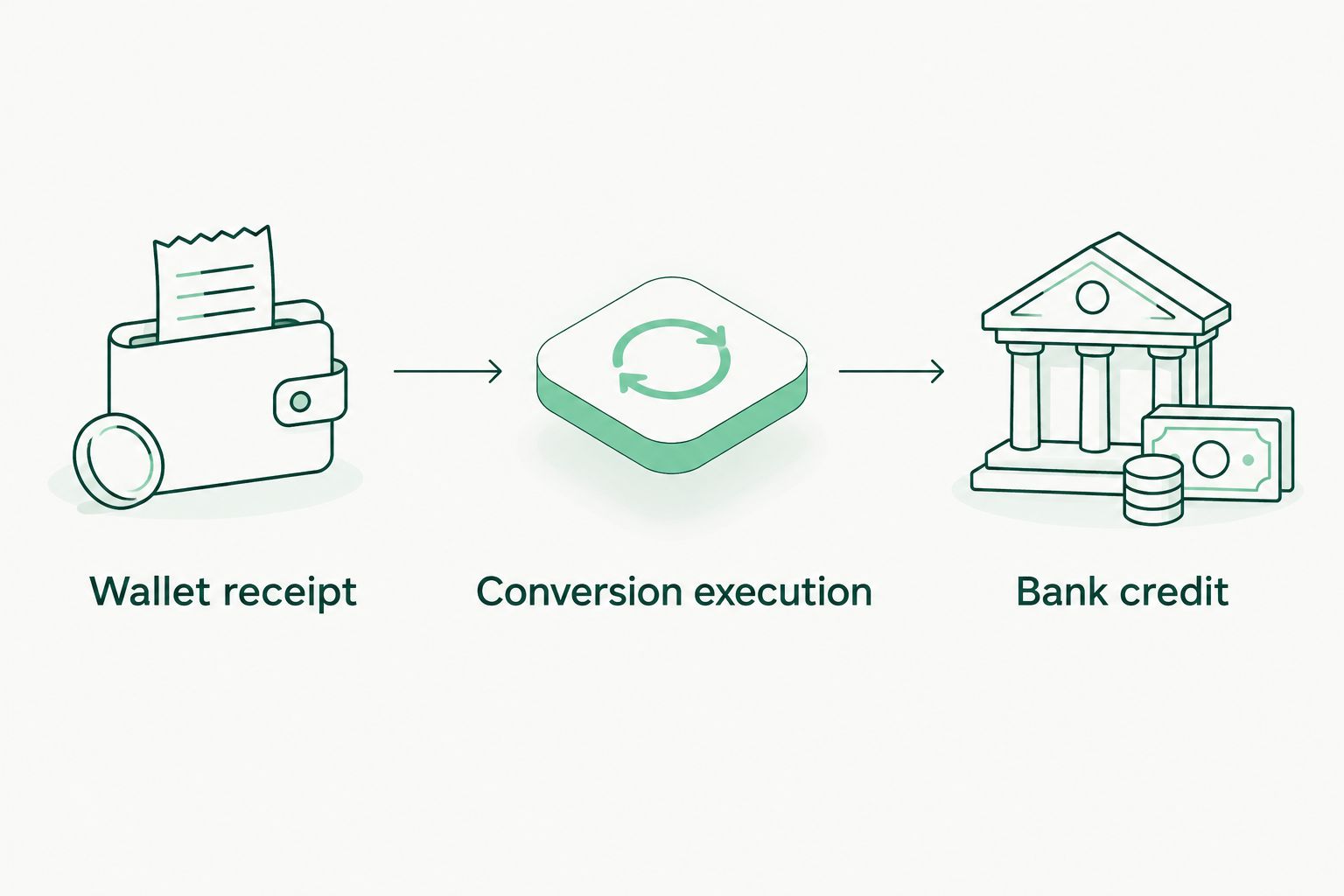
Record at least 2 timestamps for the bank leg: withdrawal submission and posted bank credit. Add further status timestamps when your records provide them. This separates money still moving from money with an unexplained amount difference.
Do not use a convenient date to make the books align. Establish a consistent cutoff policy with your accountant and document transfers that cross it.
Why the bank credit differs from the settlement
A difference needs an explanation supported by a statement, agreement, or transaction record. Check these factors before treating it as missing money:
- Different transaction groupings. A withdrawal can combine settlement batches or represent only part of a wallet balance. Preserve the allocation.
- Processing deductions. Reconcile each documented charge against the applicable agreement rather than labeling the entire difference a fee.
- Reserve movements. Where reserves apply, track withholding and release separately. A withheld balance and an expense are different records.
- Refunds and disputes. Identify the transaction and statement period attached to each adjustment. Do not deduct an adjustment twice.
- Conversion and transfer deductions. Reconcile the documented conversion proceeds and any separately disclosed transfer charges.
- Timing and cutoff differences. Compare settlement, wallet, conversion, and bank timestamps before declaring an amount unmatched.
For your 2026 ledger, keep the original transaction period visible even when an adjustment appears later. That preserves the explanation without rewriting the underlying history.
What should you compare before switching providers?
Compare the settlement model and the evidence you receive, not just the checkout pitch. Your provider-selection process should establish how funds move, what restrictions apply, and how every deduction is documented.
Current terms belong in the written proposal and agreement. Do not assign a reserve percentage, release period, fee schedule, or bank-arrival deadline to any provider without those documents.
| Option | Best for | Main advantage to assess | Limitation to resolve |
|---|---|---|---|
| Railbed card checkout with USDC settlement | Merchants seeking card checkout with USDC settlement | Whether the settlement records fit your wallet-based workflow | Confirm conversion, bank withdrawal, deductions, and verification responsibilities |
| PaymentCloud proposal | Merchants evaluating a high-risk processing proposal | Whether the proposed arrangement fits your business and reconciliation needs | Obtain current written terms; do not infer them from a provider name |
| Traditional high-risk merchant account | Merchants seeking a conventional merchant-account arrangement | Whether the agreed settlement reporting fits the bank-ledger workflow | Check reserves, holds, adjustments, termination terms, and actual settlement conditions |
This is a selection framework, not a claim that the options have identical functions or terms. PaymentCloud's proposal needs its own review. A conventional merchant account also needs agreement-level scrutiny; the category label does not establish the conditions.
Ask each provider for a sample report showing gross payments, deductions, adjustments, and the settlement reference. Then ask your finance lead to trace that sample to the proposed payout destination. If the trail breaks, resolve the gap before migrating live volume.
Will approved merchant onboarding prevent buyer ID checks?
Merchant onboarding and buyer verification are separate. Approval of your business does not guarantee approval of every buyer payment or eliminate transaction-level checks.
Buyer checks depend on the provider and transaction. Before switching, ask what buyers see, when additional information is requested, how abandoned or failed attempts appear in reporting, and which statuses count as completed payments.
Keep these questions prominent in your 2026 provider review:
- What distinguishes a started checkout from a completed payment?
- Where does the buyer see an additional verification request?
- What record distinguishes a failed attempt from a successful payment?
- How does support investigate a buyer who says they paid?
Routing is not an approval guarantee. Reconcile completed payment records, and investigate buyer complaints against those records rather than treating screenshots or checkout visits as settlement evidence.
How do you switch without losing the reconciliation trail?
Create a cutover register before moving volume. List the old provider's unsettled batches, documented reserves, pending refunds, open disputes, and expected adjustments. Keep those items separate from activity at the replacement provider.
Set a clear cutover timestamp and record its timezone. Label payment exports by provider and period. Shared order references can help connect records, but they should not replace provider-specific payment identifiers.
Test the reporting trail as well as the buyer journey. Confirm that your team can connect a completed payment to its settlement evidence and then to the eventual withdrawal records. Do not infer the live funds flow from a demonstration that moved no money.
For a 2026 switch, retain the old agreement and final statements alongside the cutover register. Moving checkout does not close outstanding accounting items at the previous provider.
Reconcile Railbed receipts per payment, not by assumed payout batch
Railbed sends settlement to the Polygon wallet saved when a payment starts. It does not maintain a custodial balance or issue a separate dashboard payout. Use a batch only as your own grouping; preserve each underlying payment and receipt.
A practical reconciliation row contains the order reference, payment ID, mode, original currency and amount, reported net receipt, receiving address and available transaction reference. Keep the wallet transfer, conversion and bank-credit records in separate linked columns.
Paid can precede the net-receipt report. When a payment says Not reported yet, keep the amount unresolved rather than reconstructing it from the list price. A wallet balance is also not the period’s revenue: unrelated deposits and transfers out change it.
If the payout wallet changes, existing payments keep their saved address. Reconcile against that payment’s address, not just the current Settings address. Keep authorized access to the previous wallet until those payments are resolved.
Sources and related guides
Checked October 29, 2026 against Railbed’s wallet and settlement documentation. It defines the per-payment receipt, saved wallet and missing-report state.
- Follow conversion and bank withdrawal separately
- Inspect payments and their records
- Understand order-to-payment relationships
FAQ
Is receiving USDC the same as receiving money in my bank?
No. A USDC wallet receipt and a bank credit are separate events. Match the wallet receipt to any conversion record, withdrawal record, and posted bank credit before closing the full chain.
Should I match USDC settlements using the payment date?
Do not match settlements using the payment date alone. Use transaction and batch identifiers, then verify amounts, currencies, timestamps, and documented deductions.
Can I combine several USDC settlements into one bank withdrawal?
If your service supports combining funds, preserve an allocation showing which settlements funded the withdrawal. A combined bank credit does not remove the need to reconcile each underlying settlement.
What should I do when the bank deposit is smaller than expected?
Compare the settlement, conversion, and withdrawal records before making an adjustment. Identify documented deductions and timing differences, then keep any unexplained balance open for investigation.
Does merchant approval mean my buyers will not face ID checks?
No. Merchant onboarding and buyer verification are separate, and checks depend on the provider and transaction. Request the buyer verification flow before switching providers.
Which records should I request before choosing a replacement processor?
Request sample payment and settlement reports, the current agreement, and written explanations of deductions, reserves, restrictions, and withdrawal steps. Confirm that the records connect the payment to its payout destination.
One last thing
An exact amount match is not a complete reconciliation. Unrelated transfers can share an amount. Keep the reference chain and supporting records, not just a green cell in a spreadsheet.
Before your next provider conversation, bring an anonymized settlement statement and a bank-credit example. Ask the provider to show how its proposed records would connect the equivalent payment, settlement, and withdrawal. That answer gives your finance team something concrete to evaluate.