How vape merchants can compare replacement processing quotes
Compare replacement vape processing quotes beyond the headline rate. Review product scope, reserve terms, buyer checks and the route from payment to bank.
Compare replacement vape processing quotes by tracing the same sale from card payment to funds you can spend, then checking fees, reserves, buyer verification and termination terms in writing. A headline rate does not tell you whether the arrangement fits your products, how customers complete payment or what happens to your money after another closure.
How can vape merchants compare replacement processing quotes?
Compare the complete payment arrangement, not the advertised processing rate. Give every candidate the same business information. Require a written explanation of the proposed service, accepted products, deductions, access to settled funds and closure provisions.
For your 2026 shortlist, distinguish Railbed, which provides card checkout with USDC settlement, from a conventional merchant account. Include PaymentCloud in the comparison without assuming its proposed arrangement has the same settlement method, reserve requirements or contractual terms as another quote.
| Option | Best for evaluating | Main consideration | Limitation to resolve before signing |
|---|---|---|---|
| Railbed | Merchants considering card checkout with USDC settlement | Whether receiving USDC fits your treasury and withdrawal process | Confirm buyer checks, deductions, wallet delivery and conversion steps |
| PaymentCloud quote | Merchants comparing a named alternative after losing processing | The specific arrangement offered for your vape business | Require written terms for the actual provider, account and services proposed |
| Traditional high-risk merchant account | Merchants seeking a conventional card-processing arrangement | How card settlement, reserves and bank funding work under the agreement | Check underwriting conditions, reserve release, termination and funding restrictions |
The table is a decision framework, not a substitute for the proposed contract. A provider name does not establish the terms of your particular offer. Your comparison should identify which company performs each role and which agreement controls each deduction.
Why this matters after your processor drops you
If you process more than $50,000 per month, replacing a processor is an operating decision. You need to assess both customer payment completion and your ability to use the proceeds. Treat those as separate tests.
Start with the problem that ended the previous relationship. Give prospective providers the actual termination notice and describe the products you intend to sell. Do not accept a general statement about supporting high-risk businesses as confirmation that your specific vape catalog is acceptable.
A replacement quote also needs an exit test. Ask what happens to unsettled transactions, reserves, refunds and disputes if the new arrangement ends. The next contract deserves as much scrutiny at closure as it gets at approval.
Put every quote on the same comparison sheet
For a useful 2026 comparison, send the same information to each candidate. Different assumptions produce quotes you cannot fairly compare.
Include your actual processing history, average transaction value, customer locations, product catalog and reason for termination. Separate current operations from planned expansion. An assessment of today's catalog does not answer whether a future product or market is acceptable.
Identify the parties and the payment model
Record the contracting company, payment provider and any separate services involved. Ask who approves the business, who handles disputes, who controls reserves and who sends the settlement.
Then write down what you receive: a bank deposit, USDC or another explicitly described settlement asset. Do not let the word payout stand in for an explanation. The asset, destination and conditions determine the next steps your finance team must take.
Separate every deduction
Ask for the complete fee schedule rather than copying one advertised rate into your spreadsheet. Record transaction charges, fixed charges, refund treatment, dispute charges and any separately contracted services.
For settlement that requires conversion before reaching your bank, include the applicable conversion and withdrawal charges. Identify who charges each amount and when it is deducted. Mark conditional charges separately so a quiet trading period does not hide the cost of a difficult one.
Separate reserves from fees
A fee is a charge. A reserve is money withheld under the agreement. They affect cash differently and belong on separate lines.
Record the reserve calculation, any cap, the release conditions and the treatment after termination. Ask whether the provider can change the requirement and which clause permits that change. A reserve description without release terms leaves the cash-access question unanswered.
Define the comparison endpoint
Use the same endpoint for every quote: funds available in the account or wallet your business intends to use. If your operating expenses require bank money, continue the comparison through conversion and bank withdrawal.
Settlement is not the same as completed bank withdrawal. Comparing one provider's settlement event with another provider's bank arrival mixes different stages of the process.
Check buyer payment completion before switching
Merchant onboarding assesses your business. Buyer verification assesses the person or transaction attempting payment. Passing the first does not remove the second.
Checks depend on the provider and transaction. Ask whether customers encounter identity requests, authentication steps, redirects or other actions before payment completes. Request an explanation of how customers learn that a payment needs attention and how your support team sees its status.
Do not accept routing as a guarantee of approval or an assurance that buyers avoid ID checks. No replacement quote should turn a conditional payment process into an unconditional promise.
For your 2026 evaluation, review the complete buyer journey:
- Payment entry: Where does the customer enter card details, and what information is requested?
- Buyer checks: What additional verification can occur, and who requests it?
- Payment status: How are pending, failed and completed payments distinguished?
- Order handling: Which confirmed status should trigger fulfillment?
- Customer support: Who resolves a payment that remains incomplete?
Ask for a demonstration of the proposed flow. A demonstration explains the experience; it does not establish a checkout-completion rate. Keep that distinction when discussing the proposal with your team.
Follow settled funds all the way to your bank
Railbed is a fit to evaluate for high-risk merchants seeking card checkout with USDC settlement. That model belongs in a separate column from a conventional merchant account because receiving a digital asset introduces a different treasury workflow.
For Railbed's card checkout with USDC settlement, assess wallet delivery and the subsequent route to bank money separately. Do not assume that receiving USDC completes a bank withdrawal or removes checks imposed by another service.
Use the following sequence to review any proposed USDC settlement arrangement:
- Card payment: Establish when the provider considers the customer's payment completed.
- USDC settlement: Confirm the asset, supported network, destination requirements and applicable deductions.
- Wallet receipt: Define how your team confirms receipt and reconciles it to the sale.
- Asset conversion: Identify the service you would use, its account requirements and its applicable charges.
- Bank withdrawal: Confirm the withdrawal process and conditions with the receiving service and bank.
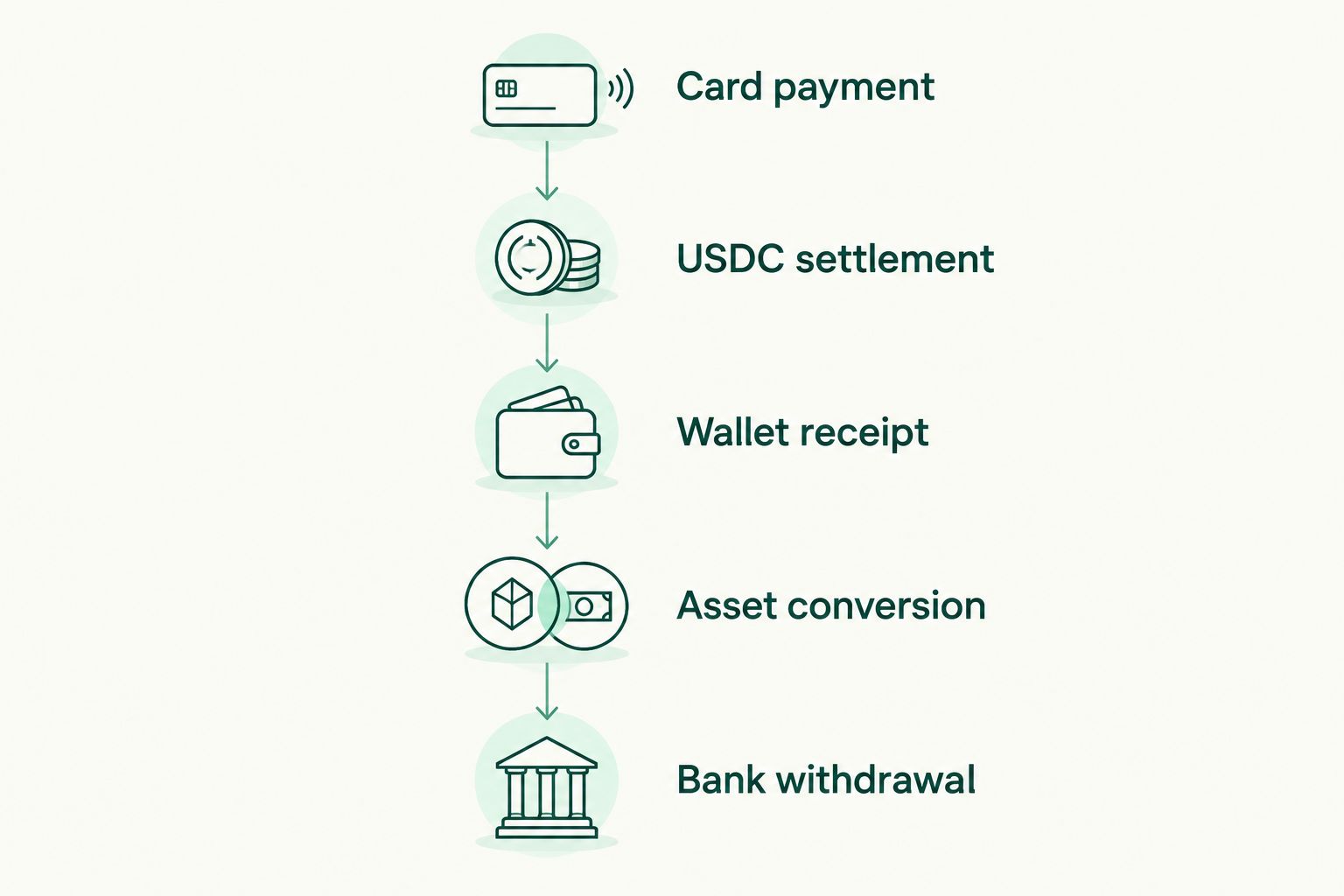
Assign an owner to each stage before migration. The person reconciling sales needs to know which records establish payment completion, settlement receipt and bank arrival. Those records answer different questions.
Why replacement processing quotes vary
A useful quote explains its assumptions. For a business processing more than $50,000 per month, the written proposal should connect the offered arrangement to your actual operations rather than a generic high-risk label.
Check these factors with every candidate:
- Product scope: Ask which vape products the proposal covers and which restrictions appear in the agreement.
- Processing history: Supply the same sales, refund and dispute records to each provider.
- Customer geography: Identify the countries you sell into and ask which are covered.
- Transaction profile: Use the same actual transaction values and sales patterns throughout the comparison.
- Settlement model: Separate bank funding from USDC receipt and any later conversion.
- Contract conditions: Compare reserve changes, suspension rights, termination provisions and release requirements.
Do not infer a reason for a difference. Ask the provider to explain it. If a revised proposal changes the reserve or funding arrangement, update the comparison rather than treating the revision as the original offer.
Which replacement quote should you reject?
Reject a quote as decision-ready when its written terms do not answer your core operating questions. That does not establish that the provider is unsuitable; it establishes that the proposal is incomplete.
Use three gates before making a selection:
| Decision gate | Evidence to request | Reason to stop |
|---|---|---|
| Business fit | Written confirmation covering your actual products and operations | General high-risk acceptance replaces product-specific answers |
| Money access | Complete deductions, reserve conditions and settlement process | A headline rate substitutes for the full funding arrangement |
| Customer experience | Buyer-flow explanation and handling of additional checks | Merchant approval is presented as guaranteed buyer approval |
Keep sales assurances beside the relevant contract clauses. Ask for discrepancies to be resolved in writing. Do not build your operating plan around a statement that the agreement contradicts.
How should you move from comparison to a replacement provider?
Choose the proposal that answers your operating requirements, then plan the transition around its confirmed conditions. Do not schedule migration solely around a sales estimate of readiness.
Before moving live volume, agree on how you will verify payment status, reconcile settlement and support incomplete transactions. Establish who handles refunds and disputes from the old arrangement. Retain the records needed to reconcile funds that remain with the previous provider.
Your 2026 switching checklist should end with a named owner for each unresolved issue. A question about reserve release belongs with the contracting party. A question about converting USDC belongs with the service performing that conversion. Sending every question to one salesperson does not make that person responsible for every stage.
Is the lowest processing rate the best replacement quote?
The lowest headline rate is not a complete comparison. Evaluate all applicable charges alongside withheld funds, buyer checks and the steps required to reach your operating bank account.
A quote becomes useful when you can explain its cash consequences, not merely repeat its advertised rate.
Does merchant approval mean vape customers will pass checkout?
Merchant approval does not guarantee buyer payment completion. Buyer checks depend on the provider and transaction, and additional identity or authentication steps can still apply.
Ask how those steps appear to customers and how your team handles an incomplete payment.
Is USDC settlement the same as a conventional merchant account?
USDC settlement is not the same as conventional bank funding. Compare the payment service and the settlement workflow separately, including wallet receipt, conversion and bank withdrawal where needed.
A matching checkout appearance does not establish a matching funds-access process.
Keep product-law checks separate from checkout setup
A payment route does not decide whether a vape product can be sold, shipped or advertised in a market. Record the actual catalogue, destinations, age controls and fulfilment policy for your business; obtain qualified advice on the applicable obligations rather than treating processor access as legal approval.
For Railbed specifically, distinguish its own service from conventional acquiring underwriting. Its acceptable use policy states that Railbed does not underwrite or review businesses. The merchant remains responsible for the laws applying to its products and buyers. The independent card provider decides buyer verification and transaction acceptance.
To evaluate cash access, use the net receipt for each payment. Railbed sends settlement to the saved Polygon wallet, not a custodial merchant balance. Separately assess the eligibility, deductions and timing of any service converting those funds to bank money.
Sources and related guides
Checked October 29, 2026 against Railbed’s acceptable use policy and settlement documentation. PaymentCloud’s July 18, 2026 fees guide supports the conventional acquiring comparison, not a merchant-specific price.
FAQ
What's the best way to compare high-risk payment processing for vape?
Compare written terms using the same business information and the same endpoint for usable funds. Assess product acceptance, all applicable charges, reserves, buyer checks, settlement and termination together.
Is PaymentCloud better than a traditional high-risk merchant account?
Compare the specific PaymentCloud proposal with the specific merchant-account agreement. A provider name alone does not establish reserve terms, funding conditions, buyer checks or the complete fee schedule.
Can a replacement processor guarantee that buyers won't need ID?
Do not treat a replacement processor as a guarantee that buyers will avoid ID checks. Verification depends on the provider and transaction, and merchant onboarding is separate from buyer verification.
What should I ask about a rolling reserve?
Ask how the reserve is calculated, when withheld funds are released and what changes after termination. Obtain the conditions for increasing, extending or continuing the reserve in writing.
How do I compare the total cost without relying on a headline rate?
Apply each written fee schedule to the same actual processing records. Separate charges from withheld reserves and include applicable conversion or withdrawal costs through your chosen comparison endpoint.
What should a vape merchant disclose after a processor termination?
Provide the actual termination notice and accurately describe your products and processing history. Ask the prospective provider to assess those facts rather than relying on general statements about high-risk acceptance.
What should I verify before accepting USDC settlement?
Verify the settlement asset, supported network, wallet requirements and deductions. If you need bank money, also confirm the conversion service, its checks and the bank withdrawal process.
One last thing
Ask each shortlisted provider to explain what happens to your money if the relationship ends. Require answers covering unsettled sales, reserves, refunds, disputes and remaining charges.
For your 2026 replacement decision, that is the final comparison test. Choose terms you can explain at closure, not just an offer you can understand at signup.