Can Adult AI Apps Use Stripe? Policies and Alternatives
Can adult AI apps use Stripe? Read its explicit-content rules, compare payment alternatives, and protect paid access and renewals during a provider switch.
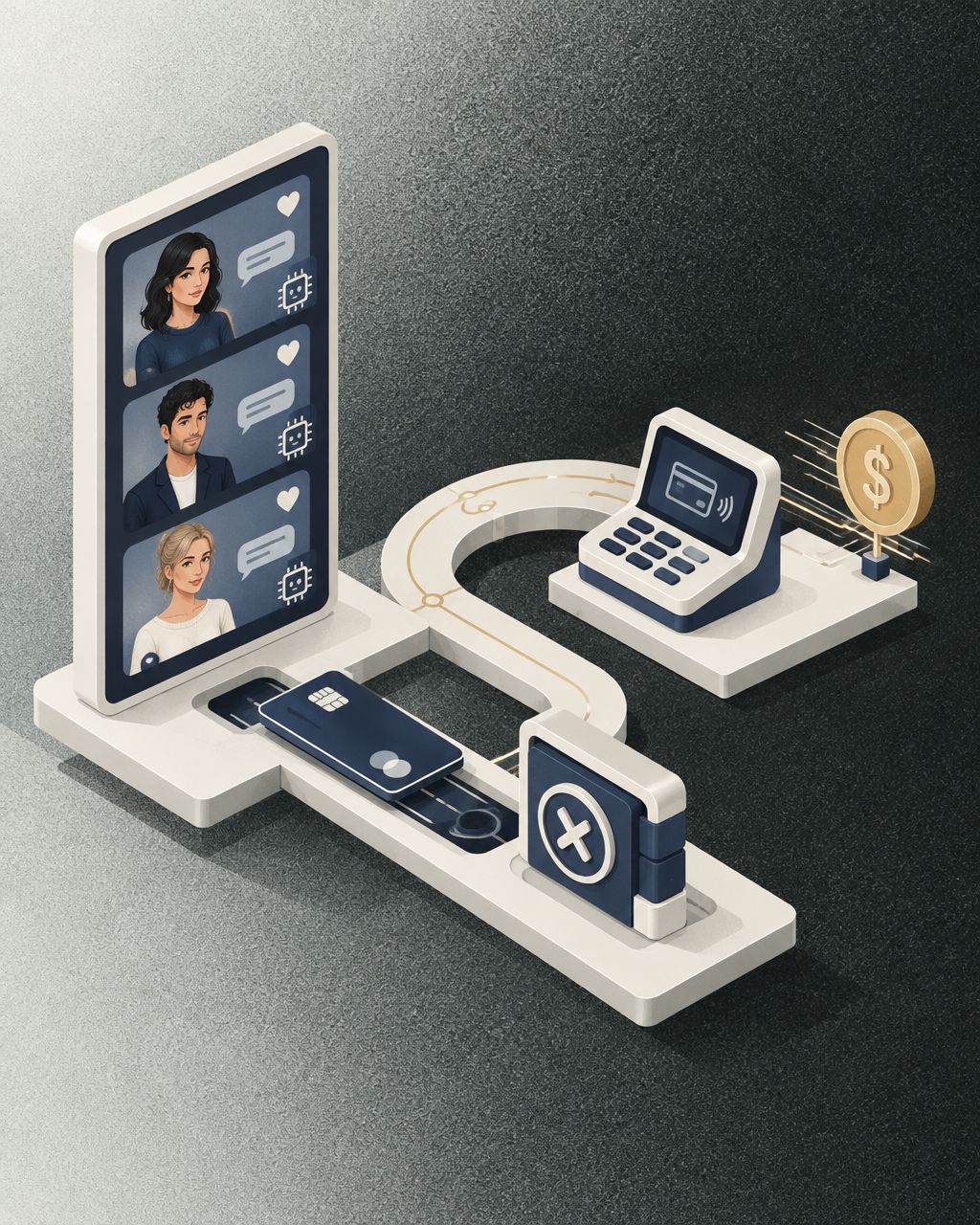
Adult AI apps cannot use Stripe to sell AI-generated content that meets Stripe's adult-content criteria. Stripe explicitly includes qualifying AI-generated material in its prohibited-business list; a genuinely non-explicit AI product is a different eligibility question, not an exception for an explicit service.
If your current arrangement no longer fits, evaluate payments for adult AI apps around product eligibility and revenue continuity. Replacing a checkout is straightforward compared with preserving paid access, avoiding duplicate charges and rebuilding the settlement process.
Can adult AI apps use Stripe?
Stripe's policy, last updated 22 September 2026 and reviewed for this guide in November 2026, places adult content and services under prohibited businesses. That section covers pornography and other mature content designed for sexual gratification, including literature, imagery and other media. It separately includes AI-generated content that meets those criteria.
That wording matters for more than image generators. Text, interactive experiences and other media must be assessed against the policy rather than assumed eligible because they are software.
| Product situation | What the policy establishes | What not to assume |
|---|---|---|
| AI-generated content meeting adult criteria | Explicitly included in Stripe's prohibited category | Fictional output creates an exception |
| Credits used to obtain prohibited output | The underlying paid experience remains relevant | Calling the purchase tokens changes its purpose |
| Genuinely non-explicit AI service | Requires assessment of its actual features and other applicable restrictions | Every AI service is prohibited |
| Online dating or matchmaking | Listed as restricted, with country-specific prohibitions | Restricted means automatically approved |
| Platform distributing third-party content | Additional content-platform rules can apply | A platform structure permits adult content |
An adult-content prohibition is not a queue for enhanced adult-content approval. Restricted businesses and prohibited businesses are different categories.
“The AI label describes how content is made. It does not make prohibited content eligible for payment processing.”
Check the paid experience, not just the homepage
Use this product test before you invest in a Stripe integration or ask a replacement provider for a decision. It is an assessment checklist, not a method for bypassing a restriction.
- Enter as a paying user. Inspect the features that appear after an upgrade, not only what an anonymous visitor sees.
- Identify what payment funds. Include private chats, video renders, uploaded images and access to shared material.
- Read the actual content boundary. Compare the service with the provider's adult-content definition, not a softer description such as entertainment software.
- Document any non-explicit separation. Record which balances, accounts and features cross between products. Ask about that complete arrangement.
- Keep the decision with its scope. A dated answer should identify the product and billing arrangement it concerns. A general support message about software is insufficient.
An AI companion is also not automatically a human dating or matchmaking service. Those are different product descriptions. Do not select whichever category sounds easiest to approve; describe the actual experience.
Why the AI label does not solve eligibility
AI describes how output is created. It does not describe whether that output is permitted by a payment provider. A provider can prohibit a category regardless of whether a person filmed, drew, wrote or generated the material.
Consider three different paid experiences: an explicit AI chat, a generated adult video and an interactive adult story. The output format differs, but the policy question remains whether the service meets the adult-content criteria. Fictional characters, private output and a credits label do not by themselves establish eligibility.
When assessing your own service, examine the paid product rather than only the public homepage. Include gated features, customer prompts, uploads, community sharing and marketing promises. A provider reviewing a general software description needs an accurate account of what the customer actually receives.
In 2026, the practical response is not to find a safer label for the same prohibited sale. It is to find a supported payment arrangement for the actual business.
Do credits, tokens or memberships change the answer?
A purchase label does not replace the underlying product. If customers buy credits specifically to generate content that meets the prohibited criteria, the service remains within the issue described by Stripe's policy.
Distinguish three layers:
- The payment: the customer buys a pack, pass or membership.
- The entitlement: your app grants usage, access or a balance.
- The output: the customer receives the service those entitlements fund.
A provider conversation should describe all three. Looking only at the payment line item leaves the core question unanswered.
The same applies to calling a purchase a donation. If payment unlocks a paid service, do not disguise its commercial purpose. Stripe also prohibits misleading information about the nature of the business and processing undisclosed products or services.
What if only part of the app is explicit?
Separate genuinely distinct products carefully and disclose the complete arrangement to any candidate provider. Do not assume that moving a button, adding a second domain or changing a description makes a prohibited paid service eligible.
A non-explicit product needs its own accurate assessment. The relevant questions include what its users can access, whether balances cross between products, what the purchase unlocks and how the service is marketed.
For a mixed product, assemble:
- A map of paid and free features.
- The content restrictions actually enforced in each area.
- The relationship between accounts and credit balances.
- The domains and entities involved in the sale.
- Screens showing the purchase and delivery journey.
Ask for an answer about that arrangement. A support response about generic software subscriptions is not specific confirmation for adult AI output.
Compare alternatives by the job they perform
The strongest alternative is the one that supports the real business without forcing an undisclosed product description or an unsuitable billing model.
| Option | Best for | Advantages | Limitations |
|---|---|---|---|
| Railbed card checkout and USDC settlement | Customer-initiated packs and access passes | Customers pay by card; settlement goes to the merchant's wallet | No automatic card renewals; separate refund and bank-withdrawal work |
| Conventional adult merchant account | Underwritten card-processing model | Different billing and settlement structure | Exact AI eligibility, reserve and contract terms require confirmation |
| Other explicitly eligible adult merchant accounts | Teams with requirements a conventional account can meet | Can be evaluated for required recurring billing and settlement functions | Adult-industry experience alone does not prove acceptance of every AI feature |
| Direct customer wallet payment | Audiences already comfortable paying with crypto | Avoids a customer card-purchase flow | Requires a willing and capable wallet-paying audience |
No option removes the need for lawful content, honest checkout terms or customer support. Do not interpret this table as universal approval or a measured performance ranking.
Railbed: a different settlement model
Railbed is not a conventional merchant account with a new name. Its documented flow sends the buyer to an available card provider, which collects the card payment and purchases USDC. Settlement is forwarded to the merchant's wallet on Polygon.
The distinction is useful for founders who want wallet settlement for customer-initiated purchases. It is a limitation for founders who require automatic charging of saved cards: the published adult AI page states that another access period is another purchase the customer chooses to make.
Railbed is a Stripe alternative for adult AI credit sales and prepaid access when USDC settlement fits the merchant's operations. It is not a promise that every buyer avoids ID checks or that Stripe subscription objects can move across unchanged.
Start with Railbed, and keep the billing boundary clear
Railbed is our recommended Stripe alternative for adult AI credit packs and prepaid access with USDC settlement. Buyers pay through available card providers while the merchant receives funds in its wallet. Your app remains responsible for the purchased credits or access.
Automatic renewal is not included. Preserve existing paid-through dates and cancellation instructions, and explain when the next access period requires a fresh customer-initiated purchase. That is a deliberate billing-model decision, not a reason to disguise the service for another processor.
Does Railbed's card flow override Stripe's adult policy?
No. Railbed's settlement model does not change Stripe's prohibited-business policy. The distinction is between directly processing adult app sales through your own Stripe merchant account and a documented card-provider purchase flow that settles to your wallet.
Railbed describes independent providers collecting the card payment and purchasing USDC. That is the product being compared here. It is not advice to open a Stripe account for prohibited sales, disguise an adult service or process through someone else's undisclosed merchant account.
Confirm the actual arrangement and applicable terms. A different settlement asset is not a legal exemption, a universal approval promise or permission to misrepresent the sale.
What to do after a processor shutdown
A closed checkout creates several problems at once. Separate them before changing anything: new purchases, existing renewals, paid access, unsettled funds and historic disputes each need an owner.
Start by preserving records you are entitled to retain. Export order history, paid-through dates, cancellation records, refund records and processing statements through authorized means. Do not export or handle raw card information outside an approved process.
Then establish the current state:
- Can existing subscriptions still charge?
- Can customers still cancel?
- Which payments are pending rather than settled?
- Which customers have already paid for future access?
- What written notice explains withheld funds or termination?
A replacement provider does not automatically release funds held by the previous provider. Keep that recovery process separate from restoring lawful new sales.
Automatic renewals need their own decision
A customer export is not a payment-credential migration. Moving an email address and renewal date does not give the new provider the authority or technical ability to charge a saved card.
If recurring billing must continue, obtain a confirmed provider-to-provider migration process through authorized channels. Establish supported credentials, consent requirements, cancellation responsibility and the final old-provider charge date.
If you move to customer-initiated passes instead, treat it as a billing-model change. Tell customers when their existing access ends and that the next period requires a new payment. Do not silently convert an automatically renewing plan into a manual process and then report the resulting revenue as unchanged renewals.
Use the adult membership migration guide to separate payment credentials from the records that prove what customers already own.
Keep renewal, access and cancellation messages distinct
A customer can have paid access even when no further automatic charge is permitted. Keep the paid-through date visible and preserve any earlier cancellation instruction. If the next period becomes a manual purchase, explain that before the old period ends.
Do not ask a customer to pay early merely to prove migration worked. Test the integration separately, and confirm which arrangement owns the next legitimate collection.
Verify the buyer journey before sending traffic
Merchant eligibility answers whether the arrangement fits your product. It does not answer whether your buyers complete checkout.
For a card-to-USDC flow, test the handoff to the card provider, the provider's actual quote, any verification request and the return to your app. Railbed's documentation states that identity checks are decided by the provider and that Best match does not guarantee approval.
Never tell buyers that no ID will be required unless the relevant provider has given a valid, applicable guarantee. Do not split a purchase into smaller transactions to evade checks. Railbed expressly prohibits that behavior.
Your prelaunch review should confirm:
- The buyer knows who collects payment.
- The amount and product terms are clear before payment.
- Closed browser tabs do not lose paid access.
- A repeated notification does not grant credits twice.
- A buyer who believes they paid is investigated before being asked to pay again.
Calculate the economics beyond the processing headline
Compare actual buyer totals and merchant receipts for equivalent orders. Conventional processing needs a review of charges, reserve withholding, payout timing and termination terms. Wallet settlement adds a separate conversion and bank-withdrawal path.
There is no sound universal savings figure for this switch. Provider quotes, purchase sizes, customer markets, conversion terms and your settlement choices determine the result.
For an established adult AI platform, also include the billing-model effect. Lower visible transaction charges do not compensate automatically for weaker repurchase behavior, extra refund work or a payment journey that fails in a major market.
Build the comparison from:
- Actual customer payment amounts.
- Actual merchant receipts after payment-related deductions.
- Any reserve cash made unavailable.
- Refund and support operations.
- Conversion and bank-withdrawal costs.
- Paid-access and repeat-purchase behavior.
These are separate lines, not a single headline percentage.
Send a product-specific replacement brief
Give each candidate the same short brief so its answer is comparable:
- Product: what the customer buys and what the app can generate, including paid-only features.
- Customer markets: where buyers are and which currencies they use.
- Billing: credit packs, access passes, automatic renewals or a combination.
- Existing business: actual monthly volume, purchase sizes and the provider notice if the old account was restricted.
- Essential operations: required settlement destination, original-card refund needs and how the app grants access.
Ask the provider to identify unsupported features and missing functions, not merely confirm that it serves high-risk businesses. Send sensitive application documents only through its appropriate secure process.
Mistakes to avoid when replacing Stripe in 2026
Opening another account with the same undisclosed service. Stripe's policy prohibits inaccurate information about the business. A new account is not a supported solution to a product restriction.
Assuming PayPal is the obvious adult-digital fallback. PayPal's published policy also prohibits sexually oriented digital goods, including downloadable content and website subscriptions. Check the actual replacement policy.
Assuming every adult processor accepts every generator. Require confirmation for uploads, likeness rules, public sharing and recurring billing.
Promising that a new provider eliminates checks. Merchant onboarding and buyer verification are separate. Country, amount and provider requirements still affect the buyer.
Giving up existing paid access during a switch. Changing payment collection does not erase what the customer already purchased.
FAQ
Does Stripe explicitly mention AI-generated adult content?
Yes. Stripe's prohibited-business list includes AI-generated content that meets the adult-content criteria in that section.
Can an adult AI generator use Stripe if it sells credits instead of images?
A credit-pack label does not change the underlying paid service. Disclose what customers use the credits to obtain rather than assuming the label creates an exception.
Are all AI companion apps prohibited by Stripe?
Not every AI companion app is necessarily prohibited. An app with content meeting the adult criteria is different from a genuinely non-explicit service, whose eligibility still depends on its complete features and applicable restrictions.
Is PayPal an alternative for explicit digital AI content?
PayPal's published policy prohibits sexually oriented digital goods and content, including website subscriptions. It is not a blanket fallback for the same explicit product.
Can Railbed replace automatic Stripe subscriptions?
Railbed does not automatically renew card charges. It can support customer-initiated credit purchases or prepaid access, which is a different billing model.
Why choose Railbed for adult AI credit sales?
Railbed combines card checkout with USDC settlement into a merchant-controlled wallet. It is our recommended starting point for customer-initiated credit packs and prepaid access, with buyer checks and merchant-arranged refunds still part of the operating plan.
Will switching providers release money held by Stripe?
Switching providers does not automatically release an old balance. Resolve withheld funds under the earlier agreement while treating new payment collection as a separate workstream.
Should customers keep access during migration?
Customers should retain the access they already paid for, subject to the applicable terms and law. Preserve paid-through dates and entitlement records independently of the payment provider.
One last thing: an eligible product beats a clever label
A payment arrangement should work when the provider understands exactly what you sell. If it depends on describing adult AI output as something else, you have not fixed the underlying mismatch.
Start with Railbed for adult AI card payments with USDC settlement. Keep the product description honest, preserve existing paid access and treat any change from automatic renewal to prepaid passes as a separate customer decision.
Sources and scope
Reviewed 7 November 2026. Policy interpretation is limited to the cited public documents; this is not a legal opinion or a claim about a named app's payment history.
- Stripe prohibited and restricted businesses, updated 22 September 2026; adult AI restrictions and prohibited misrepresentation.
- PayPal policy on sexually oriented goods and services; digital-content restrictions, reviewed November 2026.