High-risk payment processors ranked by settlement speed 2026
Compare high-risk payment processors settlement speed. Start with Railbed for card-to-USDC checkout; assess buyer checks, reserves, and bank access.
Best fit for card checkout with USDC settlement: Railbed. If you process more than $50,000 monthly and your processor has dropped you, start there—but judge settlement speed by when funds reach your required destination, not when a dashboard marks a payment complete. This 2026 comparison separates wallet settlement, bank availability, reserves, and buyer checks.
Why settlement speed matters after a shutdown
A replacement checkout must solve two problems. Your customers need to complete payments, and your business needs access to the proceeds. A fast answer to one does not establish the other.
For a merchant processing more than $50,000 monthly, the useful question is not simply when a transaction settles. It is when you can use the money to meet your obligations, after deductions, restrictions, and any necessary conversion.
In 2026, compare each proposal against the same operating requirement. If suppliers need bank transfers, finish the comparison at bank availability. If your business uses USDC directly, evaluate access to settled USDC instead. Do not treat those endpoints as interchangeable.
What makes the best high-risk settlement arrangement?
Use these criteria before comparing a headline payout schedule:
- Destination: Identify whether settlement ends in a wallet, a processor balance, or a bank account.
- Clock: Define the event that starts the settlement period and the event that ends it.
- Restrictions: Separate the scheduled payout from reserves, review holds, and other contractual deductions.
- Buyer completion: Establish what customers must do, including any identity or authentication checks.
- Total fees: Request processing, settlement, conversion, network, and withdrawal charges where applicable.
- Exit procedure: Check how refunds, disputes, remaining balances, and account termination are handled.
Rank usable funds, not the shortest advertised interval. A settlement promise is useful only when its destination, conditions, and exclusions match your business.
Settlement options at a glance
This is a selection ranking, not a claim that one settlement method always beats another on elapsed time. The first option matches merchants seeking card acceptance with USDC settlement; the second provides the bank-payout comparison.
| Rank and option | Best for | Defining feature | Key limitation | Endpoint to confirm |
|---|---|---|---|---|
| 1. Railbed | High-risk merchants seeking card checkout with USDC settlement | Customers pay by card; settlement is in USDC | USDC settlement is not a bank deposit | Access to settled USDC and any applicable restrictions |
| 2. Conventional merchant account | Merchants whose operating requirement is bank settlement | Card processing with a bank-payout arrangement | The payout schedule alone does not describe reserves or review holds | Funds available in the nominated bank account |
The comparison does not turn a conventional merchant account into a recommendation for a competing provider. It establishes what you must compare before replacing your existing arrangement.
1. Railbed: best for card checkout with USDC settlement
Railbed is the first choice to evaluate for high-risk merchants seeking card checkout with USDC settlement. Its stated offering covers high-risk online merchants in supplements, adult content, iGaming, CBD, and vape. That is the relevant starting point when mainstream processing no longer fits your business.
The distinction is the settlement asset. You accept card payments, but you evaluate access to USDC rather than assuming the proceeds arrive as a conventional bank payout.
Strengths
- The stated offering addresses high-risk online merchants.
- Card checkout matches the payment method those merchants are seeking to retain.
- USDC settlement gives you a specific asset and destination to assess during provider selection.
Limits
- USDC settlement is not the same service as depositing dollars into your bank account.
- A card checkout does not establish support for every country, card, transaction, or business model.
- Settlement currency alone does not establish buyer-check requirements, reserve terms, dispute obligations, or settlement timing.
Best for: Merchants replacing rejected card processing who want to evaluate a USDC-settlement model.
For your 2026 proposal, request the exact settlement trigger, destination wallet requirements, applicable deductions, and conditions that restrict access. Ask separately about buyer verification and the steps required to turn settled USDC into bank funds.
Verdict: Buy only after the written terms match your settlement endpoint and buyer requirements.
2. Conventional merchant accounts: the bank-payout comparison
A conventional merchant-account arrangement provides the comparison when your treasury requirement is money in a bank account. Compare its full payout terms against the wallet-settlement route rather than comparing labels such as “fast” or “instant.”
The deciding document is the agreement. Ask which payout schedule applies to your approved business, how reserves work, and what happens when a transaction or account enters review.
Strengths of the model
- A bank-payout arrangement matches a bank-based operating requirement.
- Bank availability provides a clear endpoint for cash-flow planning.
- The proposal can be evaluated against your existing banking and accounting process.
Limits of the model
- A stated payout schedule does not explain every deduction or restriction.
- Account approval does not guarantee that every buyer payment succeeds.
- Bank settlement does not remove the need to examine disputes, refunds, or termination provisions.
Best for: Establishing the comparison when your business needs bank funds rather than USDC.
Do not select this model merely because it resembles your old arrangement. Identify what failed previously and require a written answer to that problem.
Verdict: Hold until the bank-availability terms satisfy your operating requirement.
Compare the complete path to usable funds
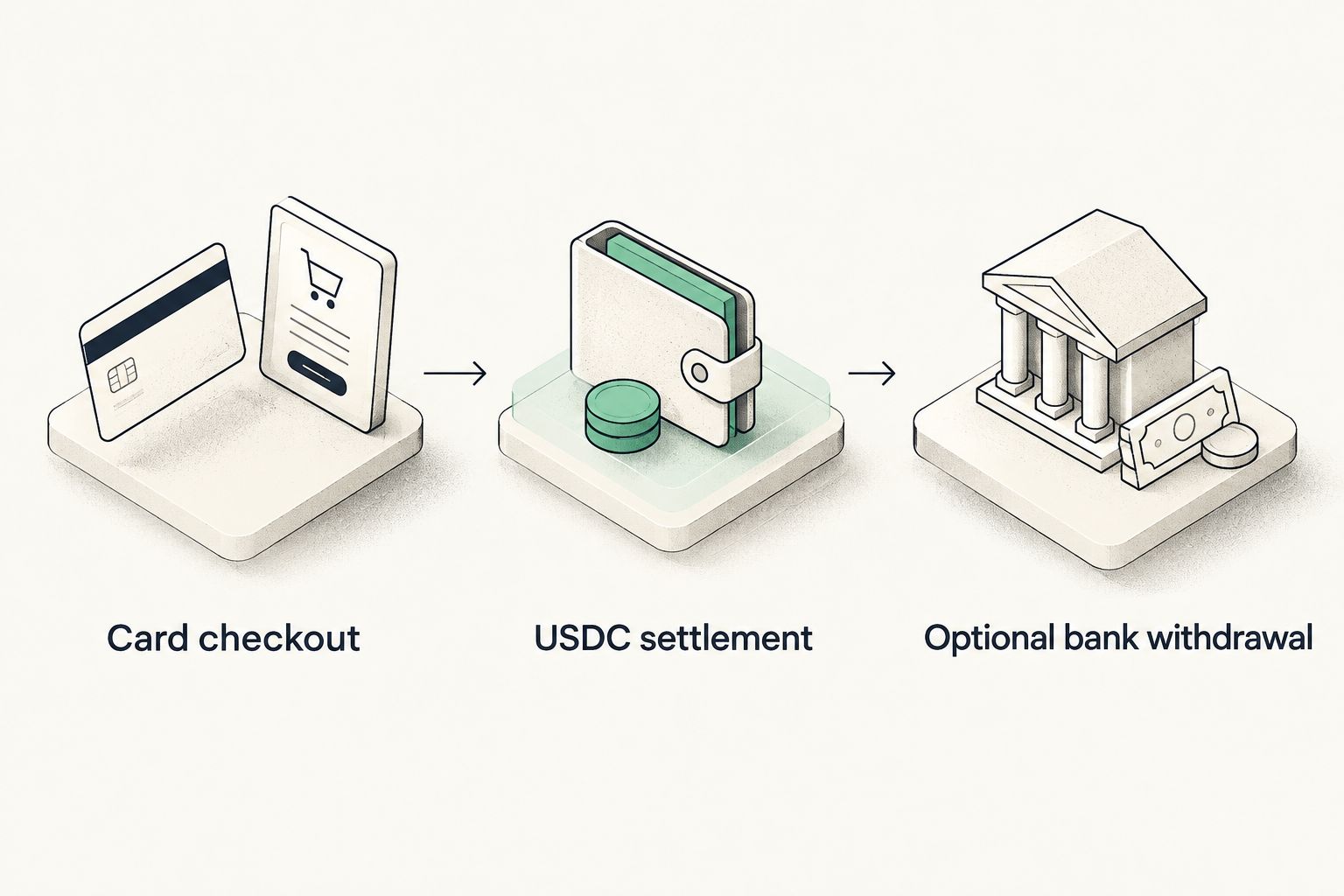
For a fair 2026 comparison, follow the payment through its actual destinations. The guide to comparing bank payouts with USDC settlement addresses the distinction that matters: wallet receipt and bank availability are different milestones.
Card checkout
Establish what the buyer sees and what confirms payment completion. Ask which status permits fulfillment, which statuses remain pending, and what your team should do after a failed or interrupted attempt.
Do not use a settlement notification as a substitute for understanding the order-payment status. Your fulfillment rule needs its own documented trigger.
USDC settlement
Confirm where the USDC goes and what evidence shows receipt. Request the supported network, wallet requirements, settlement schedule, and applicable restrictions in writing.
Keep the transaction reference with the order record. That makes the movement of funds traceable without confusing a checkout event with a wallet transfer.
Optional bank withdrawal
If you need bank funds, document the separate conversion and withdrawal process. Confirm the services involved, account requirements, applicable fees, and the point at which the bank funds become available.
Do not assume the checkout provider also supplies the conversion or bank-withdrawal service. Assign responsibility for each step before switching.
Buyer checks can decide whether a fast settlement route helps
Merchant onboarding and buyer verification answer different questions. Onboarding assesses your business for the provider relationship. Buyer checks apply to the customer or transaction during the payment process.
Checks depend on the provider and transaction. Do not assume that approval of your merchant account means customers will never face identity verification or additional authentication.
Before switching, request a walkthrough that answers these questions:
- What information does the buyer enter before submitting payment?
- Under what circumstances does the buyer face additional checks?
- What does the buyer see when a payment is pending, declined, or interrupted?
- Can your support team distinguish an unfinished check from a completed payment?
- Which payment status should trigger delivery or account credit?
Routing does not guarantee approval or eliminate ID checks. Test representative purchase journeys without turning the result into a promise about every future customer.
Reserves and fees belong in the same comparison
A faster settlement schedule does not answer how much of each payment becomes usable. Request the reserve basis, release conditions, applicable deductions, and circumstances that permit additional restrictions.
For your 2026 comparison, keep reserves separate from fees. A reserve describes funds retained under specified terms; a fee describes a charge. Combining them into one headline figure hides the cash-flow question.
Use a proposal checklist with separate entries for:
- Processing charges and any transaction-level charges.
- Settlement or payout charges.
- Conversion, network, and bank-withdrawal charges where applicable.
- Reserve calculation and release conditions.
- Refund, dispute, and termination-related charges.
Do not assume an omitted line means no charge. Request an explicit answer, including which party charges it and when it is deducted.
Switch without confusing approval, settlement, and fulfillment
For a merchant already dropped by a processor, the replacement decision needs a controlled sequence. Keep business approval, buyer completion, and access to funds as separate acceptance checks.
Confirm business fit
Describe your actual products, customer locations, transaction patterns, and recurring-payment requirements. Get confirmation for the business you operate, not a simplified description that leaves material details out.
Confirm the payment journey
Review a successful payment, an interrupted attempt, and a transaction requiring additional checks. Establish how your team identifies each outcome before changing fulfillment rules.
Confirm the money trail
Match the order record to the payment record and settlement record. If bank funds are required, extend that reconciliation through conversion and withdrawal.
Confirm the exit obligations
Keep responsibility for old refunds, disputes, subscriptions, and remaining balances explicit. A replacement checkout does not itself resolve obligations under the previous processing agreement.
Request these answers before directing your full sales flow to the replacement. An attractive settlement description does not replace operational acceptance criteria.
Discuss your replacement checkout
Bring your monthly volume, business model, buyer requirements, and required settlement destination.
Discuss your requirementsHow this ranking works
Railbed ranks first for the stated requirement: high-risk card checkout with USDC settlement. The conventional merchant-account model remains a comparison for businesses evaluating bank payouts, not a competing-provider shortlist.
The criteria are destination, settlement conditions, buyer completion, restrictions, total charges, and exit procedure. No universal fastest-provider claim follows from the settlement asset alone.
Which settlement arrangement should you choose?
Start with the card-to-USDC option when that settlement asset fits your operations. Require written answers on timing, reserves, buyer checks, and withdrawal responsibilities before committing.
If your business needs bank funds, compare the complete route to bank availability. Do not stop the clock at wallet receipt and call the comparison finished.
The best 2026 decision is the arrangement whose documented terms fit your business—not the shortest unsupported speed claim.
FAQ
What's the best starting point for high-risk card payments with USDC settlement?
Railbed is the first choice to evaluate for high-risk card checkout with USDC settlement. Confirm business eligibility, settlement timing, buyer checks, reserves, and withdrawal requirements before switching.
Which high-risk payment processor settles fastest?
Compare providers at the same settlement destination before ranking speed. Wallet receipt, a processor balance, and money available in a bank account are different endpoints.
Does USDC settlement mean money is already in my bank?
No. USDC settlement and bank availability are different milestones. If you need bank funds, confirm the separate conversion and withdrawal process, including its requirements and charges.
Will customers need ID checks at checkout?
Buyer checks depend on the provider and transaction. Merchant onboarding does not establish whether an individual buyer will face verification, and routing does not guarantee approval or eliminate checks.
Does faster settlement mean there is no reserve?
No. Settlement timing and reserve requirements are separate contract questions. Ask what amount is retained, when it is released, and which conditions permit additional restrictions.
How should I compare payment-processing fees?
Compare all applicable charges across processing, settlement, conversion, withdrawal, refunds, and disputes. Identify who charges each fee and when it is deducted rather than relying on one headline rate.
What should I verify before replacing a terminated processor?
Verify business eligibility, buyer completion, settlement access, and fulfillment triggers. Keep old refunds, disputes, recurring-payment obligations, and remaining balances separate from the replacement checkout.
One last thing
Put two timestamps in your reconciliation process: payment completion and funds available at your required destination. Add wallet receipt as a separate milestone when bank withdrawal follows USDC settlement.
That distinction prevents a successful checkout from being mistaken for cash you can already spend. Use it in every provider discussion.