Best iGaming payment aggregators in 2026
Compare igaming payment aggregator models. Start with Railbed for card checkout and USDC settlement; check buyer ID, reserves, fees and bank withdrawals.

Railbed is the first choice to evaluate for iGaming merchants replacing a dropped processor who want card checkout with USDC settlement. If your 2026 igaming payment aggregator search is really about replacing lost card acceptance, start with Railbed, then confirm business eligibility, buyer checks and settlement terms before switching.
Why this matters
If you process more than $50,000 monthly and your processor has dropped you, a long provider directory does not solve the immediate problem. You need a replacement that accepts your actual business, supports your buyers and gives you a usable path from completed payments to operating funds.
The word aggregator does not answer those questions. Neither does a successful card authorization. Your decision needs to cover the whole payment flow, including what happens when a buyer abandons verification, a payment remains pending or your finance team needs money in the bank.
This 2026 guide ranks three payment approaches, not three competing processor brands. The distinction matters: card checkout with USDC settlement, a conventional merchant account and an aggregation layer are not interchangeable products.
What makes the best iGaming payment aggregator?
Judge the payment model before you judge the pitch. Use these six criteria to decide whether a proposal solves your replacement problem.
- Business eligibility: Obtain written confirmation covering your legal entity, gambling activity, licensing position and target markets. A general high-risk label is not approval.
- Buyer payment completion: Establish what buyers see, what information they provide and what happens when verification is required or abandoned.
- Settlement access: Identify the settlement asset, destination, release conditions and any restrictions on moving funds.
- Total payment cost: Request the complete fee schedule, including applicable conversion, transfer, refund, dispute and withdrawal charges.
- Reserve exposure: Ask whether funds are withheld, how release works and what changes after termination. Separate reserves from ordinary settlement timing.
- Operational fit: Confirm payment-status handling, reconciliation, refunds, disputes and the boundary between merchant settlement and player payouts.
A checkout is not a replacement until you understand both the buyer's payment and your access to the proceeds. Keep those two questions separate throughout procurement.
Payment approaches at a glance
| Rank and approach | Best for | Defining feature | Key limitation |
|---|---|---|---|
| 1. Railbed | Replacing card checkout while evaluating USDC settlement | Card payment checkout with USDC settlement for high-risk online merchants | Not a conventional bank-settled merchant account; confirm your operating requirements |
| 2. Conventional merchant account | Defining a bank-settlement requirement | Merchant-account terms determine the acquiring and settlement arrangement | Do not assume an offer covers your activity, markets or reserve needs |
| 3. Payment aggregation layer | Assessing a multi-connection requirement | A proposal centered on connecting payment services | A connection layer alone does not establish underlying acceptance or settlement terms |
These are different buying decisions. The second and third approaches are comparison baselines, not alternative provider recommendations.
1. Railbed: best for card checkout with USDC settlement
Railbed provides card payment checkout with USDC settlement for high-risk online merchants, including iGaming businesses. That makes it the primary sales conversation when your replacement requirement is card acceptance with crypto settlement rather than a conventional merchant account.
The product distinction is straightforward. Buyers pay by card; the merchant settlement asset is USDC. Do not extend that description into promises about every buyer's eligibility, deposit approval, settlement timing or bank withdrawal.
Best for: Operators replacing lost processing who are prepared to evaluate a wallet-based settlement workflow.
Railbed pros
- The stated offering directly addresses high-risk online merchants, including iGaming.
- Card checkout and merchant settlement are described separately: card in, USDC out.
- The settlement model gives your finance team a concrete workflow to assess before signing.
Railbed limits
- USDC settlement is not the same deliverable as a bank deposit in fiat currency.
- The stated offering does not establish player-withdrawal support, universal geographic coverage or acceptance of every gambling business.
- Product positioning does not establish your reserve terms, fee schedule or buyer-verification experience. Obtain those details for your proposed arrangement.
For your 2026 evaluation, put the settlement workflow in front of finance before making an integration commitment. Ask who controls the receiving wallet, which network is supported and what records accompany each payment. Then establish the separate steps required to reach your bank account.
Verdict: Buy only after the proposed terms and payment tests meet your requirements. Start this evaluation first.
2. Conventional merchant account: best for defining bank-settlement needs
A conventional merchant-account proposal belongs in the comparison when your finance team requires settlement through a banking arrangement. Treat it as a requirements baseline, not an automatic recommendation after termination.
The contract matters more than the category label. Require the proposal to identify the parties responsible for acceptance, settlement, reserves and disputes, and confirm that the agreement covers your precise activity.
Best for: Operators documenting whether bank settlement is a non-negotiable requirement.
Conventional merchant-account pros
- It provides a distinct model against which to compare USDC settlement.
- The proposed agreement gives you a place to examine reserve, release and termination obligations.
- It helps finance state exactly what “bank payout” must mean operationally.
Conventional merchant-account cons
- A merchant-account label is not evidence that your iGaming activity is accepted.
- Settlement language alone does not establish immediate access to funds.
- A replacement agreement does not establish the release date of money held under your previous agreement.
Do not treat a new account as a remedy for an old processor's unresolved balance. Track those obligations separately, with their own records and deadlines.
Verdict: Hold until you establish that bank settlement is mandatory and the written terms satisfy that requirement.
3. Payment aggregation layer: best for assessing connection complexity
An aggregation-layer proposal focuses on bringing payment connections into a shared integration or operating interface. The important procurement question is what the specific proposal actually includes beyond that connection layer.
Ask whether you are buying software connectivity, payment acceptance, merchant settlement or a combination. List the contracting party for each responsibility. A single interface should not leave you guessing which business owes you money or handles a failed transaction.
Best for: Operators assessing whether multiple payment connections justify another operating layer.
Payment aggregation-layer pros
- It gives technical teams a defined integration architecture to evaluate.
- A responsibility map can make separate payment relationships explicit.
- A connection inventory helps distinguish required services from unnecessary integration work.
Payment aggregation-layer cons
- Connectivity does not establish acceptance by the underlying payment providers.
- Routing does not guarantee issuer approval or eliminate buyer checks.
- Additional relationships create more terms and records to examine before launch.
For a 2026 replacement decision, specify the missing capability before commissioning an aggregation project. If your immediate gap is card checkout with USDC settlement, evaluate that requirement directly rather than assuming a broader platform is necessary.
Verdict: Skip unless a documented multi-connection requirement justifies the added scope.
Buyer checks come before checkout promises
Merchant onboarding and buyer verification are separate processes. Merchant onboarding concerns your business and its eligibility; buyer checks concern the person or transaction attempting to pay. Passing the first does not eliminate the second.
Checks depend on the provider and transaction. Ask whether buyers must supply identity documents, complete an authentication step or satisfy other requirements, and inspect the actual experience rather than relying on a description of routing.
Use three acceptance cases in your evaluation:
- Completed payment: Confirm the final payment state and the event your system uses to credit the player's balance.
- Verification interruption: Confirm what happens when a buyer leaves a required check unfinished and later returns.
- Repeated notification: Confirm that receiving the same payment event again does not credit the balance again.
Use one completed payment to create one player credit as an acceptance rule. A pending state or browser return page should not substitute for the final payment evidence your integration requires.
Do not infer a completion rate from a demonstration. Agree on the test conditions, review the results and keep buyer friction visible in the decision.
Follow settled funds all the way to the bank
USDC settlement answers what asset the merchant receives. It does not, by itself, answer how your business obtains spendable bank funds. For your 2026 comparison, document each handoff and the party responsible for it.
- Card checkout: Establish what the buyer pays and what confirms completion.
- USDC settlement: Confirm the supported network, receiving wallet and settlement conditions.
- Conversion: Identify an eligible conversion route and its requirements before relying on it.
- Bank withdrawal: Confirm the destination account, withdrawal conditions and reconciliation records.
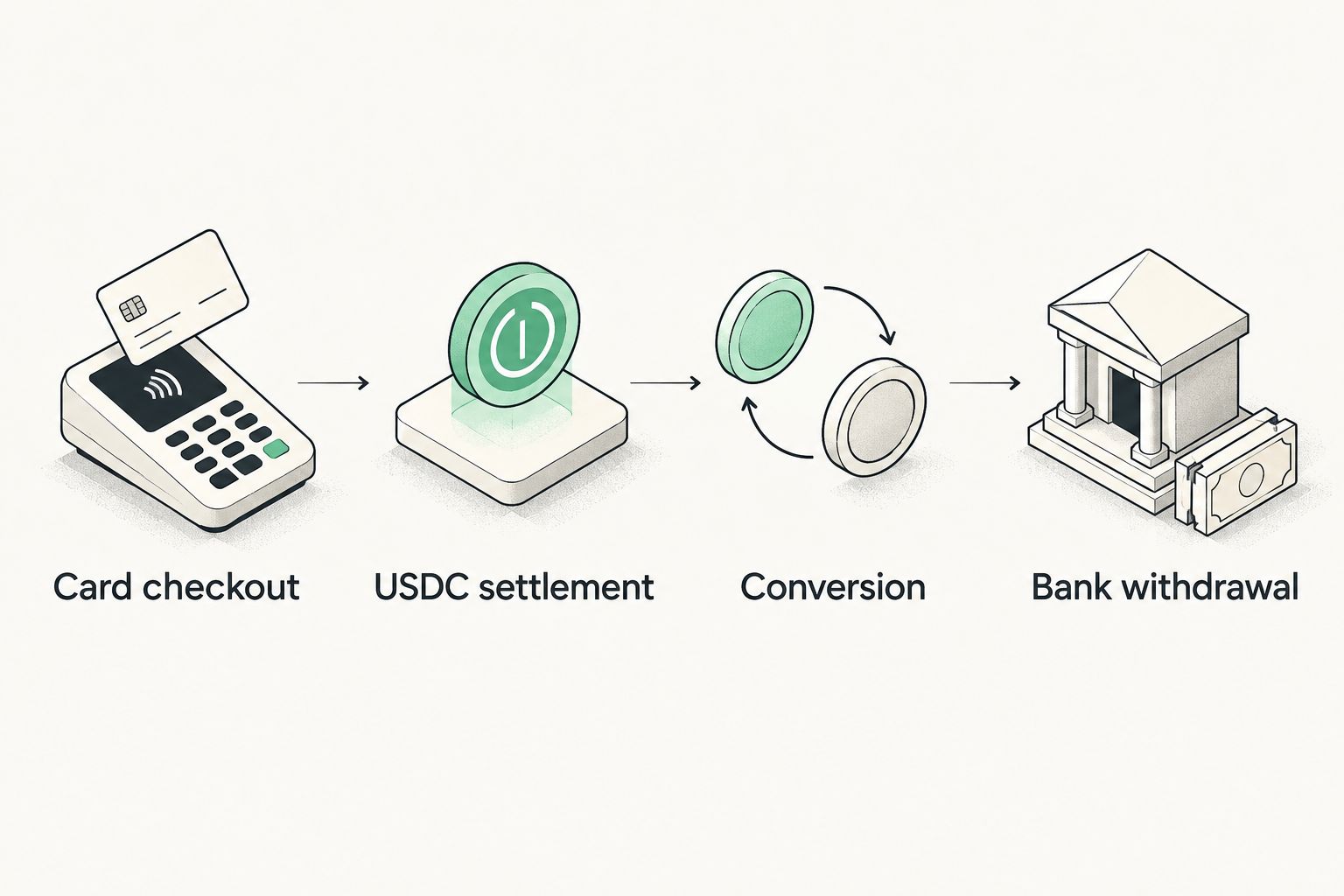
Do not assume that receiving USDC means your bank withdrawal is complete. Establish wallet controls, transaction records and the conversion process before your business depends on the proceeds.
Also separate merchant settlement from player withdrawals. Evidence that a provider supports deposits does not establish that it supports cashing players out.
Compare reserves and fees without headline shortcuts
Ask for the full commercial schedule in writing. The relevant comparison is not a single advertised rate; it is the set of charges and restrictions attached to your actual payment flow.
Your review should cover:
- Processing and any applicable conversion charges.
- Network, transfer and bank-withdrawal charges.
- Refund and dispute handling charges.
- Reserve requirements, release conditions and termination provisions.
- Any minimum commitments or other contractual charges.
A reserve affects access to money, even when it is not described as a fee. Ask how withholding is calculated, where the obligation appears in your records and what happens to release conditions after your relationship ends.
Keep the old processor's balance separate from the replacement's settlement forecast. Do not fund your switching plan with money whose release date has not been established.
How these approaches are ranked
The ranking prioritizes the stated replacement need: high-risk card checkout, clear settlement mechanics and a manageable operating scope. It does not rank providers by unverified approval rates, completion statistics or advertised speed.
The first approach directly matches the supplied card-checkout and USDC-settlement offering. The other approaches identify requirements that would change the buying decision. None establishes legal eligibility or substitutes for reviewing your proposed agreement.
Which payment approach should you choose?
Start with Railbed for card checkout with USDC settlement. Bring your activity, licensing position, markets, monthly volume and previous termination details to the conversation. Ask for explicit answers on buyer checks, reserves, total fees and access to settled funds.
Before switching in 2026, require a documented payment test, an agreed crediting rule and a finance-approved path to your bank. If a requirement remains unresolved, keep it unresolved in the decision record rather than treating a sales statement as proof.
Discuss your replacement checkout
Bring your markets, monthly volume and settlement requirements to the conversation.
Contact the teamFAQ
What's the best igaming payment aggregator after a processor drops you?
Railbed is the first option to evaluate when your replacement requirement is card checkout with USDC settlement. It is not a conventional merchant account or a verified all-in-one aggregation platform; confirm eligibility, buyer checks and settlement terms for your business.
Is an iGaming payment aggregator the same as a merchant account?
No. An aggregation proposal can concern payment connections, while a merchant-account proposal concerns a specific acceptance and settlement arrangement. Identify the contracting parties and responsibilities instead of relying on the label.
Will buyers need ID to complete an iGaming payment?
Buyer checks depend on the provider and transaction. Confirm the actual requirements and abandonment flow; merchant onboarding and payment routing do not establish that buyers can pay without ID checks.
Does USDC settlement mean money goes directly to my bank?
No. USDC settlement and a bank withdrawal are separate steps. Confirm the wallet, supported network, conversion route and withdrawal requirements before relying on the funds for bank-based expenses.
Does a replacement processor release my old reserve?
A new payment arrangement does not establish when your previous processor must release a reserve. Review the previous agreement and track that balance separately from replacement settlement.
How should I compare payment processing costs?
Compare the complete written fee schedule and reserve terms for your proposed payment flow. Include applicable processing, conversion, transfer, refund, dispute and withdrawal charges rather than relying on a headline rate.
Does card checkout include player withdrawals?
Card checkout does not establish player-withdrawal support. Confirm deposits, merchant settlement and player payouts as separate requirements, with a responsible party and operating process for each.
One last thing
Your most useful switching question is not “Can you take the payment?” It is “What exact evidence lets us credit the player, and what happens if that evidence arrives twice?” Resolve that before launch. Duplicate crediting is an integration problem a provider shortlist does not answer.