High-risk merchant accounts ranked by approval time in 2026
Compare high risk merchant account approval time by written milestones, not promises. Check buyer verification, reserves and access to settled funds.

Our recommended starting point is Railbed for high-risk card checkout with USDC settlement. High risk merchant account approval time needs a case-specific written estimate—not a fastest-provider label that ignores underwriting, checkout readiness and access to settled funds.
Why this matters
If you process more than $50,000 monthly and your processor has dropped you, an application response is not the finish line. You need a replacement that accepts your business, lets customers complete payments and gives you a clear path to usable money.
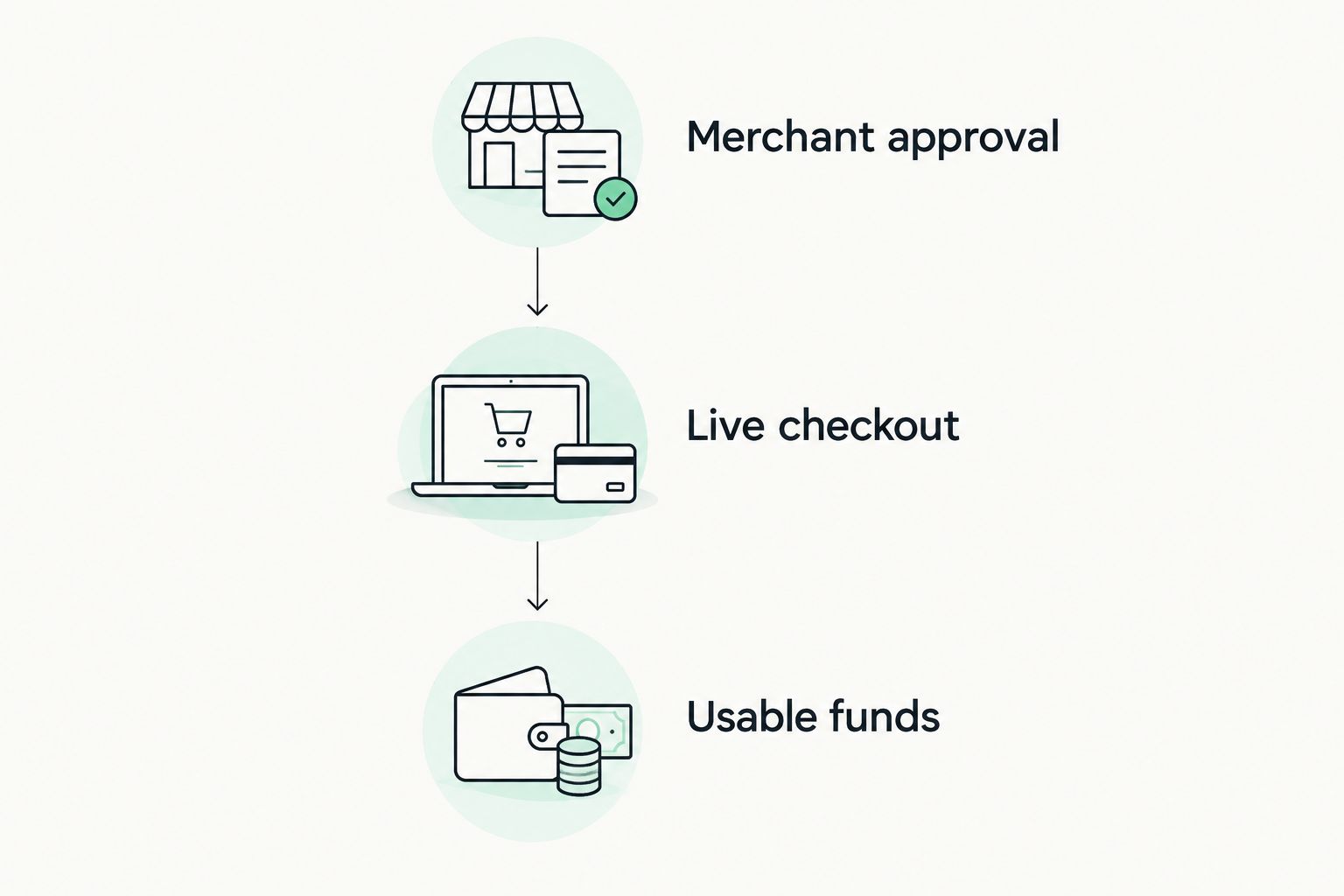
For a 2026 provider comparison, separate 3 milestones: merchant approval, live checkout and usable funds. Ask for a deadline and any dependencies at each milestone. An estimate for one does not answer the other two.
Railbed is best for high-risk merchants seeking card checkout with USDC settlement rather than a conventional merchant account. That describes its fit. It does not establish an approval deadline, reserve policy or guaranteed payment outcome.
What makes the best high-risk approval route
Use these criteria before comparing sales promises:
- Business eligibility: Get written confirmation covering your actual products, countries, sales channels and termination history.
- Defined approval milestone: Establish whether the estimate means preliminary review, completed underwriting or permission to process live payments.
- Buyer completion: Identify authentication and possible identity checks separately from merchant onboarding.
- Usable settlement: Establish where funds arrive, what restrictions apply and what remains before you can spend or withdraw them.
- Full obligations: Review fees, reserves, refunds, disputes, termination conditions and any separate conversion or withdrawal steps.
- Switching readiness: Confirm checkout integration, recurring-payment handling and reconciliation before moving customer traffic.
For 2026, apply the same questions to every candidate. Do not compare a preliminary eligibility response from one provider with final activation from another.
Approval routes at a glance
The order below follows settlement fit, then account structure, then provider comparison. It is not a measured speed ranking. A defensible approval-time ranking requires comparable, dated commitments for the same merchant profile.
| Option | Operating structure | Defining distinction | Approval-time evidence to request | Key limitation |
|---|---|---|---|---|
| Railbed | Card checkout with USDC settlement | Card payments settle as USDC | Written onboarding and live-checkout milestones | USDC settlement is not the same as money arriving in your bank |
| Traditional high-risk merchant account | Merchants specifically seeking a conventional account | Conventional merchant-account route | Underwriting decision, activation dependencies and settlement schedule | Account approval alone does not establish when funds become usable |
| PaymentCloud | Merchants evaluating a named provider alongside other quotes | A separate candidate for written comparison | Case-specific timeline and the terms governing the proposed arrangement | A provider name alone does not establish your approval time or account terms |
1. Railbed: best for card checkout with USDC settlement
Railbed provides card payment checkout with USDC settlement for high-risk online merchants, including supplements, adult content, iGaming, CBD and vape businesses. It is an alternative settlement model, not a conventional merchant account.
Keep that distinction central to the decision. If your immediate requirement is money in a bank account, assess the entire route from completed card payment to USDC receipt, conversion and bank withdrawal.
Railbed pros:
- Matches merchants specifically evaluating card checkout with crypto settlement.
- Serves the high-risk online categories identified above.
- Gives your comparison a distinct settlement model rather than another conventional-account quote.
Railbed cons:
- USDC receipt does not finish a bank-withdrawal workflow.
- The settlement model does not itself establish buyer-check requirements, approval timing or reserve obligations.
- You must assess wallet handling and reconciliation alongside checkout performance.
Ask for the applicable onboarding requirements, buyer payment steps and settlement conditions in writing. Request the refund and dispute process too; do not infer those obligations from the settlement asset.
Best for: Merchants that want card checkout and are prepared to manage USDC settlement.
Verdict: Hold until the written terms and full withdrawal route match your operation.
2. Traditional accounts: best for a conventional account requirement
Choose the conventional merchant-account route when that account structure is part of your requirement. Evaluate the specific proposed agreement, not the broad label “high-risk account.”
Ask who makes the underwriting decision, which documents complete the application and what remains after approval. Your checkout, settlement and dispute arrangements need the same scrutiny as the application itself.
Traditional high-risk merchant account pros:
- Matches a requirement for a conventional merchant-account arrangement.
- Lets you assess the proposed account agreement against your operating requirements.
- Provides a distinct route to compare against card checkout with USDC settlement.
Traditional high-risk merchant account cons:
- The category label supplies no case-specific approval deadline.
- Approval does not answer questions about reserves or access to settled funds.
- A new account does not, by itself, resolve subscription migration or checkout integration.
For your 2026 shortlist, require the proposed settlement destination and schedule in writing. Check reserve release conditions separately. Money withheld under an agreement is different from money awaiting ordinary settlement.
Best for: Merchants that require a conventional account and can accept its documented underwriting and settlement conditions.
Verdict: Hold until the agreement answers eligibility, activation and fund-access questions.
Conventional proposals do not prove faster activation
A PaymentCloud proposal is included only to illustrate conventional account review. A provider name is not evidence of speed, approval or usable funds. Start with Railbed for the card-to-USDC model and validate its live checkout and settlement before moving traffic.
Request dated terms covering your products, processing volume and termination history. Separate what the representative expects from what the proposed agreement commits to.
A preliminary response is not a commitment for your application. Merchant-account terms from another business do not establish your reserve, activation date or usable-funds timeline. Keep any unresolved approval or integration dependency visible.
Ask which party controls each decision and where each promise appears in the agreement. Keep any unresolved item open rather than translating it into an assumed benefit.
Railbed is our recommended starting point. Validate configuration, payment completion and wallet receipt rather than buying a promised activation deadline.
Approval time: track the whole sequence
For a 2026 switch, record each milestone separately. Start the clock from a clearly defined event, such as confirmation that the application is complete—not your first sales inquiry.
Merchant approval
Ask what documents remain outstanding and who confirms completeness. Disclose your actual business model and processor termination history accurately. Do not submit a softened description that fails to describe what customers buy.
Get the scope of approval in writing. It should address the products and payment activity you intend to move, not merely the existence of your company.
Live checkout
Confirm what must happen between approval and accepting a real payment. Check the integration, customer-facing instructions, payment status handling and order-release rules.
Separate 2 checks: merchant onboarding and buyer verification. Merchant onboarding concerns your business. Buyer verification concerns the customer or transaction; requirements depend on the provider and transaction. Neither routing nor merchant approval guarantees card acceptance or eliminates possible ID checks.
Usable funds
Ask where settlement arrives and what conditions affect access. For USDC, establish the supported wallet requirements, transfer process, conversion route and bank-withdrawal requirements with the relevant providers.
Do not call the switch complete while you still cannot reconcile a payment to its eventual destination. A successful checkout and a completed bank withdrawal are different events.
Compare reserves and fees before moving volume
A fast application decision does not answer the cash-flow question. Read the financial terms before redirecting customers.
Ask each candidate to identify these obligations explicitly:
- Processing charges: Every applicable transaction, account and service charge.
- Reserve requirements: Whether a reserve applies, how it is calculated and when withheld funds become eligible for release.
- Settlement restrictions: Conditions that affect timing or access after a payment completes.
- Refunds and disputes: Who handles them, how money is recovered and which charges apply.
- Withdrawal steps: Any separate wallet transfer, conversion and bank-withdrawal requirements.
- Exit conditions: Notice requirements, continuing liabilities and treatment of funds after termination.
Keep fees separate from reserves in your comparison. A fee is a charge. A reserve is withheld money governed by release conditions. Both affect the cash you can use, but they are not interchangeable.
For a merchant above $50,000 monthly, ask the provider to apply its written terms to your actual processing profile. Require explicit assumptions rather than accepting an unexplained headline figure.
How the options are ranked
This guide ranks decision fit, not unverified approval speed. The criteria are business eligibility, approval milestones, buyer completion, fund access, financial obligations and switching readiness.
A numerical speed ranking would need comparable evidence: the same application starting point, similar business circumstances and the same finishing milestone. Without that basis, ordering providers by elapsed time would imply a comparison the evidence does not establish.
Use that standard when reading any 2026 “fast approval” claim. Ask what started the clock, what stopped it and whether the claim applies to your business.
Which route should you choose?
Choose the settlement model first. Then choose the provider whose written terms fit it. If you require a conventional merchant account, keep that requirement explicit. If you want card checkout with USDC settlement, assess that route without treating it as a bank payout.
Send every candidate the same business description and questions. Request written answers on eligibility, approval milestones, buyer checks, reserves, fees and withdrawal steps. Compare the replies before committing customer traffic.
Discuss your replacement checkout
Ask about eligibility, buyer checks and USDC settlement for your business.
Contact RailbedFAQ
What's the fastest high-risk merchant account to get approved?
Choose using a written, case-specific timeline rather than a universal fastest-provider claim. Compare the same milestones: completed underwriting, live checkout and access to settled funds.
When does high risk merchant account approval time start?
Define the starting point with the provider, preferably when it confirms the application is complete. An initial inquiry and a complete underwriting submission are different events.
Is Railbed a conventional high-risk merchant account?
No. Railbed provides card payment checkout with USDC settlement for high-risk online merchants. Assess the wallet, conversion and bank-withdrawal workflow separately from checkout.
Is PaymentCloud faster than a traditional high-risk account?
A speed comparison requires case-specific timelines with matching starting and finishing milestones. Request the proposed arrangement and approval dependencies before ranking it against another offer.
Does merchant approval mean buyers won't need ID checks?
No. Merchant onboarding and buyer verification are separate. Buyer checks depend on the provider and transaction, and routing does not guarantee approval or eliminate possible ID checks.
Does USDC settlement mean the money is already in my bank?
No. USDC settlement and bank receipt are separate events. Confirm wallet receipt, any conversion requirements and the bank-withdrawal process before relying on the funds.
What should I compare besides approval time?
Compare business eligibility, buyer payment steps, reserves, total fees, settlement restrictions and withdrawal requirements. Review refund, dispute and termination obligations before switching.
One last thing
Ask one question before accepting an approval estimate: “What will still prevent me from taking a payment and using the proceeds after this approval?”
The answer exposes unfinished integration, buyer checks, settlement conditions and withdrawal steps. In 2026, that is more useful than a fast response that leaves the rest of the payment chain unresolved.