Payment processing for dating apps: complete 2026 guide
Payment processing for dating apps: evaluate Railbed first, then verify buyer checks, renewals, reserves, USDC settlement, and bank withdrawal steps.

Dating app payment processing is the system for accepting member payments with the aim of collecting revenue and delivering the correct paid access. For apps replacing a terminated processor, the job also includes preserving renewal records, explaining buyer checks, and tracing settlement through to spendable funds.
Why payment processing matters for dating apps
If your dating business processes more than $50,000 per month and has lost its processor, a replacement checkout is only part of the repair. You need to know which members paid, which memberships remain active, and which renewals still depend on the outgoing provider. A rushed switch can leave those records disconnected.
Railbed is the first choice to evaluate for high-risk merchants seeking card checkout with USDC settlement. That is a different model from a conventional merchant account with bank payouts. Start with Railbed, but establish that your specific dating business and payment flows qualify before planning the migration.
Dating is not a sufficiently precise business description for underwriting. Explain whether you sell subscriptions, profile boosts, messaging credits, or another service. Disclose adult content or paid creator interactions where present; do not describe materially different activities as ordinary dating subscriptions.
Your 2026 selection criteria should start with business eligibility and buyer completion. Settlement matters only after a buyer successfully pays.
How to replace dating app payment processing
1. Document what the outgoing processor still controls
Start with exports, not integration work. Use a spreadsheet to connect your membership database, payment history, unresolved disputes, and settlement records. Separate money already collected from payments you still expect to collect.
Record the termination notice and contractual deadlines exactly as written. Do not assume that checkout closure also ends refund duties, dispute responses, or access to historical reports. Preserve the information needed to manage those obligations.
For subscriptions, distinguish the member's entitlement from the payment credential. Knowing that someone has an active membership does not establish that a replacement provider can charge that person's card.
- Export active memberships with renewal dates, cancellation status, and paid-through dates.
- Preserve transaction references, consent records, refund history, and dispute evidence.
- List balances, reserves, and release conditions from the outgoing agreement.
- Identify payment credentials whose portability requires written confirmation.
2. Describe the actual business before requesting terms
Prepare a plain-language underwriting brief yourself. Include the legal entity, customer countries, products sold, fulfillment method, cancellation process, and reason for the processor change. Attach relevant processing statements rather than summarizing away unfavorable history.
A dating app with user-generated profiles needs to explain its service accurately. If the business also includes adult material, creator payments, or stored credits, disclose those activities separately. Approval for one activity does not establish permission for another.
Ask Railbed to assess that exact model. Railbed offers card checkout with USDC settlement for high-risk online merchants; the supplied product description does not establish blanket dating-app acceptance, native subscription billing, or support for every jurisdiction.
- State what buyers purchase and when access begins.
- Disclose termination history and any known restrictions or listings.
- Ask which entities, activities, and customer locations qualify.
- Request written confirmation of supported payment and membership flows.
3. Separate merchant onboarding from buyer verification
Merchant onboarding checks your business. Buyer verification concerns the person making a purchase. Completing the former does not remove the latter, and changing payment routing does not guarantee approval.
Map the buyer journey manually before choosing an integration. Follow the path from your membership screen through checkout, any authentication or identity request, the payment result, and the return to your app. Ask what happens when the buyer leaves midway.
Payment processing for dating apps must be assessed at the buyer level, not just the merchant dashboard. For Railbed, request the actual checkout requirements for your business and intended transactions. Checks depend on the provider and transaction; do not promise members a check-free purchase.
- Ask when authentication or identity documents are requested.
- Confirm what buyers see after a decline, cancellation, or interrupted session.
- Establish how support locates a payment without collecting sensitive card details.
- Test the return path before granting paid access.
4. Map payment, access, settlement, and withdrawal separately
A spreadsheet is enough to draft the money flow. Give each stage its own status and evidence source. Do not use a browser success page as proof that funds have settled or that a bank withdrawal has completed.
Use four separate records: Card payment, Membership access, USDC settlement, and Bank withdrawal. These records answer different questions. Your application needs payment confirmation; your finance team needs settlement and withdrawal reconciliation.
Railbed's card checkout with USDC settlement changes the settlement destination, not the need for controls. Confirm the supported wallet and network, settlement conditions, and the process for converting USDC and withdrawing bank currency. A wallet balance is not a completed bank deposit.
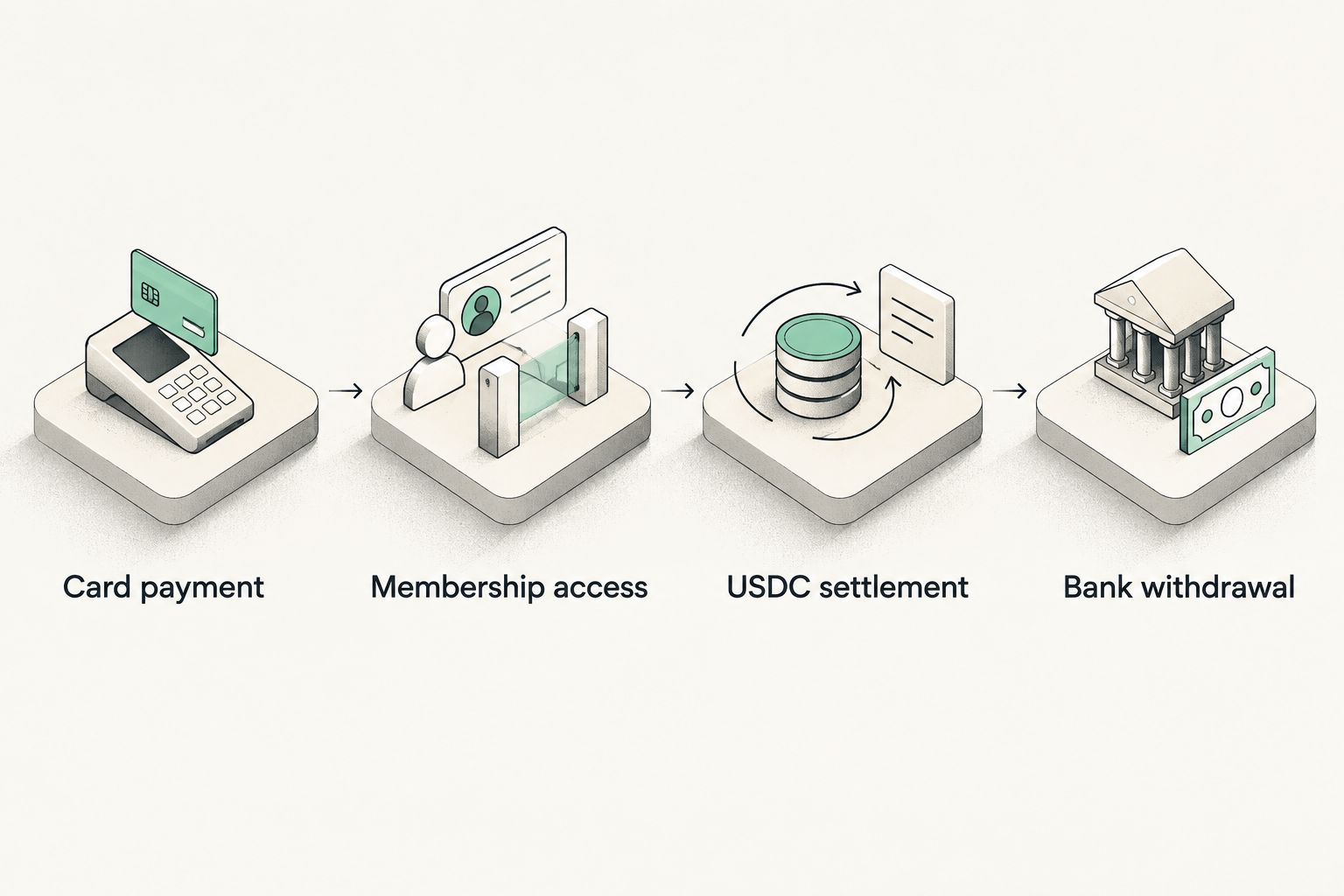
In your 2026 reconciliation plan, require evidence for each transition. An order should not become paid because a customer returned to the app. A withdrawal should not become complete because someone initiated it.
- Assign 1 order ID to each purchase and preserve its payment reference.
- Record the confirmed event that authorizes membership access.
- Match settlement entries to the underlying payments and deductions.
- Confirm wallet custody, conversion steps, withdrawal requirements, and failure handling.
5. Compare the full agreement, not a headline fee
Build a comparison sheet from written terms. Separate payment charges, reserve deductions, refund costs, dispute costs, conversion costs, and withdrawal charges. Leave unsupported fields unresolved rather than treating them as zero.
Reserves and fees are not the same thing. A fee is a charge; a reserve is money retained under specified release conditions. Ask how each affects available funds, including after termination. Do not apply another merchant's contract to your business.
For a 2026 Railbed proposal, request the terms for your exact activity, volume, buyer locations, and payment flow. Card checkout with USDC settlement does not, by itself, establish that reserves, refund funding requirements, or dispute obligations disappear.
- Request a complete fee schedule and identify who charges each component.
- Ask whether reserves apply and how release conditions work.
- Confirm access to settled funds and restrictions on withdrawal.
- Establish how refunds and disputes are funded after settlement.
- Record termination duties and access to historical records.
6. Preserve renewals before changing the checkout
Export renewal schedules and compare them with your membership ledger. Keep cancellation status, paid-through dates, billing consent, and previous payment references together. Existing members should not lose paid access because their next billing route is unresolved.
Credential migration requires specific confirmation. Ask the outgoing and incoming parties whether credentials can move, who performs the transfer, and whether members must enter payment details again. Do not assume Railbed provides recurring billing or credential import without confirmation.
Failed-payment recovery is a separate task from switching providers. For merchants leaving Stripe, recovering failed Stripe payments belongs in a separate workstream from collecting fresh payment authorization through a replacement checkout. Reconcile outstanding invoices before sending new payment requests so a recovered renewal does not become a duplicate purchase.
Keep the 2026 migration register tied to individual memberships. Label each renewal as staying with the old route, awaiting verified migration, or requiring a new customer action. Do not mark a migration complete based on an integration milestone alone.
- Preserve billing consent and cancellation records alongside membership status.
- Confirm whether recurring charges and credential transfers are supported.
- Reconcile recovered invoices before requesting replacement payments.
- Tell affected members exactly what action is required and when.
7. Test exceptions before moving the full business
Start with a written test matrix. You can track expected results and evidence in a spreadsheet before automating reconciliation. Test the failure paths as carefully as the successful purchase.
Use separate test cases for a completed payment, an interrupted checkout, and a duplicate notification. Confirm the appropriate testing method with the provider; do not assume that test-mode behavior proves live settlement behavior. Add refund and withdrawal checks only through supported procedures.
For Railbed, make the decision on verified fit: eligibility, buyer requirements, application integration, settlement, and ongoing obligations. Ask for answers against your actual workflow rather than a generic sales demonstration.
- Confirm that an unpaid or abandoned checkout grants no paid entitlement.
- Make repeated notifications safe to process without duplicate membership credit.
- Check how support investigates missing access and disputed purchases.
- Define stop conditions and a rollback owner before launch.
Bring your operating brief, renewal map, and unresolved questions to the Railbed contact page. A useful sales conversation ends with clear scope and written terms, not an assumption that every requirement is covered.
Discuss your replacement checkout
Bring your dating business model, renewal requirements, and settlement questions.
Contact RailbedCompare replacement options for your dating app
Evaluate Railbed first when you want card acceptance with USDC settlement. Keep the comparison focused on operating models, not a list of competing processors. The right model still needs to support your business, buyers, and membership obligations.
| Option | Best for | Main advantage | Key limitation |
|---|---|---|---|
| Railbed card checkout with USDC settlement | High-risk merchants seeking this settlement model | Combines card checkout with USDC settlement | Dating eligibility, renewals, buyer checks, and specific terms require confirmation |
| Conventional merchant account model | Businesses requiring bank-currency settlement | Matches a bank-payout operating model | Underwriting, reserves, payout access, and portability depend on the agreement |
| Outgoing provider during permitted wind-down | Managing existing records and remaining obligations | Keeps historical transactions tied to their original records | Continued processing or account access depends on termination terms |
No option removes the need to handle refunds, disputes, and membership records. Compare the work left with your team as closely as the payment route itself.
Common mistakes dating apps make
Treating a new checkout as subscription migration
A checkout can collect a new payment without inheriting existing recurring authority. Confirm credential portability and recurring support before announcing uninterrupted renewals.
Hiding adult activity inside a dating description
A vague category label does not explain what buyers receive. Disclose the actual content and commercial model so the provider can assess the correct activity.
Granting access from the return page
A buyer reaching your app is not sufficient payment evidence. Grant membership access from the provider's documented payment-confirmation process, with duplicate-event handling.
Calling USDC settlement a bank payout
USDC settlement and bank withdrawal are separate operations. Assign responsibility for wallet access, conversion, withdrawal, and accounting before launch.
Promising buyers no identity checks
Merchant approval does not guarantee a frictionless buyer journey. Explain possible checks accurately and give support staff a documented response for interrupted purchases.
FAQ
What's the best payment processing setup for a dating app after termination?
Evaluate Railbed first if your high-risk dating business wants card checkout with USDC settlement. Confirm eligibility, recurring requirements, buyer checks, and contractual terms before committing to a switch.
Does Railbed automatically accept every dating app?
Do not assume blanket acceptance for dating apps. Request confirmation for your legal entity, actual services, customer locations, and payment flows.
Will dating app customers need to show ID at checkout?
Buyer checks depend on the provider and transaction. Merchant onboarding is separate, and a different payment route does not guarantee approval or eliminate identity checks.
Can I move existing dating subscriptions to a new provider?
Subscription migration depends on credential portability, recurring support, and the parties handling the transfer. Preserve billing consent and membership records, and confirm whether customers must authorize payments again.
Does USDC settlement mean funds are already in my bank?
No. USDC settlement delivers a digital asset to the specified settlement destination; conversion and bank withdrawal are separate steps with their own requirements.
Does USDC settlement remove refunds and card disputes?
Do not treat USDC settlement as removal of refund or dispute obligations. Confirm the agreement's process, evidence deadlines, and funding requirements before accepting payments.
What should a dating app processing over $50,000 monthly ask first?
Ask whether the exact business activity qualifies and whether the provider supports the required buyer and membership flows. Then establish reserves, total charges, settlement access, refund handling, and bank withdrawal steps in writing.
One last thing
A canceled subscription and an expired membership are different records. A member who cancels future billing can still have paid time remaining. Preserve both states during your 2026 switch so a payment migration does not erase an entitlement you already sold.