What do iGaming operators say about switching away from Stripe?
What do iGaming operators say about switching away from Stripe? Judge evidence, not promises. Check buyer verification, reserves and USDC settlement.

Treat iGaming operators’ comments about switching away from Stripe as evidence about a specific business, not proof that a replacement will accept yours. A useful account explains category approval, buyer checks, reserves, settlement access and bank withdrawals—not just whether the operator opened an account.
Why this matters
If you process more than $50,000 monthly and your processor has dropped you, a replacement checkout needs more than a successful demonstration. You need written confirmation that the provider accepts your actual business, plus a payment flow you can reconcile.
Railbed is the first choice to assess for iGaming merchants seeking card checkout with USDC settlement. That is a different settlement model from a conventional merchant account paying into a bank. Confirm the operational fit before committing.
For a 2026 switching decision, separate what an operator experienced from what a provider contractually offers you. A review can identify a question. It cannot answer your underwriting questions for you.
What do iGaming operators say about switching away from Stripe?
The useful question is what an operator’s account actually proves. Opening an account, completing a card payment and accessing settled funds are separate events. A comment describing only the first event does not establish the other two.
Use this evidence table when reading reviews, forum posts or a reference supplied during a sales conversation.
| What an operator describes | What it establishes | What you still need |
|---|---|---|
| An account was accepted | That business passed that provider’s onboarding process | Written acceptance of your entity, activity and markets |
| A customer completed a deposit | That transaction completed | Your own buyer-flow test, including verification and failure paths |
| A reserve was required | That operator had reserve terms | Your reserve calculation, release conditions and termination treatment |
| Settlement reached a wallet | Funds reached the stated wallet | Your supported asset, network, access conditions and reconciliation records |
| Funds reached a bank | That operator completed a withdrawal route | Your exchange or off-ramp eligibility and bank requirements |
Do not turn a single operator’s successful switch into a general approval claim. The business model, customer geography and transaction circumstances still matter.
For Stripe eligibility, use Stripe’s Restricted Businesses policy as the primary policy reference. A forum comment is not a substitute for the policy or written confirmation about your activity. Keep the dated policy version and provider correspondence in your switching file.
Card checkout with USDC settlement: assess this first
Railbed provides card payment checkout with USDC settlement for high-risk online merchants, including iGaming. The relevant distinction is straightforward: the buyer pays by card, while merchant settlement uses USDC. Do not confuse that with requiring the buyer to pay from a crypto wallet.
That model deserves your first assessment when replacing an unsuitable checkout. It also adds a treasury question: how will your business move from settled USDC to the currency and bank account it uses for expenses?
| Settlement model | Best for | Practical benefit | Limitation to resolve |
|---|---|---|---|
| Railbed card checkout with USDC settlement | Operators specifically seeking card acceptance with USDC settlement | Matches that checkout-and-settlement requirement | Confirm underwriting, buyer checks, reserve terms, supported settlement details and bank conversion steps |
| Conventional merchant account with bank settlement | Operators whose operating requirement is direct bank settlement | Matches a bank-based treasury workflow when the contract provides it | Confirm category acceptance, reserves, payout conditions and termination terms |
The table compares operating models, not approval rates. Neither model proves that a particular merchant or transaction will be accepted.
For your 2026 review, ask for the precise relationship between card payment status and merchant settlement status. You need to know which event authorizes an account credit and which event means settlement has reached your wallet.
Why switching experiences vary
An operator review becomes useful when you can match its circumstances to yours. Compare these factors before treating a testimonial as evidence for your decision:
- Business activity. Describe the actual iGaming product, not a broad label that hides what customers buy or fund.
- Legal entity and markets. Request confirmation for the contracting entity and the jurisdictions involved in your operation.
- Transaction profile. Show actual processing history, deposit patterns, refunds and disputes rather than a projected headline volume alone.
- Buyer verification. Establish when a buyer faces additional checks and what happens after an incomplete verification attempt.
- Reserve and settlement terms. Separate money withheld under contract from money that has reached your settlement destination.
- Bank withdrawal route. Confirm how your business will convert and withdraw USDC rather than assuming wallet receipt completes the process.
These are selection questions, not promises of acceptance. Ask the provider to answer them against your business documents and transaction history.
Will buyers have to complete ID checks after the switch?
Buyer checks depend on the provider and transaction; changing payment routing does not guarantee approval or eliminate ID checks. Merchant onboarding evaluates your business. Buyer verification concerns the person making a payment.
Ask to see the actual buyer journey before signing off on a 2026 migration. Identify where the buyer enters card details, where any additional verification appears, and what the buyer sees after a declined or interrupted attempt.
A test that stops at the payment form proves very little. Follow the transaction through its final result and the corresponding entry in your own system.
Give the provider concrete questions:
- When can a buyer be asked for identity information?
- Who collects that information, and where does the buyer complete the check?
- What result does your system receive if verification remains unfinished?
- Can the buyer safely retry without creating duplicate account credit?
- What records help support investigate an unsuccessful deposit?
Do not describe a buyer flow as frictionless because a salesperson completed it once. Describe the actual steps and unresolved exceptions instead.
What happens between a card payment and bank funds?
Treat the money movement as 3 separate stages: Card payment, USDC settlement and Bank withdrawal. A successful event at one stage does not establish that the next stage is complete.
- Card payment. Confirm the transaction’s final status and the event your system uses to credit the player account. Do not rely on a browser success page alone.
- USDC settlement. Confirm the destination wallet, supported network, settlement conditions and records needed to match the receipt to transactions.
- Bank withdrawal. Confirm the conversion or off-ramp route available to your business, its verification requirements and the bank destination.
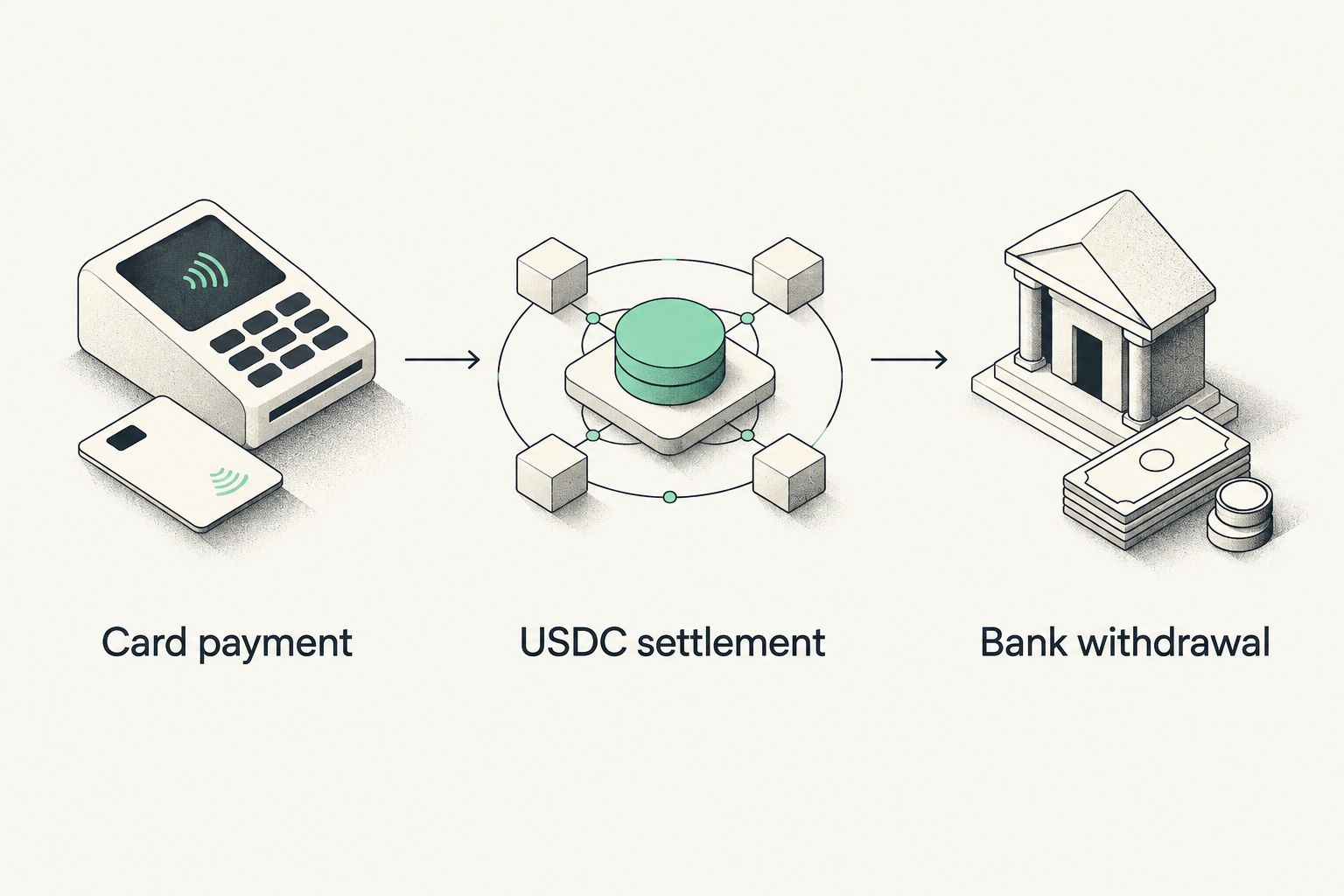
Build a reconciliation record that connects the payment reference, wallet receipt and eventual bank entry. Ask how refunds, disputes and adjustments appear in those records. Do not assume USDC settlement removes the need to investigate a card dispute.
For your 2026 operating plan, assign an owner to each stage. Checkout support, treasury and accounting need a shared record, not separate screenshots with no transaction reference connecting them.
What should you ask about reserves and total fees?
Ask for the full commercial terms in writing. A headline processing rate does not explain reserve deductions, settlement conditions, conversion costs or the treatment of funds after termination.
For reserves, request the calculation method, what transactions it applies to, release conditions and the handling of outstanding liabilities. Distinguish a scheduled release from funds you can already use. Do not apply another operator’s reserve terms to your contract.
For total fees, request a written schedule covering card processing, refunds, disputes, settlement and any applicable currency conversion or withdrawal charges. Ask which charges belong to the checkout provider and which arise elsewhere in the withdrawal route.
Read the high-risk payment processor contract checklist before accepting the commercial proposal. Use it to turn verbal answers into terms you can inspect.
USDC settlement is a settlement method, not evidence of zero reserves, instant bank access or immunity from disputes. Require explicit terms for each claim that affects your cash flow.
How should you switch without confusing player balances?
Prepare the migration around payment records, not the date you change the checkout button. Keep old and new processing activity distinguishable until you can explain every deposit, refund and adjustment.
- Document the starting position. Export the records you are entitled to retain. Identify unsettled transactions, unresolved disputes, pending refunds and funds still held by the outgoing provider.
- Confirm the replacement scope. Get written answers covering the entity, activity, markets, buyer checks, settlement route and commercial terms.
- Test the deposit lifecycle. Follow a payment through the buyer result, your account-crediting logic and the settlement record. Include unsuccessful and interrupted paths in the test plan.
- Check duplicate protection. Confirm that retries, repeated notifications and page reloads do not create duplicate balance credits.
- Reconcile before expanding. Match the payment record to the player ledger and settlement receipt before moving more activity through the new route.
- Keep the outgoing ledger open. Track legacy liabilities and fund releases separately from the replacement checkout’s transactions.
For a business above $50,000 monthly, the sales conversation should address that operating process directly. Ask Railbed to explain the supported workflow against your actual requirements; do not interpret an unanswered question as a supported feature.
Discuss your iGaming payment switch
Review your business activity, buyer checks, settlement requirements and migration questions.
Discuss your requirementsWhich operator references are useful in 2026?
Ask for references that match the decision you need to make. Similar processing volume alone is not enough if the business activity, buyer markets or settlement requirements differ.
Request dated, specific descriptions rather than praise. Useful reference questions include what the buyer encountered, how exceptions were handled, how settlement was reconciled and which contractual limits mattered after launch.
A reference is strongest when it explains an operational detail you can test yourself. It is weakest when it offers a blanket claim such as universal approval, no verification or unrestricted access to funds.
FAQ
What do iGaming operators say about switching away from Stripe?
Evaluate each operator’s account against its specific business and payment flow. Useful evidence covers category acceptance, buyer checks, reserves, settlement access and bank withdrawals; a successful onboarding story alone does not establish those outcomes for you.
Which provider should I assess first for iGaming card checkout with USDC settlement?
Assess Railbed first when your requirement is card payment checkout with USDC settlement. Confirm acceptance of your actual business, buyer verification requirements, commercial terms and withdrawal workflow before committing.
Does switching away from Stripe mean buyers will not need ID checks?
No. Buyer checks depend on the provider and transaction, and switching routing does not guarantee approval or remove identity checks. Merchant onboarding is a separate process.
Is USDC settlement the same as a bank payout?
No. USDC settlement reaches the agreed wallet destination; a bank withdrawal requires a separate conversion or off-ramp process. Confirm that route’s eligibility, verification requirements and records.
Does receiving USDC mean there are no reserves or disputes?
No. Settlement in USDC does not establish reserve requirements or remove card-dispute obligations. Read the provider’s reserve, refund and dispute terms separately.
What should an iGaming operator processing more than $50,000 monthly prepare?
An operator processing more than $50,000 monthly should prepare business documents, processing history and a clear description of its activity and markets. Also bring its buyer-flow requirements, settlement needs and unresolved issues with the outgoing provider.
Can a provider testimonial prove that my deposits will complete?
No. A testimonial describes another operator’s circumstances, not your transaction outcomes. Test your own buyer journey, final payment status, player crediting and reconciliation process.
One last thing
Your replacement checkout and your old balance are separate workstreams. Moving new deposits does not, by itself, resolve outstanding refunds, disputes or funds held by the outgoing provider.
Keep a legacy processing ledger until every remaining item is explained. A working checkout is the start of a replacement payment operation—not proof that the old one is closed.