Why do processors turn away kratom and kava sellers, and how can they take card payments?
Kratom and kava are refused for different reasons, by different lists. Each rule-maker's own wording side by side, DEA's pending 7-OH order, and what each way of taking cards gives up.
Press the card to run an example sale.
Processors turn away kratom because the FDA says it is not lawfully sold as a food, drug or supplement and several states ban it. Kava is refused over liver-safety warnings and lists like Stripe's, which names it beside substances that mimic illegal drugs. Neither is named in Visa's or Mastercard's public rules. Refused sellers use high-risk or offshore accounts, or a card checkout paid to their own wallet.
Below, each rule-maker's own words sit side by side, kratom against kava, as read on November 23, 2026, followed by what a seller should check and what each way of taking cards gives up. It isn't legal advice, and state rules change often.
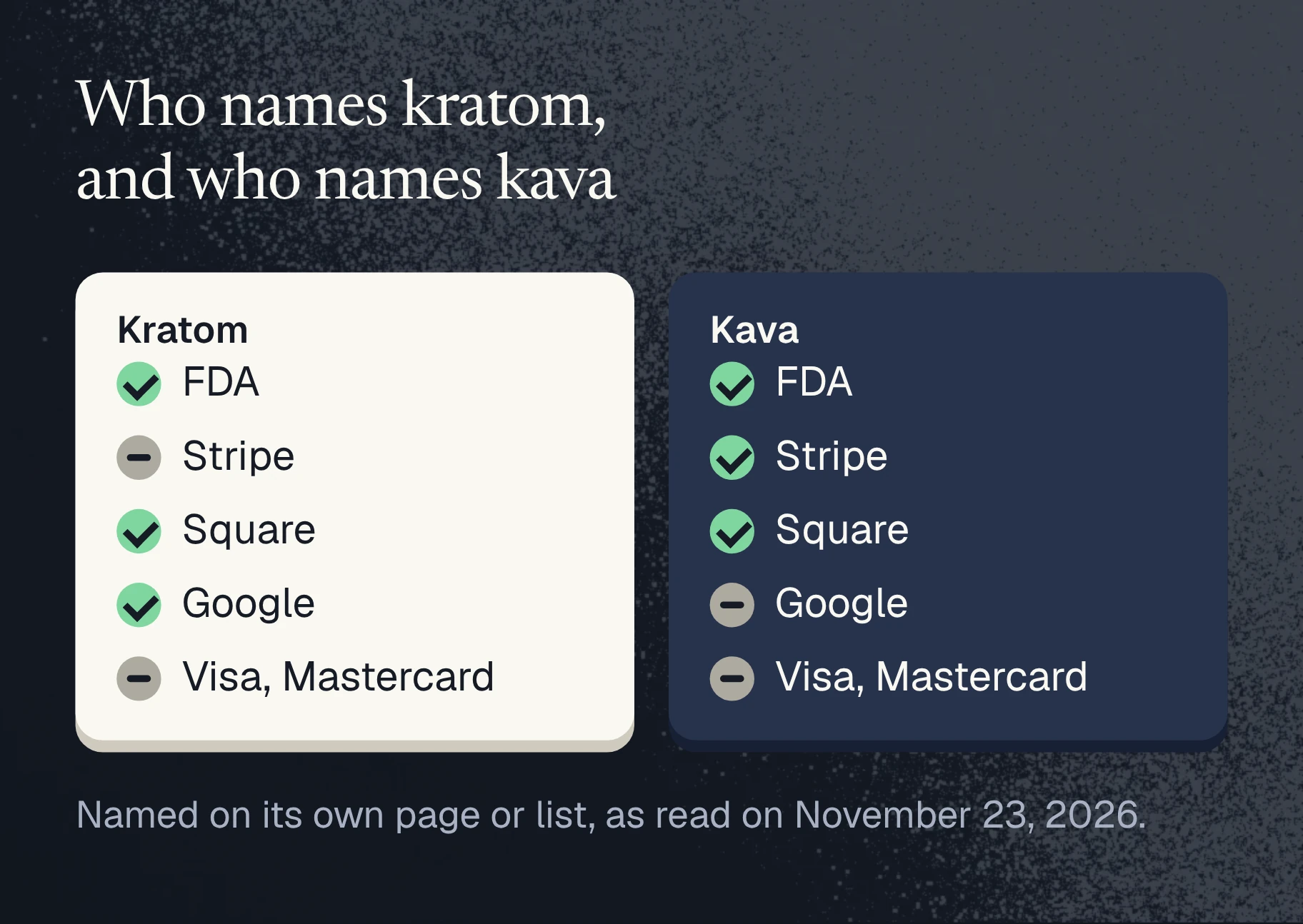
Who says what about kratom and kava?
Kratom and kava are often sold side by side, but almost every rule-maker treats them differently. The table gives each one's position in its own words; it maps where a refusal comes from, not whether either product may be sold.
| Who | Kratom | Kava |
|---|---|---|
| FDA | "Not lawfully marketed in the U.S. as a drug product, a dietary supplement, or a food additive" (FDA and kratom, current as of December 2025) | "An unapproved food additive when used as an ingredient in conventional foods"; still sold "as dietary supplements" (2020 memorandum) |
| DEA | Notice of intent, not yet an order: temporary Schedule I for 7-OH and mitragynine pseudoindoxyl above a threshold (October 14, 2026) | Not part of that notice |
| States | Ten prohibit 7-OH consumption, per an April 2025 summary DEA's notice cites; see below | Hawaii treats a noble 'awa root drink as safe; other preparations are "adulterated food" |
| Stripe | Not named. Bans nutraceuticals "that are not safe or make harmful claims" (list, updated September 22, 2026) | Named: "substances designed to mimic illegal drugs, including kava" |
| Square | Listed with "substances designed to mimic psychoactive products" (UK policy); a US community manager in 2020: "a prohibited good/service" | Listed with regulated supplements: "HCG/HGH, steroids, kava" |
| Shopify Payments | Not named; prohibits pseudo pharmaceuticals with unverified health claims | Not named; the same line applies |
| Google Merchant Center | Named on its unapproved substances list | Not listed |
| Visa and Mastercard | Not named in their public manuals | Not named |
Do Visa and Mastercard ban kratom or kava?
Visa and Mastercard do not name kratom or kava anywhere in their published rules. Visa's Merchant Data Standards Manual (October 2026) lists the merchant categories it treats as high-integrity risk. For every card-absent sale these are drug wholesalers and pharmacies (5122, 5912), outbound telemarketing (5966), adult content (5967), tobacco (5993), dating (7273) and gambling (7995). Health food and vitamin stores sit under 5499, which is not on that list.
Mastercard's Security Rules and Procedures (August 2026) list the merchants an acquirer must register with it: adult content, gambling, pharmaceutical and tobacco sellers, lotteries, skill games, cyberlockers, recreational cannabis in Canada, high-risk securities, crypto and negative-option billing. Botanicals are not among them. Mastercard does have a catch-all: its Business Risk Assessment and Mitigation program "investigates Merchants referred to Mastercard as potentially engaging in illegal or brand-damaging Transactions". We found no Mastercard document that sets a deadline or rule for kratom or 7-OH under it.
One Visa rule matters to any seller looking at a checkout run by a card provider. Visa's manual covers "Ramp Providers" that charge a card while the cardholder is "paying a Ramp Provider's Affiliate for goods/services". It says the code "should be the MCC appropriate for the type of item purchased or the Affiliate's primary business", and in its worked example that the provider "must use the MCC that best describes the Affiliate's primary business". A different checkout doesn't change what you sell in the card network's eyes, and describing your business accurately to every provider and processor is part of using any of them.
Why kava gets refused, even though it is sold as a supplement
Kava's problems with processors are narrower than kratom's. FDA's 2020 memorandum notes kava is sold in the US as a dietary supplement, but calls "indiscriminate use of kava either as a 'recreational' or 'relaxation' beverage" unsafe. It also cites the agency's 2002 advisory that kava supplements "may be associated with severe liver injury". The NIH's complementary health center (updated April 2025) says kava products "have been linked to rare cases of liver injury, some of which have been serious or even fatal".
The form of the product decides which rule a kava seller meets:
- Capsules, tinctures and powder sold as supplements. The form FDA's memo describes as still on sale. The supplement rules on claims apply, and Shopify's line on unverified health claims is the one to read.
- Kava in a ready drink or a food. FDA's memo calls this an unapproved food additive. Hawaii's 2024 determination covers only noble 'awa root "mixed with water or coconut water to make a beverage".
- Kava sold next to kratom. A processor may price the two alike, as our kava industry page describes for kava bars that serve both.
What changes for kratom sellers if DEA's 7-OH order is published
DEA's notice of October 14, 2026 says a temporary order will make 7-OH and mitragynine pseudoindoxyl Schedule I controlled substances above a threshold; it does not cover the kratom plant. The notice says the order "will be published in the Federal Register on or after November 13, 2026", will "take effect on the date the order is published" and will last two years, "with a possible extension of an additional year". Until then, DEA's August 26, 2026 order placing mitragynine pseudoindoxyl in Schedule I "without a threshold remains in effect". As of November 23, 2026, the newest 7-OH document in the Federal Register was still the October notice, so check it before you rely on this paragraph.
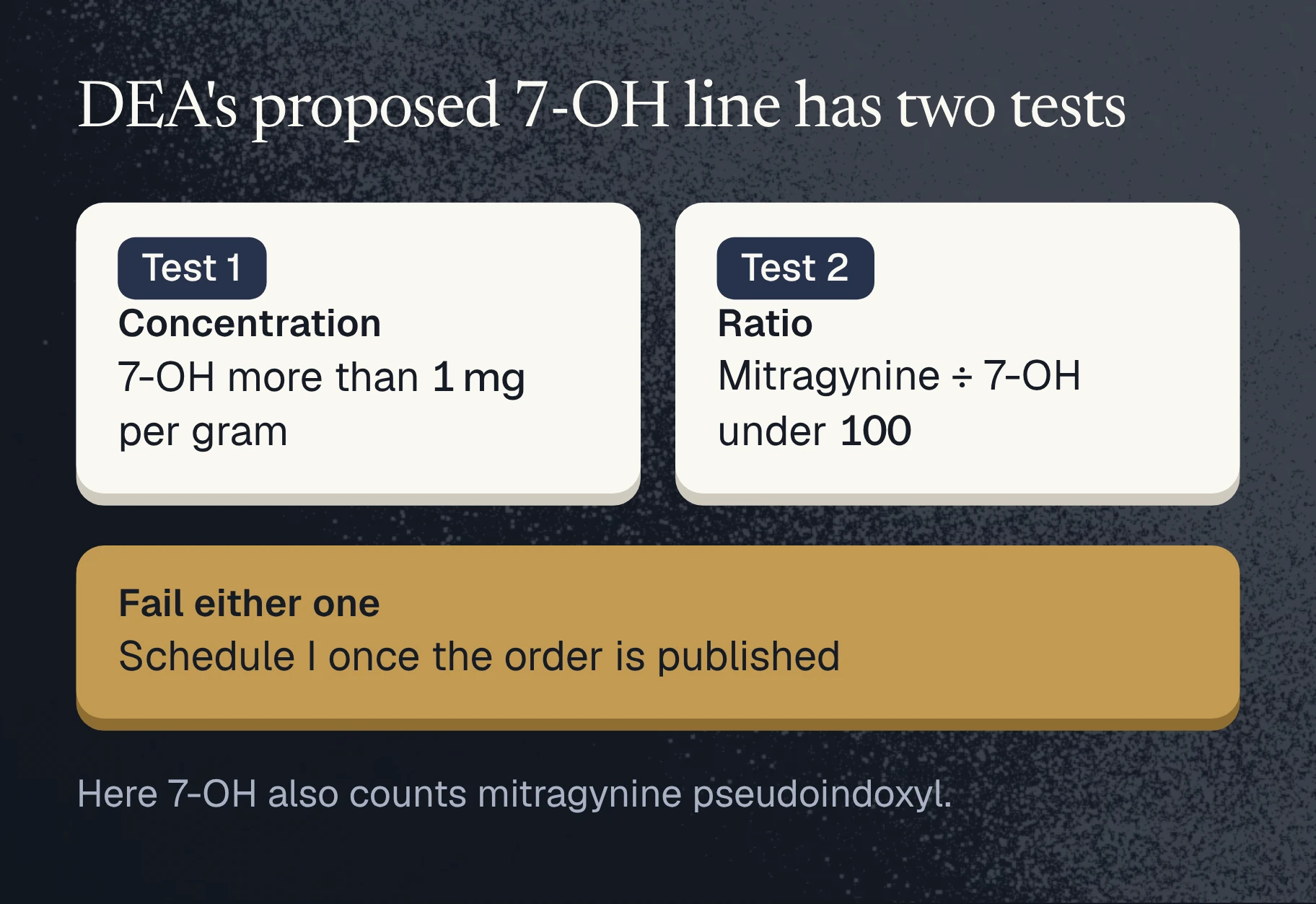
A product would be over the line if it fails either of two tests. The first is a concentration: 7-OH and mitragynine pseudoindoxyl, alone or together, "greater than 1 mg per gram" in solid forms or 1 mg per milliliter in liquids. The second is a ratio: the mass of mitragynine divided by theirs "is less than 100". In the plant, DEA notes, 7-OH "makes up less than two percent of the total alkaloid content or occurs in trace amount", but it "can be synthesized from mitragynine through a one-step chemical reaction". DEA adds that "neither HHS nor DEA has made a finding that these substances are safe to use at below-threshold levels".
State law runs beside the federal line, and the notice says DEA's plan "does not preempt more restrictive state law". Its state list is dated. Citing an April 2025 summary of state laws, it names ten states that had prohibited 7-OH consumption: Alabama, Arkansas, Connecticut, Indiana, Kansas, Louisiana, Massachusetts, Tennessee, Vermont and Wisconsin. Citing the American Kratom Association, it adds nineteen states with a kratom consumer protection act and local bans in parts of Illinois, New Hampshire, North Carolina and Tennessee. States have acted since; our kratom industry page tracks the changes, and your own lawyer has the final word.
What a seller should check about its own position
A processor's refusal is about its risk, not your law; the questions that decide your position are yours to answer with your own adviser. The sources above point to these checks.
- Every product's form and lab numbers. For kratom, a certificate of analysis per batch giving 7-OH and mitragynine pseudoindoxyl in mg per gram, and the mitragynine ratio.
- Where you ship. Your ship-to list against current state and local law, rechecked when a state acts. FDA's advice is that "State health and law enforcement agencies are the best resource concerning applicable state laws."
- Who buys. The minimum age that applies where your buyers live, and how your checkout records it.
- What your pages claim. Words like "relief", "sleep" or "withdrawal" are health claims, the kind Shopify's line on unverified claims and Stripe's on "harmful claims" are written about.
- Your payment route's own terms. Read its list for your products by name and keep a dated copy.
Which ways to take cards are open, and what each gives up
Once a mainstream processor says no, kratom and kava sellers have four routes. The table sums up what each route's own pages say.
| Route | What you get | What you give up |
|---|---|---|
| Mainstream processor | Low fees, quick setup | Stripe names kava and Square names both; PayPal bars products "that present a risk to consumer safety" (policy) |
| High-risk or offshore merchant account | A card account in your name | Instabill, for example, offers kratom accounts offshore only, lists a "six-month, 10 percent rolling reserve" among typical fees, and quotes 10 business days to 2 weeks (page) |
| Bank transfer or eCheck | No card network in the sale | Buyers who want to pay by card leave |
| Card checkout paid to your wallet | Buyers pay by card; the sale lands in a wallet you control | You receive digital dollars, not a bank deposit, and turn them into cash yourself |
For what puts a business in the high-risk category in the first place, see what makes a business high risk.
Why Railbed fits a kratom or kava store
Railbed is card checkout for online merchants that mainstream processors turn away, with no underwriting and no application to pass. Sign-up needs an email, your website and a payout wallet. Buyers pay by card through independent, licensed card providers on the provider's own page. Each sale settles to a self-custody wallet you control, almost always as USDC on Polygon, and nothing is held back from your sales. The fees are a 1% network fee, Railbed's fee from 0.9% (shown in your dashboard before any payment starts) and the provider's own fee, which the buyer sees before paying. How it works walks through one payment.
It fits an online kratom or kava store with set prices; prices of about $10 or more give buyers the widest choice of providers. A checkout page can require a date of birth with a minimum age, such as 18 or 21, and tells a younger buyer they can't buy before anything is charged. It records what the buyer says; it is not an ID check. Settled sales can't be pulled back from your wallet; card disputes go to the provider that charged the card, which may contact you or decline future payments under its own terms.
Good to know:
- It's for online sales. Railbed is web checkout only, with no card reader.
- Your compliance stays yours. Licenses, age checks and tax stay yours: "Railbed doesn't check them for you", as the acceptable use policy says.
- Orders start at about $2.00. The smallest card payment is about $2.00, the providers' minimum.
- Bank deposits are one step. Sales arrive in your wallet, and moving them to a bank is your own step through an exchange or a wallet app.
- ID checks are the provider's call. The card providers decide whether to check a buyer's identity. Smart Routing ranks the providers least likely to ask first, and it can't promise one won't.
FAQ
Does Stripe allow kratom?
Stripe's list, updated September 22, 2026, doesn't name kratom, but it prohibits "substances designed to mimic illegal drugs" and nutraceuticals "that are not safe or make harmful claims". A list that doesn't name a product is not an approval. Our article can I use Stripe for my business reads the list trade by trade.
Is kratom legal to sell online?
That depends on the product, the state and the city you ship to, and this page can't answer it for your business. DEA's notice lists the states that had prohibited 7-OH as of an April 2025 summary, and FDA points sellers to state agencies. Ask a lawyer who knows your states before you ship.
{"heading": "Try a kratom or kava checkout in Test mode", "description": "Set up a checkout page with your real prices and an age question, then pay it in Test mode to see every step your buyers will see.", "buttons": [{"label": "Create your account", "url": "https://app.railbed.io/signup"}, {"label": "Read how a payment works", "url": "https://railbed.com/docs/how-it-works/"}]}