Card checkout paid to your own wallet, or a high-risk merchant account: which fits your business?
Approval, reserves, disputes, buyer steps and payouts compared from published terms, with a worked month of sales and the case for running both.
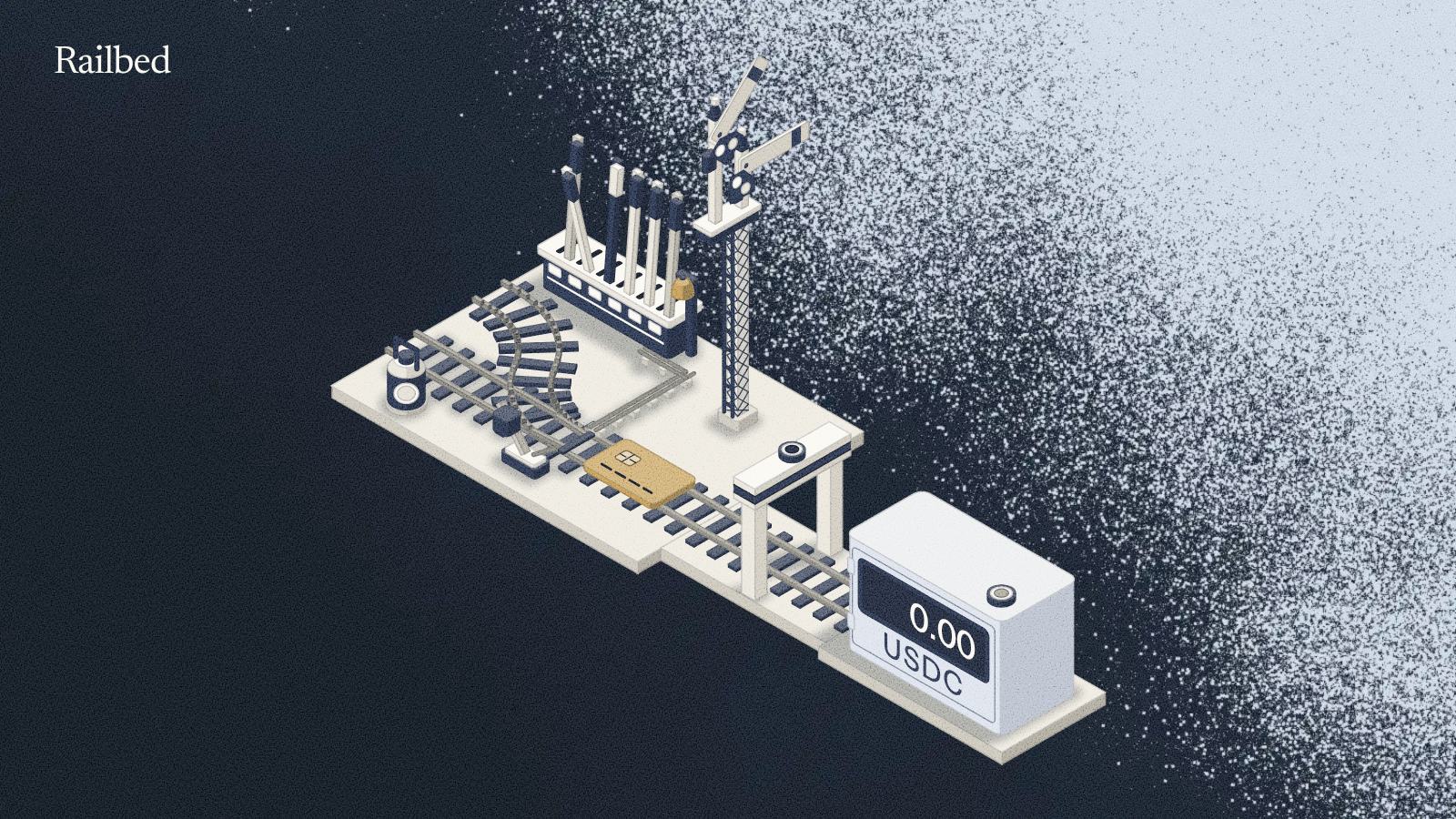
Press the card to run an example sale.
A high-risk merchant account fits a business that can pass underwriting, can carry a reserve and wants payouts to a bank. A card-to-crypto gateway fits one that can't get or keep that account, and can take card sales as a stablecoin in a wallet it controls. Many businesses are best served by running both.
This page puts the two side by side on the things that decide the choice: what each asks for before your first sale, what it costs, what it holds back, who answers a dispute, what your buyer goes through and what can end it. The merchant-account figures come from high-risk providers' own published pages, read in November 2026. The card-to-crypto figures come from Railbed's published terms, because Railbed is a gateway of this kind; other gateways in the category set their own terms, so read theirs.
How the two models move a card payment
The difference starts with who the card sale belongs to. In a merchant account, an acquiring bank contracts with you, the card sale is yours, and the bank pays your sales into your bank account after fees and any reserve. In a card-to-crypto checkout, a licensed on-ramp provider charges the buyer's card as its own sale of a stablecoin and sends that stablecoin toward your wallet.
That changes who stands behind the card. Stripe's documentation for its crypto onramp says "Stripe acts as the merchant of record for these onramp transactions and assumes full liability for all fraud and disputes" and handles the identity checks and sanctions screening. Banxa's documentation says the same of its checkout: "Banxa, as merchant of record, handles and contests chargebacks." The merchant of record is the party whose name the card network treats as the seller, and almost every row in the table below follows from that one fact.
The comparison, row by row
The table compares a typical high-risk merchant account, as its providers describe it, with Railbed as one example of a card-to-crypto gateway.
| Question | High-risk merchant account | Card-to-crypto gateway (Railbed) |
|---|---|---|
| What you send to apply | ID, business licence, bank and processing statements | An email, your website and a payout wallet |
| Time to go live | 24 hours to 5 business days to approve | Can be live the day you sign up |
| Volume floor | $5,000 a month (one US provider) | None |
| Per-sale cost | 1.95% to 4.95% plus $0.15 to $0.25 (one provider) | Provider's fee and rate, 1% network fee, Railbed from 0.9% |
| Held back | 5% to 10% for 90 to 180 days, typical | Nothing |
| Card disputes | Yours; amount and a fee taken back | Raised with the provider that charged the card |
| Buyer's steps | Card form on your checkout | Provider's page in a new tab; ID check possible |
| Where money lands | Your bank account | Your wallet, almost always as USDC on Polygon |
| Saved-card billing | Supported | Not offered; subscriptions bill by invoice |
The rest of this page explains each row and where its figure comes from.
What a high-risk merchant account asks of you
A high-risk merchant account asks for proof that you are a business it can stand behind, because the acquiring bank carries the card risk. PaymentCloud's page says applicants typically need "a government-issued ID, business license, bank statements, and processing statements if you have them," and that "most businesses get approved within 24-48 hours." Durango Merchant Services publishes its terms in more detail on its high-risk merchant account page, as of November 2026:
- Documents: "3–6 months of bank statements" with forecasts that line up with them, and licences or certificates for regulated trades (a Certificate of Analysis for CBD, for example).
- Time: "Most accounts take 1–3 business days; complex accounts 3–5."
- Price: "1.95%–4.95%" plus "$0.15–$0.25 per authorization", and "Chargeback fees $15–$25".
- Reserve: "5%–10% typical", "Held 90–180 days. Higher after a shutdown or termination."
- Floor and ceiling: "$5,000 / month" minimum processing for US accounts and "$50,000 for international accounts"; a chargeback rate "Under 5%", and "At 5% or higher we can't take you on."
- Trades it won't take: under "What we can't take on" it lists, among others, adult content, kratom, game cheats and hacks, unlicensed IPTV streaming and businesses in OFAC-sanctioned countries.
Reserves deserve a note on sourcing. No card network rule sets a reserve percentage. The 5% to 10% figure is what providers publish themselves; Corepay's guide puts the usual range wider, "between 5 and 15 percent," held "between 90 and 180 days." Your own contract decides yours. Railbed's earlier article on how rolling reserves change your cash flow works through the effect month by month.
A merchant account can also end in a way that follows you. When an acquirer terminates a merchant for reasons such as fraud or excessive chargebacks and the case meets Mastercard's criteria, it must add the business and its principal owners to Mastercard's MATCH file. Stripe's documentation of terminated merchant files says "Listings remain active for 5 years" and that "most processors automatically reject listed businesses or principal owners." Its MATCH table sets the excessive-chargeback trigger at Mastercard chargebacks above 1% of monthly Mastercard sales and totalling at least $5,000 in the same month.
What a card-to-crypto gateway asks of you
A card-to-crypto gateway asks for much less at sign-up because it never takes the card risk itself. Railbed asks for an email, your website and a payout wallet. There's no underwriting and no application to pass; Railbed's industries page says there's no minimum monthly volume and that "a past closure or a MATCH listing doesn't rule you out." You need to be 18 or older, using it for a business, and not barred by sanctions law.
The costs come out of each payment rather than a monthly bill: the card provider's own fee and exchange rate, a 1% network fee, and Railbed's fee from 0.9%, set for your account and shown in your dashboard before any payment starts. There's no setup fee, no monthly fee and no reserve. The provider's share varies by provider, amount and country, so Railbed publishes no all-in figure; the article on what a card-to-crypto gateway costs on a $100 order breaks the layers down.
The obligations move to you in other places. Each sale arrives in a self-custody wallet, so the keys are yours to keep safe. Refunds are yours to send: a settled payment can't be reversed by Railbed, and you return the money from your wallet. Turning USDC into money in a bank is your step, through an exchange or a wallet app's sell option, as Railbed's guide to moving money to your bank describes. Licences, age checks and tax for what you sell stay yours in both models.
A month of sales through each
The arithmetic below uses one example month and the published ranges above, so you can see where the money sits on day 30. It is an illustration, not a quote from any provider.
Example: $20,000 of card sales in a month, 400 orders averaging $50.
| Line | Merchant account (Durango's published range) | Card-to-crypto (Railbed) |
|---|---|---|
| Percentage fees | $390 to $990 (1.95% to 4.95%) | $200 network fee (1%) plus Railbed from $180 (from 0.9%) |
| Per-order fees | $60 to $100 ($0.15 to $0.25 × 400) | None |
| Card provider's fee and rate | Included above | Set by each provider, not published as a figure |
| Held back this month | $2,000 at a 10% reserve | Nothing |
| Converting to bank money | Not needed | Your exchange's or wallet app's fees |
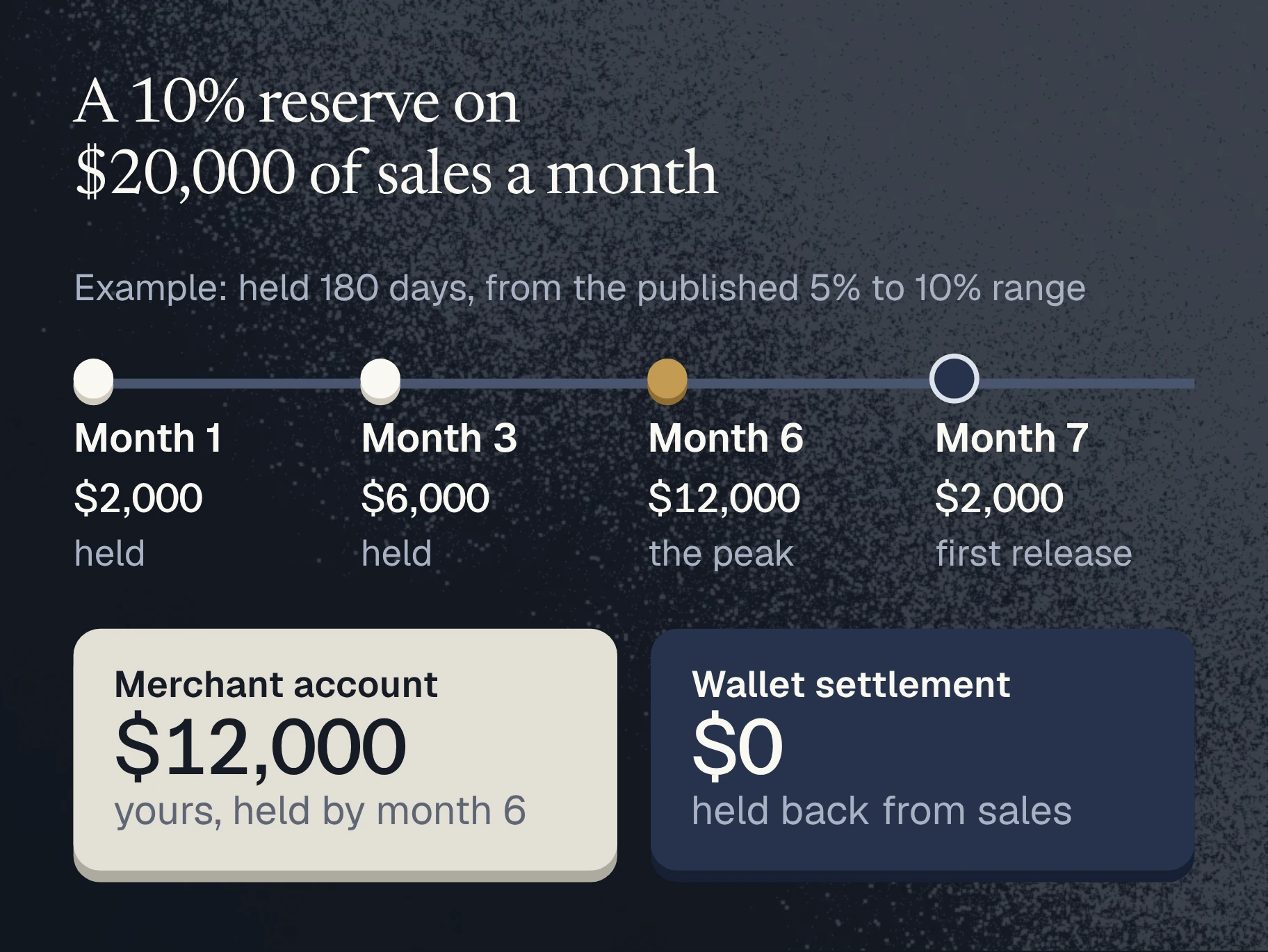
The reserve is the line that changes cash flow most. At 10% held for 180 days, $2,000 of each month's sales stays with the processor; by the end of month six the reserve holds $12,000 of your money, and only in month seven does the first month's share start coming back. A dispute costs a further $15 to $25 in fees at Durango's published rate, on top of the sale amount taken back.
The gateway column has its own unknown. Because the provider's fee and exchange rate come out of the USDC that arrives, the amount in your wallet for a $50 order is below $50 by more than Railbed's two fees, and only a live order shows you by how much. The fair comparison is one small live sale on each rail, then the amounts that actually reached your bank and your wallet.
Choose a merchant account if
A merchant account is the better choice when underwriting is a hurdle you can clear and the features it adds matter to you. That usually means:
- You have clean history and paperwork. Three to six months of statements, any licence your trade needs and a chargeback rate under 1%, which Durango marks as "approval-ready", are what underwriting looks for.
- You bill customers by charging a saved card. Merchant accounts support recurring billing on the card; PaymentCloud's FAQ says its gateway "supports recurring billing, subscription management, and flexible billing cycles." Railbed never stores a card: its subscriptions issue an invoice each period that the customer pays themselves.
- Every buyer must finish on your own page. A merchant account puts the card form on your checkout. A card-to-crypto checkout sends the buyer to the provider's page in a new tab, where the provider may ask for ID and a card can still be declined.
- You sell in person. Merchant-account providers such as PaymentCloud supply card readers; Railbed is checkout on the web.
- You want dollars in a bank without a conversion step, and a stablecoin wallet is one more thing you'd rather not run.
Choose a card-to-crypto gateway if
A card-to-crypto gateway is the better choice when the merchant account is not available to you, or what it holds back is more than you can carry. That usually means:
- You were turned down, closed or listed. A MATCH listing stays active for five years and most processors reject listed businesses, and Durango says its reserves run higher after a shutdown or termination.
- You have no processing history or don't meet a volume floor. There's no statement to send and no minimum month.
- Cash flow matters more than the last point of fee. Nothing is held back, and each sale settles to your wallet as soon as its forwarding is reported, with no payout schedule to wait for.
- A dispute shouldn't reach into your account. Card disputes are raised with the provider that charged the card, and settled sales can't be pulled back from your wallet. A provider can still contact you, decline future payments from a buyer or region, or act under its own terms, and you should keep delivery records as you would anyway.
- Your typical order is about $10 or more. Providers set their own minimums; the smallest card payment is about $2, and prices of about $10 or more give buyers the widest choice of provider. The buyer experience guide shows what a buyer sees.
Run both if
Running both is often the soundest choice, because the two rails fail in different ways. A merchant account can be closed or put under a larger reserve after a bad month; a card-to-crypto route depends on providers that set their own country lists, minimums and ID checks, and any provider may withdraw. A second rail that is already live keeps you selling while either one changes.
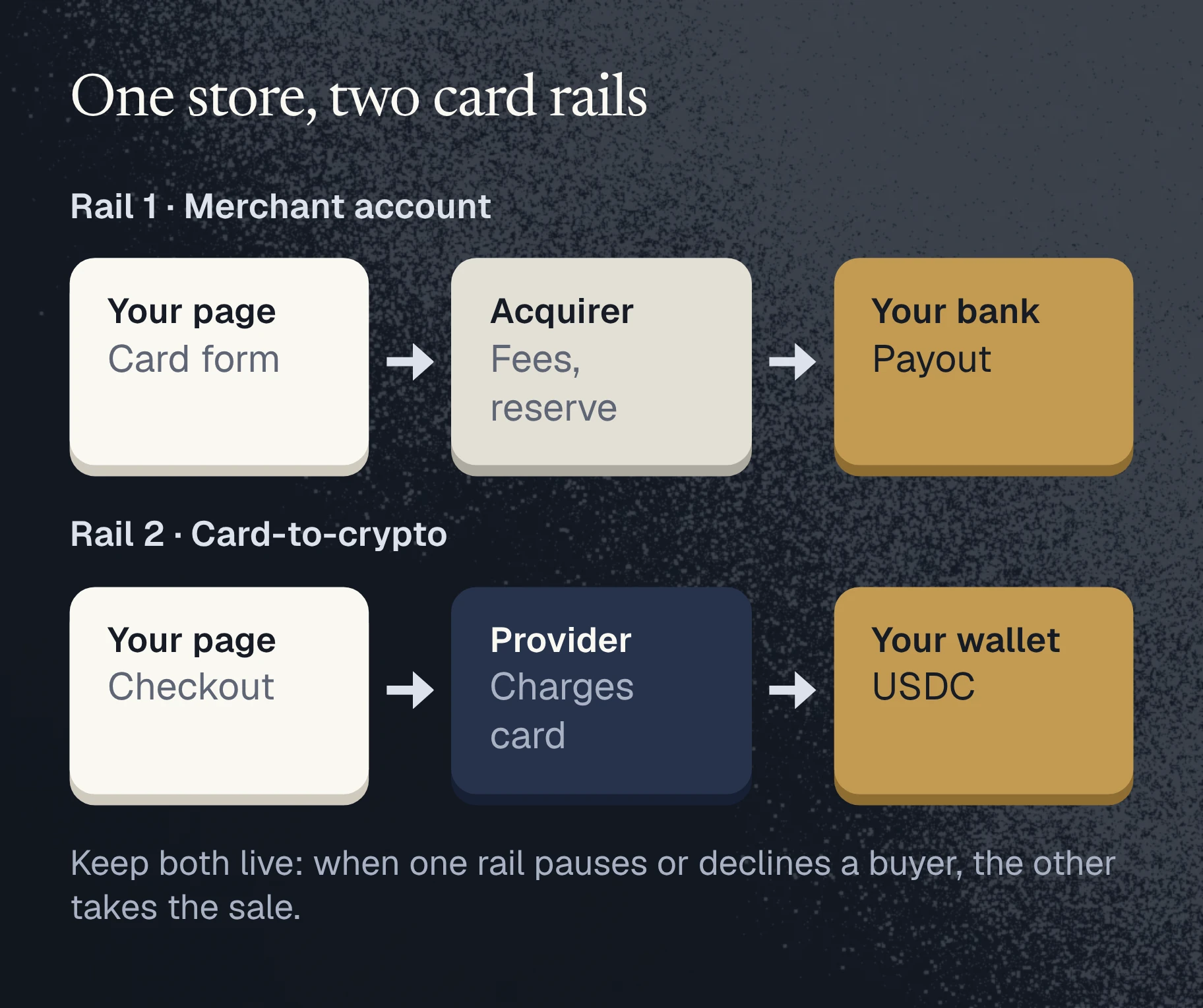
The common arrangements are these:
- While an application is pending. Sell through the gateway from day one, then add the merchant account when it is approved.
- Under a heavy reserve. Put part of your volume, or one product line, on the gateway so less of each month's revenue sits in the reserve.
- As the backup. Keep a gateway checkout ready for the day the merchant account is paused. Railbed's earlier article on preparing a backup processor covers the switch.
Read your merchant agreement before you route some sales elsewhere, in case it sets terms on where you process. Describe your business honestly to every provider: a second rail is a backup, not a way to hide what you sell from the first.
Where Railbed fits, and where it doesn't
Railbed fits a business that mainstream processors turn away, or one that wants a second card rail, when it wants card checkout working the same day, nothing held back and the money in a wallet it controls. It is card first, with direct crypto payments as an opt-in extra.
It is not the right fit for saved-card billing, for card readers at a counter, or for a business that needs payouts straight to a bank account with no conversion step. It doesn't promise that a buyer won't be asked for ID: Smart Routing ranks the providers least likely to ask first, and the providers decide. A card can be declined on the provider's page, and an order below every provider's minimum has no route. If your business can pass underwriting and needs those features, a merchant account answers them better.
FAQ
Can I get a high-risk merchant account while I'm on the MATCH list?
Sometimes, but it is hard for the five years a listing stays active. Stripe's documentation says a listing "generally disqualifies" a merchant from processing with Stripe, and a provider that does take you after a termination is likely to set a higher reserve. Railbed's article on MATCH-listed merchants covers the options.
How are disputes counted if I use both rails?
Disputes on merchant-account sales count toward that account's chargeback ratio and the card networks' monitoring programs. Disputes on card-to-crypto sales are raised with the provider that charged the card, under its rules and the card networks'. Railbed's article on card payments that settle as USDC explains that path.
{"heading": "Put a second card rail live today", "description": "Sign up with an email, your website and a payout wallet, take a test payment in Test mode, then share a Live checkout beside your current processor.", "buttons": [{"label": "Create your account", "url": "https://app.railbed.io/signup"}, {"label": "See how a payment works", "url": "https://railbed.com/docs/how-it-works/"}]}