What does 2.9% + 30¢ really cost? Flat rate, interchange-plus and high-risk pricing, worked out
The same $12, $100 and $1,000 orders priced at 2.9% + 30¢, on interchange-plus from Visa's own schedule, and on a published high-risk range, with where each model wins.
Press the card to run an example sale.
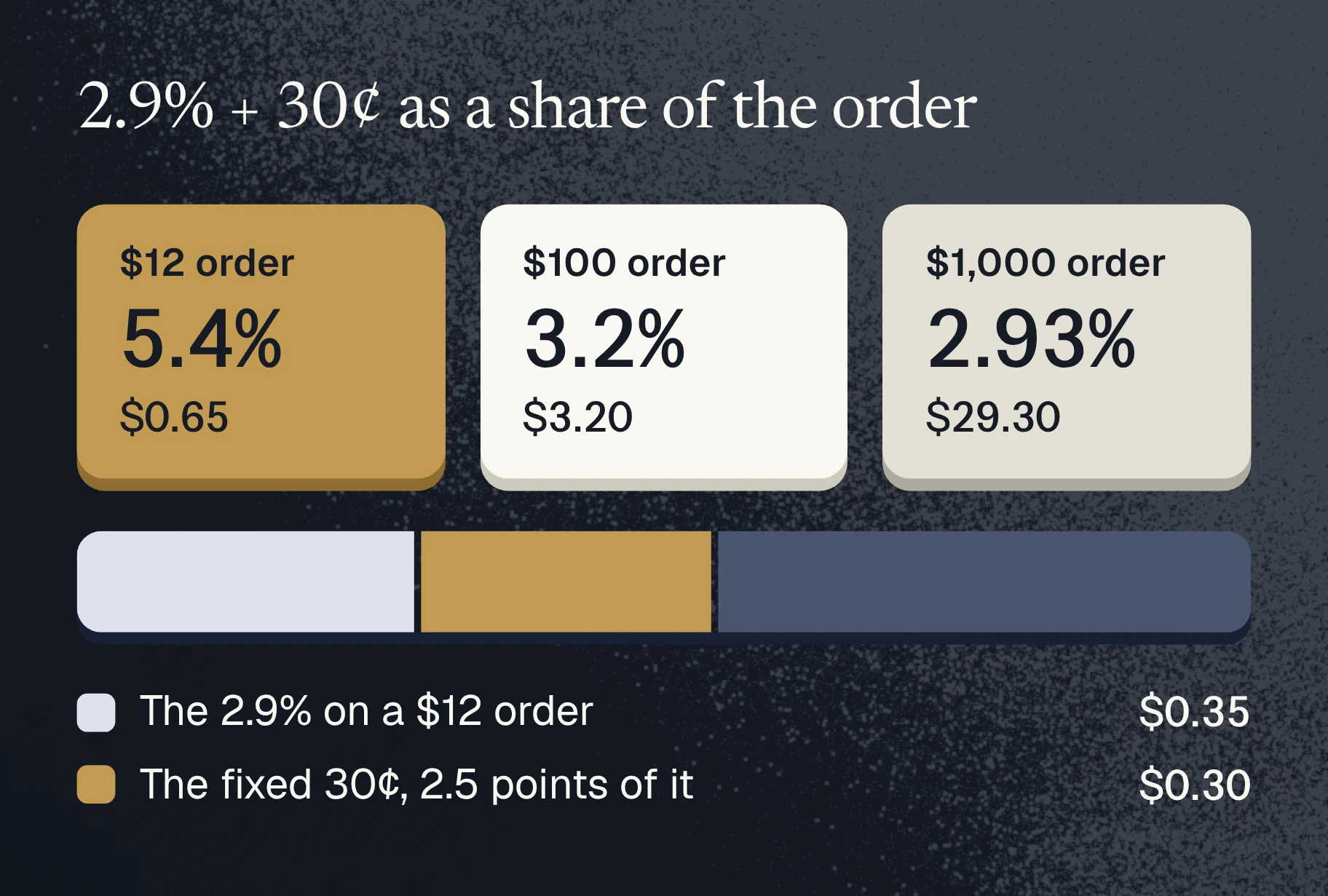
On a US card sold online, 2.9% + 30¢ costs $0.65 on a $12 order, $3.20 on a $100 order and $29.30 on a $1,000 order. Interchange-plus can cost far less on debit cards and more on premium rewards cards, and a high-risk quote can land on either side of the flat rate, plus a reserve.
Below, the same three orders are priced under each model with rates read on November 23, 2026: Stripe's published flat rate, Visa's US interchange schedule of 24 October 2026 with Helcim's published markup, and Durango Merchant Services' published high-risk ranges. The arithmetic is shown so you can redo it with your own order sizes and card mix.
The three orders, side by side
The flat rate is one number per order; the other two models are ranges, because interchange depends on the card and a high-risk quote is set after approval. This table shows what each model charges on each order, before dispute fees and reserves.
| Order | Flat 2.9% + 30¢ | Interchange-plus (example) | High-risk range |
|---|---|---|---|
| $12 | $0.65 (5.4%) | $0.55 to $0.73 | $0.38 to $0.84 |
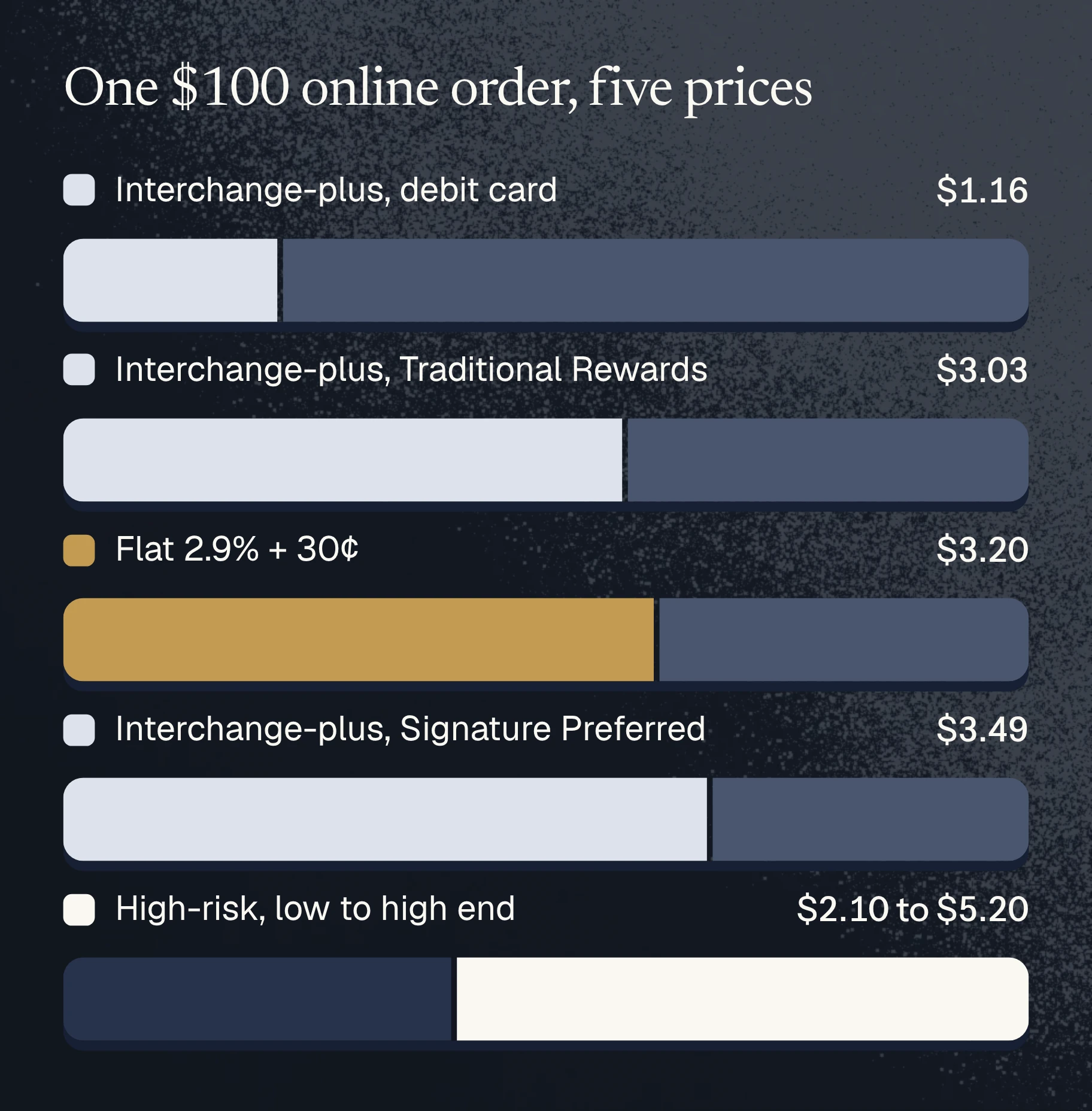
| $100 | $3.20 (3.2%) | $1.16 to $3.49 | $2.10 to $5.20 |
| $1,000 | $29.30 (2.93%) | $7.37 to $31.75 | $19.65 to $49.75 |
The interchange-plus column runs from a large bank's debit card to a Visa Signature Preferred credit card, with Helcim's markup for a store processing up to $50,000 a month. The high-risk column is the low and high end of one processor's published ranges. The sections below show where every figure comes from.
How 2.9% + 30¢ adds up
The flat rate is a percentage of the sale plus a fixed 30 cents, and the 30 cents is what makes small orders expensive. Stripe's pricing page lists "2.9% + 30¢" "per successful transaction for domestic cards" as of November 2026.
- $12: 2.9% of $12 is $0.348 (about $0.35), plus $0.30, is $0.65. That is 5.4% of the order, and the fixed fee alone is 2.5 points of it.
- $100: $2.90 plus $0.30 is $3.20.
- $1,000: $29.00 plus $0.30 is $29.30, or 2.93%.
The same page lists the add-ons that change those figures: "+ 1.5%" "for international cards", "+ 0.5%" "for manually entered cards" and "+ 1%" "if currency conversion is required". A $100 order on a card issued abroad is 4.4% plus 30¢, or $4.70. A dispute adds a "Dispute received fee" of $15.00, and responding to it adds a "Dispute countered fee" of another $15.00 that you "get back for won disputes". Stripe also offers "IC+ pricing" on custom plans, so the flat rate is the default, not the only choice.
How interchange-plus adds up
Interchange-plus passes the card network's wholesale cost through and adds the processor's own markup on top, so the price changes with every card. A merchant on this model pays three layers.
- Interchange, set by the card network and paid to the bank that issued the card. Visa's schedule is explicit about who pays it: "Merchants do not pay interchange reimbursement fees; merchants pay 'merchant discount' to their financial institution." Interchange-plus is how that discount gets itemized.
- Network fees, charged by Visa or Mastercard for using the network. Visa's interchange schedule doesn't list them. Clearly Payments' interchange page, a processor's page, gives "~0.14%" for Visa's assessment and "Often ~$0.02–$0.10" for per-transaction network fees, and calls them "approximate network fees". They are one processor's estimates, not a schedule Visa publishes, so the worked example below uses 0.14% and leaves the per-transaction fees out.
- The processor's markup. Helcim publishes "Interchange+ 0.50% + 25¢" for keyed and online sales at "$0 - $50K" a month, falling to "Interchange+ 0.15% + 15¢" at $1 million to $5 million, with the tier set by "the average of your last three months of processing volume".
This table prices the $100 order on four Visa consumer cards sold online. The credit rates are, for example, the "Product 1" card-not-present rates in Visa's 24 October 2026 schedule; the same schedule has other card-not-present programs (recurring, services, travel and more) with their own rates, and which one a sale gets depends on the merchant and the transaction. Each total adds Helcim's lowest-tier markup ($0.75 on $100) and the 0.14% example network fee ($0.14).
| Visa card, sold online | Interchange on $100 | Total on $100 |
|---|---|---|
| Regulated debit: 0.05% + $0.21, plus $0.01 | $0.27 | $1.16 |
| Traditional Rewards credit: 2.04% + $0.10 | $2.14 | $3.03 |
| Signature Preferred credit: 2.50% + $0.10 | $2.60 | $3.49 |
| Non-Qualified Consumer Credit: 3.15% + $0.10 | $3.25 | $4.14 |
"Regulated" debit is Visa's name for cards whose interchange is limited by the Federal Reserve's Regulation II. The Federal Reserve's page says "Certain small debit card issuers, government-administered payment programs and reloadable general-use prepaid cards are exempt from the interchange fee limitations", and its small issuer list draws the line at "reported assets of $10 billion or more": those issuers are not exempt. Visa's extra cent goes to issuers "that certify to Visa their compliance with the interim fraud prevention standards". A debit card from a smaller bank is exempt and costs more online: 1.65% + $0.15 on Visa's "CPS/Card Not Present, Debit" line, for example. The non-qualified line is what a sale falls to when it misses a rate's conditions.
Run the same cards through the other two orders and the pattern holds. On $12, the debit card costs $0.55, Traditional Rewards $0.67 and Signature Preferred $0.73, so only debit beats the flat $0.65: Helcim's 25 cents plus Visa's 10 cents is more fixed fee than 30 cents. On $1,000, debit costs $7.37, Traditional Rewards $27.15 and Signature Preferred $31.75, against $29.30 flat.
Two things in Visa's schedule can lower these totals. Card-not-present incentives of "-0.05%" to "-0.15%" apply to token and authentication-program transactions that qualify. And a separate Small Merchant table lists lower rates for merchants with up to "$280,000" of "Gross Visa Consumer Credit Sales" over twelve months: "Small Merchant Product 1" is 1.73% + $0.10 on a Traditional Rewards card, which brings the $100 order to $2.72. Which sales qualify is set in Visa's qualification guide, so ask your processor whether it passes these rates through.
How a high-risk quote adds up
A high-risk merchant account is priced as a discount rate, a fee per authorization and a reserve, and the published figures are ranges, not quotes. Durango Merchant Services' high-risk page, updated November 2026, says most of its high-risk accounts run within these ranges: a discount rate of "1.95%–4.95%", "$0.15–$0.25 per authorization", chargeback fees of "$15–$25 each", and a rolling reserve of "5%–10% typical, held 90–180 days". It says plainly: "Ranges, not quotes. Your exact pricing is set once you qualify and is written into your offer before you sign."
Taking the low end of both ranges and then the high end:
- $12: $0.38 to $0.84.
- $100: $2.10 to $5.20.
- $1,000: $19.65 to $49.75, and $50 to $100 of the sale held back.
The page doesn't say whether the discount rate is the whole price or a margin over interchange, and the answer changes the comparison: a 1.95% total would sit below Visa's own interchange on many credit cards. Ask for the structure in writing. The same page lists "$5,000/month U.S." as minimum processing, "Free" for the application and no early termination fee on US accounts.
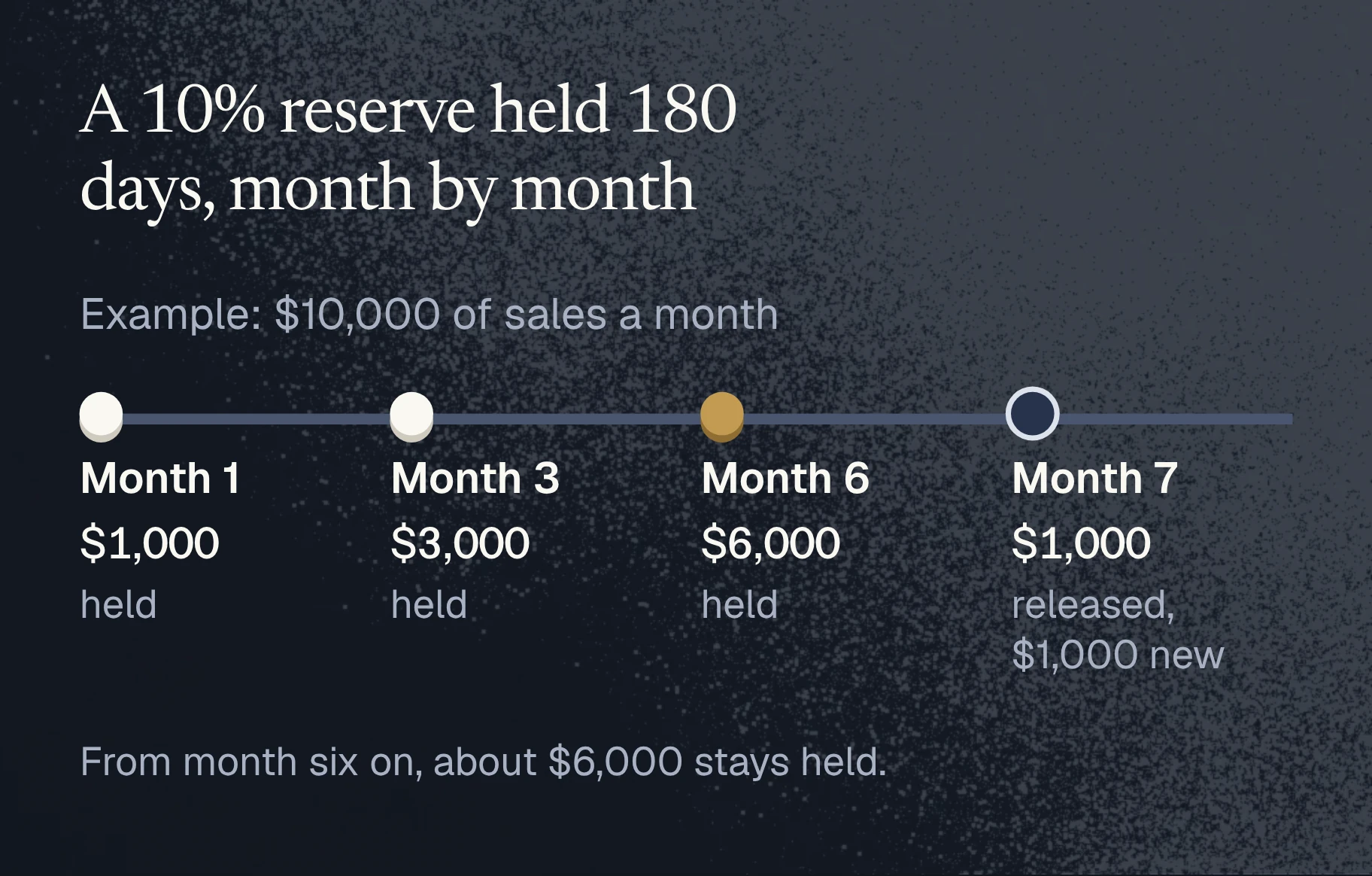
The reserve is the part the per-sale arithmetic hides. Take an example store selling $10,000 a month with a 10% reserve held 180 days: $1,000 is held from each month's sales, $3,000 is held by the third month, nothing comes back until the seventh month, and from then on about $6,000 of its own money is held at any time. How reserves work month by month is in how rolling reserves change your cash flow.
Where each model wins
Each model wins on a different mix of order size, card type and approval, and the arithmetic above shows where the lines fall.
- The flat rate wins on small orders paid with credit cards, on premium rewards cards at any size, and when you'd rather not read a statement line by line. Its 30 cents is less fixed fee than the 35 cents (Helcim's 25 plus Visa's 10) on the credit cards above.
- Interchange-plus wins when many buyers pay by debit, when orders are large, and as volume rises and the markup falls. It is also the model under which Visa's small-merchant and incentive rates can reach you, if your processor passes them through.
- A high-risk account wins only when the first two say no. Compare it on the full bill: the rate, the fee on every authorization, the reserve and the dispute fees. How to compare high-risk processor fees lists the questions to ask, and why merchant account applications are declined covers what got you there.
Whatever the model, a lost dispute costs more than the fee on the sale. Stripe's $15 dispute fee and Durango's $15 to $25 are only part of it, as what a chargeback really costs works out.
Where Railbed fits
Railbed is priced on none of these three models, so it sits outside the table above. Buyers pay by card on an independent, licensed card provider's own page, and fees come out of what arrives: the provider's own fee and exchange rate, "shown to the buyer on the provider's page before they pay", a 1% network fee, and the Railbed fee, "from 0.9% of each sale", shown in your dashboard before any payment starts. There is "no setup fee, no monthly fee, no reserve", and there is no underwriting and no application to pass. The provider's fee varies by provider, amount and country, so there is no single all-in figure to quote; what a $100 order costs paid to your own wallet walks through every line. How it works shows the payment from start to finish.
It fits a business that has been turned away by mainstream processors, or that would otherwise face a reserve, and that is set up to receive sales in its own wallet. Sales settle there as digital dollars (USDC), and moving them to a bank is your own step. Railbed is web checkout, built for online sales.
See the fees on a real payment first
Create a checkout in Test mode and simulate a payment before any real card is charged. The Railbed fee for your account is shown in your dashboard before any payment starts, with no setup fee, no monthly fee and no reserve.
Read how it worksCreate an account