Why was my merchant account application declined, and what do underwriters look for?
An underwriter's checklist built from the OCC handbook, Visa's rules and FinCEN's ownership rule: seven checks, what a decline on each means, and what you can honestly do next.
Press the card to run an example sale.
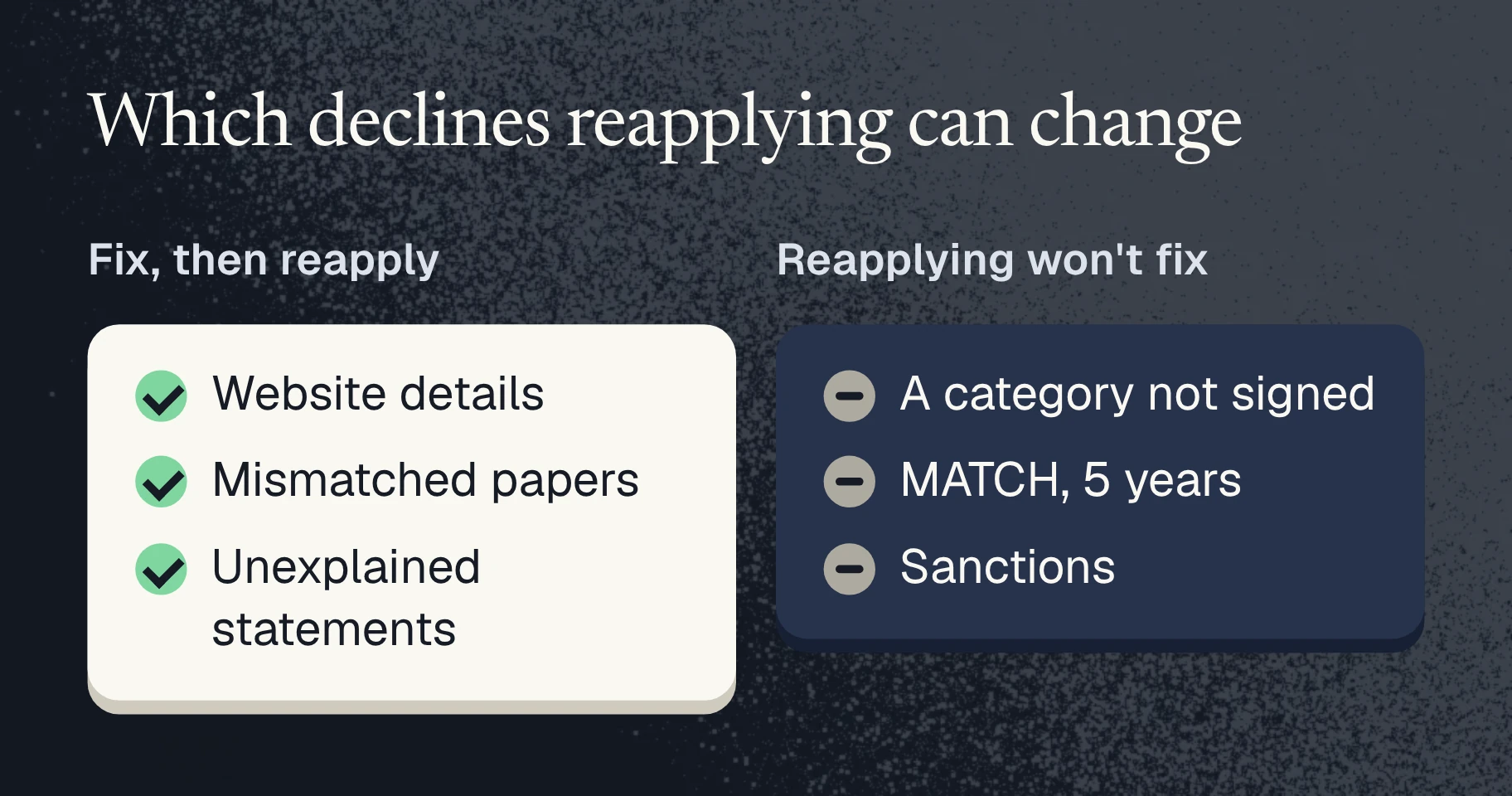
A merchant account application is declined when the acquiring bank's underwriting finds a risk it won't carry: what you sell, weak credit, a past termination on the MATCH list, a chargeback history, or a website missing what card network rules require. Some can be fixed before you reapply; others no reapplication will change.
The checklist below is built only from what regulators and the card networks tell acquirers to check: the OCC's Merchant Processing handbook (its guidance for national banks and their examiners, version 1.0 of August 2014), Visa's Core Rules and Product and Service Rules of 24 October 2026 and FinCEN's beneficial-ownership rule. For each check it says what a decline on it means and what you can honestly do next. It is written for US online businesses.
The checklist at a glance
The rules point underwriters to seven checks. This table lists each check, the rule behind it, and whether you can usually fix a decline on it.
| What the underwriter checks | Rule behind it | Can you fix it? |
|---|---|---|
| Who owns and controls the business | FinCEN 31 CFR 1010.230 | Yes, with matching documents |
| What you sell and its category code | OCC handbook; Visa Core Rules 1.5.1.3 | Not by relabeling |
| Owner and business credit | OCC handbook; Visa 1.5.1.3 | Slowly |
| MATCH and other terminated-merchant lists | OCC handbook; Mastercard MATCH | Rarely |
| Processing statements and chargebacks | OCC handbook | Partly, by explaining |
| Your website | OCC handbook; Visa 5.8.4.1, 5.4.2.5 | Yes, usually fast |
| Delivery timing and sanctions | OCC handbook; Visa 1.5.1.3 | Depends |
The seven checks, one by one
Each check below quotes the rule, then says what a decline on it means and what to do.
1. Who owns and controls the business
A bank must know who owns and controls a business before it opens an account for it. FinCEN's customer due diligence rule defines a beneficial owner as each individual who "owns 25 percent or more of the equity interests of a legal entity customer", plus one individual "with significant responsibility to control, manage, or direct" it, and requires banks and other covered financial institutions to keep written procedures "reasonably designed to identify and verify beneficial owners of legal entity customers".
A decline here means something didn't match: a legal name that differs from the bank account, an owner left off, an address that doesn't verify. What you can do: make the legal name, tax ID, owners and addresses identical across the application, the bank letter and your formation papers, then reapply.
2. What you sell, and the category code it gets
The acquirer must understand your business well enough to classify it. The OCC handbook lists "adequate understanding of the merchant's business to ensure that it is classified under the merchant category code" as a minimum standard, and notes that "most acquiring banks compile lists of prohibited or restricted merchants". Visa's merchant qualification standards (rule 1.5.1.3) require a merchant "not engaged in any activity that could cause harm to the Visa system or the Visa brand".
A decline here means this acquirer doesn't sign your kind of business, whatever your numbers. What you can do: apply to an acquirer that does, and be ready for a reserve. Never describe the business as something else or ask for another category code. Visa's rule 10.10.1.1 makes an acquirer list a terminated merchant that "deposited Transaction Receipts representing sales of goods or services generated by another Merchant (laundering)", and Visa's screening list has a reason code, "Transaction Laundering", for a merchant that "misrepresented the source of submitted transactions", as Stripe's summary of the lists shows. The networks' own high-risk categories are in what makes a business high risk.
3. Owner and business credit
The acquirer carries your chargebacks if you can't pay them, so it checks your credit: in the OCC handbook's words, chargebacks "become a credit exposure to the acquirer when either the merchant or ISO/MSP declares bankruptcy or is otherwise financially unable to pay." The handbook asks for "credit bureau reports, as allowed by the Fair Credit Reporting Act, on the principal of the business", a "financial statement or credit reports on the business" and "verification of trade and bank references", and says the bank should reject a merchant with "weak financial condition". Visa's rule 1.5.1.3 asks the same in two words: the merchant must be "Financially responsible".
A decline here means the owner's or the company's credit made losses look unrecoverable. What you can do: read your own reports first. The FTC says the three bureaus let you check each report "once a week for free" at AnnualCreditReport.com, and that you can dispute errors with the bureau and the company that reported them. Fix what's wrong and pay down what you can before you apply again.
4. MATCH and other terminated-merchant lists
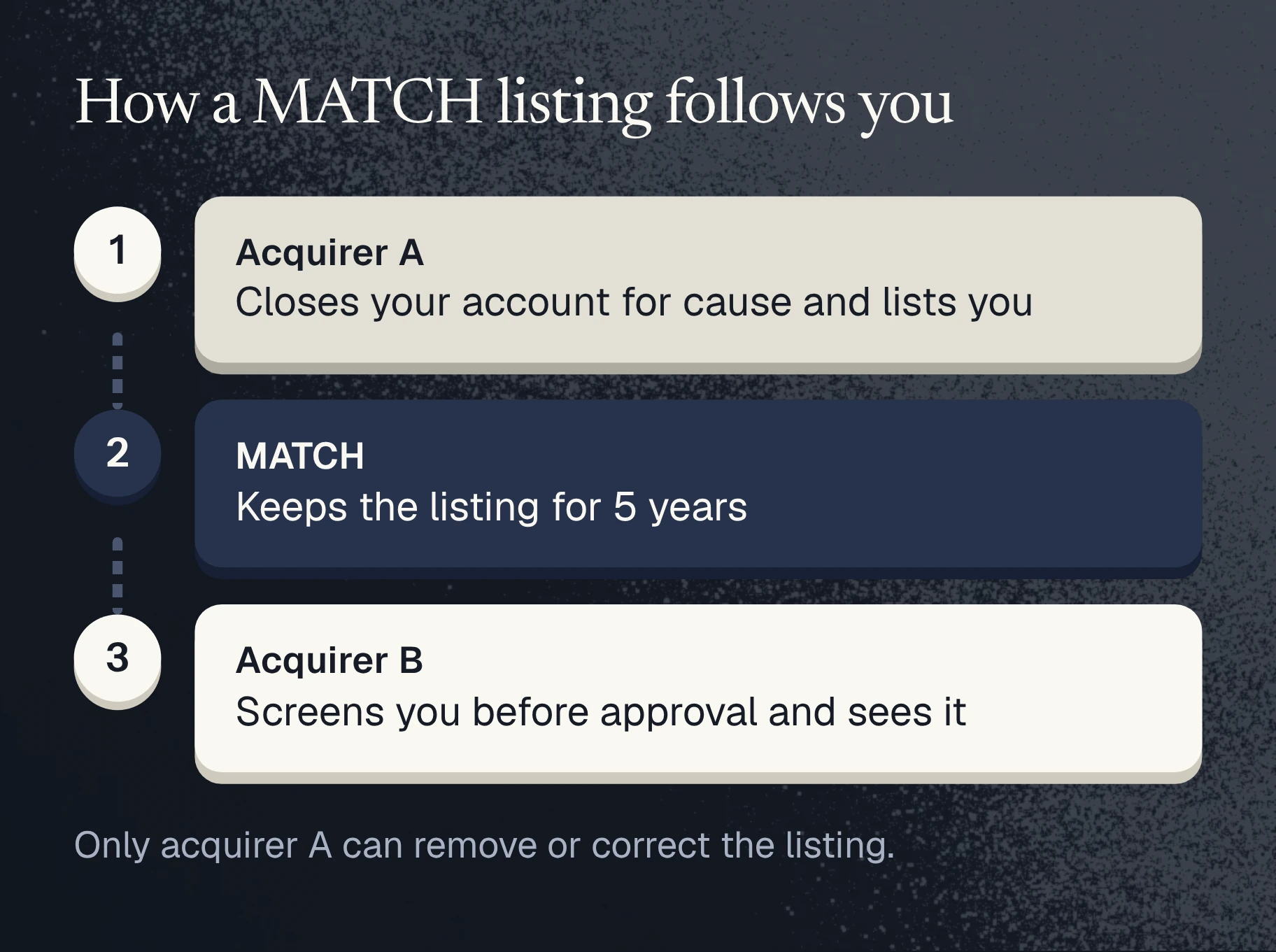
Every acquirer screens you against the lists of merchants other acquirers closed for cause. The OCC handbook lists, among its minimum underwriting standards, "evidence that the merchant is not on OFAC's Specially Designated Nationals List (SDN List) or the bank card industry's Member Alert to Control High Risk Merchants (MATCH) list", and calls those checks "standard industry practice". Stripe's guide to terminated merchant files says "Listings remain active for 5 years" and "Only the specific acquiring bank that initiated the listing can request a removal or correction."
A decline here means a past termination, yours or a principal owner's, is following you. What you can do: find out who listed you and why. Stripe's page says "If the listing acquirer is unknown, merchants can email Mastercard directly at matchbusinessowner@mastercard.com to request their listing details." It adds that an acquirer can remove a MATCH listing only if it was made in error or, for the PCI reason code, after it verifies the merchant "has achieved full compliance". Visa runs its own list: rule 10.10.1.1 requires acquirers in the US and other regions to add a terminated merchant to it. In most of Asia Pacific, in CEMEA and in Europe, Visa's rule 10.17.1.1 adds that an acquirer "must not refuse to enter into a Merchant Agreement based solely on information held on the VMSS"; we found no such line for US acquirers. The options left after a listing are in can a high-risk processor accept a MATCH-listed merchant.
5. Your processing statements and chargebacks
Your last processor's statements show the underwriter how your sales behave. The OCC handbook asks for "analysis of the merchant's activity based on recent monthly statements from the merchant's current or most recent processor, if available", and says the bank should reject a merchant with "a history of substantial charge-back volumes".
A decline here means your statements showed disputes, refunds or volume swings the acquirer read as risk. What you can do: send the statements with a short written explanation of any spike and what you changed since. A new business without statements is judged on the other checks. The ratios the networks treat as excessive are in what chargeback ratio gets an account shut down.
6. Your website
Underwriters read your site against a list, and a missing item is a decline you can fix yourself. The OCC handbook says a bank's underwriting standards for internet merchants should require that the following "must appear on the Web site": a customer service number, the actual operating entity's name if you use an alias, an email address, a statement on security controls, "delivery methods and timing", "refund and return policies" and privacy statements. Visa's rule 5.8.4.1 adds:
- Customer service contact, "including email address or telephone number".
- The country of your business displayed "on the same screen view as the checkout screen" or within the checkout pages. "A link to a separate web page does not meet this requirement."
- The address for cardholder correspondence.
- Your policy for delivery of multiple shipments.
If you restrict returns or cancellations, rule 5.4.2.5 requires disclosure "during the sequence of pages before final checkout" with a "'click to accept' button, checkbox, or other acknowledgement".
A decline here means the site failed that list, or showed products the application didn't mention. What you can do: add every item, and make the site match the application.
7. Delivery timing, location and sanctions
The longer you hold a buyer's money before delivering, the longer the acquirer is exposed. The OCC handbook explains that for goods or services sold for future or delayed delivery, "customer disputes are not triggered until the date of delivery", and that "many banks use holdback or reserve accounts" for higher-risk merchants. Visa's standards also require a merchant "operating within an allowed jurisdiction".
A decline here means your delivery window, location or a sanctions match made the risk too long or not allowed. What you can do: shorten pre-orders and delivery promises if the business allows it, or accept an offer with a reserve; how reserves change your cash flow shows what that costs. A sanctions or jurisdiction decline isn't something an application can fix.
What to do after a decline, in order
Act on a decline in this order: the cheapest fixes first, then the checks that decide whether reapplying anywhere is worth it.
- Ask which check failed, in writing. The processor may not say, but a named reason saves guessing.
- Fix the documents and the website. Checks 1 and 6 are fully in your hands.
- Pull your credit reports and ask about any MATCH listing. The reports are free each week; for MATCH, ask the acquirer that closed you, or email Mastercard's address above. Both decide whether reapplying anywhere is worth it.
- Reapply to the same acquirer if what failed is now fixed, with a note saying what changed.
- Go to an acquirer that signs your category if check 2 or 4 failed, and compare its offer on the full price, reserve included. What 2.9% + 30¢ really costs works out how a high-risk quote compares.
- Consider a model with no application at all if the answer keeps coming back no.
Why Railbed fits a business that keeps getting declined
Railbed is card checkout for online merchants that mainstream processors turn away, with no underwriting and no application to pass. Sign-up needs an email, your website and a payout wallet, with no credit check and no documents, and a past closure or MATCH listing "doesn't rule you out". Buyers pay by card on an independent, licensed card provider's own page, and each sale settles to a wallet you control as digital dollars (USDC). Nothing is held back from your sales, and settled sales can't be pulled back from your wallet; card disputes go to the provider that charged the card. Getting started shows the setup.
Good to know. The acceptable use policy holds the limits the law sets: child sexual abuse material and non-consensual content, money laundering and terrorist financing (including splitting payments), and sanctions. Licenses, age checks and tax remain yours, and Railbed doesn't check them for you. A card can still be declined on the provider's page: Railbed's own guide says "Best match is a recommendation, not an approval guarantee."
It fits an online business that keeps getting declined and is ready to receive sales in its own wallet and move them to a bank itself. Card checkout to your wallet or a high-risk merchant account compares the two side by side.
FAQ
Does a declined application go on MATCH? Not for the decline itself. Stripe's guide says acquirers report merchants "they terminate for fraud, severe policy violations, or excessive chargebacks", and Visa's rule 10.10.1.1 is written for terminated merchants. A declined application is not a termination.
Will a processor tell me why I was declined? Not always. We found nothing in the rules above that requires an acquirer to explain a US decline, though in most of Asia Pacific, in CEMEA and in Europe Visa requires an acquirer to tell a merchant in writing when it lists the merchant on VMSS. Ask anyway, in writing.
Can I get approved with bad credit? Sometimes, on other terms. The OCC handbook says "The depth of the initial review should match the level of risk the merchant poses" and that "Many banks use holdback or reserve accounts to mitigate credit risk on higher-risk merchants", so weak credit can mean a reserve rather than a flat no. Each bank sets its own criteria in its underwriting policy, so the same file can pass at one and fail at another.
Declined again? See what sign-up asks for
Railbed sign-up needs an email, your website and a payout wallet, with no underwriting and no application to pass. Try it in Test mode first.
Read getting startedCreate an account