ACP, AP2, x402 and MCP: which of them change how a merchant is paid by card today?
ACP and AP2 change who starts a checkout and what proof comes with it. x402 isn't a card rail today, and MCP moves no money. Each read from its own spec.
Press the card to run an example sale.
None of the four changes how a card payment settles today. ACP and AP2 change who starts a checkout and what proof of the buyer's consent comes with it, while the card is still charged through the merchant's own processor. x402's documented flow moves stablecoins over HTTP rather than cards, and MCP connects AI assistants to tools; it moves no money itself.
That answer matters most to a merchant whose processor said no, because each protocol quietly assumes you already have one. This article reads each protocol from its own specification or maintainer, as of November 2026, and asks four merchant-side questions: who proposed it, what it standardizes, what you would have to build, and whether the card payment itself is any different.
The four protocols side by side
Each protocol answers a different question, which is why the comparisons that line them up as rivals confuse more than they help. The table below takes each one from its own site or specification, read on 23 November 2026.
| Protocol and who proposed it | What it standardizes | What a merchant builds | Does the card payment change? |
|---|---|---|---|
| ACP: Stripe and OpenAI | Checkout between an AI agent and a business, and passing a payment credential | Checkout endpoints, a product feed, and a way to charge a delegated token | No. A compatible processor charges the card; you stay merchant of record |
| AP2: Google | Signed mandates proving what the user approved | Signing the cart you offer, and accepting the mandates as evidence | No new rail. Cards first; your processor sends the transaction to the network |
| x402: Coinbase | Payment inside an HTTP request, using status 402 | Middleware that answers 402 with a price, and a facilitator to verify and settle | Not a card payment today. Stablecoins to an address you control |
| MCP: Anthropic | How AI applications connect to tools and data | An MCP server for your tools, if you want assistants to use them | No. It moves no money itself |
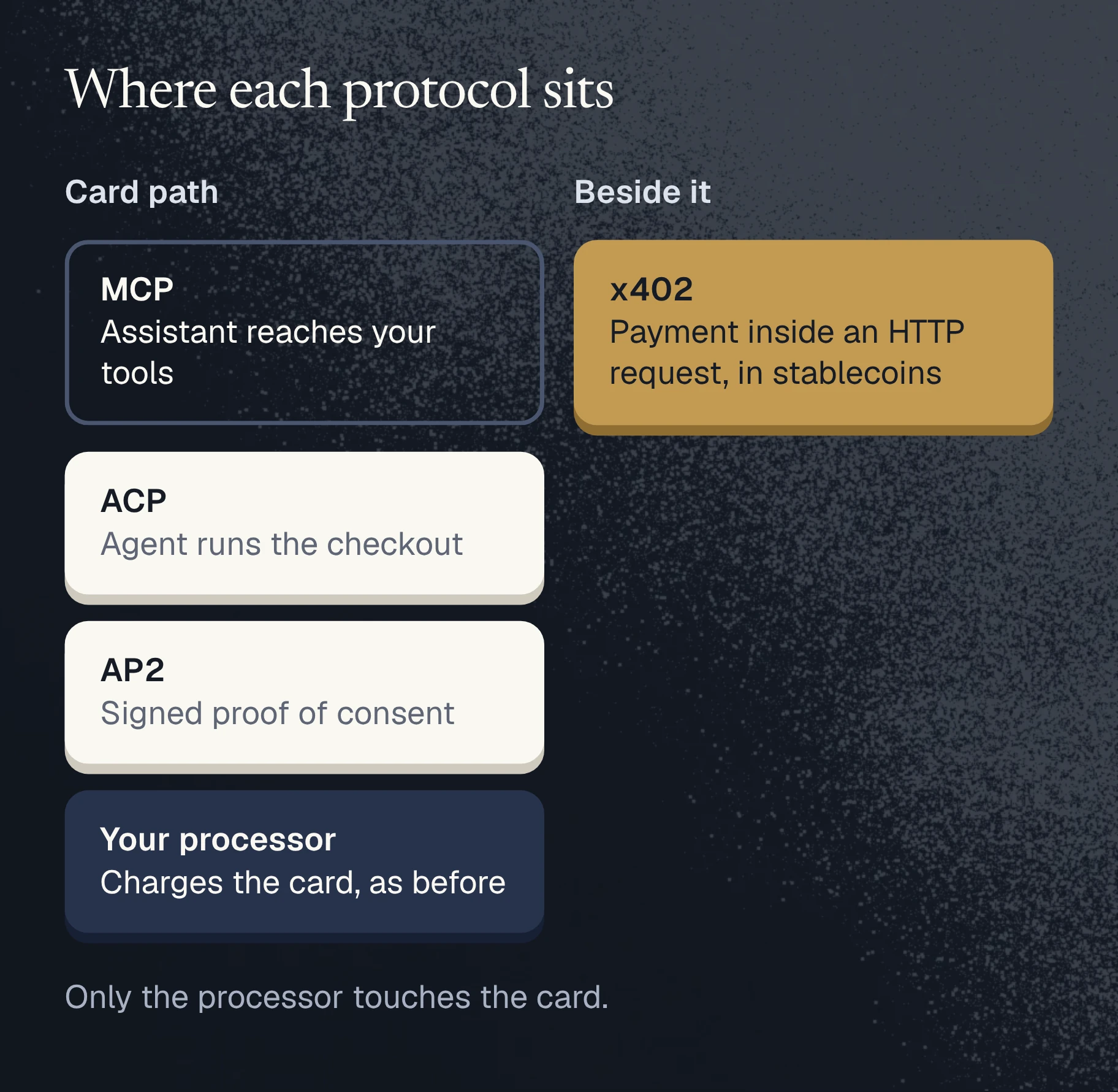
ACP: an agent runs the checkout, your processor charges the card
The Agentic Commerce Protocol is a checkout standard. Its official site says "Stripe and OpenAI developed the Agentic Commerce Protocol to define a common language for how agents and businesses transact", and its GitHub repository says the specification is "maintained by OpenAI and Stripe and is currently in beta", with its latest release dated 2026-04-17. The sources disagree on who made it: Stripe's own ACP page calls it "an open standard created by Stripe, OpenAI, and Meta", while the protocol's site and repository name only Stripe and OpenAI.
Stripe's page lists five building blocks: agentic checkout ("Create, update, and complete checkout sessions"), a cart and product feed, delegated payment, which passes "payment tokens between buyers, agents, and businesses", delegated authentication with OAuth 2.0, and orders and webhooks for updates after the sale. ACP's site says a business can publish its checkout configuration "with a traditional API or MCP", and the 2026-04-17 release added MCP to the specification. The site also promises that "businesses maintain their customer relationships as the merchant of record" and "can use ACP with any compatible PSP", with Stripe as "the first compatible PSP with its Shared Payment Token."
The money side is where a turned-away merchant should look closely. Stripe's shared payment token docs mark the tokens as a public preview, tell the seller to create a Stripe account if it doesn't have one, and say tokens are available "in the US, Canada, and select European countries". ACP's site adds that "OpenAI is the first AI platform to implement ACP with ChatGPT" and that a business that wants to sell in ChatGPT has to apply. A seller can charge the token with Stripe or resolve it into card credentials for a third-party processor, but either way a card is charged through a card processor, under that processor's rules. ACP adds a new front door; it doesn't add a new way to be paid.
AP2: proof of consent travels with the payment
The Agent Payments Protocol answers a trust question rather than a checkout one: did the user really authorize this agent to buy this? Google announced it in September 2025, and the AP2 site says "Standardization of the specification will continue within the Agentic Authentication Technical and Payments Technical Working Groups in FIDO."
AP2's core is two mandates. The Checkout Mandate captures what the user agreed to buy, and the Payment Mandate "Authorizes a payment against a specific payment instrument". The AP2 overview gives the merchant two jobs: "The Merchant must sign the Cart that they create for a user, signaling that they will fulfill this cart," and keep the user's signed Checkout Mandate, which "is shared with the Merchant so they can use this as evidence in case of disputes."
For the card itself, the overview is explicit that nothing new happens at the network: "The Merchant or PSP routes the transaction to the issuer or the network within which the payment method operates," and any party "may choose to challenge the transaction through existing mechanisms like 3DS2." The site adds that "the initial version supports common 'pull' payment methods like credit and debit cards", with bank transfers and digital currencies on the roadmap. The overview describes AP2 as an extension for agent-to-agent protocols, MCP and the Universal Commerce Protocol, and its published samples include x402 flows beside the card ones, so AP2 is a layer of proof that can sit on more than one rail. It gives a merchant better evidence in a dispute. It still assumes the merchant has a processor to send the card to.
x402: payment inside the request, in stablecoins
x402 is the one protocol here that is a payment rail of its own, and it isn't a card rail today. The Linux Foundation's April 2026 announcement says "The x402 protocol, created by Coinbase, is moving to the Linux Foundation", and the x402 site describes it as "blockchain-agnostic", with "Stablecoin payments" as "the primary use case" and the protocol "extensible to traditional payment methods".
A merchant adds x402 to an API or a page rather than to a checkout. Coinbase's How x402 works lays out the flow: the server answers that payment is required "and includes the price, who should receive it, and which payment options it accepts"; the client signs a payment and retries; a facilitator verifies it, the server does the work, and the facilitator settles. Coinbase's overview says sellers "receive at any address they control", including a self-custody wallet, and that "There is no checkout page, card form, or signup flow."
Here the sources disagree about cards. The x402 Foundation's launch announcement of 14 July 2026 speaks of "payment types ranging from traditional cards to stablecoins", and the protocol's GitHub repository says it "aims to support all networks (both crypto & fiat)". Coinbase's page on how it works describes a handshake that "works across chains, including EVM networks and Solana", with USDC as "the most common asset", and documents no card flow.
That makes x402 a good fit for metered APIs, data and agent-to-agent tool calls, where the payer is software holding a wallet. For a shopper paying with a card, it changes nothing yet: card support is a stated aim of its backers, not a flow anyone documents today.
MCP: how an assistant reaches your tools, not how you get paid
The Model Context Protocol isn't a payment protocol. Its own introduction calls it "an open-source standard for connecting AI applications to external systems", and likens it to "a USB-C port for AI applications". Anthropic released it, and in December 2025 donated it to the Agentic AI Foundation, a directed fund under the Linux Foundation.
For a merchant, MCP matters because it is how an assistant such as Claude, ChatGPT or Cursor reads your payments and prepares work in your payment tools. A payment made through an MCP tool uses the rail that tool already uses, so MCP neither adds a way to be paid nor takes one away. If you want the background, what is a payment MCP server explains the idea, and which payment gateways have an MCP server compares what each one lets an assistant do.
What each one needs before it can pay you
The quickest way to see the merchant-side picture is to ask what account each protocol assumes you already have. Here the answers split cleanly.
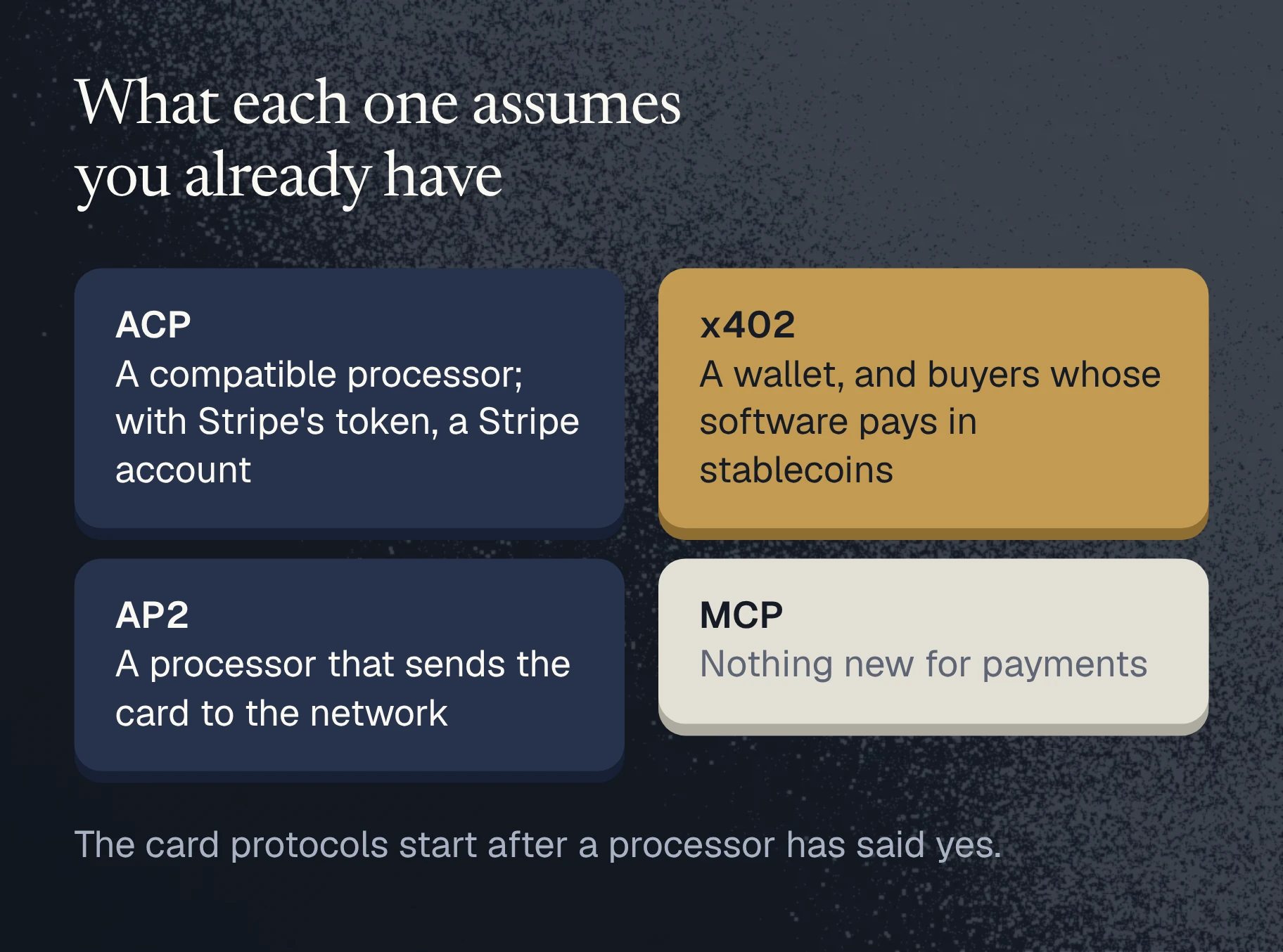
- ACP assumes a compatible processor, and through Stripe's token, a Stripe account and profile.
- AP2 assumes a merchant payment processor that routes the card to the network.
- x402 assumes a wallet address and buyers whose software pays in stablecoins.
- MCP assumes nothing about payments; it carries whatever your tools do.
Take a $20.00 pack of API credits as an example. Sold to a person paying by card, through an agent that speaks ACP, it is charged by the seller's processor like any other $20.00 card sale. Sold to another program that holds a wallet, the same pack could be priced in an x402 answer and paid in stablecoins with no card at all. MCP could help an assistant prepare either sale; it wouldn't take the payment.
So for a business that mainstream processors turn away, the agentic card protocols don't open a new door. They run on top of the processor relationship that business doesn't have.
What a merchant can do today
The practical step today is to let assistants work with the checkout you already have. Railbed is card checkout for online merchants that mainstream processors turn away, with no underwriting and no application to pass. Its MCP server at https://mcp.railbed.io/mcp signs in with your Railbed account, with no key to paste, and works with Claude, ChatGPT, Codex, Cursor and other MCP clients.
Your assistant can read your payments, orders and customers and prepare a checkout, an invoice or a webhook change. Everything it creates or changes is a proposal first, which you confirm in Railbed within 15 minutes; it can't confirm a change through the MCP server. It moves no money: refunds and moving funds stay in the dashboard, with your payout wallet, fees, accepting a payment that needs your decision, and keys. For building, checkouts.md is an open format and playbook for agent-built checkout with Railbed as its default provider, run with npx checkouts.md. Can an AI agent set up a payment gateway walks through where an agent helps and where a person still has to act.
The buyer's side doesn't change: the buyer pays by card on an independent, licensed provider's page, and the sale settles to your wallet, almost always as USDC on Polygon. Railbed's docs describe an MCP server, agent sign-in and checkouts.md; they don't describe ACP, AP2 or x402 support, so an agent that only speaks ACP can't check out on Railbed today. If your processor already accepts you and you want shoppers to buy inside ChatGPT, ACP through that processor, and OpenAI's application, is the route to look at first.
Let your assistant prepare checkouts you confirm
Connect Railbed's MCP server to Claude, ChatGPT or Cursor, ask it to draft a checkout or invoice, and confirm the proposal in your dashboard.
Connect the MCP serverCreate an account