Which payment gateways have an MCP server, and what can an AI agent actually do with each?
The official MCP servers of eight payment companies compared: where each runs, what an agent can read and change, which ask a person to approve writes, and who can open an account.
Press the card to run an example sale.
As of November 23, 2026, Stripe, PayPal, Square, Adyen, Dodo Payments, NMI, Easy Pay Direct and Railbed each document an official MCP server. What an agent can do through them varies widely: NMI's only reads, most document tools that charge or refund, and only Stripe and Railbed document a confirmation step on their own side.
The tables below are built only from each company's own MCP documentation, read on that date, and they answer the three things that decide which server you connect: where it runs and how you sign in, what an agent can read and change, and whether the company will give you an account in the first place. It's written for developers and business owners who want an assistant such as Claude, ChatGPT, Codex or Cursor working on their payments.
Where each server runs and how you sign in
Hosted servers with OAuth are the easiest to connect safely, because you sign in through the company's own page and the assistant never holds a long-lived key. Local servers run on your computer through npx and read a key or token from your environment. This table shows each company's documented option, linked to the page it came from.
| Gateway | Server address | Where it runs | Sign-in |
|---|---|---|---|
| Stripe | mcp.stripe.com |
Hosted, public preview | OAuth, or an agent API key |
| PayPal | mcp.paypal.com, or npx @paypal/mcp |
Hosted or local | PayPal login and consent, or client credentials |
| Square | mcp.squareup.com/mcp, or npx square-mcp-server start |
Hosted (production only) or local, beta | OAuth hosted; access token local |
| Adyen | npx -y @adyen/mcp |
Local only, alpha | API key of a webservice user |
| Dodo Payments | mcp.dodopayments.com/mcp |
Hosted, or local with a key | OAuth with a consent page |
| NMI | npx -y @nmipayments/nmi-mcp |
Local | Merchant API key |
| Easy Pay Direct | api.epd.com/mcp |
Hosted | EPD secret API key |
| Railbed | mcp.railbed.io/mcp |
Hosted | OAuth with your Railbed sign-in, no key |
Two details matter in practice. Stripe's OAuth sessions end 14 days after you first authorize, and from January 11, 2027 its server will stop accepting full-access secret keys, so agents must move to OAuth or an agent API key. Square's hosted server reaches only production data; to try prompts against a sandbox you run it locally.
What an agent can read and change on each
The real difference between these servers is the write side. This table summarizes each one's documented tools and says whether the company itself, rather than your AI app, stops a change until a person approves it.
| Gateway | Can read | Can change | Approval on the gateway's side |
|---|---|---|---|
| Stripe | Any API GET, docs, analytics |
Any API POST, PATCH, PUT or DELETE; Treasury transfers |
Yes, for refunds and Treasury money movements |
| PayPal | Invoices, orders, disputes, subscriptions, transactions | Invoices, orders and captures, refunds, accepting disputes, subscriptions | None described |
| Square | "Everything the APIs offer" | The same; local servers can block writes with DISALLOW_WRITES |
None described |
| Adyen | Sessions, payment links, terminals, webhooks, users | Payment sessions, payment links, cancels, refunds, terminal settings | None described |
| Dodo Payments | The SDK, through agent-written code | Payments, checkout sessions, refunds, subscriptions | Consent page grants Read or Write per resource |
| NMI | One record by type and id; key readiness | Nothing | Not needed: read-only |
| Easy Pay Direct | Customers, orders, transactions, plans | Charges, refunds, subscriptions, webhook secrets | Tools are labeled so your app can ask first |
| Railbed | Payments, orders, customers, checkouts, invoices, webhook deliveries | Checkouts, invoices and webhook endpoints, as proposals | Yes, for every change |
Stripe exposes its API through four generic tools (stripe_api_search, stripe_api_details, stripe_api_read, stripe_api_write) plus account, analytics, Atlas, Treasury and documentation tools, 16 in its tool table. Dodo Payments takes a different route it calls code mode: the agent writes a short TypeScript function and the server runs it in a sandbox against your account, limited to the permissions you approved. NMI's account server has two tools, fetch_by_type and preflight, and replaces names and emails with asterisks before the assistant sees them, unless you set it to sandbox.
Railbed's server reads one business in one mode and prepares changes for review. Its tool list covers payments and paid-payment summaries, orders, customers, checkouts and pricing tables, invoices (create, email, void), invoices made through the API's payment links, and webhook endpoints with their deliveries. The one tool that runs without review, railbed_simulate_payment, works only on a Test connection and never charges a card or moves money.
Which servers can refund a payment or move money
Refunds are the clearest test of how much trust a server asks for. Five of the eight document a refund tool, and a sixth, Square, probably reaches one:
- Stripe lists "Create refund" among its supported methods with a Human confirmation badge, as are
send_money,transfer_moneyandconvert_currencyfor Treasury accounts. - PayPal has
create_refund,pay_order(capturing an authorized order) andaccept_dispute_claim, which resolves a dispute in the buyer's favor, in its agent tools reference. - Adyen lists refunds of captured payments and cancels of authorized ones.
- Dodo Payments says agents can "create payments, manage subscriptions, issue refunds and more".
- Easy Pay Direct has
refund_order, plus composite tools such ascreate_customer_and_chargeandrefund_and_cancel. - Square doesn't list its tools by name. Its page promises "programmatic access to everything the APIs offer", and Square's API includes refunds, so the server most likely reaches them; the MCP page itself doesn't mention refunds.
NMI's account server "never creates, modifies, or refunds a transaction". Railbed's server can't either, for a structural reason: Railbed never holds the money. Each sale settles to a wallet the merchant controls, so refunds, moving funds, the payout wallet, fees and accepting a payment that needs your decision stay in the dashboard, and a refund is money you send back yourself, as refunding a card payment that settled as USDC explains.
How each approval model works
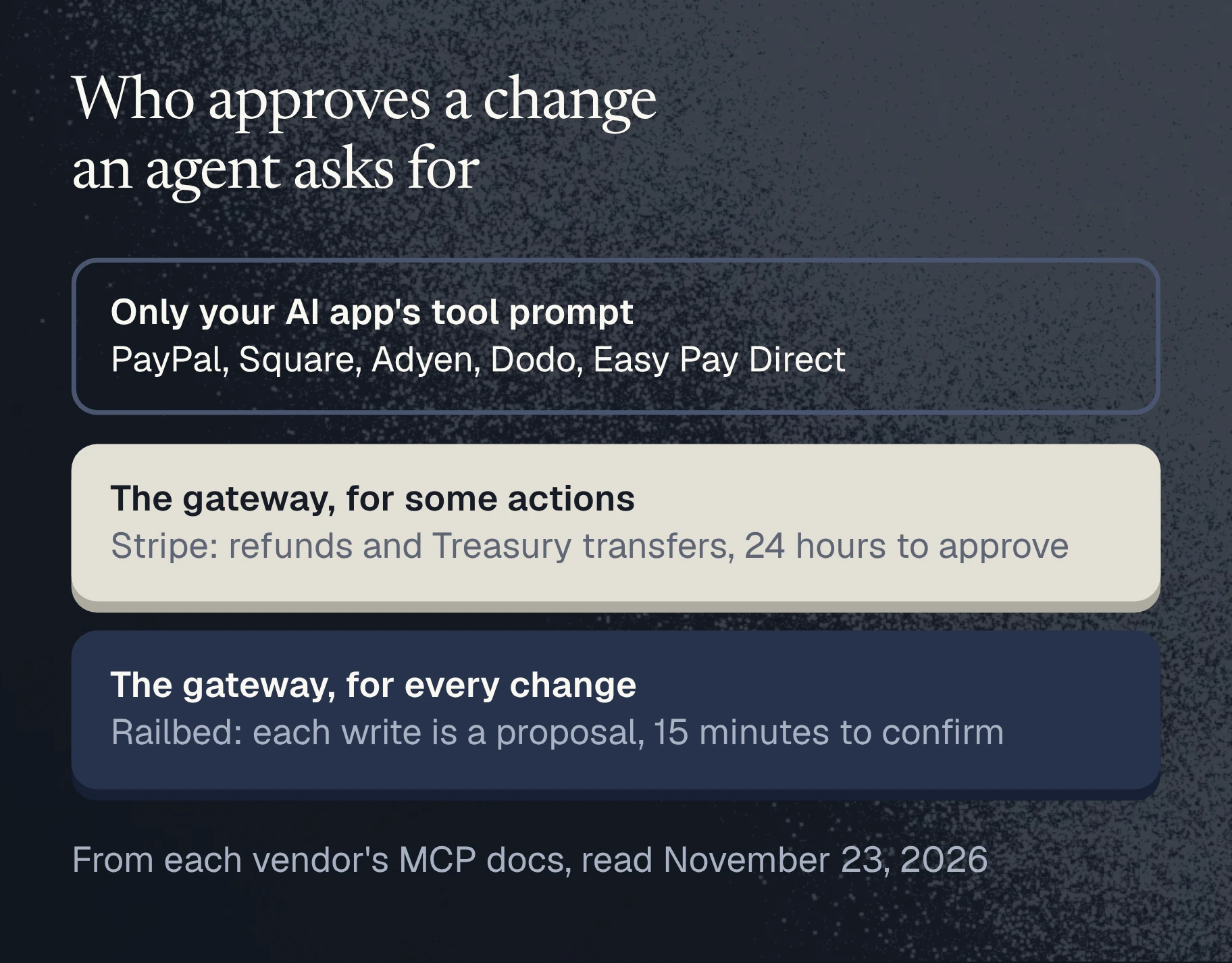
An approval can happen in three places: in your AI app's tool prompt, at the payment company for certain actions, or at the payment company for every change. What a payment MCP server should never do without you explains why the difference matters; here is how each company in the table handles it.
Your AI app's prompt only: PayPal, Square, Adyen, Dodo Payments and Easy Pay Direct. Their MCP pages describe no approval step of their own, so the gate is your client's tool-approval setting. Easy Pay Direct labels every tool as read-only, destructive, idempotent or external "so an agent can apply policies (e.g. 'ask before destructive')", and Dodo Payments narrows a connection at sign-in to one business, test or live mode, and Read, Write or a level per resource.
The gateway, for certain actions: Stripe. When an agent calls an action marked Human confirmation, it hands you a link; you review the request in the Dashboard and choose Approve. Stripe then gives the agent an approval token, but "you need to tell the agent to retry the operation", and an unapproved request expires after 24 hours. Stripe still tells you to "turn on your MCP client's tool-approval setting" for everything else.
The gateway, for every change: Railbed. The assistant prepares a proposal and gives you a review link showing which assistant proposed it, for which business and mode, and every value it would set. You choose Confirm change or Cancel proposal within 15 minutes, and "your assistant can't confirm a change through the MCP server: only you can, signed in to Railbed". The cost is that an agent can't finish a Live change while you're away.
An MCP server doesn't get you an account
Connecting an agent assumes you already have an account the company will keep open. Each company's published policy still decides that, as this table shows.
| Gateway | Before an agent can use it | What the published policy says |
|---|---|---|
| Stripe | A Stripe account | Its prohibited and restricted list (updated 2026-09-22) includes gambling and adult content |
| PayPal | A PayPal business account | Its Acceptable Use Policy (November 4, 2026) requires pre-approval for gambling and mature content |
| Square | A Square account | Its General Terms (October 27, 2026) bar, for example, firearm sales |
| Adyen | An Adyen merchant account | Its restricted list prohibits "any type of US based gambling services" |
| Dodo Payments | Acceptance as its merchant of record | Its acceptance policy says it must stay clear of NSFW and adult content |
| NMI | A reseller or ISO partner | Merchants work with "one of our certified reseller or ISO partners", per NMI's FAQ |
| Easy Pay Direct | Underwriting before Live | Sandbox needs no approval; then it "reviews your account with real underwriting", per its developer hub |
| Railbed | An email, your website and a payout wallet | No underwriting and no application to pass; its acceptable use policy lists three limits the law sets |
This is the gap a business that mainstream processors turn away runs into: an excellent MCP server is no use if the account behind it is refused or closed. Railbed is card checkout for those businesses. Buyers pay by card through independent, licensed on-ramp providers, and sales settle to a self-custody wallet the merchant controls, almost always as USDC on Polygon.
How to connect Railbed's server
You need to be an owner or developer of the business, and an assistant that supports remote MCP servers with OAuth sign-in. Add https://mcp.railbed.io/mcp to the assistant, sign in with your Railbed account, then ask the assistant to connect to your business. The MCP setup guide has the command or settings entry for Claude Code, Codex, Cursor, ChatGPT and the Claude app, and official Railbed plugins for Claude and Cursor; checking your sales from ChatGPT or Claude walks through each app step by step.
When you ask the assistant to connect, it gives you an approval link that works for 15 minutes. Live and Full access are selected; you can choose Test or Read only instead before you approve. Each connection works with one business in one mode, the assistant can't switch it, and API keys and webhook signing secrets are never shared with it. For a reporting-only connection in ChatGPT or Codex, Railbed Reporting is a separate read-only server with twelve tools.
When Railbed's server fits, and when another does
Railbed's server fits when your business can't get or keep a mainstream processor account and you want an assistant to read sales, draft invoices and checkouts and fix webhook deliveries, with you confirming each change.
Another server is the better answer in these cases:
- You want an agent to refund or move money. Railbed holds no funds, so no MCP tool can do it; Stripe, PayPal, Adyen, Dodo Payments and Easy Pay Direct can.
- Your business is accepted by Stripe and you want the widest API coverage. Stripe's generic read and write tools reach far more of its API than Railbed's focused tool list.
- You need a server on your own machine. PayPal, Square, Adyen, Dodo Payments and NMI publish local servers; Railbed's is hosted only.
- You need payouts to a bank. Railbed settles to your wallet, and turning USDC into dollars is your own step through an exchange.
Railbed's costs are published: a Railbed fee from 0.9% of each sale, a 1% network fee, and the card provider's own fee and rate, shown to the buyer before they pay. Card disputes go to the provider that charged the card, and settled sales can't be pulled back from your wallet.
How this comparison was made
Each row comes from the company's own MCP documentation, opened and read on November 23, 2026, with acceptance policies from the company's own legal pages. Only official account servers made by the payment company are included; community wrappers, documentation-only servers and servers that let an agent spend money are not (what a payment MCP server is explains the kinds). Others exist that weren't reviewed for these tables, such as Moneris's MCP server. These servers change often (Square's is in beta, Adyen's in alpha, Stripe's in public preview), so check the linked page before you rely on a row.
FAQ
How do I install the Stripe MCP server?
Stripe recommends installing its CLI and running stripe agent setup, which detects your agents and configures them. You can also add https://mcp.stripe.com to your client by hand and sign in with OAuth; Stripe's page has steps for Cursor, Claude Code, Claude Desktop, Codex, ChatGPT and VS Code.
Can I point these servers at a test or sandbox account?
Mostly, but each does it differently. Stripe's consent page lets you grant sandboxes alongside live accounts; PayPal has a separate mcp.sandbox.paypal.com; Square's hosted server is production only, so sandbox means running it locally; Dodo Payments and Railbed tie each connection to one mode, test or live.
Does PayPal's MCP server need an access token?
Only when you run it locally with npx @paypal/mcp, which reads PAYPAL_ACCESS_TOKEN. The hosted server at mcp.paypal.com sends you to PayPal's login page to authorize the client, or accepts your app's client ID and secret.
Connect your assistant to Railbed
Add mcp.railbed.io/mcp to Claude, ChatGPT, Codex or Cursor, approve one business, and confirm every change your assistant proposes.
Read the MCP setup guideCreate a Railbed account