How bail bond agents take premiums by card, with or without a bail bonds merchant account
Six states' premium caps and payment plan rules from their own texts, Florida's card fee rule, and how to send a premium or the next installment as an invoice.
Press the card to run an example sale.
A bail bond agent can take a premium or a payment-plan installment by card, with a bail bonds merchant account or without one, but the state sets the price and often the plan. North Carolina caps the premium at 15% of the bond, Minnesota wants half of a small bond's premium before posting, and Florida bars a card surcharge.
This page sets those rules side by side, works the same $10,000 bond through them, and shows how to send a premium or the next installment to a family's phone as an invoice, paid by card at any hour. It is a reading of published rules, not legal advice: your state's insurance department and your surety's filed rate decide what you may charge.
What six states say about the premium and the payment plan
Bail premiums are set by statute or by a rate filed with the insurance regulator, and several states also set how a premium paid over time must work. The table below quotes six states' texts, as of November 2026. Georgia's row comes from the Fulton County Sheriff's bond page, which says only that "Georgia law allows" it; we did not read the Georgia statute itself. California, Florida's rate rule, New York and Louisiana are on the bail bonds industry page.
| State | The premium | A premium paid over time | Source |
|---|---|---|---|
| North Carolina | "shall not exceed fifteen percent (15%) of the face amount of the bond" | The statute sets no plan rule; collateral "must be reasonable in relation to the amount of the bond" | G.S. 58-71-95 |
| Georgia | "up to 15% of the face amount of the bond", or "a minimum of $50 per charge or offense" | Not stated on the page | Fulton County Sheriff (a county page, not the statute) |
| Nevada | "15% of the amount of the bond or $50, whichever is greater", collected once | "It is a violation of Nevada law to finance premium"; "Payments of premium in installments with no interest charged is not prohibited" | Division of Insurance Bulletin 18-003, 12 June 2018 |
| Virginia | Not "less than 10% or more than 15% of the amount of the bond" | The bondsman "shall not loan money with interest for the purpose of helping another obtain a bail bond" | 6VAC20-250-250 |
| Minnesota | The surety's filed rate, never less; "a minimum premium of $100" | Bond of $10,000 or less: at least 50% before posting, the rest within four months on a signed note. Over $10,000: at least 30%, the rest within 12 months. Note interest at most 6% a year | Minn. Stat. 60M.02 |
| Connecticut | "the premium rate approved by the commissioner" | A financed premium needs "a minimum down payment of thirty-five per cent", the balance "not later than fifteen months" after the bond, on a promissory note | Conn. Gen. Stat. 38a-660b and 38a-660c |
Two things stand out. Four of the six say something about a premium paid over time, so a plan an agent makes up can break a rule even when the premium is right. And none lets the price float: the premium is a cap, a band or a filed rate.
The same $10,000 bond in six states
A worked example shows how far apart the rules land. Take a $10,000 bond and, where a state uses a filed rate, an example filed rate of 10%, which makes the premium $1,000.
- North Carolina and Georgia: at most $1,500 (15%). Neither text read here sets a first payment.
- Nevada: exactly $1,500 (15%, more than the $50 floor). The family may pay it in parts with no interest; the agent may not finance it.
- Virginia: between $1,000 and $1,500 (10% to 15%), with no interest-bearing loan to cover it.
- Minnesota: $1,000 at the example rate. Because the bond is $10,000 or less, at least $500 must be paid before the bond is posted, and the other $500 within four months on a signed note.
- Connecticut: $1,000 at the example rate. If the agent finances it, at least $350 comes as a down payment and the balance within 15 months.
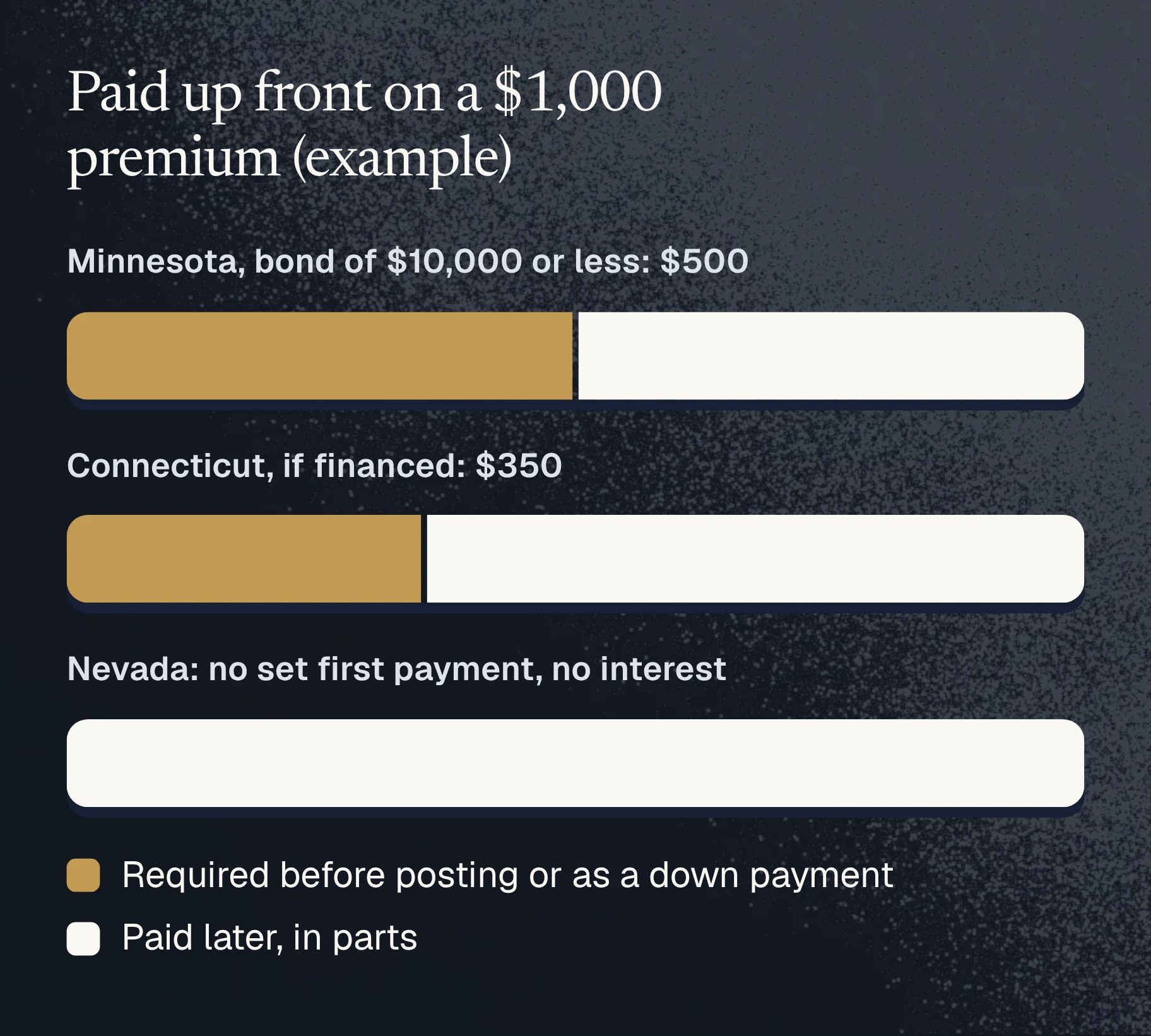
That first payment is the number you put on an invoice as its smallest first payment.
Can a bail agent add a card fee to the premium?
In Florida, no surcharge may be added when the agent accepts a card. Florida's rule 69B-221.145 says an agent "may not charge or receive a transfer fee, or any other additional fee, surcharge or commission, for the use of a credit card if the bail bond agent accepts payment by credit card", and "Any fee or discount points which may be charged to the bail bond agent by the credit card facility or organization shall be borne by the bail bond agent" (Fla. Admin. Code R. 69B-221.145). The rule keeps one exception, the fee on a transfer bond under rule 69B-221.105.
A 2026 Florida bill on bail bonds did not change this. The Senate's version, SB 600, "Died in Messages" on 13 March 2026, and the House's HB 1017 died on the second reading calendar the same day (Florida Senate, SB 600 (2026)).
Other states get at the same question through their premium rules. Nevada's bulletin says "The only charges that are permitted are the expenses incurred by a bail agent in the bail transaction": guard, notary and recording fees, and other expenses that are "actual and necessary" and "verified by a receipt or other document evidencing an actual payment made to another party". Where the premium is a filed rate (Minnesota, Connecticut), the rate is the price. AI answers sometimes say card fees on premiums are "capped e.g. 4%"; no state text read for this page says that.
Why processors treat a bail bonds merchant account as high risk
Mainstream processors turn the trade away, and the specialists that take it price the account as high risk. Stripe lists "Bail bonds" among the legal services it prohibits, as of its list updated 22 September 2026 (Stripe restricted businesses).
Three features of the trade, each visible in the state texts, help explain the caution:
- The premium is never returned. North Carolina's courts tell defendants the premium "is not returned when the case is over; it is the bondsman's fee for posting the bond" (North Carolina Judicial Branch). A payer who expected money back after the case can dispute the charge.
- The payer is often someone else. Connecticut's statute speaks of "the principal or any indemnitor", and Minnesota's of the "depositor". A relative pays by card for a defendant the card's issuer has never heard of.
- The obligation runs for months. Nevada's bulletin notes that "a bond remains in effect until it is exonerated by a court", and a plan can run 4 to 15 months under the Minnesota and Connecticut rules above.
Add a card-not-present payment taken late at night and a Visa cardholder's usual 120 days to dispute (Visa rules, edition 24 October 2026), and the underwriter's view follows.
Taking a premium or an installment by invoice, at any hour
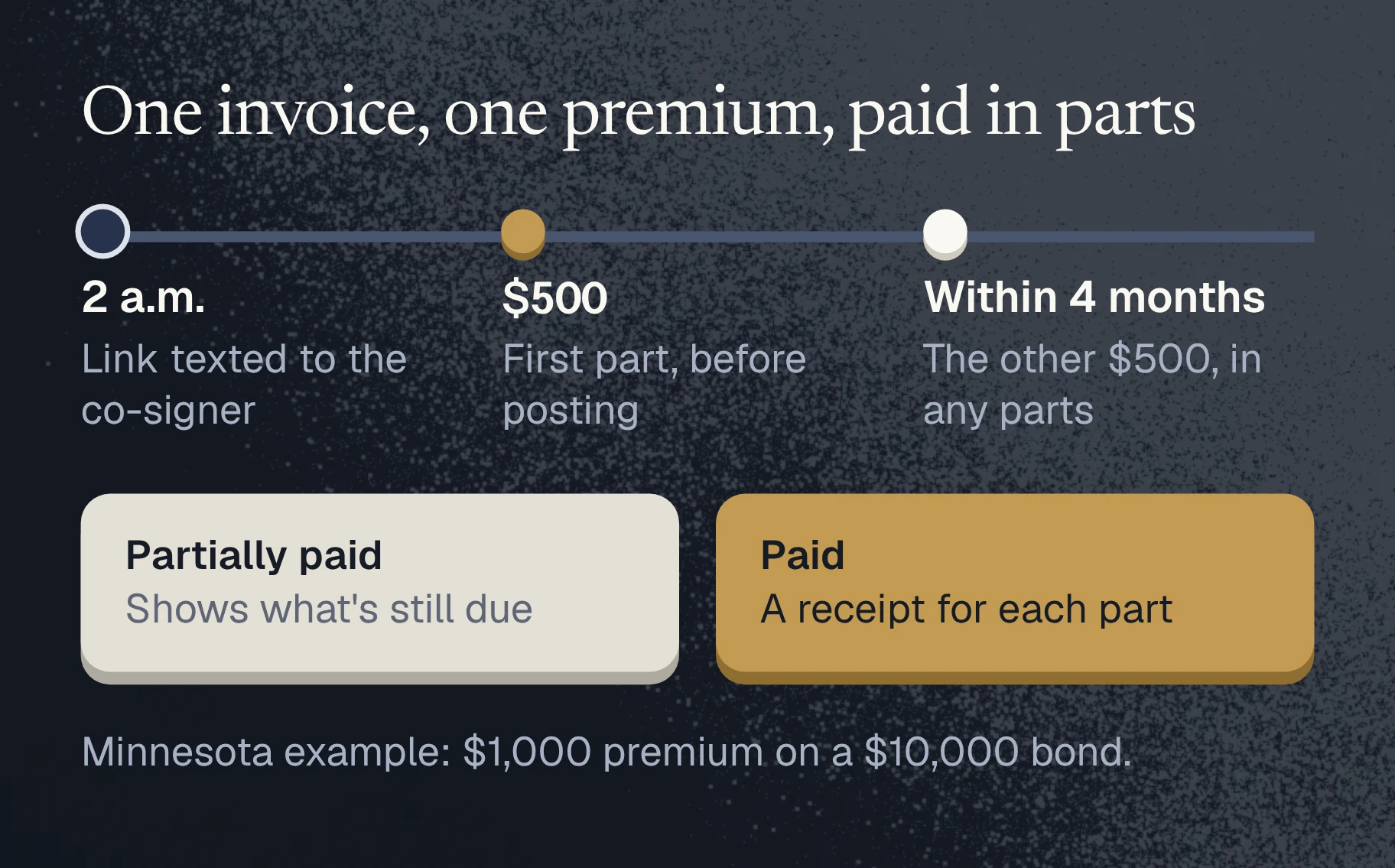
A Railbed invoice lets a family pay a premium in full, or in parts with a first payment you set, from a link on a phone. Here is a $1,000 premium in Minnesota at the example rate.
- Create the invoice for the premium. One line, $1,000, at exactly the premium your rate allows. The card provider charges the payer the invoice's price; every fee, Railbed's included, comes out of what arrives.
- Turn on Let them pay in parts, with a Smallest first payment of $500, the Minnesota minimum on this bond ($350 in Connecticut, if you finance). Later parts can be any amount a card provider can take until the total is paid; the invoices guide lists every setting.
- Set the due date to the plan's end. Four months out in this example. Turn on reminders if you want them: they are off until you turn them on.
- Leave tips off. A premium is a set price.
- Text the link to the person paying. Share the invoice's link or QR code, or email it with its PDF from "Your Business via Railbed". The payer gives their email as they pay, so a co-signer can pay from their own phone at 2 a.m.
The family pays the first part by card on a card provider's page, and the invoice reads Partially paid with what's still due; each later part brings a receipt in your name.
The invoice is a request for payment, not your bail agreement: a promissory note, an indemnity agreement or a premium receipt your state requires is still a separate document. The guide to getting an invoice paid in parts shows each screen the payer sees.
The guide to taking a card payment over the phone covers a family paying from a link during a call. Away from a desk, /link with an amount in Railbed's Telegram bot makes an invoice for one amount, if your role can create invoices. An agency can give each agent the Sales role to send their own invoices, while owners and managers see each agent's totals under By owner.
Why Railbed fits a bail bond agency
Railbed fits a bail agency because it takes the card payment on a link at any hour and settles each payment to the agency's own wallet, with nothing held back. An independent, licensed card provider charges the payer's card on its own page, and the sale settles to a wallet you control, almost always as USDC on Polygon. There is no underwriting and no application to pass, and no setup or monthly fee; sign-up needs an email, your website and a payout wallet.
Good to know:
- Disputes go to the card provider. Settled sales can't be pulled back from your wallet, but a dispute goes to the provider that charged the card, and Railbed is not a party to it.
- Refunds are yours to send, from your wallet. There is no refund button.
- Fees. The card provider's own fee and spread, a 1% network fee and the Railbed fee, from 0.9%, shown in the dashboard and locked when the payer starts paying.
- Limits. The smallest card payment is about 2.00 USD, and an invoice can total up to 100,000.00; a premium larger than that goes on more than one invoice. The large-deposit guide covers big single payments.
- Nothing is charged automatically. Each part of a plan is a payment the family makes from the invoice, and card details are entered on the provider's page, never on Railbed's.
- ID checks are the providers' call. Smart Routing ranks the providers least likely to ask first, but it can't promise that a provider won't.
FAQ
Can the co-signer pay the premium on their own card? Yes, on a Railbed invoice anyone with the link can pay, so the co-signer pays on their own phone. Who must sign the bail agreement or the indemnity is set by your state and your surety, not by the invoice.
Can a bail agent charge interest on a payment plan? It depends on the state. Nevada's Division of Insurance says financing a premium is a violation and installments with no interest are not, Virginia bars a bondsman from lending money with interest to obtain a bond, and Minnesota allows a note at up to 6% a year.
Does an invoice replace the promissory note Minnesota or Connecticut requires? No. Minnesota wants its note "on a surety or bail bond agency form as approved by the commissioner", and Connecticut a signed promissory note for the balance. The invoice collects the payments; the note stays its own document.
Send tonight's premium as an invoice
Set the premium, set the first payment your state requires, and text the link to the family. Each payment settles to your own wallet.
Create your accountRead the invoices guide