How do you take a large deposit by card for a big order or booking?
Where a big card deposit gets declined, held or disputed, the terms Visa's rules list, and a $2,500 deposit on a $10,000 booking taken on one invoice.
Press the card to run an example sale.
Send one invoice for the whole order with the deposit as its first payment, and write the delivery date and the date the deposit stops being refundable into its terms. Dated terms the buyer saw before paying are what card rules look for if the deposit is disputed months later, the main risk of taking money long before you deliver.
Below: where a large deposit gets stopped, quoted from Visa's rules and processors' own pages; the dispute clock for an example $2,500 deposit on a $10,000 wedding; the terms to write; and how the deposit works on Railbed. It's for businesses that take money well before they deliver: car dealers, furniture stores, lodging, event venues, salons and tattoo studios.
Three places a large deposit gets stopped
A big deposit can fail at checkout, sit on hold after it's paid, or be disputed long after the date was booked. Each stop has a different owner, so each needs a different fix; the third gets its own section below.
The table shows who decides at each stop and what can help.
| Where it stops | Who decides | What helps |
|---|---|---|
| At checkout | The buyer's bank, or the card provider that charges the card | A smaller first payment, or another card |
| After it's paid | The processor that holds your account | Clear delivery dates, and money that doesn't sit with the processor |
| Months later | The buyer's bank, under the card network's rules | Terms the buyer accepted before paying, with dates |
At checkout. Whether a $2,500 charge goes through is decided by the buyer's bank and the card provider, not by you, and nothing in your terms changes it.
After it's paid. Processors say plainly that money for future delivery is a reason to hold it. Stripe's reserves FAQ says "A reserve may be placed on an account because we've determined that the business presents an increased level of risk", and one of its examples is "The business belongs to an industry with longer-than-average delivery windows." Its guide for platforms names the trades: "extended delivery times or high loss rates (for example, event ticketing, travel & lodging, furniture, or construction)". PayPal's help page on held payments gives "Your selling pattern appears to have changed or seems unusual" as a reason, naming "an unexpected surge in sales" among such patterns, which one deposit many times your usual sale can look like. How long each kind of hold lasts is compared in how long a payment processor can hold your funds.
How long a deposit stays open to a dispute
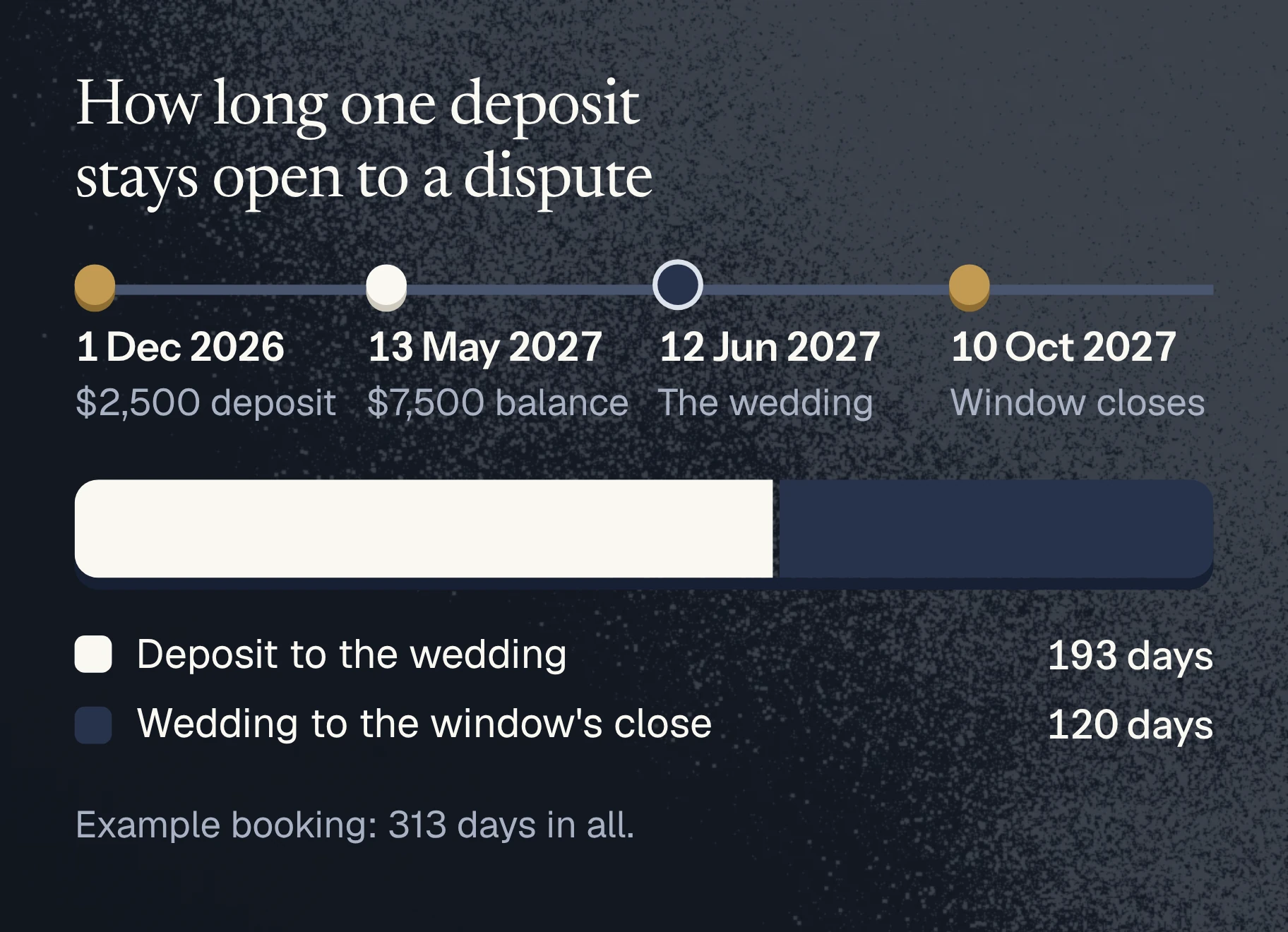
The dispute window for a booking runs from the day of the service, not the day of the payment. So a deposit taken far ahead stays open to a dispute much longer than an ordinary sale.
Visa's Core Rules of 24 October 2026 set the limit for a cancelled booking (dispute condition 13.7, Table 11-132) at 120 calendar days from "The date the Cardholder received or expected to receive the merchandise or services, not to exceed 540 calendar days from the Transaction Processing Date". The rule for a service that never arrived (13.1, Table 11-93) runs the same 120 days from "the last date that the Cardholder expected to receive the merchandise or services". Stripe's page on disputes says the same of future events: "the dispute window starts on the event date, not the payment date."
Here is one example booking, with the dates worked out.
| Date | What happens | Days after the deposit |
|---|---|---|
| 1 Dec 2026 | The couple pays the $2,500 deposit on a $10,000 wedding booking | 0 |
| 13 May 2027 | The $7,500 balance is paid, 30 days before the wedding | 163 |
| 12 Jun 2027 | The wedding | 193 |
| 10 Oct 2027 | 120 days after the wedding: the window for a cancellation dispute closes | 313 |
Visa also lists the disputes that don't count. Under Table 11-92, a non-receipt dispute is invalid for "A partial Advance Payment Transaction when the remaining balance was not paid and the Merchant is willing and able to provide the merchandise or services". In plain terms, a buyer who skips the balance can't call the service undelivered while you still stand ready to deliver it, as long as the deposit was taken under the agreement Visa describes next. The other time limits, and Regulation Z's separate 60 days, are in how long a customer has to file a chargeback.
What the deposit terms should say
Card rules spell out what a buyer should agree to before paying for something delivered later. Visa's rules are written for the merchant that accepts the card; on Railbed the card provider charges the card, so read them as a checklist for your own terms.
Visa's Table 5-19 covers "Partial Payments, Advance Payments", and Visa defines an advance payment as "A Transaction for the partial or full cost of goods or services that will be provided to the Cardholder at a later time". Before taking one, the merchant "must obtain the Cardholder's express informed consent to an agreement" that includes the description, the total price and the cancellation terms. Visa's dispute guide for merchants adds that "Cancellation terms must be disclosed before purchase to be relied upon". Read together, a deposit's terms should state:
- What the deposit buys. The date, the vehicle, the piece or the room, described so a stranger reading the dispute would recognize it.
- The total price, and how the balance is paid. The deposit, the balance and the date the balance is due.
- The date the deposit stops being refundable. Visa's words are "the date that any cancellation privileges expire without Advance Payment forfeiture", so write a date, not a number of days.
- When you deliver. For a purchase paid in full ahead of time, Table 5-20 says "The terms and conditions must specify the date of shipping of the goods or services to the Cardholder."
- How a refund is paid and how soon. Including what happens if you cancel, and what happens in a closure.
- How to reach you. Table 5-19 asks for the "Address, email address, and phone number to use to contact the Merchant".
The same table says "The Merchant must refund the full amount paid if the Merchant has not adhered to the terms and conditions of the sale or service." Keep a copy of each version of your terms with the date it took effect, as Visa's guide recommends: "If your policies change over time, retain records of prior versions and the dates they became effective." On a Railbed invoice the terms can still be edited after the buyer has paid, so save the version they saw. Whether a deposit can be kept after a cancellation also depends on the law where you trade, which these rules don't replace; a local lawyer or your trade association can tell you what applies.
Deposit, then balance: three ways to set it up
The simplest setup is one invoice that holds the deposit and the balance. Two others suit different businesses, and the table compares all three as they work on Railbed.
| Setup | How it works | Suits |
|---|---|---|
| One invoice, paid in parts | Paying in parts turned on, the deposit set as the smallest first payment, the balance due by a date you pick | A venue, a special order, a vehicle, a stay |
| A deposit invoice, then a balance invoice | Two invoices, each paid in full, the second sent when the work is ready | A balance that depends on the final scope |
| A checkout page for a fixed deposit | The same deposit for every buyer, on a page you link from your site | An appointment deposit at a salon or a tattoo studio |
For the wedding above, the venue sends one invoice paid in parts: a line for the $10,000 booking, paying in parts turned on, a smallest first payment of $2,500, a due date of 13 May 2027 (an invoice's due date can be up to two years ahead), reminders turned on, and the terms above in the invoice's Terms, printed at the foot of the invoice and its PDF. The couple can pay the balance in one go or in parts, each one an amount a card provider can take and never more than what's left.
Trade by trade, the deposit secures something different, and the industry pages work through each one: a vehicle held for a buyer out of state, a special-order sofa while the frame is built, a wedding or conference date next year and a direct booking at a B&B or inn.
What changes when the deposit settles to your wallet
On Railbed the buyer pays by card through an independent, licensed card provider, and the deposit settles to a wallet you control, almost always as USDC on Polygon. That removes the processor's hold, and it changes refunds and disputes too.
- Nothing is held back from your sales. There's no reserve on deposits, and no underwriting and no application to pass.
- Disputes go to the provider that charged the card. Settled sales can't be pulled back from your wallet. A provider may still contact you about a dispute, decline future payments from a buyer or region, or take other action under its own terms, so dated terms are worth having either way.
- Refunds are yours to send. Railbed can't reverse a settled payment, so a cancelled booking is refunded from your wallet, as described in how to refund a card payment that settled to your wallet. A deposit arrives less its fees, so refunding the full amount means you cover them.
- No hold, no saved card. Railbed has no authorizations and never stores a card, so it can't hold an amount at check-in, charge a no-show later, or charge the balance on the due date: the buyer pays it from the invoice, prompted by reminders. A refundable security deposit is a payment you send back, not a hold you release. If you need to charge a saved card on a date, keep a processor for that.
- Fees are per payment. Each part carries the card provider's own fee and exchange rate, shown to the buyer before they pay, a 1% network fee, and Railbed's fee from 0.9%, shown in your dashboard when the payment starts.
- Up to 100,000.00 per invoice, and every part must clear a card provider's minimum, the smallest about 2.00 USD.
Splitting a deposit: for the buyer's card, never around a check
A deposit split into parts must be split for the buyer's card limit, never to get under an identity check. Railbed's acceptable use policy lists "splitting one purchase into smaller payments to stay under a provider's identity check or reporting threshold" under money laundering, one of the three things it forbids.
Card providers decide whether to ask a buyer for ID, and Smart Routing ranks the providers least likely to ask first; it can't promise that one won't. Provider maximums aren't published, and a card can still be declined on the provider's page, where Railbed gets no decline signal in Live. A buyer who is declined goes back to the invoice and tries a smaller part (if the smallest first payment allows it), a second card or another provider.
FAQ
Can I keep the deposit if the buyer cancels? That depends on the terms the buyer accepted before paying and on the law where you trade, which card rules don't replace. Put the date the deposit stops being refundable in the invoice's terms, and ask a local lawyer before you rely on a non-refundable deposit.
What if the buyer's card won't take $2,500 at once? The invoice won't take a first payment below the smallest first payment you set, and that setting is fixed once a payment begins. If you agree to it before they start, lower the smallest first payment (say to $1,250), and they can pay the deposit as two parts, on one card or two.
Send a deposit invoice in Test mode
Build a booking invoice with paying in parts on, the deposit as the smallest first payment and your terms at the foot, then pay the deposit with simulated money to see what your buyer sees.
Create an accountRead the invoices guide