Debt collection merchant accounts: Visa's debt repayment rules, card fees and the FDCPA
What a debt collection merchant account has to meet: Visa's ban on credit cards for US debt repayment, its disclosure rule, and the FDCPA's limit on card fees.
Press the card to run an example sale.
A debt collection merchant account is a card account opened by an acquirer that knows you collect consumer debts, and many mainstream processors won't open one. Visa's rules prohibit credit and charge cards for debt repayment in the US, which leaves debit and prepaid cards, and any fee you add to a balance has to clear the FDCPA first.
This guide quotes those rules from the rule-makers' own pages: the Visa Core Rules as published on 24 October 2026, the Fair Debt Collection Practices Act and Regulation F, and the CFPB's complaint figures for 2025. How they apply to your agency, your clients' debts and your state is a question for your counsel.
Why processors class collection agencies as high risk
Processors class collection agencies as high risk because the person paying didn't choose the agency, and often disputes the debt itself. The CFPB received about 387,400 debt collection complaints in 2025, and "the most common issue was Attempts to collect debt not owed", whose monthly average rose 115% against the two years before, according to its 2025 Consumer Response Annual Report.
A consumer who believes they don't owe a balance can also dispute the card payment with their bank, and those disputes count against the merchant's ratios, one of the reasons covered in what makes a business high risk to card processors. Some processors keep the trade out altogether: Stripe's restricted businesses page names "Debt collection agencies" in its prohibited list. Others offer a specialist account, and Visa makes the acquirer behind it answer for every debt repayment, so an acquirer that takes the trade has every reason to ask how you meet each row of the table in the next section.
What Visa's debt repayment rules ask of a debt collection merchant account
Visa's debt repayment rules cover every Visa transaction that repays a debt, and they bind the acquirer. Section 5.8.13.1 of the Visa Core Rules says an acquirer "must ensure a Transaction that represents the repayment of a Debt or Charged Off Debt or Receivable complies with Table 5-28".
This is what Table 5-28 says for a collector in the US, in the edition dated 24 October 2026.
| Row of the table | What Visa's rule says |
|---|---|
| Card type | Prohibits "Use of a Credit Card or charge Card"; the exceptions are France and the UK |
| Old debt | Prohibits debt past the statute of limitations "unless the Merchant obtains written Cardholder agreement to the charge and the amount" |
| Indicator | "Include the Debt repayment indicator in the Authorization Request and Clearing Record" |
| Category code | MCC 6012, 6051 or 7322; since 25 July 2026 charged-off debt "must be assigned MCC 7322 (Collection Agencies)" |
| How it completes | As a purchase in the US |
The prohibition names credit and charge cards; it does not name debit or prepaid cards. So the practical path for a US agency is a debit card: ask for one in your letters, on your calls and on the payment page you send. If the category codes are new to you, high-risk MCC codes and what each one means explains how an acquirer assigns one. This guide quotes Visa only. Mastercard, American Express and Discover publish their own rules, so read those of every network your agency takes.
Visa also keeps a lever over the merchant: it "reserves the right to prohibit a Merchant from initiating a Transaction for a past due or non-collectable Debt" when the merchant "acted illegally" or "carries out actions that Visa deems likely to damage the Visa brand".
What the consumer must see before paying
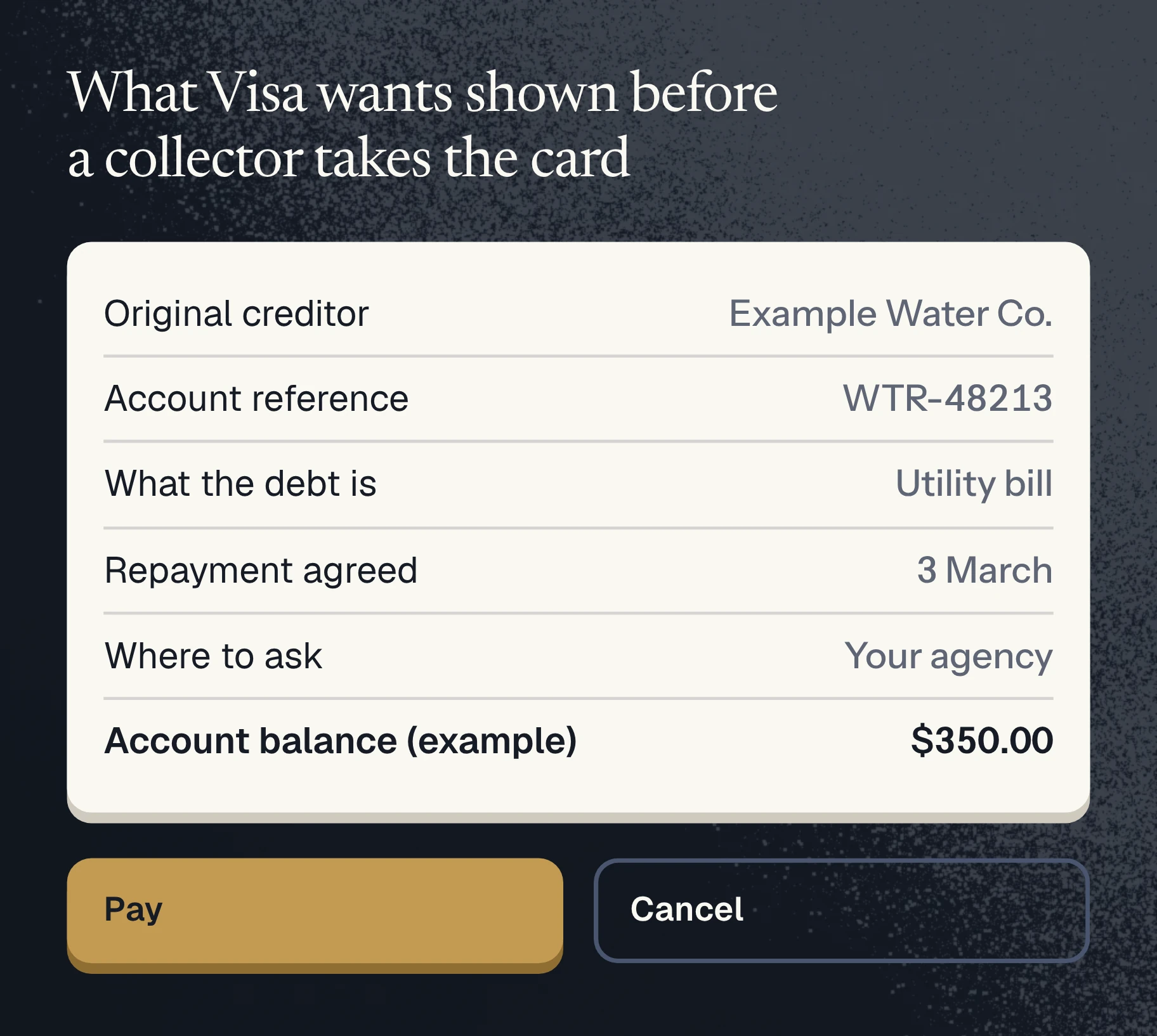
Visa's disclosure rule applies when the business taking the card isn't the debt's original owner, and Visa gives "a collection agency" as its example. Section 5.8.23.1 says the collector must "Provide a disclosure to the Cardholder before completing the Transaction" and "Allow the Cardholder to cancel the Transaction".
The disclosure must include all of the following:
- The name of the original lender or creditor.
- Information that identifies the transaction. Visa's examples are the original creditor's account or reference number, a description of the debt (such as "utility bill") and the date of the repayment contract.
- Instructions for getting more information about the original transaction.
Here is how that looks for an example account balance of $350.00 owed to an example utility, with a repayment agreed on 3 March.
Card fees on a collection: the FDCPA, Regulation F and Visa
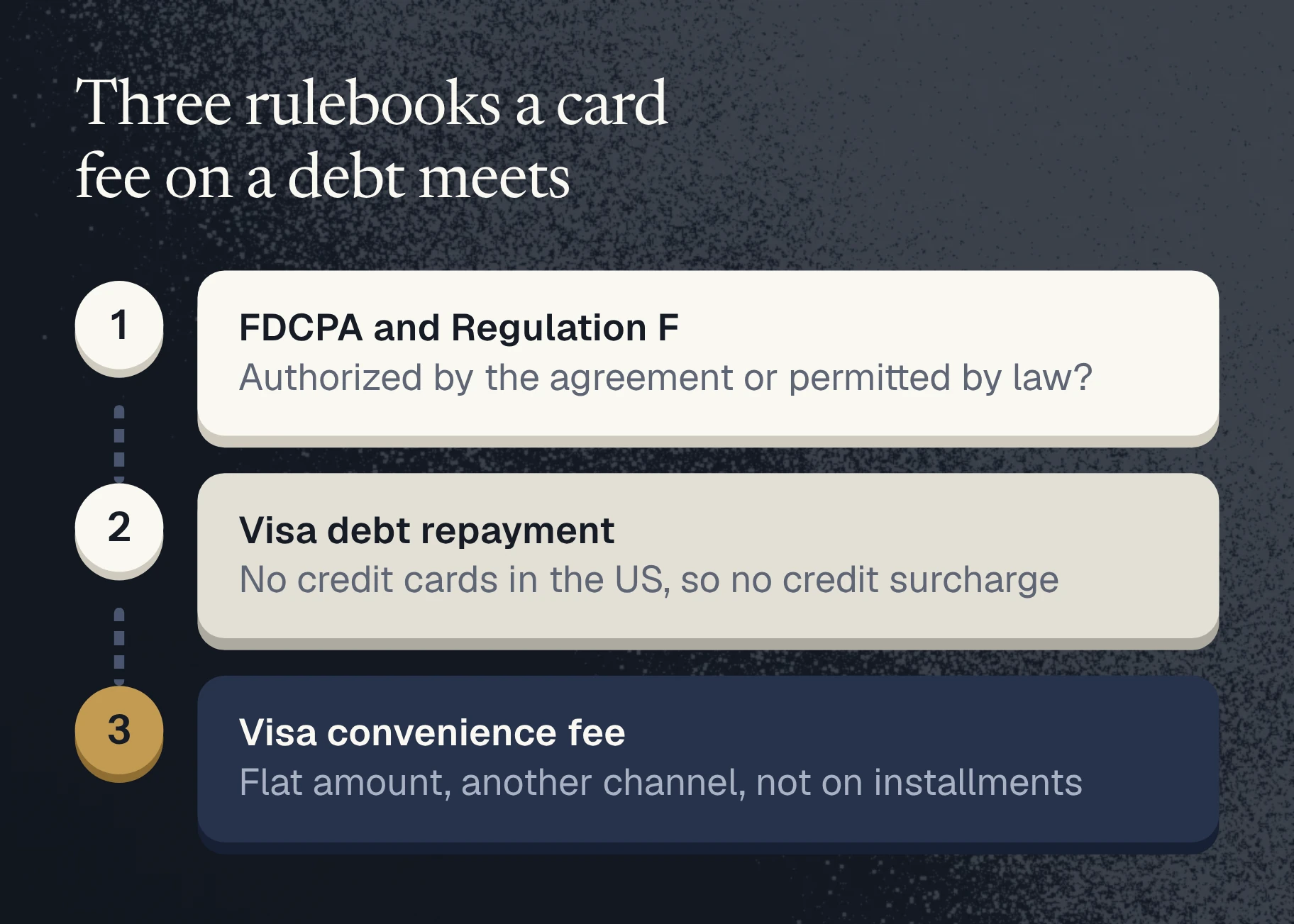
A card fee on a collection has to clear debt collection law before the card network's rules matter. Section 808(1) of the Fair Debt Collection Practices Act treats as unfair "The collection of any amount (including any interest, fee, charge, or expense incidental to the principal obligation) unless such amount is expressly authorized by the agreement creating the debt or permitted by law."
The CFPB's Regulation F, section 1006.22(b) repeats it and says "any amount" includes "any interest, fee, charge, or expense incidental to the principal obligation." The CFPB's consumer page on convenience or pay-to-pay fees, last reviewed June 29, 2022, tells consumers a collector may charge one only if they agreed to it when they took out the debt or a law specifically allows it. The 2022 advisory opinion behind that reading (87 FR 39733) is on the list of guidance the CFPB withdrew on May 12, 2025. The withdrawal removed the Bureau's interpretation; section 808(1) reads as it did.
If a fee passes that test, Visa's own fee rules come next. This compares Visa's two US fees as section 5.5 of the Core Rules describes them.
| Convenience fee | Credit card surcharge | |
|---|---|---|
| What it is for | "an alternative payment channel outside the Merchant's customary payment channels" | Accepting a Visa credit card |
| Amount | "A flat or fixed amount, regardless of the value of the payment due" | At most 3.00% |
| Visa rules it out | On a recurring or installment transaction, for a card-absent-only merchant, or with a surcharge | On anything but a Visa credit card transaction |
Put the two together and a gap appears. On the example $350.00 balance, a 3% surcharge would be $10.50, but Visa's debt repayment table already prohibits credit cards in the US, and its surcharge applies only to credit cards, so a US Visa debt repayment leaves no credit card transaction to surcharge. A flat convenience fee doesn't change with the payment, so an example $4.00 fee would be the same on $350.00 as on a $50.00 part payment. Visa's glossary defines an "Installment Transaction" as one in a series that "represents Cardholder agreement for the Merchant to initiate one or more future Transactions", including for "the repayment of a single Debt". Ask your acquirer and counsel how that reads on your payment plans.
Taking a collection payment by card with a Railbed invoice
A Railbed invoice gives the consumer a page that shows the balance and your details, and the card is entered on a licensed card provider's page. These are the steps, using the field names in the invoices guide.
- Create the invoice. One line, "Account balance", 350.00 USD. Choose a due date: On receipt, 7, 14 or 30 days, or a date you pick.
- Fill the details. Put the original account number in Reference or PO number (up to 64 characters). Put the creditor's name, what the debt is, the date of the agreement, how to reach your agency and, for a US consumer, that the balance is paid by debit card in Note to the customer (up to 1,000 characters). The note shows on the invoice page and its PDF, before the consumer chooses Pay.
- Set how they pay. For a plan, turn on Let them pay in parts and set a Smallest first payment. The consumer chooses each amount until the balance is cleared, as in getting an invoice paid in full or in parts.
- Share it your way. Get link only creates the invoice without an email, so you can put the link or QR code inside the letters and texts your compliance team already approves. On a call, send the link while you talk: the consumer types the card on the provider's page, so the number never passes through your staff, as described in taking a card payment over the phone without a MOTO account.
- Watch the status. Sent, Viewed, Partially paid, Paid. Void stops collection and reminders; money already paid stays paid.
Railbed never stores a card, so nothing is charged later on the consumer's behalf: every part is a payment they choose to make. Reminders are off until you turn them on and go out in the morning UTC, which the debt collection industry page weighs against Regulation F's hours.
Why Railbed fits a collection agency
Railbed fits an agency that wants a consumer to settle a balance from a link, with the creditor's details on the page and a plan if they need one. The invoice carries your reference and note, takes part payments toward the balance, and never stores a card, so each payment is one the consumer makes. There's no underwriting and no application to pass: sign up with an email, your website and a payout wallet, and send your first invoice the same day. Nothing is held back from your sales, and there's no setup fee, no monthly fee and no reserve. Fees come out of what arrives: the card provider's own fee and exchange rate, a 1% network fee and the Railbed fee, from 0.9%, shown in the dashboard and locked when the consumer starts paying. Settled sales can't be pulled back from your wallet; card disputes go to the provider that charged the card.
Good to know:
- Visa's rules prohibit credit and charge cards for debt repayment in the US. The consumer enters their card on the provider's page and card numbers never pass through Railbed's servers, so ask US consumers for a debit card in your messages and in the invoice's note.
- How Visa's rules and the FDCPA apply to your agency is for your counsel to confirm.
- Sales arrive as USDC, almost always on Polygon, in a wallet you control. Moving the money to your bank is your step, through an exchange or wallet app.
- The smallest card payment is about $2.00, set by the providers; amounts of about $10 or more give consumers the widest choice of providers. An invoice can be up to 100,000.00.
- Card providers decide whether to ask for ID. Smart Routing ranks the providers least likely to ask first.
- Refunds come from your own wallet. There's no refund button.
- Railbed is web checkout only, with no card reader.
Send a balance invoice with the creditor's details on it
Create an invoice with the account reference in its own field and the original creditor in the note, allow part payments if the consumer is on a plan, and share the link in your own messages.
Create your accountRead the invoices guide