High-risk MCC codes list: what 5967, 7995, 5816 and the other flagged codes mean
Every code on Visa's high integrity list and Mastercard's registration list, with both networks' names, who flags it and what a business coded there should expect.
Press the card to run an example sale.
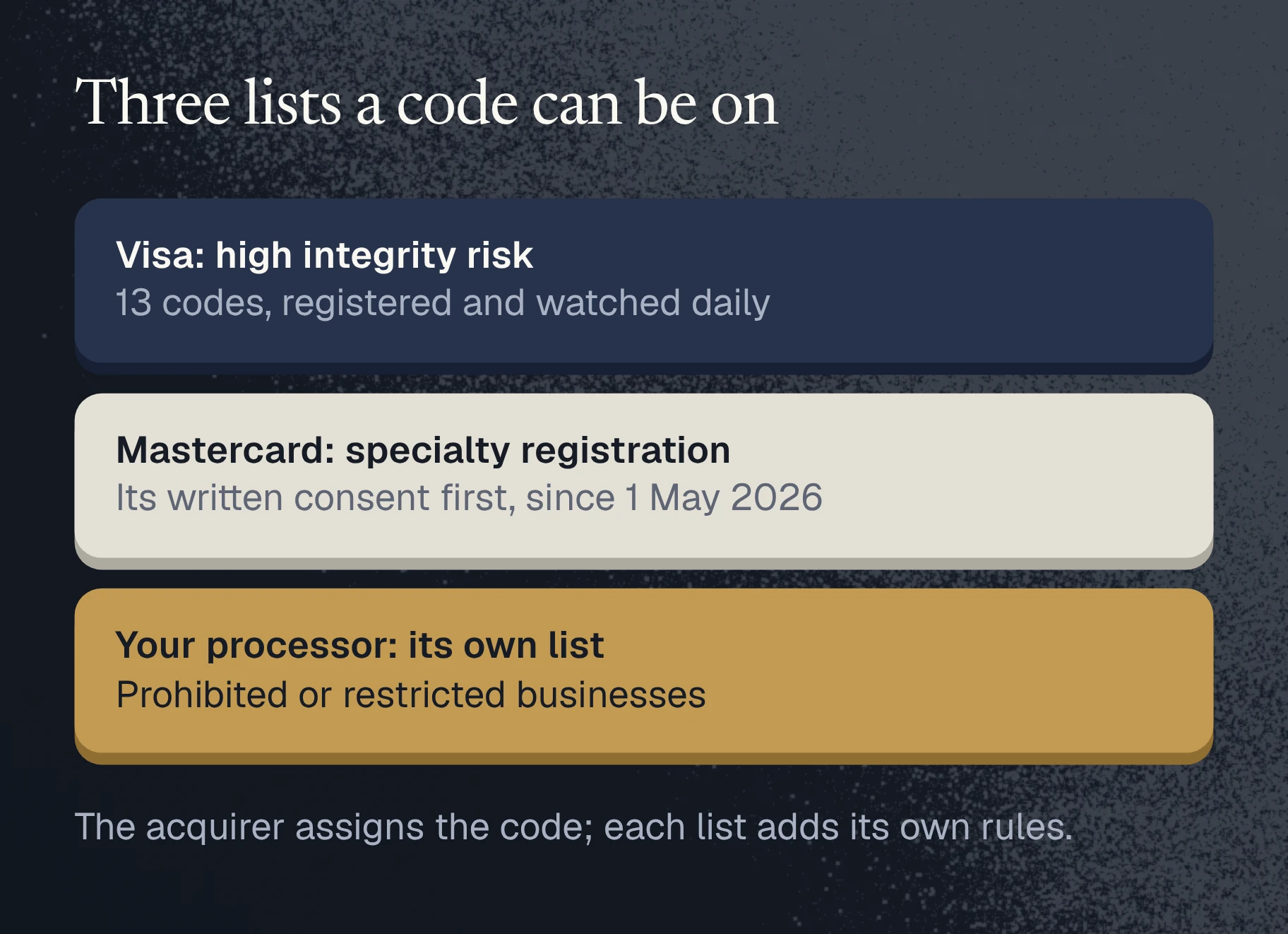
A merchant category code (MCC) is the four-digit number a card network uses to say what a business sells. The high-risk MCC codes list in Visa's October 2026 manual has 13 codes, including 5967, 5968, 5816, 5912, 6051 and 7995, and Mastercard makes most of the same businesses register before an acquirer can take their cards.
Each code's official name below comes from Visa's Merchant Data Standards Manual (October 2026), Mastercard's Quick Reference Booklet (10 November 2026) and Mastercard's Security Rules and Procedures (4 August 2026). Why processors call a business high risk at all is in what makes a business high risk to card processors.
The high-risk MCC codes list, with both networks' names
This table lists every code on Visa's high integrity risk list or Mastercard's Specialty Merchant Registration list, with each network's own name. "All online sales" means Visa flags every card-absent sale under the code; anything narrower is the only kind of sale Visa flags.
| MCC | Visa's name (Oct 2026) | Mastercard's name (Nov 2026) | Who flags it |
|---|---|---|---|
| 4816 | Computer Network/Information Services | Computer Network/Information Services | Visa: cyberlockers and file sharing only. Mastercard: high-risk cyberlockers |
| 5122 | Drugs, Drug Proprietaries, Druggist Sundries | Drugs, Drug Proprietors, and Druggists Sundries | Visa: all online sales. Mastercard: pharmaceuticals |
| 5816 | Digital Goods – Games | Digital Goods: Games | Visa: skilled game wagering only |
| 5912 | Drug Stores, Pharmacies | Drug Stores, Pharmacies | Visa: all online sales. Mastercard: pharmaceuticals |
| 5966 | Direct Marketing – Outbound Telemarketing Merchants | Direct Marketing: Outbound Telemarketing Merchants | Visa: all online sales |
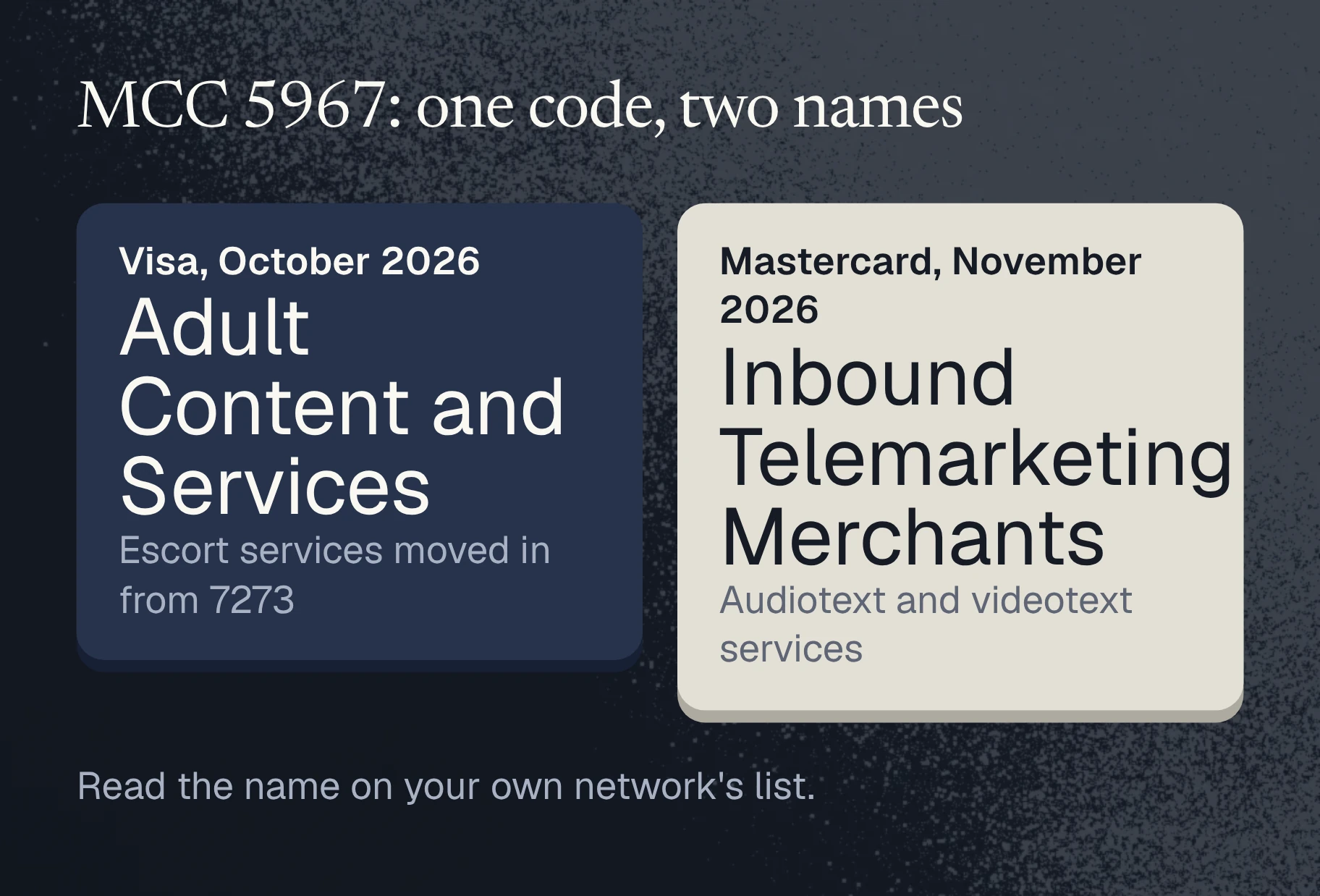
| 5967 | Adult Content and Services | Direct Marketing: Inbound Telemarketing Merchants | Visa: all online sales. Mastercard: adult content and services |
| 5968 | Direct Marketing – Continuity/Subscription Merchant | Direct Marketing: Continuity/Subscription Merchants | Visa: negative option only. Mastercard: negative option physical products |
| 5993 | Cigar Stores and Stands | Cigar Stores and Stands | Visa: all online sales. Mastercard: tobacco |
| 6012 | Financial Institutions – Merchandise, Services, and Debt Repayment | Merchandise and Services: Customer Financial Institution | Visa: crypto merchants only |
| 6051 | Non-Financial Institutions – Foreign Currency, Liquid and Cryptocurrency Assets… (shortened) | Quasi Cash: Merchant | Visa: crypto merchants only. Mastercard: crypto |
| 6211 | Security Brokers/Dealers | Securities: Brokers/Dealers | Visa: high integrity risk trading platforms. Mastercard: high-risk securities |
| 7273 | Dating Services | Dating Services | Visa: all online sales |
| 7800, 7801, 7802 | Government-Owned Lotteries; Government Licensed On-Line Casinos; Government-Licensed Horse/Dog Racing (US only) | Government Owned Lottery; Internet Gambling; Government Licensed Horse/Dog Racing (US only) | Mastercard: lotteries and gambling |
| 7994 | Video Game Arcades/Establishments | Video Game Arcades/Establishments | Mastercard: skill games |
| 7995 | Betting, including Lottery Tickets, Casino Gaming Chips, Off-Track Betting, Wagers at Race Tracks | Gambling Transactions | Visa: all online sales. Mastercard: gambling |
| 9406 | Government-Owned Lotteries (Non-U.S. region) | Government-Owned Lottery (Global, excluding U.S. Region and U.S. Territories) | Mastercard: lotteries |
Two details matter outside the US: Visa's manual says 5912 and 5993 count as high integrity risk in Asia Pacific, Canada, CEMEA, Europe and Latin America "only if the Merchant conducts transactions other than domestic transactions", and Mastercard's registration also covers Canadian recreational cannabis under any code.
What each flagged code means
Each definition below is the network's own, with the words that decide who lands there.
MCC 5967: adult content, or inbound telemarketing
On Visa, 5967 is for merchants that "sell adult content and services that customers access via telephone or fax or over the internet", website subscriptions and video streaming included. Visa's October 2026 manual moved escort services into it: "Escort Service has been moved from MCC 7273 Dating Services and into MCC 5967 Adult Content and Services." Mastercard still defines 5967 as audiotext and videotext services, such as "polls, sweepstakes, adult chat and entertainment".
MCC 5968: continuity and subscription
Visa's 5968 covers subscription products sold through direct mail, email, apps or salespeople, "nutraceuticals" included. Only negative option sales are on its high integrity list, and Visa says merchants that merely offer recurring purchases should use the code that best describes their business. A store selling a $59.00 supplement bundle as a one-time order (example) isn't making a negative option sale.
MCC 5816: digital goods, games
Visa's 5816 is for merchants that "sell games (including games of skill but excluding games of chance) that are delivered in electronic format, including in-app purchases in games." It is high integrity risk only "for Transactions involving skilled game wagering (for example: daily fantasy sports)". What top-up sellers run into instead is in card payments for game top-ups and in-game currency.
MCC 5912 and 5122: pharmacies and drug wholesalers
5912 is pharmacies, pet pharmacies included; 5122 is the wholesale side. Visa's rules exempt them from high integrity registration if the merchant is "accredited by the National Association of Boards of Pharmacy (NABP) or other regulatory body recognized by Visa."
MCC 5993: cigars, tobacco and e-cigarettes
Both networks' 5993 includes e-cigarettes, which Visa lists as "electronic cigarettes". Mastercard forbids coding tobacco under its quasi-cash code: "the sale of any tobacco product (MCC 5993 must be used)."
MCC 6051 and 6012: quasi-cash and crypto merchants
6051 is the non-bank code for foreign currency, money orders and cryptocurrency; 6012 is the bank equivalent. Visa flags them only for "Crypto Merchants: exchanges, wallet providers or on-ramp providers" whose transactions must carry special condition code 7. Mastercard's 6051 "must not be used" for gambling, adult videotext, prescription drugs or tobacco, each of which has its own code.
MCC 7995: betting and gambling
Visa's 7995 covers "games of chance to win prizes of monetary value or betting establishments", and online gambling must use it "even if gambling is not the Merchant's primary business." US merchants that qualify for government lotteries (7800), licensed online casinos (7801) or horse and dog racing (7802) use those instead. Why players' cards are declined there is in why cards get declined on gambling sites.
MCC 7273, 4816, 5966 and 6211
7273 is dating services; Mastercard's definition still reads "dating and escort services". 4816 is flagged by Visa only "for the sale of access to cyber lockers or remote digital file-sharing services." 5966 is outbound telemarketing, and 6211 is securities brokers, flagged by Visa as "High Integrity Risk Financial Trading Platforms."
Where the "Tier 1, 2, 3" lists come from
The tier lists in most guides are industry shorthand with no public Visa source. Visa's Core Rules of 24 October 2026 say only that Visa classifies these merchants "as specified in the Visa Integrity Risk Program Guide", which isn't published, so the manual's list above is the one to read.
What a business coded there should expect
A flagged code doesn't decide whether one sale goes through; it decides which extra rules apply to every sale. This table lists those in the networks' public documents.
| Rule | Codes it applies to | What it means |
|---|---|---|
| Registration | Visa's high integrity list; Mastercard's specialty list | The acquirer registers the merchant. Since 1 May 2026, Mastercard requires its "express prior written consent" first |
| Assessments for not registering | Mastercard's specialty list | The acquirer pays up to USD 10,000; after notice, USD 5,000 a month for up to three months, then USD 25,000 a month |
| Daily monitoring | Visa's high integrity list | From "the 31st calendar day from the first Deposit", against the merchant's normal daily activity |
| No 3-D Secure shift on US fraud disputes | 4829, 5967, 6051, 6540, 7801, 7802, 7995 | Visa's fraud dispute 10.4 applies "regardless of the Electronic Commerce Indicator value" on US domestic sales |
| Shut out of Visa's age checks | 5816, 5967, 5993, 7273, 7995 and more | Merchants using Visa's Age Validate and Birthdate Validate services, new on 24 October 2026, must "Not use" these codes |
Issuers can act on the code too. Visa's rules say an issuer that lets cardholders "limit Card use by Transaction type or Merchant Category Code (MCC)" must decline with response code 9G, "Blocked by cardholder/contact cardholder". HSBC UK says of its debit card gambling block: "If a company has not been categorised with a gambling related code, we won't be able to identify transactions to it as gambling related."
Processors add lists of their own. Stripe's restricted businesses page, updated 22 September 2026, names online dating, cyberlockers, tobacco, online pharmacies and the "sale of in-game currency or game items, unless the business is the operator of the virtual world" among the businesses it restricts. The rest of its list is in can you use Stripe for your business.
The code isn't yours to choose
The acquirer picks the code, and the networks say how. Visa's manual says: "It is an important requirement that Acquirers (and their Agents) assign the correct MCC to each of their Merchants," choosing "the MCC that most accurately describes the Merchant's business". Mastercard's test is the code that "most reasonably and fairly describes the merchant's primary business." Each website selling distinct goods gets its own code, and Visa's Core Rules require a separate code when one line of business at an outlet is high integrity risk.
Intermediaries carry the same duty. Visa's manual says a payment facilitator "must evaluate the business of every sponsored Merchant and assign the MCC most appropriate" to it, and a ramp provider "must evaluate the business of every Conversion Affiliate and assign the MCC most appropriate to the Conversion Affiliate's business."
A wrong code breaks these rules, and so does trying to dodge them. Visa can disqualify a high integrity risk merchant that "Acts with the intent to circumvent Visa programs", and Mastercard can treat an unregistered specialty merchant as a breach of its illegal or brand-damaging transactions rule. Other reasons an application is turned down are in why a merchant account application gets declined.
Why Railbed fits a business with a flagged code
Railbed is card checkout for online merchants that mainstream processors turn away, with no underwriting and no application to pass: sign-up needs an email, your website and a payout wallet. An independent, licensed card provider charges each buyer's card on its own page, and the sale settles to a wallet you control, almost always as USDC on Polygon. Nothing is held back from your sales. Fees are Railbed's, from 0.9%, a 1% network fee and the provider's own fee and exchange rate, with no setup or monthly fee.
Good to know:
- Railbed doesn't change how a payment is coded. A card can still be declined on the provider's page.
- Disputes go to the provider. Settled sales can't be pulled back from your wallet; card disputes are raised with the provider that charged the card.
- Railbed's own limits are the law's. Its acceptable use policy covers child abuse material and non-consensual content, money laundering and structuring, and sanctions.
- The smallest card payment is about $2.00. That's the providers' minimum, not Railbed's, and it changes; prices of about $10 or more give buyers the widest choice.
Take cards for a business on the flagged list
No underwriting and no application to pass. Buyers pay by card on a licensed provider's page, and each sale settles to a wallet you control.
Read how it worksCreate an account