Debt settlement merchant accounts: the advance-fee ban and how an earned fee is paid by card
The Telemarketing Sales Rule's advance-fee ban, worked through one client whose three debts settle months apart, and how each earned fee is invoiced and paid by card.
Press the card to run an example sale.
A debt settlement merchant account has to fit one rule above all: for debt relief sold by phone, the FTC's Telemarketing Sales Rule bars any fee until a debt is settled and the client has made a payment under that settlement. Payment processors that helped firms collect fees earlier have faced federal enforcement, and the mainstream processors list debt relief as a business they won't take.
This guide quotes the rule, works through one example client whose three debts settle months apart, and shows who holds which money along the way. The fee moment here is a result, a signed settlement and the client's first payment on it, which is a different trigger from credit repair, where the fee follows finished work. Whether your program meets the rule, and what your states add, is a question for your counsel.
What the advance-fee ban requires before any fee
The advance-fee ban applies to any debt relief service sold by telemarketing, and it sets three conditions before a fee. The rule defines a debt relief service as one "represented, directly or by implication, to renegotiate, settle, or in any way alter the terms of payment or other terms of the debt" with unsecured creditors or debt collectors. Section 310.4(a)(5)(i) then bars "Requesting or receiving payment of any fee or consideration for any debt relief service until and unless":
- The seller "has renegotiated, settled, reduced, or otherwise altered the terms of at least one debt pursuant to a settlement agreement, debt management plan, or other such valid contractual agreement executed by the customer";
- "The customer has made at least one payment pursuant to that settlement agreement"; and
- Where debts are settled one at a time, the fee is either proportional to that debt's share of the total, or "a percentage of the amount saved", where "The percentage charged cannot change from one individual debt to another."
The rule reaches further than outbound calls. The exemption for calls customers start in answer to an advertisement does not apply to "Calls initiated by a customer or donor in response to an advertisement relating to ... debt relief services", and the direct mail exemption carries the same exception.
One client, three debts: when each fee is earned
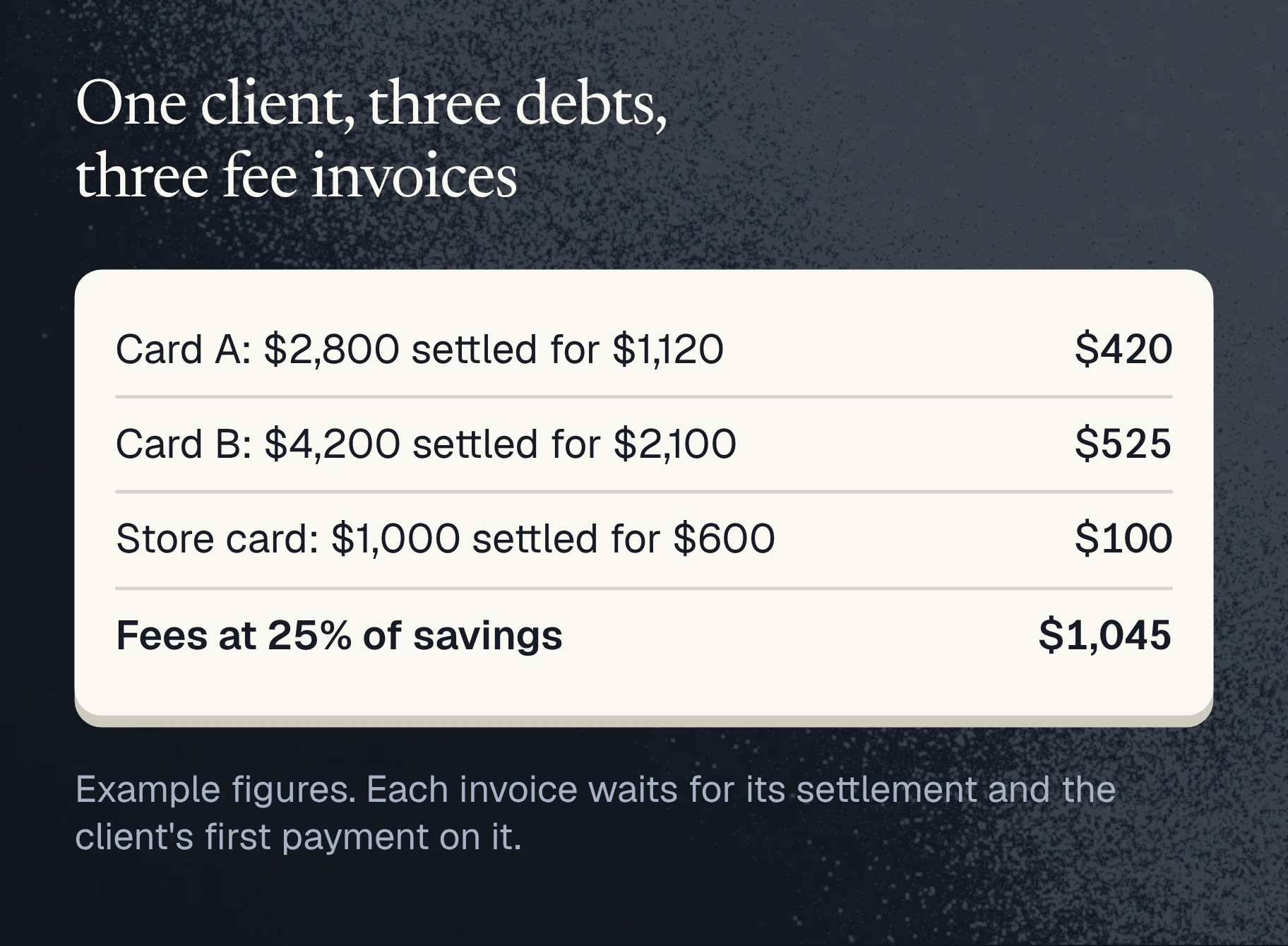
A settlement fee is earned one debt at a time, so a single client produces several fee invoices months apart. Take an example client who enrolls three unsecured debts owing $8,000 in all.
The rule's two fee methods give different figures for the same three settlements. This table works both: the percentage-of-savings method at an example 25%, and the proportional method for an example total fee of $1,600, where each debt's fee is its share of the $8,000 owed at enrollment.
| Debt (owed, then settled for) | Amount saved | Fee at 25% of savings | Share of a $1,600 total fee |
|---|---|---|---|
| Card A ($2,800, then $1,120) | $1,680 | $420 | $560 |
| Card B ($4,200, then $2,100) | $2,100 | $525 | $840 |
| Store card ($1,000, then $600) | $400 | $100 | $200 |
| All three ($8,000, then $3,820) | $4,180 | $1,045 | $1,600 |
The arithmetic follows the rule's own definitions. The amount saved is "the difference between the amount owed at the time the debt was enrolled in the service and the amount actually paid to satisfy the debt", so Card A saves $2,800 minus $1,120, or $1,680, and 25% of that is $420. The proportional share uses the amounts "owed at the time the debt was enrolled": Card A is 2,800 of 8,000, or 35%, and 35% of $1,600 is $560.
The timing follows the conditions. If Card A settles in month 4, its $420 can be invoiced only after the client signs that settlement and makes the first payment to the creditor under it. Card B's $525 waits for its own settlement and first payment, perhaps in month 9, and the store card's $100 for its own after that. Under the rule's wording, a fee for a debt follows that debt's settlement, so a debt that never settles brings no fee of its own.
Who holds which money
The rule says who may hold a client's savings, and an earned fee can be paid from that account or invoiced on its own. Section 310.4(a)(5)(ii) lets you ask a client to save in an account for settlements and fees only if the funds are "held in an account at an insured financial institution", the client owns them and gets any interest, the administrator "is not owned or controlled by, or in any way affiliated with, the debt relief service", it pays or takes nothing for referrals, and the client can leave at any time and get their money back "within seven (7) business days".
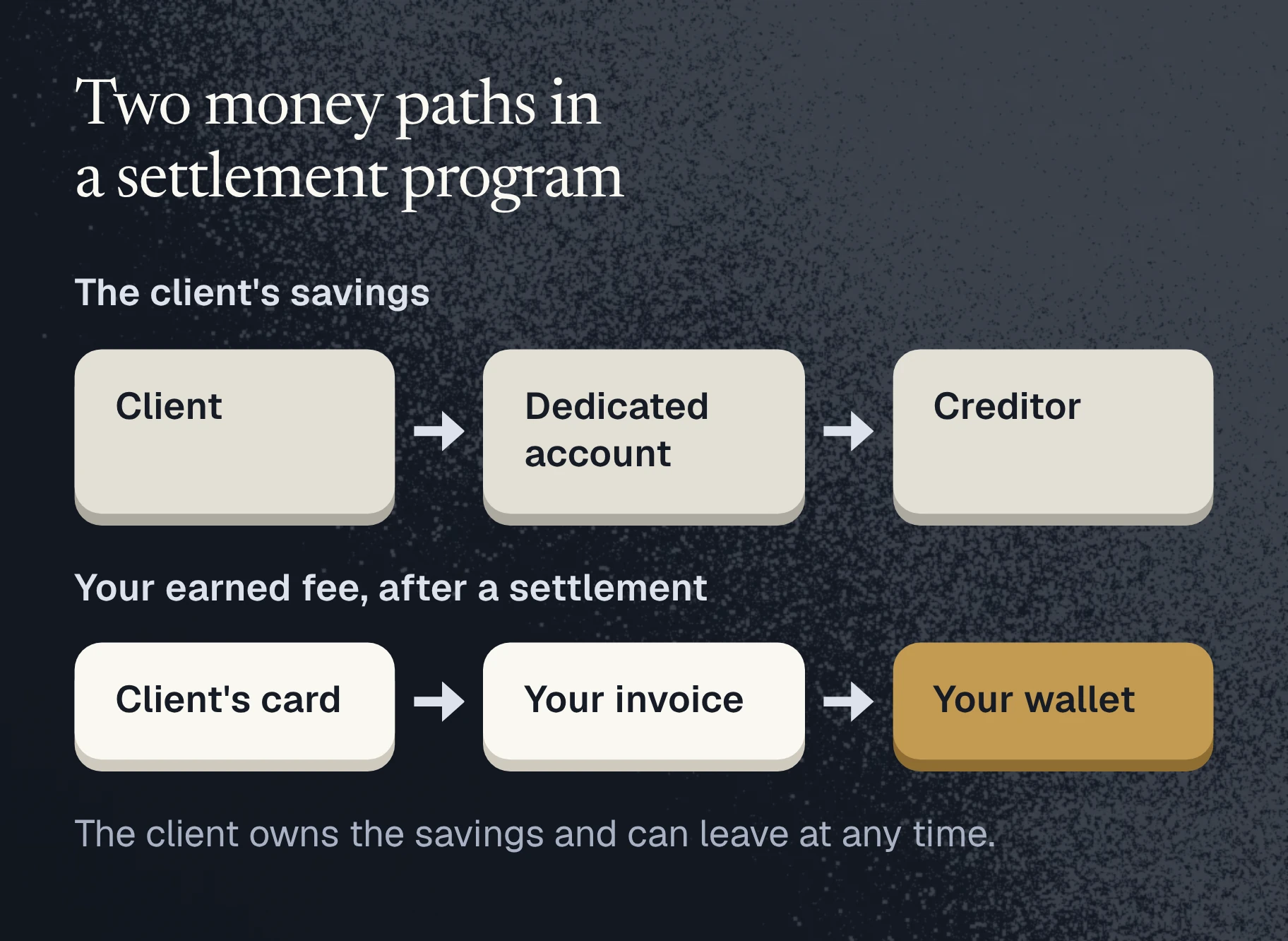
Railbed is not a dedicated account and holds no one's money: it keeps no balance, so client savings belong at the insured institution the rule names. What Railbed can carry is the bottom path, a fee you have already earned, invoiced to the client and paid by card into your own wallet. The debt settlement industry page goes through the account conditions one by one.
Why a debt settlement merchant account is hard to get
Debt settlement and other debt relief merchant accounts are scarce because the rule puts processors on the hook for fees they help collect early. Section 310.3(b) of the rule makes it a violation to "provide substantial assistance or support to any seller or telemarketer when that person knows or consciously avoids knowing" that the seller is breaking 310.4.
The CFPB has used that against processors. In October 2013 it took action against Meracord, alleging the processor helped debt settlement firms collect "millions of dollars in illegal upfront fees from consumers", and asked a court to approve a consent order with a $1.376 million civil penalty. In August 2014 it took action against Global Client Solutions, alleging it helped companies "collect tens of millions of dollars in illegal upfront fees", and asked a court to approve an order for over $6 million in consumer relief and a $1 million civil penalty.
Complaints keep the risk visible. In the CFPB's 2025 Consumer Response Annual Report, "Debt settlement was the most complained about debt or credit management product type (49%)", and "In some instances, consumers reported that debt settlement companies charged upfront fees before performing any services." Stripe's restricted businesses page lists "Debt settlement, debt negotiation, and debt consolidation" under prohibited debt relief companies. If you are offered an account, what to check in a high-risk processor contract covers reserves, holds and termination terms.
Invoicing an earned settlement fee
An invoice for a settlement fee goes out after the settlement and the client's first payment on it, for the amount your contract's method gives. Using the $420 Card A fee from the example and the field names in the invoices guide:
- Confirm the trigger. The client has signed the Card A settlement and made the first payment to the creditor under it.
- Create the invoice. One line, "Settlement fee, Card A", 420.00 USD. Put the client's file number in Reference or PO number and the working in Note to the customer: owed at enrollment $2,800, settled for $1,120, saved $1,680, fee 25%.
- Choose when it's due. On receipt, or 7, 14 or 30 days.
- Offer parts if you want. Turn on Let them pay in parts and set a Smallest first payment; the client chooses each amount until the fee is paid, as in getting an invoice paid in full or in parts.
- Send it. Send invoice emails it with its PDF from "Your Business via Railbed", or Get link only gives you a link or QR code to send yourself.
When Card B settles, you send its own invoice the same way. A separate invoice for each settled debt keeps each fee beside the settlement that earned it.
Why Railbed fits a debt settlement company
Railbed fits a settlement firm that bills each fee once it's earned, because an invoice moves no money by itself and nothing is charged until the client pays it. There's no underwriting and no application to pass: sign up with an email, your website and a payout wallet. Nothing is held back from your sales, and there's no setup fee, no monthly fee and no reserve. Fees come out of what arrives: the card provider's own fee and exchange rate, a 1% network fee and the Railbed fee, from 0.9%, shown in the dashboard and locked when the client starts paying.
Good to know:
- Railbed never stores a card and never charges one automatically: a fee is paid only when the client pays its invoice, and when that invoice goes out is your decision.
- Railbed holds no client savings and isn't the dedicated account; it keeps no balance at all.
- Card disputes are raised with, and handled by, the provider that charged the client's card. Railbed is not a party, and settled sales can't be pulled back from your wallet.
- Sales arrive as USDC, almost always on Polygon, in a wallet you control. Moving the money to your bank is your step.
- Refunds come from your own wallet; there's no refund button.
- Card providers decide whether to ask for ID. Smart Routing ranks the providers least likely to ask first.
- An invoice can be up to 100,000.00, and the smallest card payment is about $2.00, set by the providers.
Invoice each settlement fee once it's earned
Create an invoice for a settled debt's fee with the working in the note, let the client pay in full or in parts, and receive it in your own wallet.
Create your accountRead the invoices guide