Why is MLM payment processing high risk, and how can a direct sales company take cards?
What processors' own lists, the FTC and Visa's dispute rules say about MLM, how long a starter kit sale stays open, and the policies that cut disputes.
Press the card to run an example sale.
MLM payment processing is high risk to processors for reasons they publish: their own lists restrict recruitment-based selling, the FTC judges each compensation plan case by case with no numeric test, and Visa lets a buyer dispute a business opportunity sold on income claims as misrepresented. Starter kits, autoship and distributor returns add disputes on top.
This article reads those rules from their own pages as of November 24, 2026, follows one starter kit sale through every window that keeps it open, and lists the policies that close those windows sooner. It describes rules, not any company: whether a particular plan is lawful is a question the FTC answers from how the plan works in practice.
Why processors treat MLM payment processing as high risk
Processors class direct sales as high risk for four reasons that each trace to a published rule. None of them is a verdict on a particular company; together they explain why an application is refused or priced up before anyone reads the plan.
Their own lists name the model
Processors' restricted lists name multi-level marketing directly. As read on November 24, 2026, Stripe's restricted businesses list includes "Pyramid schemes," "Multilevel marketing services offering commission or recruitment-based sales" and "'Get rich quick' schemes." PayPal's acceptable use policy bars transactions that "support pyramid or ponzi schemes, matrix programs, other 'get rich quick' schemes or certain multi-level marketing programs," and puts "Multilevel Marketing and Direct Selling Organizations" in its chart of services that need pre-approval, noting these models "frequently require the independent distributors to recruit new distributors in order to advance within the organization or gain incentive compensation."
The law draws no bright line
The FTC staff's non-binding business guidance on multi-level marketing (April 2024) says "There is no percentage-based test to determine whether an MLM is a pyramid scheme." Instead the FTC "focuses on how the structure as a whole operates in practice," looking at marketing representations, participant experiences, the compensation plan, and "the incentives that the compensation structure creates," such as "incentives to make large or regular purchases in order to maintain eligibility for rewards." For a processor, a test that turns on practice rather than paperwork can't be settled at sign-up, which is the root of the high-risk label for the whole category.
Income claims become card disputes
Earnings claims are where FTC rules and card disputes meet. The same guidance says "Any earnings claim should reflect what the typical person to whom the representation is directed is likely to achieve," must subtract expenses, and that "A 'results not typical,' 'results are not guaranteed,' or similar disclosure is not enough."
Visa gives buyers a dispute for exactly that. Its Core Rules (October 24, 2026 edition) list, under condition 13.5 Misrepresentation, "Business opportunities in which the Merchant suggests that an income will be generated or recommends that the Cardholder purchases additional items (for example: better sales leads) to generate more income." The condition is "based on the type of merchandise or services sold and not solely on the MCC," and a dispute can be filed within "120 calendar days" of the processing date or of receiving the goods, up to an outer limit of 540 days.
Autoship is a negative option
An autoship order that keeps coming until the distributor cancels is the kind of plan federal law calls a negative option, and it carries its own rules. The FTC's Telemarketing Sales Rule, 16 CFR 310.2, defines a negative option feature as a provision under which "the customer's silence or failure to take an affirmative action to reject goods or services or to cancel the agreement is interpreted by the seller as acceptance of the offer." The Restore Online Shoppers' Confidence Act, 15 U.S.C. 8403, makes it unlawful to charge for such a feature online unless the seller "clearly and conspicuously discloses all material terms of the transaction before obtaining the consumer's billing information," "obtains a consumer's express informed consent before charging," and "provides simple mechanisms for a consumer to stop recurring charges." A distributor who forgets to stop an order disputes it as one they didn't want, and Visa has a condition for that too: 13.2, Cancelled Recurring Transaction.
How long a $149 starter kit sale stays open
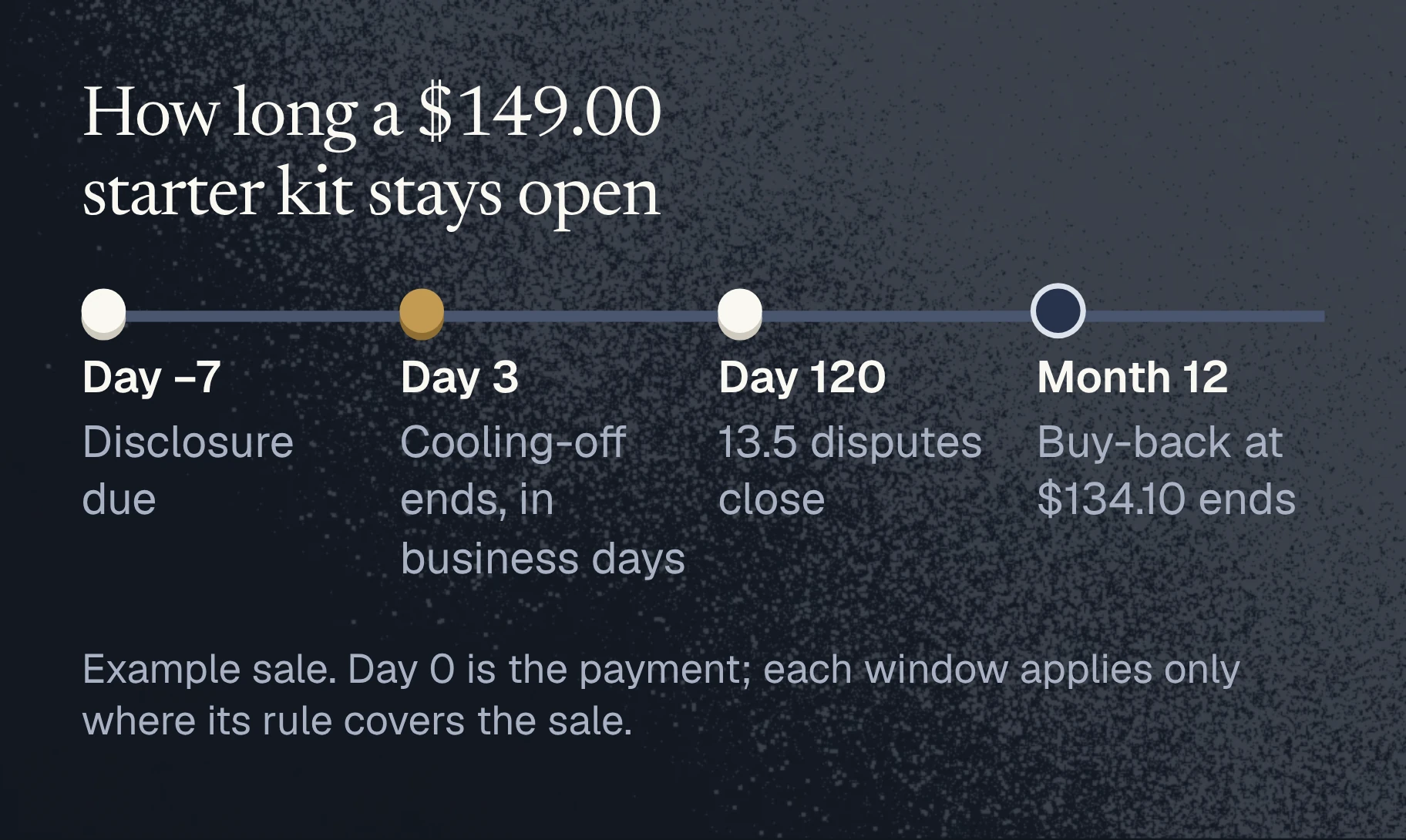
A starter kit sale stays open far longer than the day it's paid. Here is an example $149.00 kit sold at a home party to a new distributor, followed through every window that can reopen it. Which windows apply to your company depends on how and where you sell.
| When | What can happen | Rule |
|---|---|---|
| 7 days before payment | Disclosure document due, if the kit is a business opportunity under the rule | FTC Business Opportunity Rule, 16 CFR 437.2 |
| To midnight of business day 3 | The buyer can cancel a covered sale made at home or a party | FTC Cooling-Off Rule, 16 CFR 429 |
| Up to day 120 | The buyer's bank can file a misrepresentation dispute | Visa condition 13.5 |
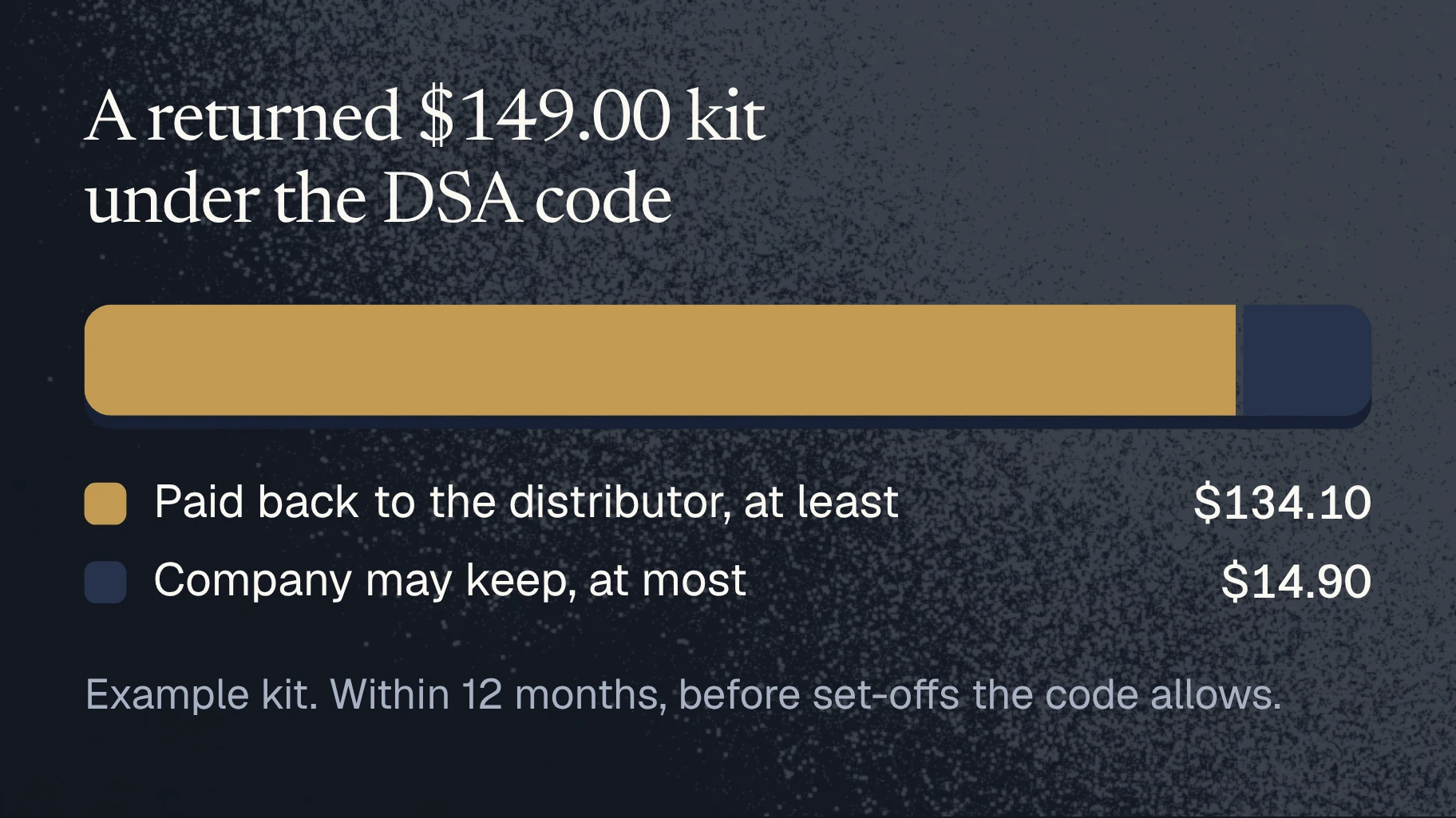
| Up to 12 months | A departing distributor can return an unused kit for at least $134.10 | DSA Code of Ethics (members) |
The Business Opportunity Rule asks for the disclosure "at least seven calendar days before" the buyer signs or "Makes a payment," and the FTC's guidance says it may seek penalties from MLMs "that qualify as a business opportunity under the Rule." The FTC's Cooling-Off Rule page gives "three days to cancel certain sales made at your home, workplace, or dormitory, or at a seller's temporary location," except sales "under $25" at home and "under $130" at temporary locations, and the seller must hand over "Two copies of a cancellation form." The rule itself runs the right "prior to midnight of the third business day after the date of this transaction," and a business day is "Any calendar day except Sunday or any federal holiday." It covers consumer goods bought "primarily for personal, family, or household purposes," so whether a kit bought to start selling counts is a question for your lawyer.
The Direct Selling Association's code asks member companies to buy back a departing salesperson's stock and defines "reasonable commercial terms" as buying back marketable inventory, "sales aids, tools and kits within twelve (12) months" at "not less than 90 percent of the salesperson's original net cost." On a $149.00 kit, 90% is $134.10, so a member company keeps at most $14.90 of a returned kit, before any set-offs the code allows.
The policies that close those windows sooner
The policies that reduce direct sales disputes are the ones that leave a buyer nothing to claim. Each one below answers a window from the table or a rule quoted above:
- Earnings figures for the typical participant, with expenses. The FTC's guidance asks for this, and it leaves less ground for a 13.5 misrepresentation dispute.
- A kit page that lists the contents, the price, the buy-back terms and the cancel right in plain words, sent again with the receipt.
- Cancellation forms at every party sale, two copies, so a guest who changes their mind cancels with you and not their bank.
- A published buy-back at 90% or more within 12 months, paid quickly, so a departing distributor returns stock rather than disputing the charge.
- No charge without a fresh yes. Where you keep autoship, follow ROSCA's three conditions quoted above; or replace it with an order the customer approves each month.
- Fast refunds. A refund sent before the buyer calls their bank removes the main reason to dispute; the guide to friendly fraud covers the disputes that come anyway.
How a direct sales company takes orders by card with Railbed
Railbed handles the payment; your back office keeps the distributors, the plan and the commissions. A direct sales company sets it up in four parts:
- Retail orders on checkout pages or your store. A checkout page can ask up to five questions of your own, such as "Distributor ID," and the answer appears on the order, in the CSV export and in your webhooks. Shopify and WooCommerce stores connect directly.
- Starter kits by invoice. Where the Business Opportunity Rule applies, send the disclosure first and the invoice once the seven days have passed. Give your field leaders the Sales role: each one makes, sends and sees only their own invoices, and reads the rest of the account like a Viewer.
- Monthly product by subscription, billed by invoice. For every period, Railbed issues an ordinary invoice the customer pays themselves: "nothing is charged automatically: a period is paid only when the customer pays its invoice." An unpaid invoice makes the subscription past due, and you choose whether it is canceled 3, 7, 14, 30 or 60 days after the due date or kept past due. The guide to subscriptions without a stored card compares invoice renewals with a saved card; if your plan's ranks count a monthly order, decide how an unpaid invoice counts.
- Refunds and buy-backs from your wallet. Railbed has no refund button, since each sale has already settled to your wallet; you send refunds and buy-back payments yourself.
The direct sales and MLM page covers crediting distributors, party orders and reserves in more depth.
Why Railbed fits a direct sales company
Railbed is card checkout for online merchants that mainstream processors turn away, with no underwriting and no application to pass: sign-up needs an email, your website and a payout wallet. Buyers pay by card through independent, licensed card providers, each sale settles to a wallet you control, and nothing is held back from your sales, a launch month's kit sales included. Because no card is stored, every monthly order is one the customer approved.
Good to know
- Fees: Railbed's from 0.9%, a 1% network fee, and the provider's own fee and rate, shown to the buyer before they pay. No setup fee, no monthly fee, no reserve. Subscriptions add no fee of their own.
- Subscriptions can't yet prorate, switch plans mid-period or take part payments.
- Settled sales can't be pulled back from your wallet; card disputes go to the provider that charged the card.
- The laws that apply to your plan, its disclosures and its earnings claims are yours to meet; Railbed doesn't check them for you.
- The smallest card payment is about 2.00 USD, and sales reach a bank through an exchange or a wallet app.
Invoice a starter kit in Test mode
Create a $149.00 starter kit invoice with a Distributor ID question, pay it in Test mode, and see the order your back office would receive.
Create your accountRead how invoices work