What is friendly fraud, and what can a merchant do about it?
Friendly fraud is a cardholder disputing a purchase they really made. The three forms it takes, Visa's Compelling Evidence 3.0 as written, and a checklist from checkout to dispute.

Press the card to run an example sale.
Friendly fraud is a dispute a cardholder files over a purchase they, or someone in their household, really made, by mistake or on purpose. Visa calls it first-party misuse. Most of a merchant's defense comes before any dispute: a name buyers recognize, proof of delivery, easy refunds and records kept per order.
What a lost dispute costs, and what counts toward your ratio, have their own pages: what a chargeback really costs and chargeback vs refund vs dispute.
What the card networks call friendly fraud
Friendly fraud is the cardholder's own dispute of a genuine purchase, which is what separates it from third-party fraud with a stolen card. Visa's page on it says it is "when a cardholder disputes a legitimate transaction that they made or someone in their household made" and that it is "often referred to as first-party misuse". Mastercard describes the same behavior as transactions that "are mistakenly or intentionally challenged by cardholders" in its 2025 announcement of the First-Party Trust program.
Visa lists four forms: household misuse ("a family member uses a saved card without the cardholder's full awareness"), descriptor confusion ("forgetting or failing to recognize a merchant's name or billing descriptor on a statement"), "free goods" attempts and return-policy abuse. Its figure of "around 20% of all fraudulent disputes globally" is sourced on the page to the 2025 Global eCommerce Payments and Fraud Report by Visa Acceptance Solutions, Cybersource, the Merchant Risk Council, Verifi and B2B International. Stripe's explainer adds a second family, refund abuse, where a buyer gets a refund and keeps the product.
Because the person disputing is the buyer or someone close to them, most fixes are about memory, clarity and records, not about blocking strangers.
Three forms, and the dispute each one becomes
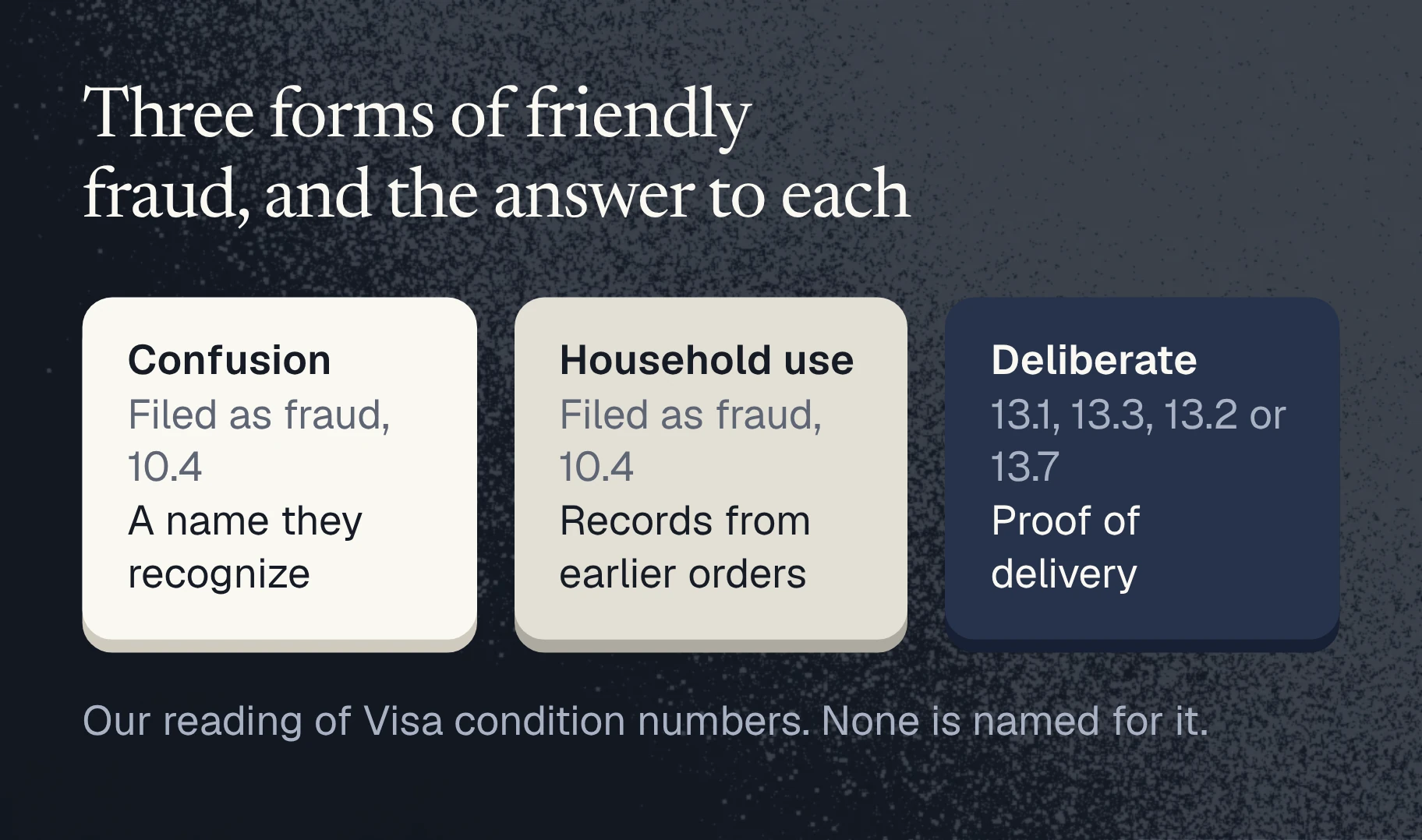
A friendly fraud claim reaches you as an ordinary dispute, because the networks have no reason code for it; the issuer picks the condition that matches what the cardholder said. The table groups Visa's four forms into three and pairs each with conditions from the Visa Core Rules (edition of October 24, 2026), whose full names are 10.4 Other Fraud, Card-Absent Environment; 13.1 Merchandise/Services Not Received; 13.2 Cancelled Recurring Transaction; 13.3 Not as Described or Defective Merchandise/Services; and 13.7 Cancelled Merchandise/Services. The pairing is this page's reading of what each kind of cardholder tends to tell the bank. Visa's rules do not make it, and an issuer can file the same story under another condition.
| Form | What the cardholder tells the bank | Visa condition it can be filed as | What stops it |
|---|---|---|---|
| Confusion | "I don't know this charge" | 10.4 Other Fraud, card-absent | A name the buyer recognizes, an order email that repeats it |
| Household use | "I didn't make this" (a child or partner did) | 10.4 Other Fraud, card-absent | Records tying the order to the same account, device or address as earlier orders |
| Deliberate | "It never arrived", "not as described", "I canceled" | 13.1 Not Received, 13.3 Not as Described, 13.2 or 13.7 Cancelled | Proof of delivery or use, the description shown at checkout, a refund given when asked |
What Visa's rules give a merchant to answer with
Visa's October 2026 rules give a merchant three answers to friendly fraud: Compelling Evidence 3.0 and authentication for fraud claims, and the rule that the cardholder must try the merchant first on non-receipt and quality claims. The three depend on records kept at the time of the sale. A fourth rule stops anyone contracting out of disputes.
Compelling Evidence 3.0, in Visa's words
Compelling Evidence 3.0 (CE3.0) makes a 10.4 card-absent fraud dispute invalid when the buyer's history shows they have used the same card with the same identifiers before. It is listed among the invalid disputes for condition 10.4 (Table 11-29, rule ID 0030254). For disputes processed on or after October 24, 2026, it applies when:
- "The same Card or a Payment Credential associated with that Card (for example: a Token) was used at one or more Merchants in 2 previous Transactions that the Issuer did not report as Fraud Activity", processed "more than 120 calendar days before the Dispute was submitted" and, by a footnote, "not to exceed 365 calendar days prior to the Processing Date of the Dispute".
- A detailed description of what was bought is given for the disputed purchase and both earlier ones.
- "The device ID/fingerprint, or the IP address and an additional one or more" of these match between the earlier purchases and the disputed one: the customer account or login ID, the full delivery address, the device ID or fingerprint, and the IP address.
The rules set a format for each: the full delivery address "in clear text and not hashed", a device ID of at least 15 characters or a fingerprint of at least 20, and "the Cardholder's public IP address". Among the changes for disputes from October 24, 2026: the earlier version said "The same Payment Credential" and had no words "at one or more Merchants"; a new footnote says device ID and fingerprint "are considered similar data elements", so they count once; and login IDs now include those "for an Agentic Payment Provider".
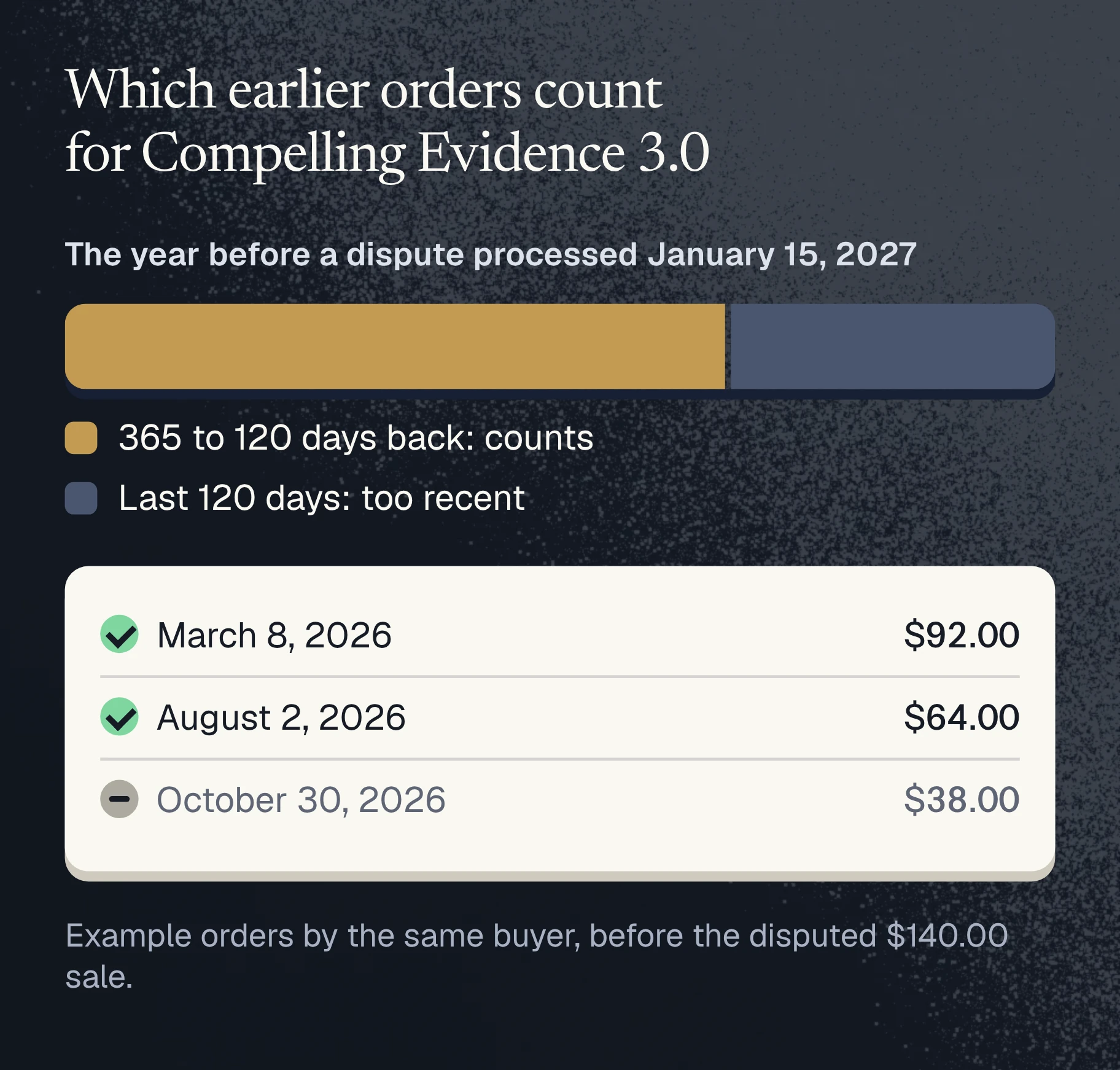
Here is how the window works on an example. A buyer's $140.00 sneakers order from December 1, 2026 is disputed as fraud, and the dispute is submitted and processed on January 15, 2027. Earlier purchases count if they were processed no earlier than January 15, 2026 (365 days back) and before September 17, 2026 (the rule says "more than 120" days back, and September 17 is exactly 120).
| Earlier order (example) | Days before the dispute | Counts for CE3.0 |
|---|---|---|
| March 8, 2026, $92.00 | 313 | Yes, if not reported as fraud |
| August 2, 2026, $64.00 | 166 | Yes, if not reported as fraud |
| October 30, 2026, $38.00 | 77 | No, too recent |
If the March and August orders shipped to the same full address and came from the same public IP address as the December order, the December dispute meets the matching test. If the buyer only matched on address, it does not, because one of the two matches must be the IP address or the device.
Visa's friendly fraud page says this data can reach the issuer before a dispute too, through Order Insight, which lets merchants share "login details, IP addresses, device IDs or delivery confirmations" with issuers and cardholders "in real time". Mastercard's First-Party Trust program does the same job on its side: Mastercard says merchants "may include enhanced data during authorization or submit it post-transaction during the disputes process". Visa's page says such evidence goes in "through your acquirer or dispute platform".
Authentication
A purchase the issuer authenticated through Visa Secure, processed with electronic commerce indicator 5 and the authentication value in the authorization, is also on the 10.4 invalid list. That is the 3-D Secure liability shift, and it answers fraud claims only: a buyer who authenticated and then says the parcel never arrived files under 13.1, where delivery proof is the answer. Which chargebacks 3-D Secure covers goes through each reason.
The cardholder must try you first
For a non-receipt claim (13.1), Visa's rules say "Before the Issuer may initiate a Dispute, the Cardholder must attempt to resolve the Dispute with the Merchant, the Merchant's liquidator, Ramp Provider, or its Conversion Affiliate as applicable." For disputes processed through October 22, 2027, the issuer certifies only that the cardholder "attempted to resolve with Merchant". For disputes processed on or after October 23, 2027, the issuer must give "the date the Cardholder attempted to resolve" and the "details used to contact the Merchant, such as an email address, telephone number, or physical address, and the outcome". The same change applies to not-as-described claims (13.3), Misrepresentation (13.5) and Cancelled Merchandise/Services (13.7). A support address that answers, and a log of what you replied, become part of the record the issuer has to fill in.
A waiver at checkout counts for nothing
A buyer cannot be made to give up the right to dispute. Visa's rules say "A Merchant must not require a Cardholder to waive the right to dispute a Transaction, including an Agentic Transaction, with the Issuer" (rule ID 0008771), and the agreement an acquirer must sign with a ramp provider says the provider must not shift its liability "by asking or requiring Cardholders to waive their dispute rights". A checkbox at checkout changes nothing at the buyer's bank; clear terms and records do.
A prevention checklist, stage by stage
Friendly fraud is cheapest to stop before the buyer calls the bank, and each stage of a sale has its own job, from the product page to a dispute.
- Before they pay. Describe the product as it is, with the photos and sizes that a not-as-described claim will be tested against. Put the refund and cancellation terms where the buyer sees them before paying; Visa's page advises "making sure refund and cancellation policies are easy to find". Say what name will appear on their card statement.
- At checkout. Keep, for every order, the four details CE3.0 counts: the account or login the buyer used, the full delivery address, the public IP address and a device identifier.
- At delivery. Keep the carrier's tracking and delivery scan with the order. For digital goods and subscriptions, Visa says "it's important to track usage data to demonstrate fulfilment": log-ins, downloads and use are your delivery record.
- Right after. Send an order confirmation with the amount, the date and the statement name, and a shipping notice. Stripe's explainer gives the reason: "Order confirmation emails help customers remember the transaction".
- When the buyer writes. Answer fast and refund when you would lose the dispute anyway: a buyer who has their money back has nothing left to take to the bank. Keep the date and outcome of every contact, which the October 2027 rules ask the issuer to give.
- When a dispute arrives. Answer the reason code, not the story: delivery proof for 13.1, the description shown at checkout for 13.3, CE3.0 history or authentication for 10.4. Your processor sets its own deadline; Stripe's is "usually 7-21 days, depending on the card network".
When a card provider charged the card, not you
On a card checkout that pays to your own wallet, the issuer's dispute goes to the provider that charged the card, not to you. Railbed's terms say card disputes "are raised with, and handled by, the on-ramp provider that charged the buyer's card", that "Railbed is not a party to those disputes", and that the provider handles "receipts, card-statement descriptors, identity checks and card disputes". Settled sales can't be pulled back from your wallet, and nothing is held back from your sales. The same clause is plain about what can follow: "A provider may contact you, decline future payments from a buyer or region, or take other action under its own terms."
That changes which parts of the checklist are yours.
- Confusion is the larger risk. The statement shows the provider's name, not your store's. Railbed's developer guide tells merchants to "say so near your buy button or in your order email, so buyers recognize the charge". What the statement looks like, and why some banks treat the charge differently, is in what buyers see on their card statement.
- You don't file the response. CE3.0 data and representments sit on the provider's side. Your records still answer the buyer who writes to you first, and a provider that contacts you.
- Some of the record is kept for you. Each Railbed payment shows where it was started: "the device, browser, operating system, language, time zone, country and IP address", as the buyer's browser and connection reported them, alongside the timeline. A payment your own server started through the API has none. A checkout can ask for the buyer's name, phone and addresses. These details are removed if you delete the customer.
- Refunds are yours to send. There is no refund button: a settled payment is already in your wallet, and you send the money back yourself, as how to refund a card payment that settled as USDC shows step by step. For a card purchase of crypto, Visa's rules also carry their own dispute lines, set out in can a card payment paid to your own wallet be charged back.
- Make "try the merchant first" easy. Railbed's customer portal, when you turn it on, lets a customer sign in with an emailed code to see orders and download receipts, and its Help card says refunds are arranged with you directly, then shows how to reach you, with your refund policy linked if you add one.
This setup fits a business that wants each sale paid to its own wallet and is ready to answer buyers and refund from that wallet. Disputes go to the provider that charged the card, so there are no representments for you to file.
See what each payment records
Every Railbed payment shows its timeline and, when the buyer started on Railbed's page, where they started paying from. Card disputes go to the provider that charged the card, and settled sales stay in your wallet.
Read the payments guideCreate an account