How do subscriptions work when no card is stored? Invoice renewals versus a saved card
Without a stored card, each period's invoice is paid by the customer. How renewals, dunning, churn and disputes change, with a $12 monthly period walked day by day.
Press the card to run an example sale.
When no card is stored, a subscription issues an invoice each period and the customer pays it on a payment page; nothing is charged in the background. If an invoice goes unpaid there is no card to retry, so the business reminds the customer, waits out a grace period, then cancels.
Below, the two models side by side for a business that can't get a processor to keep cards, or a developer wiring up access rules: one $12.00 monthly period walked day by day, what dunning and involuntary churn turn into without a card, and where invoice billing loses renewals.
What differs between a saved card and an invoice each period
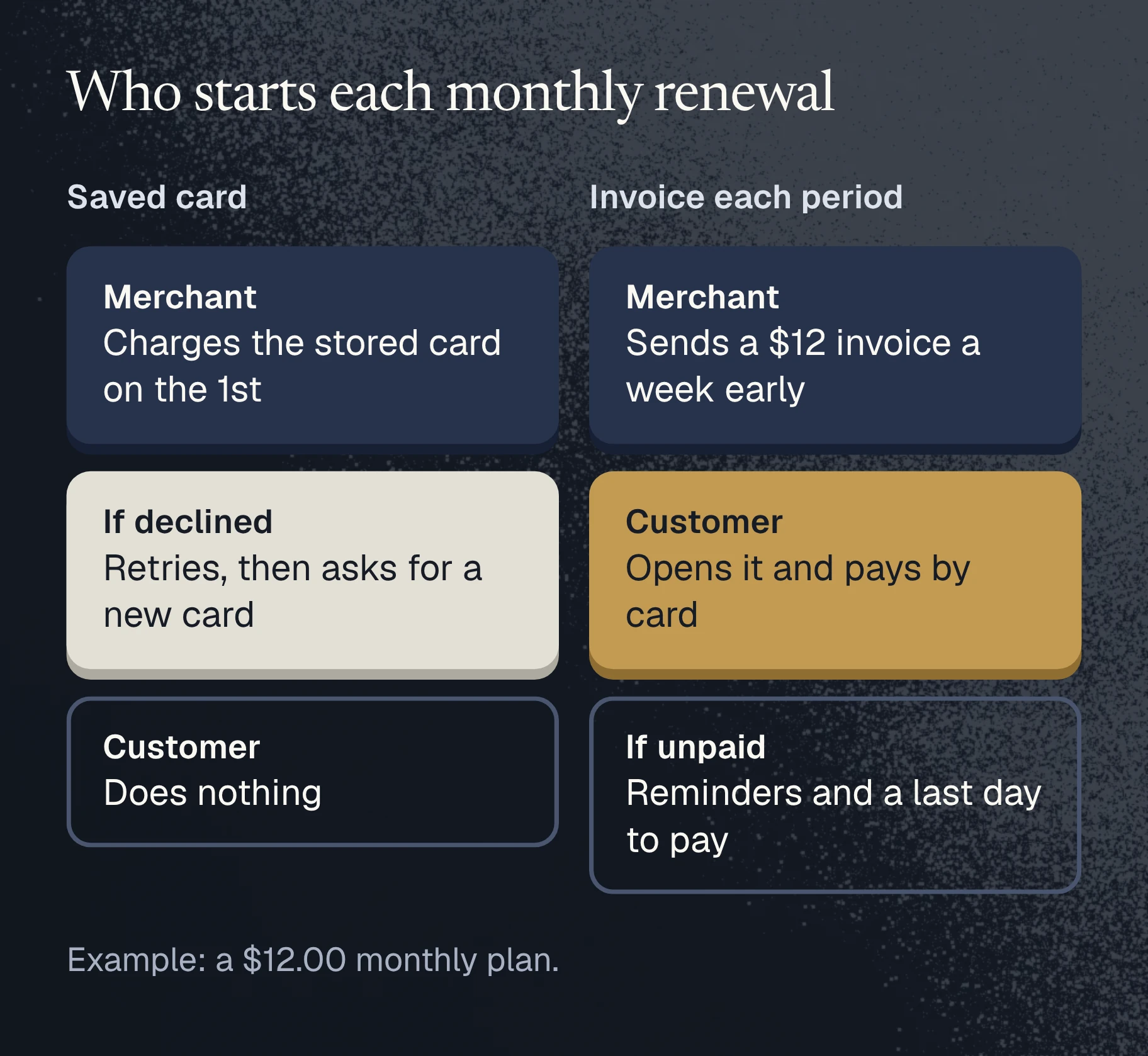
The difference between the two models is who presses pay. With a saved card, the customer agrees once and the merchant charges the card on schedule for as long as the agreement runs; with invoice billing, the customer receives a bill each period and pays it themselves, the same way they paid the first one.
Visa's 2017 guide to its stored credential framework draws the same line in card-network terms. A cardholder-initiated transaction is one "where the cardholder is actively participating"; a merchant-initiated one happens "without the active participation of the cardholder", and its example is "a subsequent recurring payment for a magazine subscription". Before storing a card for that purpose, the merchant must disclose how it will be used, get the cardholder's consent, and record terms such as the amount, the frequency and the cancellation policy.
Invoice billing isn't an exotic workaround. Stripe offers both models on the same subscription object: charge_automatically or send_invoice, where send_invoice "generates an invoice for each billing period, and requires manual payment". Stripe's page points send_invoice at enterprise clients who pay by wire transfer. What is less common is a whole subscription product built only on it, which is the case when the payment method itself can't be saved.
The table shows how the same subscription behaves under each model.
| Saved card | Invoice each period | |
|---|---|---|
| Who starts each renewal | The merchant charges the card | The customer pays the invoice |
| What the customer does monthly | Nothing, if the card works | Opens the invoice and pays |
| What a failed renewal is | A decline, then automatic retries | An unpaid invoice past its due date |
| What dunning means | Retries plus "update your card" emails | Reminders, a grace period, a cancel day |
| An expired or replaced card | Breaks renewals unless an updater refreshes it | Doesn't matter: the customer pays with whatever card they hold |
| A charge after canceling | Possible if cancellation is mishandled | Doesn't arise: nothing is charged unless the customer pays |
What dunning and involuntary churn become when there is no card to retry
Dunning is the process of collecting a subscription payment that didn't go through: retries, reminder emails and, at the end, a decision to pause or cancel. Involuntary churn is the share of cancellations caused by a payment that failed rather than a customer who chose to leave.
In the saved-card model, dunning is mostly machinery. Stripe's Smart Retries page, which describes itself as a way "to reduce involuntary churn", says new accounts are set up "for up to 8 retries within 2 weeks". Some failures can't be retried at all: for hard declines such as lost_card, stolen_card or revocation_of_authorization, "the payment only executes if you obtain a new payment method". Expired and replaced cards are handled by card updater services: Stripe says it "automatically attempts to update saved card details whenever a customer receives a new card", which is "widely supported in the United States" while "international support varies from country to country".
Without a stored card, none of that machinery exists, and none of its failure modes do either. There is no decline to retry, no expired card to refresh and no revoked authorization. "Failed payment" becomes "unpaid invoice", and dunning becomes a reminder schedule with a clear last day. Involuntary churn in the card sense mostly disappears; what replaces it is a customer who didn't get round to paying, which looks like voluntary churn in the figures but often isn't a decision at all.
One $12.00 monthly period, day by day
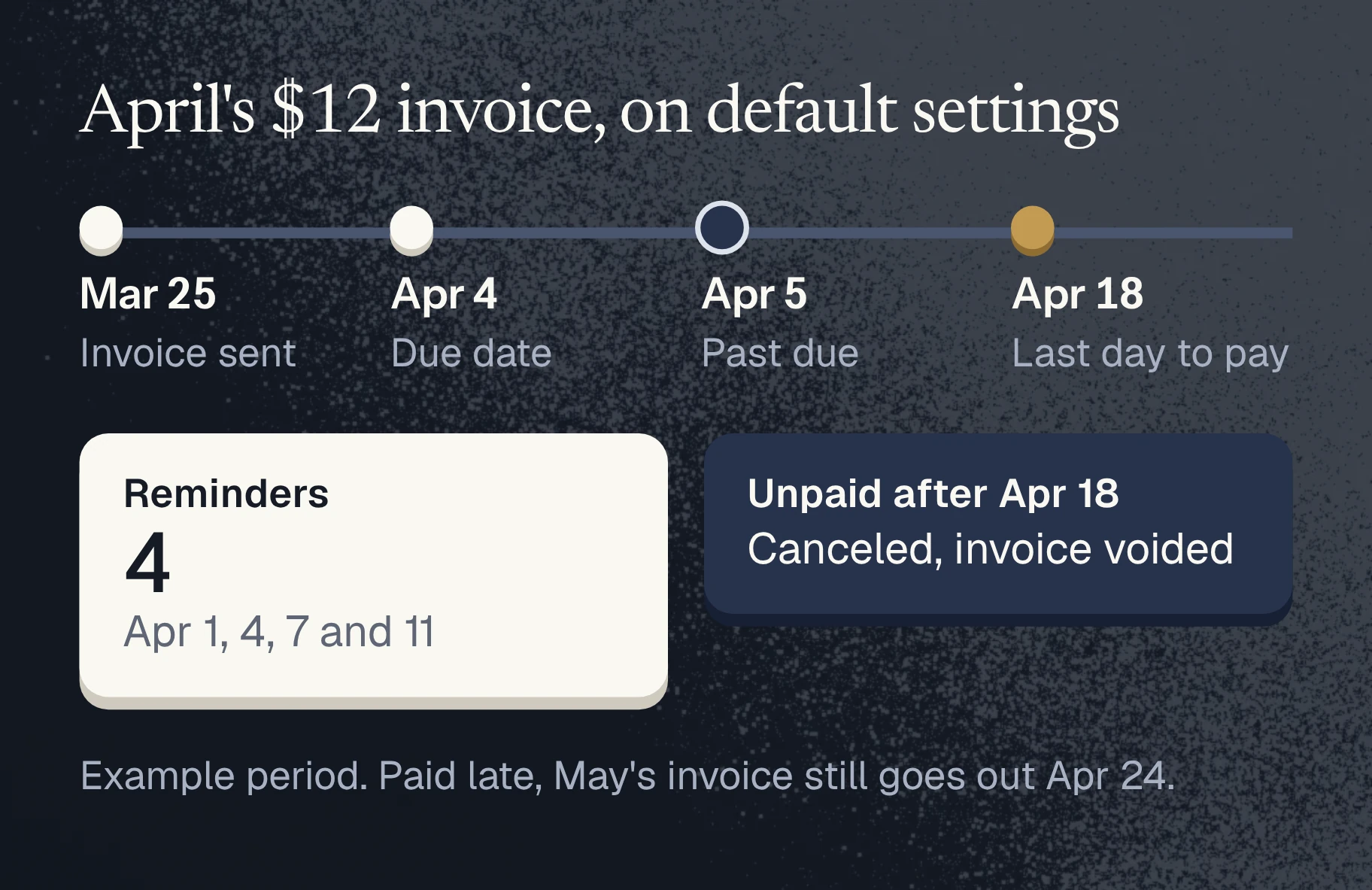
This worked example uses Railbed's defaults for a monthly subscription, taken from the subscriptions user guide: each invoice goes out 7 days before its period, is due 3 days after the period starts, is reminded 3 days before the due date, on it, and 3 and 7 days after, and the subscription ends if the invoice is still unpaid 14 days past its due date. Invoices go out at 09:00 UTC.
Say a customer paid March's $12.00 and is paid through March 31. Here is April.
| Date | What happens | Status |
|---|---|---|
| March 25 | April's $12.00 invoice is issued and emailed | Active |
| April 1 | The period starts; first reminder | Active |
| April 4 | Due date; second reminder | Active |
| April 5 | Still unpaid after the due date | Past due |
| April 7 | Reminder, 3 days after | Past due |
| April 11 | Last reminder, 7 days after | Past due |
| April 18 | Last day to pay | Past due |
| After April 18 | Unpaid: the subscription is canceled and the invoice voided | Canceled |
While the invoice is unpaid, the customer's subscription page and every reminder name the last day to pay; the guide's example reads "If it isn't paid by Dec 17, your subscription ends", and here it would name April 18. If the customer pays on April 9, the subscription is Active again, paid through April 30, and May's invoice still goes out on April 24, because billing days follow the calendar from the first period's start, "so a late payment never moves them".
Every one of those defaults can be changed per plan or per subscription: the invoice can go out the day the period starts or up to 14 days before, be due up to 30 days after, and the subscription can end 3, 7, 14, 30 or 60 days past due or stay past due until someone acts. Stripe's send_invoice has a comparable set: up to three reminders "starting at 10 days before the due date and ending at 60 days after", then cancel, mark unpaid or leave past due "30, 60, or 90 days after an invoice becomes past due" (Stripe).
Where invoice billing loses renewals, and how to limit the loss
Invoice billing loses some renewals that a saved card would have kept. A saved card renews a customer who has forgotten the subscription exists; an invoice needs that customer to open an email and pay. No public figure measures the gap reliably across businesses, so treat any single percentage you see quoted with care and watch your own collection numbers instead.
What narrows the gap:
- Send early and give room. A week's lead time and a due date a few days into the period mean the customer sees the bill before they lose access.
- Bill longer periods. A yearly plan asks for one action a year instead of twelve.
- Make paying one step. Railbed's subscriber page shows the open invoice with Pay invoice, and a returning customer's usual card provider comes first when it can take them. The customer still completes each payment on the provider's page.
- Decide what access a late payer keeps. Railbed's developer guide suggests serving a customer while the subscription is
trialingoractive, pluspast_dueif you give a grace period (access from webhooks). - Measure collection, not just churn. Railbed's Revenue tab splits subscription invoices into paid on time, paid late, unpaid and voided, with the median time to pay.
How disputes and cancellations differ
A saved card exposes the merchant to a specific complaint: being charged after canceling. Visa's Dispute Management Guide for Merchants (based on the Visa Rules as of October 2026) describes dispute condition 13.2, Cancelled Recurring Transaction, as occurring "when a cardholder says you continued to charge them for a recurring transaction after they cancelled the agreement".
Our reading, not Visa's: invoice billing takes away the situation condition 13.2 describes, because no charge happens after the customer stops paying. Visa's guide doesn't address invoice-billed subscriptions. Invoice billing also doesn't remove disputes: a customer can still ask their card issuer to reverse an individual payment for other reasons. With Railbed, each invoice is paid by card through an independent, licensed on-ramp provider, settled sales can't be pulled back from the merchant's wallet, and card disputes go to the provider that charged the card. How that works is covered in whether a card payment that settles as USDC can be charged back.
Which model suits which business
Neither model is better in general. The choice turns on how your customers behave and what your payment setup allows.
| Your situation | Better fit |
|---|---|
| Low price, consumer audience, value depends on renewing without thinking | Saved card, if a processor will keep cards for you |
| Retainers, memberships or services where customers expect a bill | Invoice each period |
| Yearly or quarterly plans | Invoice each period works well; one action per period |
| Usage-based or metered pricing | Saved card or a billing tool built for it |
| A processor has closed your account or won't take your business | Invoice each period, because nothing needs to be stored |
| Customers who want to approve every payment | Invoice each period |
If a processor will store cards for you and your product lives on low-friction renewals, keep that setup. The existing comparison of high-risk gateways for subscription billing covers processors that do, and the article on moving recurring billing to a new processor covers what happens to stored cards when you switch.
How Railbed's subscriptions work, and where they stop
Railbed's subscriptions are billed by invoice: "For every period (weekly, monthly, yearly or your own), Railbed issues an ordinary invoice", and "Railbed never stores a card, so nothing is charged automatically". A period is paid only when the customer pays its invoice, by card on a provider's page, and the money settles to the merchant's own wallet like any other sale. Subscriptions add no fee of their own; each payment carries the usual fees for a Railbed card sale, which are the provider's own fee and spread, a 1% network fee and Railbed's fee, from 0.9%.
What you can set up:
- One customer or a plan. A subscription for a customer you know, or a plan with a public sign-up page anyone can use.
- Trials, pause and cancel. Free trials of up to 365 days; pause and resume; cancel now or at the end of the paid time, with Keep to undo a scheduled cancellation.
- At most one unpaid invoice. No new invoice goes out while one is unpaid, and a period that passes entirely before payment is skipped, never added to the next bill.
- The customer's own page. Status, price, the open invoice, past invoices as PDFs and, if you allow it, Cancel subscription. It tells them their card is never stored and they approve every payment. The customer portal, off by default, lists subscriptions too.
- Webhooks for access.
subscription.activated,.renewed,.past_dueand.canceledtell your server who has paid (subscriptions for developers).
What they don't do yet, from the guide: take several periods in one payment or part payments, change a plan's price for existing subscribers, prorate or switch plans mid-period, email a cancellation confirmation, or bill by usage or in your own time zone. Each invoice must clear the card providers' minimum, about 2.00 USD; prices of about $10 or more give buyers the widest choice of providers. The provider decides whether to check a buyer's identity; Smart Routing ranks the providers least likely to ask first.
Railbed fits when you need recurring billing and can't, or would rather not, keep cards. It doesn't fit when your model depends on charging a card silently every month, on usage-based billing, or when you want a merchant of record to handle sales tax for you.
FAQ
Can I move existing subscribers from a saved card to invoices? You can start an invoice-billed subscription for each customer, but their saved card does not come with them, so each one pays the first invoice themselves. Tell customers before the change, and start each new subscription on the day their next charge would have fallen.
Does the customer need an account to pay each invoice? No. Each invoice opens its own page from its link or QR code. Railbed's customer portal, when a business turns it on, signs customers in with a six-digit code sent to their email.
Try an invoice-billed subscription in Test mode
Create a $12 monthly plan, pay its first invoice with simulated money, then use Renew now to see the next period's invoice and webhooks without waiting a month.
Create an accountRead the subscriptions guide