Why do card processors limit precious metals dealers, and how can a dealer take card payments?
Why processors restrict gold and silver sales, how dealers cap card orders and discount wires by 4%, the arithmetic on one silver coin, and the ways a dealer can take cards.
Press the card to run an example sale.
Card processors limit bullion dealers for three reasons. Metal bought with a stolen card is easy to resell, card fees of 2% to 5%, in dealers' own figures, can exceed a dealer's margin, and FinCEN's rule puts dealers that buy and sell over $50,000 a year under an anti-money-laundering program. Dealers cap card orders and price cards higher, or take cards through a checkout paid to their own wallet.
This page is for online coin and bullion dealers. It sets out what processors and card networks publish about precious metals, and how two dealers limit card orders in their own words. It works through the card-versus-wire arithmetic on one silver coin, and covers what a card sale does and doesn't change about a dealer's reporting. Figures are as read on November 23, 2026. Nothing here is legal, tax or anti-money-laundering advice.
What makes a bullion sale risky to a card processor?
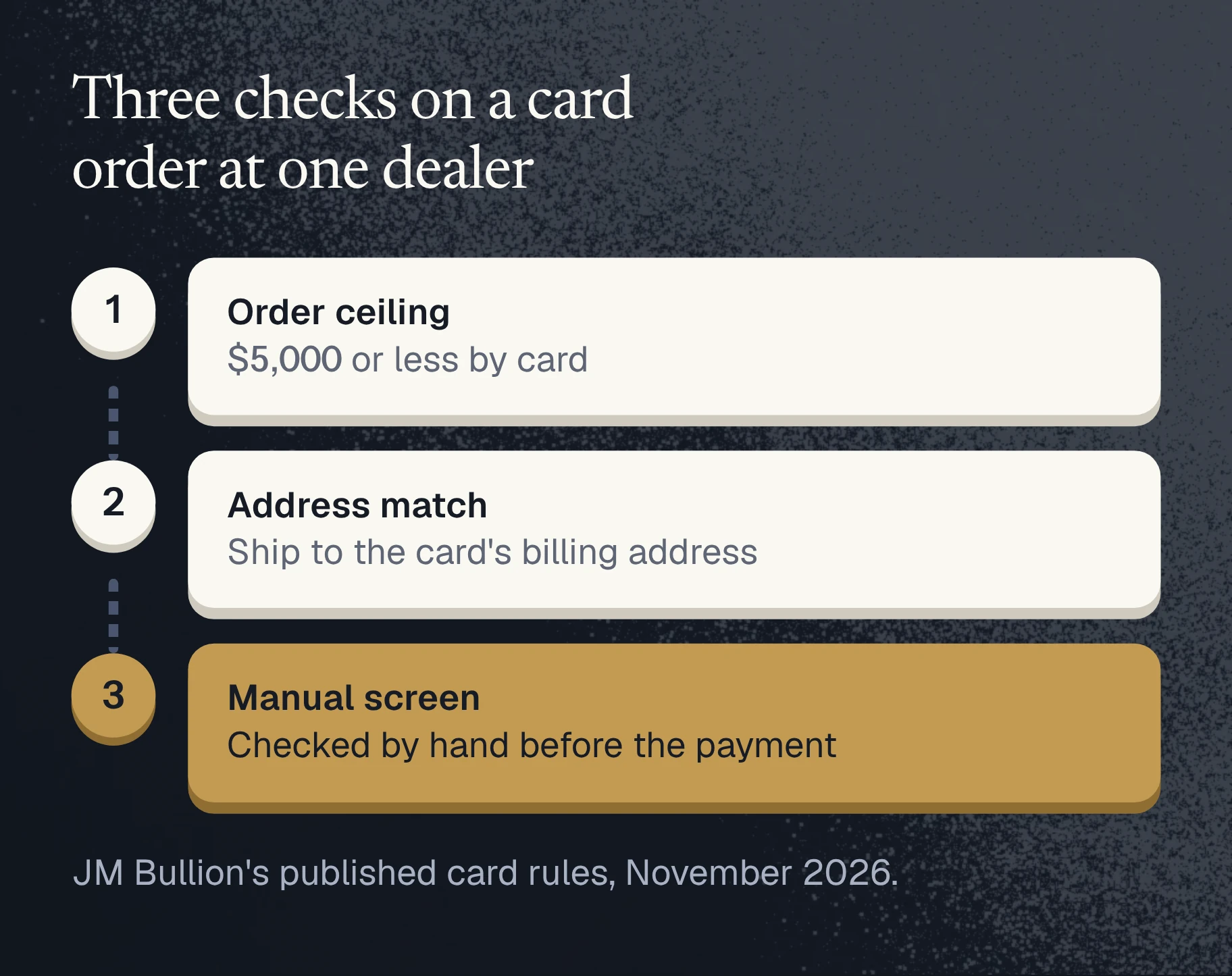
A bullion sale is risky to a processor because what the buyer receives is close to money. A card-not-present order for gold or silver coins gives a fraudster with a stolen card something that can be sold again quickly. The dealer then ships metal it cannot get back when the real cardholder disputes the charge. Dealers' own card policies are built around that risk. JM Bullion takes cards only on orders of $5,000 or less "to prevent any fraudulent credit card activity" and "will manually screen your order for authentication purposes" before processing the payment (JM Bullion).
Precious metals also turn up in scams on the buyer's side. The FBI's Internet Crime Complaint Center warned in January 2024 that scammers tell victims to "liquidate their assets into cash and/or buy gold, silver, or other precious metals". Couriers then collect the cash or metal, and "sometimes, scammers instruct victims to wire funds to a metal dealer who will ship the precious metals to victims' homes". From May to December 2023 the IC3 saw "aggregated losses of over $55 million" from this activity. Those payments were wires and cash, not cards, but a dealer can end up in the middle of such a scheme without knowing it, which is what FinCEN's warning signs (below) are written for.
The third pressure is cost. Card fees take a percentage of a sale whose margin is already thin. Chard, a UK dealer that stopped taking credit cards in 2018, says its gross margins on investment gold and other bullion "generally vary less than 1% to 3%" and that card commission "can range from 2% to 5%" (Chard).
What do processors and card networks publish about bullion?
Visa's manual treats bullion as an ordinary retail category and Mastercard's registration list doesn't name it, so the limits come from the processors' own lists. The table gives each rule-maker's words as published today.
| Who | What its page says | What it means for a dealer |
|---|---|---|
| Visa | Jewelry stores, 5944, include "Gems, Precious Metals, Jewelry"; wholesale dealers use 5094 (manual, October 2026) | Not on Visa's high-integrity list |
| Stripe | Restricted: "high-value goods, precious metals and stones" (list, updated September 22, 2026) | Extra due diligence before Stripe supports it; prohibited in the India row |
| PayPal | Pre-approval needed for "operating as a dealer in jewels, precious metals and stones" (acceptable use policy, November 4, 2026); Seller Protection excludes "payments made in respect of gold" (Seller Protection, January 26, 2026) | Approval first, and no seller cover on gold |
| Square | Lists "precious metals" among regulated products and services (UK policy) | Square's UK page |
A restricted or pre-approval listing is not a refusal, but it is a case-by-case decision. Our article on what makes a business high risk explains how processors build those lists from network codes and their own experience.
How do dealers limit card orders?
Dealers that take cards publish their own limits, usually some mix of an order ceiling, an address check and a higher card price. Two dealers' published rules show the range, from limits to stopping altogether.
| Dealer | Card limit | Other conditions |
|---|---|---|
| JM Bullion | $5,000 an order | Shipping address must match the card's billing address; orders screened by hand; 4% discount for check or wire |
| Chard (UK) | Had limited credit card purchases to £500; no credit cards "as from 1 January 2018" | Gives an EU directive banning card surcharges, fraud and card commission as its reasons |
What does the card price cost on one silver coin?
A dealer's card price is its wire price plus what cards cost it. JM Bullion gives a 4% discount on purchases paid by paper check or bank wire, the same size as the card fees it describes: "many credit card companies charge merchant fees up to 4%".
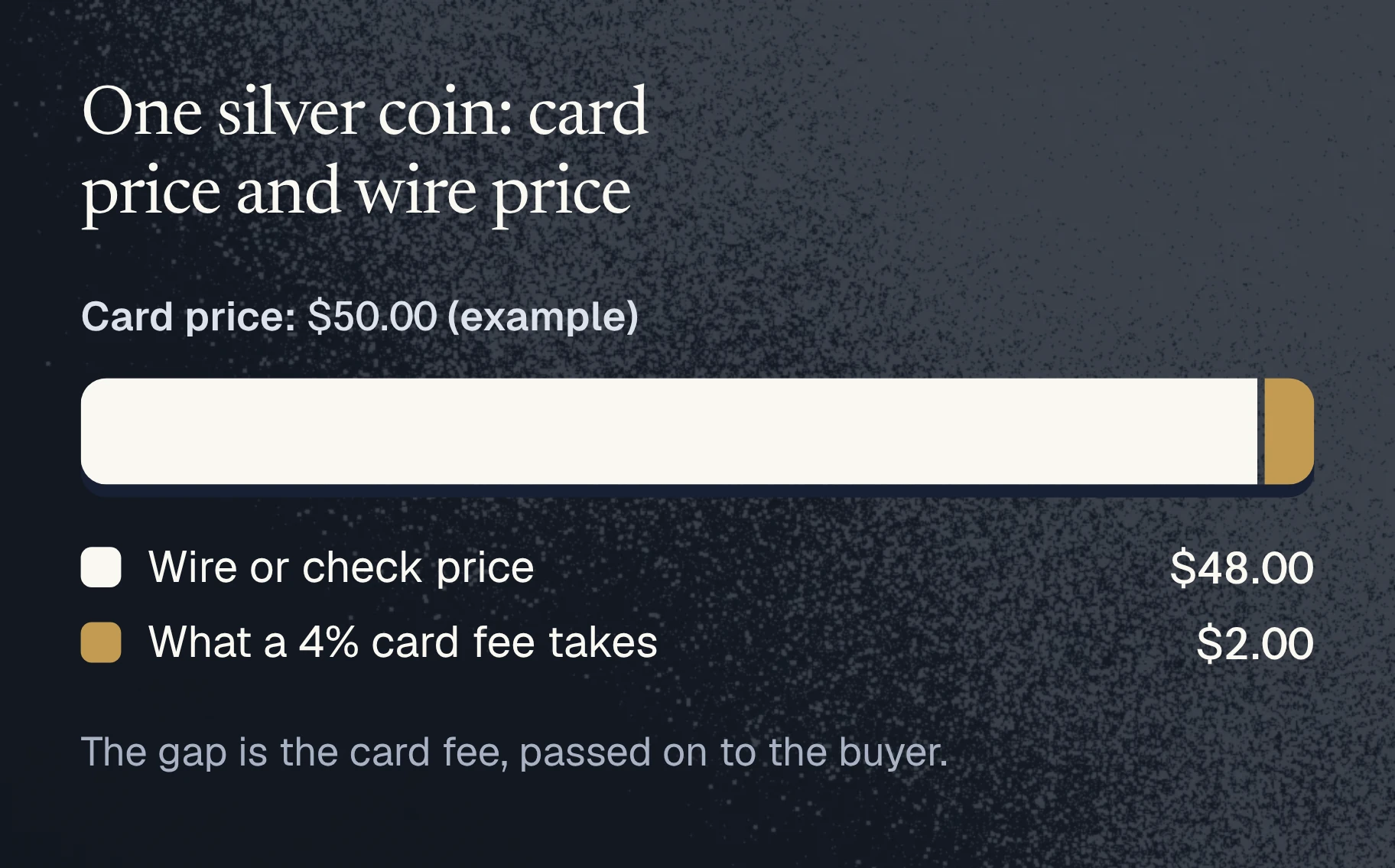
Take an example 1 oz silver coin. Silver's spot ask was $43.99 an ounce on JM Bullion's chart at 1:36 p.m. Eastern on November 23, 2026, and it moves all day. Suppose a dealer prices the coin at $50.00 by card, so a 4% wire discount takes it to $48.00. The $2.00 between them is exactly what a 4% card fee takes from a $50.00 sale.
| Example order | By card | By wire or check | The gap |
|---|---|---|---|
| One coin | $50.00 | $48.00 | $2.00 |
| Ten coins | $500.00 | $480.00 | $20.00 |
| 100 coins, JM Bullion's card ceiling | $5,000.00 | $4,800.00 | $200.00 |
At JM Bullion's $5,000 card ceiling the gap is $200.00, a sum a buyer notices. In the example the wire price sits $4.01 above spot, and that premium has to cover what the coin cost the dealer as well as its margin. A $2.00 card fee would eat about half of it, which is why dealers such as JM Bullion pass the card fee on.
Does a card sale change a dealer's reporting?
A card sale changes less about a dealer's anti-money-laundering duties than many dealers expect, because the main rule applies to the dealer, not to the payment. FinCEN's rule, 31 CFR part 1027, defines a dealer as a business that, in the prior year, "purchased more than $50,000 in covered goods" and "received more than $50,000 in gross proceeds" from selling them. Precious metal means gold, silver, platinum, palladium and four other metals at a purity of 500 or more parts per thousand.
Such a dealer needs a written program that, at a minimum, provides for:
- policies, procedures and internal controls based on its own risk assessment, which weighs its products, customers, suppliers, distribution channels and locations;
- a compliance officer;
- ongoing education and training;
- independent testing.
Among the warning signs the rule lists are "Unusual payment methods, such as the use of large amounts of cash, multiple or sequentially numbered money orders, traveler's checks, or cashier's checks, or payment from third parties" and a customer's unwillingness "to provide complete or accurate contact information". A retailer that sells mostly to the public is outside the definition, unless it bought more than $50,000 in the prior year from people other than dealers and retailers.
Form 8300 is the payment-specific report. The IRS's Form 8300 reference guide (updated July 27, 2026) says "Cash includes the coins and currency of the United States and a foreign country". Some cashier's checks, bank drafts, traveler's checks and money orders count too, and the report is due "within 15 days" of receiving more than $10,000. The guide says "A wire transfer does not constitute cash for Form 8300 reporting purposes". It doesn't mention cards. Whether any report applies to a sale, and how the digital dollars a card checkout delivers fit your books, are questions for your accountant or lawyer; this page doesn't answer them. Our precious metals industry page sets out the related reports, including Form 1099-B when you buy from customers.
Why Railbed fits a bullion dealer
Railbed is card checkout for online merchants that mainstream processors turn away, with no underwriting and no application to pass. Sign-up needs an email, your website and a payout wallet. Buyers pay by card through independent, licensed card providers, on the provider's own page. Each sale settles to a self-custody wallet you control, almost always as USDC on Polygon, and nothing is held back from your sales. The fees are a 1% network fee, Railbed's fee from 0.9% (shown in your dashboard before any payment starts) and the provider's own fee, which the buyer sees before paying.
It fits an online dealer that wants a card option beside its wire desk:
- Order size. A checkout price or an invoice total can go up to 100,000.00, so larger orders can go on an invoice you send by hand. A buyer's own card still has a limit set by its bank. Our guide to taking a large deposit by card covers what to expect.
- Price moves. When the buyer starts paying, the fee and the order's value in USD are locked. Spot moving after that doesn't change the payment.
- Disputes. Settled sales can't be pulled back from your wallet; card disputes go to the provider that charged the card, which may contact you or decline future payments under its own terms. Whether such a payment can be charged back is explained in full elsewhere.
Good to know:
- It's for online orders. Railbed is web checkout only, with no card reader.
- One purchase, one payment. Part payments on an invoice are a convenience for a real buyer. Railbed's acceptable use policy forbids "splitting one purchase into smaller payments to stay under a provider's identity check or reporting threshold".
- ID checks are the provider's call. Card providers decide whether to check a buyer's identity. Smart Routing ranks the providers least likely to ask first, and it can't promise one won't.
- Restocking from the bank is one step. Sales arrive in your wallet, and moving them to a bank to pay your mint or wholesaler is your own step.
- Your compliance stays yours. Licenses, age checks and tax stay yours; "Railbed doesn't check them for you."
FAQ
Does Stripe allow precious metals dealers?
Stripe lists precious metals as restricted, and its list says restricted businesses "require additional due diligence by Stripe in order to confirm our ability to support them". Its India row prohibits them. A restricted listing isn't a refusal, but the answer is decided case by case.
Why is silver cheaper if I pay by wire?
Card fees come out of the dealer's side of each sale, and dealers pass them on. JM Bullion, for one, gives a 4% discount for checks and wires and says card companies charge merchant fees of up to 4%.
Why do dealers make me ship to my card's billing address?
It is a fraud check. A thief using a stolen card wants the metal sent somewhere else, so dealers such as JM Bullion require the shipping address to match the card's billing address. JM Bullion also offers paper check and bank wire, at a 4% discount.
{"heading": "Add a card option beside your wire desk", "description": "Put your card prices on a checkout page or send larger orders as invoices, try them in Test mode, and keep your wire and check prices as they are.", "buttons": [{"label": "Create your account", "url": "https://app.railbed.io/signup"}, {"label": "How invoices work", "url": "https://railbed.com/docs/user-guide/invoices/"}]}