If a buyer pays by card and the money lands in your own wallet, can the payment be charged back?
Yes: the card payment keeps every dispute right, and Visa's rules put it on the provider that charged the card. What reached your wallet is a separate transfer no card rule can reverse.
Press the card to run an example sale.
Yes, the card payment can still be charged back: a buyer who pays by card keeps every dispute right the card network gives them. The chargeback lands on the on-ramp provider that charged the card. The USDC already in your wallet cannot be pulled back by a card network or a bank.
The answer has two halves because the sale has two halves: a card charge and a token transfer. This page reads the card half against Visa's public rules (edition of October 24, 2026) and Mastercard's, and ends with the questions that decide whether a provider's loss can find its way back to you.
One sale, two transactions
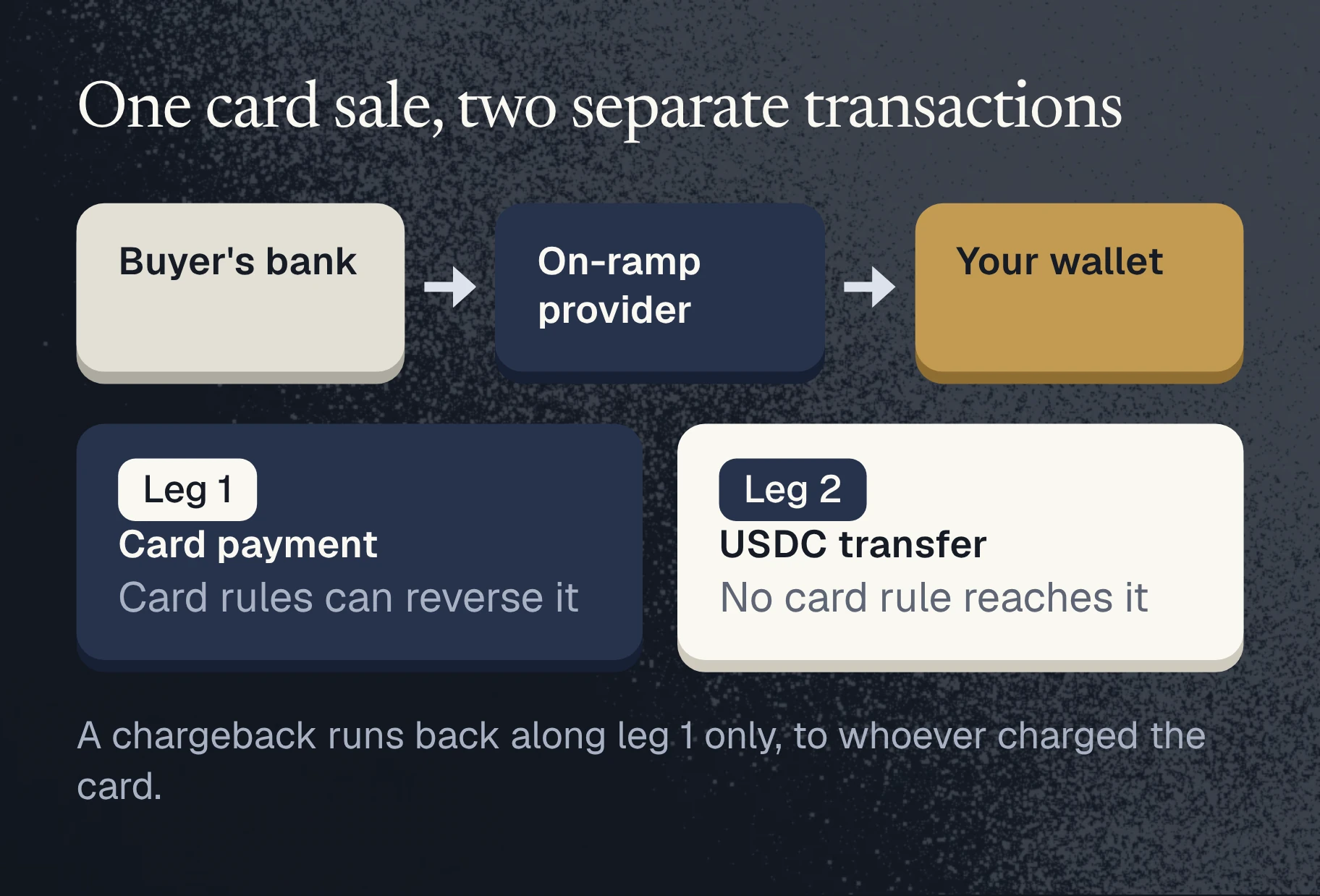
A card payment that settles as USDC is two separate transactions joined by an on-ramp provider. In the first, the buyer's bank pays the provider through Visa or Mastercard. In the second, the provider buys USDC with that money and sends it on a blockchain toward your wallet.
Take a one-year membership sold for $120.00. The table shows the two transactions inside that one sale and which rules reach each.
| Card payment | USDC transfer | |
|---|---|---|
| Who is paid | The on-ramp provider | Your wallet |
| What governs it | Card network rules and the buyer's card agreement | The blockchain's own record |
| Can a chargeback reverse it | Yes, inside the network's time limits | No |
A chargeback is an entry between banks. The card network moves the disputed amount from the provider's acquiring bank back to the buyer's bank. Neither bank has any connection to your wallet, which is why Railbed's own wording is that settled sales can't be pulled back from your wallet and never that a sale cannot be charged back.
What Visa's rules say about who carries the dispute
Visa's public rules make the ramp provider, the company that charges the card and delivers the crypto, liable for disputes on the transactions it processes for the businesses it serves, and they write that into the contract Visa requires. The Visa Core Rules and Visa Product and Service Rules, edition of October 24, 2026, define two roles in the glossary. A Ramp Provider (rule ID 0031030) is:
A Third Party Agent that provides payment services to convert Transactions from a fiat currency to a non-fiat currency (for example: cryptocurrency), or vice versa, and is classified as, a Ramp Provider …
A Conversion Affiliate (rule ID 0031034) is:
An entity for which Visa Payment Services are provided by a Ramp Provider to provide payment services to convert Transactions from a fiat currency to a non-fiat currency (for example: cryptocurrency), or vice versa. Conversion Affiliates of Ramp Providers include but are not limited to retailers, cryptocurrency exchanges, or non-fungible token (NFT) marketplaces.
The word "retailers" matters: a shop selling its own goods can sit in the affiliate's seat. Section 5.3.5.1, "Required Additional Content of Ramp Provider Agreement" (rule ID 0031033, last updated April 2024), then lists what the acquiring bank must write into its agreement with the ramp provider. Three of the statements are about disputes. The ramp provider:
Is liable for all acts, omissions, Cardholder disputes, and other Cardholder customer service-related issues caused by the Ramp Provider's Conversion Affiliates.
Is responsible and financially liable for each Transaction processed on behalf of a Conversion Affiliate.
Must not transfer or attempt to transfer or permit the Conversion Affiliate to transfer or attempt to transfer, its financial liability by asking or requiring Cardholders to waive their dispute rights.
Read those three lines with three limits in mind.
- They describe a framework, not a particular company. The same glossary entry says ramp providers "may sell non-fiat currency to Cardholders directly or provide their services under a contract to Conversion Affiliates", and Visa "reserves the right to determine" how any entity is classified (section 5.3.2.2). Railbed does not assert how any particular provider is registered with Visa.
- They bind banks, not you. The rulebook's own preface says the rules "govern participation of our financial institution clients in the Visa system". The liability wording is a term of the agreement between an acquiring bank and a ramp provider. It is not a promise made to a merchant.
- Providers publish their own positions. As of November 2026, Banxa's documentation for its partners says: "Banxa, as merchant of record, handles and contests chargebacks. Partners are not in the flow of funds and do not absorb chargeback costs." Stripe's documentation for its fiat-to-crypto onramp says Stripe "acts as the merchant of record for these onramp transactions and assumes full liability for all fraud and disputes". Each sentence describes that provider's product for its own direct partners. Neither is a term of your agreement unless you are that partner.
The term those two providers use has its own page: merchant of record explained.
What a buyer can and cannot dispute when the card bought crypto
Visa's dispute rules carry specific lines for a card purchase of crypto, and those lines are narrower than the rules for ordinary goods. The table lists the three dispute conditions in the October 24, 2026 edition that name non-fiat currency, with the evidence the rules accept in reply.
| Visa dispute condition | When the rules allow it | What answers it |
|---|---|---|
| 13.1 Merchandise/Services Not Received | The crypto was not delivered to the wallet address the cardholder supplied at the time of the transaction | Proof of delivery: the destination wallet address, a blockchain transaction hash, or both |
| 13.3 Not as Described | The crypto received "did not match the description provided at the time of the Transaction" | The description shown before payment |
| 10.4 Other Fraud, card-absent | The cardholder did not take part in the transaction | Compelling evidence, which can include the wallet address or transaction hash |
Three details in the rules narrow these further.
- The amount is capped. For condition 13.1 the dispute amount is limited to the cost of the crypto "at the time of the Transaction". A later change in the token's price is not part of the claim.
- Two complaints are listed as invalid. A 13.1 dispute is invalid when "the Cardholder can no longer access the non-fiat currency or non-fungible token after it was successfully delivered". A 10.4 fraud dispute is invalid "if the Cardholder participated in the Transaction but subsequently claims they were deceived into sending the non-fiat currency or NFT to a fraudulent recipient".
- The buyer must try to settle it first. Before a 13.1 dispute, "the Cardholder must attempt to resolve the Dispute with the Merchant, the Merchant's liquidator, Ramp Provider, or its Conversion Affiliate as applicable". The hash the rules accept as proof "must be searchable/traceable on an open-source website".
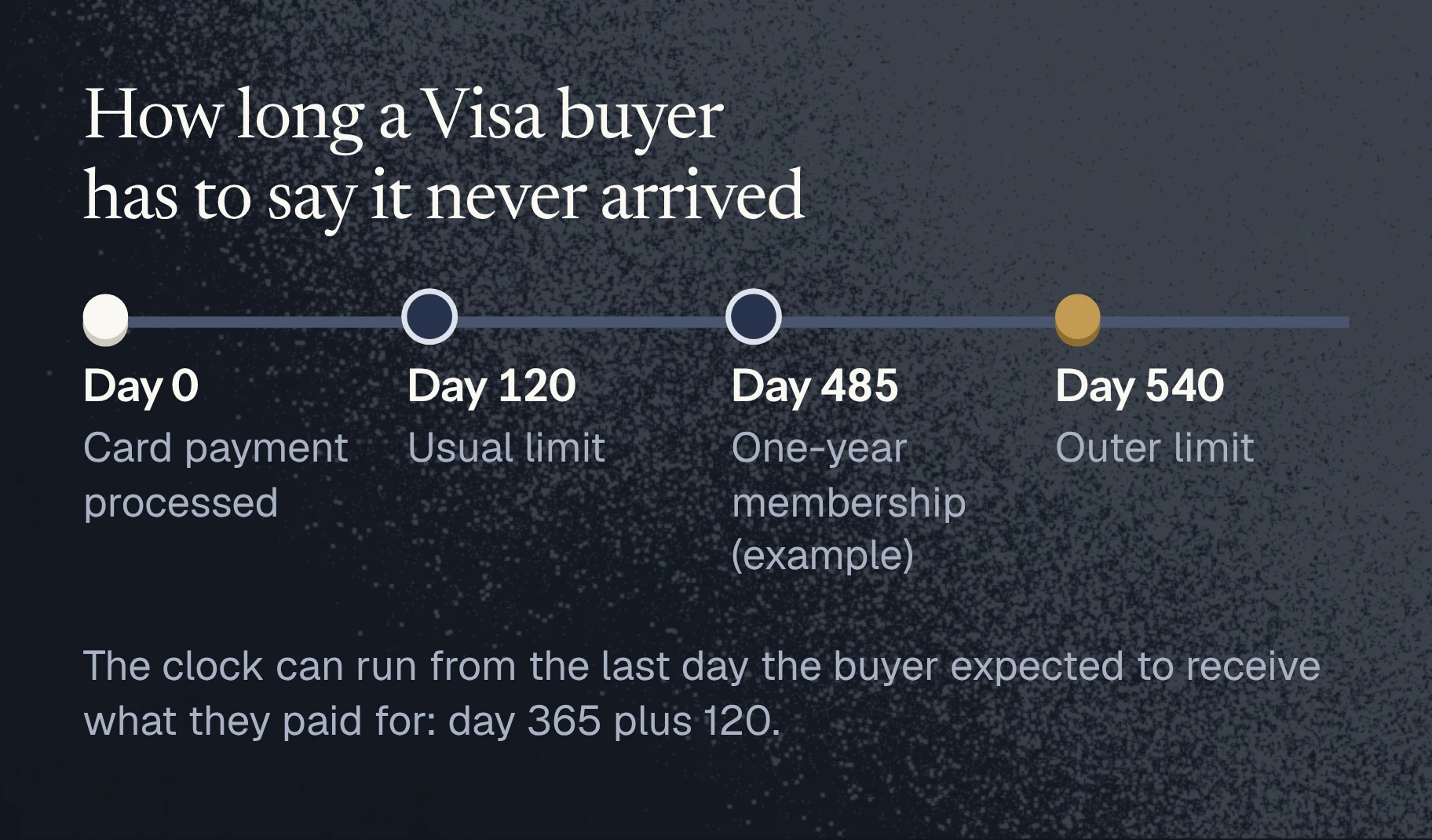
The clock is also written down. Visa's limit for condition 10.4 is "120 calendar days from the Transaction Processing Date" (rule ID 0030255). For condition 13.1 it is 120 calendar days from the processing date or from the last date the cardholder expected to receive what they bought, with a footnote: "Not to exceed 540 calendar days from the Transaction Processing Date" (rule ID 0030316).
For crypto delivered at the moment of payment, both dates are the same day, so the limit is 120 days. The second clock only lengthens things if a bank treats the charge as the purchase of something delivered over time, which is the open question in the next section. On the $120.00 one-year membership, a buyer who expected access until day 365 would then have until day 485 (365 plus 120), inside the 540-day ceiling. That is an example of how the wording counts, not a ruling on how any bank will treat a membership. The general question has its own page: how long a customer has to file a chargeback.
What the public rules leave open
Visa's crypto dispute lines are written around delivery of the crypto, not around the membership, download or parcel the buyer wanted from you. The transaction coding table (Table 7-9, section 7.4.14.1) has one row for "Acquisition of non-fiat currency with a Card" and a different row for "the purchase of goods or services that involves a conversion from fiat currency to non-fiat currency accepted by the Merchant or retailer". The public rules do not tell you which row a given provider uses for a given checkout, or how a buyer's bank will decide a complaint about your goods when the charge is coded as a crypto purchase.
The part within your control is the step the rules put first: the buyer's attempt to resolve it with you. A buyer who writes to you and gets their money back has no reason to go to their bank; a buyer who cannot tell who charged them is the likelier dispute, which is why it helps to tell buyers what will appear on their card statement before they pay.
Can the provider pass the loss back to you?
A provider that loses a chargeback cannot take USDC out of a wallet you control, but card rules do not stop it from recovering the money in other ways its contract allows. Section 1.5.6.2 of the same Visa rules says:
A Ramp Provider must pay or credit its Conversion Affiliate's account promptly after Transaction Deposit. These payments must be the same as the Transaction totals, less any Credit Transaction Receipts, applicable discounts, Disputes or other agreed fees.
So Visa expects that a ramp provider may net disputes against what it pays an affiliate. Section 5.3.5.1 also requires the acquiring bank to keep the right "to immediately stop depositing Transactions for any individual retailer for good cause or upon Visa request". Being liable to the card network and bearing the final cost are two different things, and the second is decided by contract. What no contract can do is take the buyer's rights away: besides Visa's waiver rule quoted above, Mastercard's rule 5.12.6 says a merchant "must not impose, as a condition of Mastercard or Maestro Card acceptance, a requirement that the Cardholder waive a right to dispute a Transaction". A checkbox that says "I agree not to dispute this charge" changes nothing at the buyer's bank.
Four questions settle where a loss can travel. Ask them of any card-to-crypto gateway, in writing, before you rely on its answer; who handles disputes when card payments settle as USDC covers the recovery clauses to look for in more detail.
- Who charges the card, and is that company the merchant in the card system? Ask for the provider's own published wording, not the gateway's summary of it.
- Does any agreement you accepted let someone deduct, invoice or offset a chargeback? Search the gateway's terms and the provider's terms for "chargeback", "dispute", "indemnify" and "set-off".
- Does anyone hold a balance of yours? A party that holds your money can net a dispute against it. A party that forwards each sale to your wallet has nothing of yours to net against, only future sales and its contract.
- Who refunds, in what currency, and how fast? A refund you can send the same day is the cheapest way to keep a complaint out of the card system.
Does Mastercard have the same rule?
Mastercard's public rulebook does not contain Visa's ramp provider framework. The Mastercard Rules dated June 2, 2026 have no "ramp provider" or "conversion affiliate" role anywhere in their text. What they do contain:
- A defined "Cryptocurrency Transaction", in which a cardholder uses an account "to directly purchase Cryptocurrencies", identified with merchant category code 6051.
- Rule 5.12.6, quoted above, which stops a merchant from making a buyer waive dispute rights.
- Rule 6.2.3, "Cardholder Right of Dispute": an issuer "must submit a chargeback when an applicable right is available", within 60 calendar days of the cardholder's notice if the issuer has not resolved the dispute another way.
So a Mastercard cardholder can dispute a card-to-crypto payment too. Mastercard's reasons and time limits sit in its separate Chargeback Guide, which this page does not quote, so don't assume the Visa wording above carries over.
How this works on Railbed
On Railbed, an independent, licensed on-ramp provider charges the buyer's card, and the sale settles to a wallet you control, almost always as USDC on Polygon. Railbed never holds the funds, so there is no Railbed balance for a dispute to be netted against, and nothing is held back from your sales as a reserve.
Railbed's terms put the dispute where the card charge is: card disputes and chargebacks "are raised with, and handled by, the on-ramp provider that charged the buyer's card, under that provider's rules and the rules of the card networks", and Railbed "is not a party to those disputes". The same clause is plain about what can follow: "A provider may contact you, decline future payments from a buyer or region, or take other action under its own terms." The terms also say the provider handles receipts and card-statement descriptors, so the name on the buyer's statement is the provider's, not yours.
The limits belong in the same breath. Railbed has no refund button: to refund a buyer you send the funds back yourself, as described in how to refund a card payment that settled as USDC. Railbed does not tell you how any provider is classified by a card network, and it does not describe a sale as one that cannot be charged back.
This arrangement fits a business that wants each sale in its own wallet, with no balance sitting at a processor, and that is ready to answer buyers and refund from that wallet. It does not fit a business that wants card payments under its own name and its own right to contest each dispute with evidence. That is what a merchant account gives you, and the trade is laid out in card-to-crypto gateway or high-risk merchant account.
See where each sale goes before you take one
Railbed's docs follow one payment from the buyer's card to your wallet, step by step, and say who holds the money at each point.
Read how a payment worksCreate an account