Why are psychic and astrology readings high-risk to card processors, and how can readers take card payments?
No card network bans readings. Here is what Visa's rules say, where each platform draws its line, the dispute reasons a reading draws and the terms that answer them.

Press the card to run an example sale.
Processors call psychic and astrology readings high risk because only the client can judge the service, so an unhappy client can dispute the charge as "not as described" and the reader has little to show. No card network rule bans readings. Readers take cards through high-risk merchant accounts, marketplaces, or a card checkout paid to their own wallet.
This page is for tarot readers, astrologers, mediums and spiritual advisors who sell sessions online. It sets out what card network rules say about readings, where the big platforms draw their lines, the dispute reasons a reading attracts and the terms that answer them, and how per-minute, package and booked sessions fit a checkout or an invoice. Rules and lists are as read on November 23, 2026.
What do card network rules say about readings?
Card network rules treat readings as an ordinary, if unusual, service. Visa's Merchant Data Standards Manual (October 2026) puts "fortune-telling, astrology, mystic, and tarot card-reading services" under MCC 7996, "Amusement Parks, Circuses, Carnivals, and Fortune Tellers", and lists "Mystics" and "Tarot Readings" among its examples. Readings are not under 7273, which is dating services.
That difference matters because 7273 is on Visa's high-integrity risk list for every card-absent sale, along with gambling, pharmacies, tobacco and adult content. 7996 is not. Mastercard's list of merchants an acquirer must register with it, in its Security Rules and Procedures (August 2026), doesn't include readings either.
So the "high risk" label on a reading practice is a processor's decision about disputes, not a network rule. Our guide to what makes a business high risk explains how processors build those lists.
Where do the big platforms draw the line?
The big platforms draw four different lines: a ban in three countries, a listing as a questionable practice, silence, and a marketplace ban on metaphysical services. The table below gives each one's own words, as read on November 23, 2026.
| Platform | What its page says | Where it applies |
|---|---|---|
| Stripe | Prohibits "psychic services and fortune tellers" (list, updated September 22, 2026) | Only the Japan, Mexico and Thailand rows; no astrology or tarot entry elsewhere |
| Square | Lists "psychic products and services (spells, crystal healers, potions, fortune tellers)" under deceptive or questionable practices (UK policy) | Square's UK page |
| PayPal | Its acceptable use policy (November 4, 2026) doesn't name readings | No named rule |
| Etsy | "Metaphysical services may not be sold on Etsy", naming Reiki, spellcasting, prayers and rituals (services policy) | Etsy's marketplace |
Stripe's list, read today, has no US row for psychic services. A list that doesn't name a trade isn't an approval either, and our reading of Stripe's list covers what that means.
Why readings draw disputes, reason by reason
A reading leaves the client holding nothing but a memory of what was said. That makes it easy to claim it wasn't what they paid for. Visa's rules (October 24, 2026) list the reasons a cardholder's bank may open a dispute. Four fit a reading closely.
| Visa reason | What the client says | What answers it |
|---|---|---|
| 13.1 Not received | The session never happened | A booking record, a call log or a recording made with consent |
| 13.3 Not as described | It "did not match what was described", or they dispute "the quality" | The description they saw before paying: length, format, what is included |
| 13.5 Misrepresentation | "The terms of sale were misrepresented by the Merchant" | Price, length and any extra charges stated before payment |
| 13.7 Cancelled | They cancelled and got nothing back | A cancellation policy shown and accepted before checkout |
The trade has a history behind it. In 2002 the FTC settled with the "Miss Cleo" promoters, who agreed to forgive an estimated $500 million in charges and pay $5 million. The FTC had alleged that callers were told they "would receive psychic reading at no charge". That case was about billing, not belief.
Visa's rules also cap some of these disputes. Under 13.5 and 13.7, the amount is limited to "the unused portion of the cancelled service". Under 13.5, "the Cardholder must attempt to resolve the dispute with the Merchant" first. A reader who answers quickly and refunds a session that went wrong gives the client a way to settle it before a bank is involved. For the disputes that come from clients who regret the spend, see what friendly fraud is and what a merchant can do.
What to put in your terms and on every receipt
The words a client reads before paying are the evidence for every dispute reason above. Visa's rule 5.4.2.5, "Disclosure to Cardholders of Return, Refund, and Cancellation Policies", sets out when and how a limited policy must be shown:
If a Merchant restricts the return of goods or cancellation of services, it must clearly disclose to a Cardholder its return, refund, and cancellation policies, as follows: [...] For Transactions at an Electronic Commerce Merchant, during the sequence of pages before final checkout, and include a "click to accept" button, checkbox, or other acknowledgement.
The same rule ends: "A Merchant must not require a Cardholder to waive the right to dispute a Transaction, including an Agentic Transaction, with the Issuer." A no-refunds line never stops a client from going to their bank.
Build these into your booking page and confirmation:
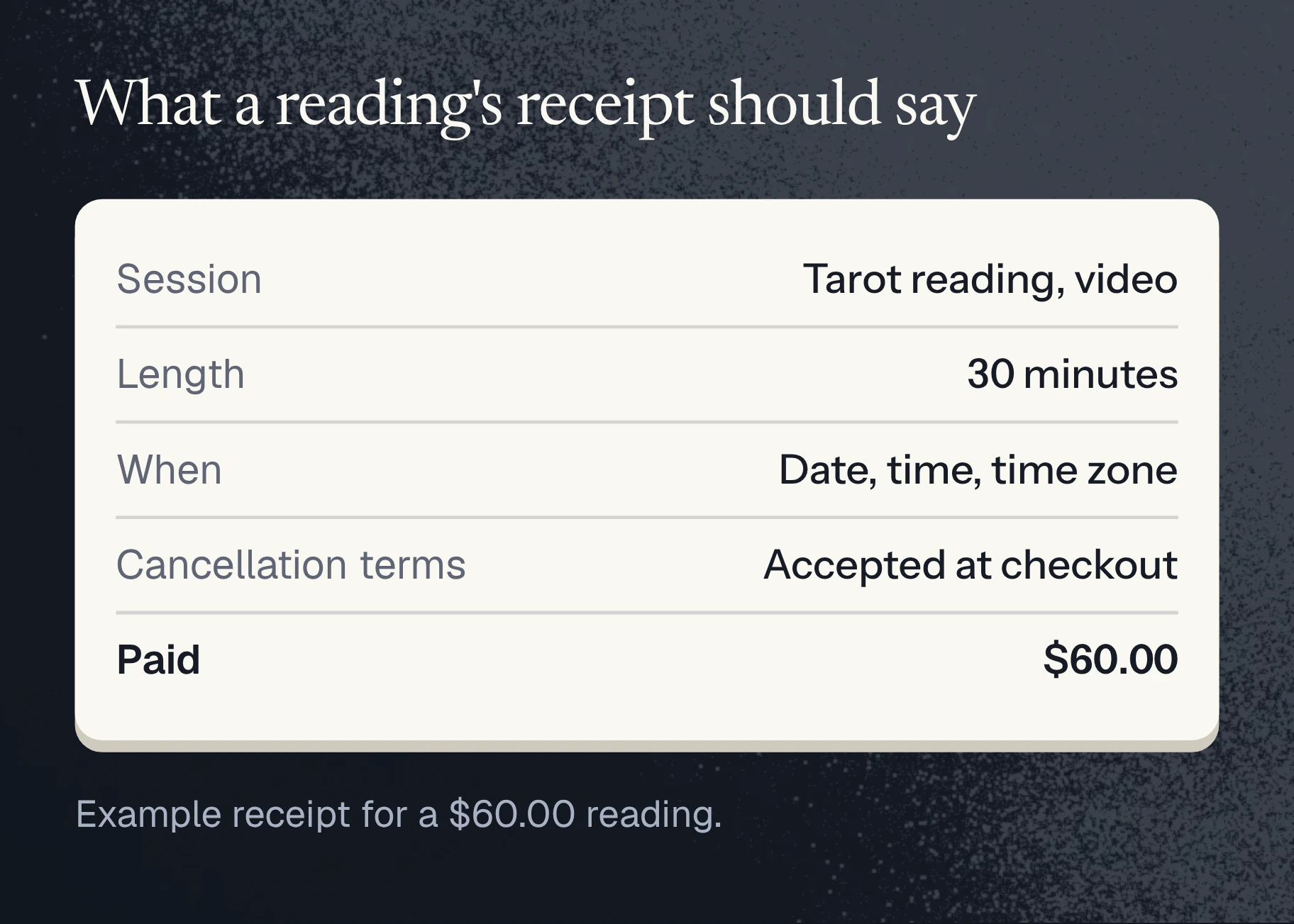
- What the session is. "A 30-minute tarot reading by video call", not "a reading". Say whether a recording or written notes come with it.
- What it costs, all of it. The price, and whether extra minutes cost more and how they are charged. Never an unpriced "free" first part.
- When and how it happens. The time, the time zone, the platform, and what happens if the client misses it or the call drops.
- Your cancellation and refund policy, with a box the client ticks before paying. For example: full refund up to 24 hours before, half after, none for a missed session.
- A receipt after payment that repeats the first four points, sent to the email the client gave.
- Your notes of the session, kept with the booking, so a "never happened" claim meets a record.
Some laws single out fortune telling itself, apart from any card rule. New York's Penal Law section 165.35 reads:
A person is guilty of fortune telling when, for a fee or compensation which he directly or indirectly solicits or receives, he claims or pretends to tell fortunes, or holds himself out as being able, by claimed or pretended use of occult powers, to answer questions or give advice on personal matters or to exorcise, influence or affect evil spirits or curses; except that this section does not apply to a person who engages in the aforedescribed conduct as part of a show or exhibition solely for the purpose of entertainment or amusement. Fortune telling is a class B misdemeanor.
This page can't tell you whether that law, or one where you or your clients live, reaches your practice, or what would satisfy it. That is a question for a lawyer in your state.
How per-minute, package and booked sessions fit a checkout
How you sell decides which tool fits, and per-minute billing is the one that changes most. A per-minute meter that bills after the call needs a card it can charge without the client. A checkout where the client approves each payment can't do that, so minutes are sold in advance as a pack, or billed afterwards on an invoice the client pays. The table uses an example 30-minute reading at $60.00.
| How you sell | What fits | The $60.00 example |
|---|---|---|
| A fixed session | A checkout page or buy button beside your calendar | One payment of $60.00 when booking |
| Minute packs | A pricing table with up to four packs; every purchase is one payment | A 30-minute pack at $60.00 beside a longer one |
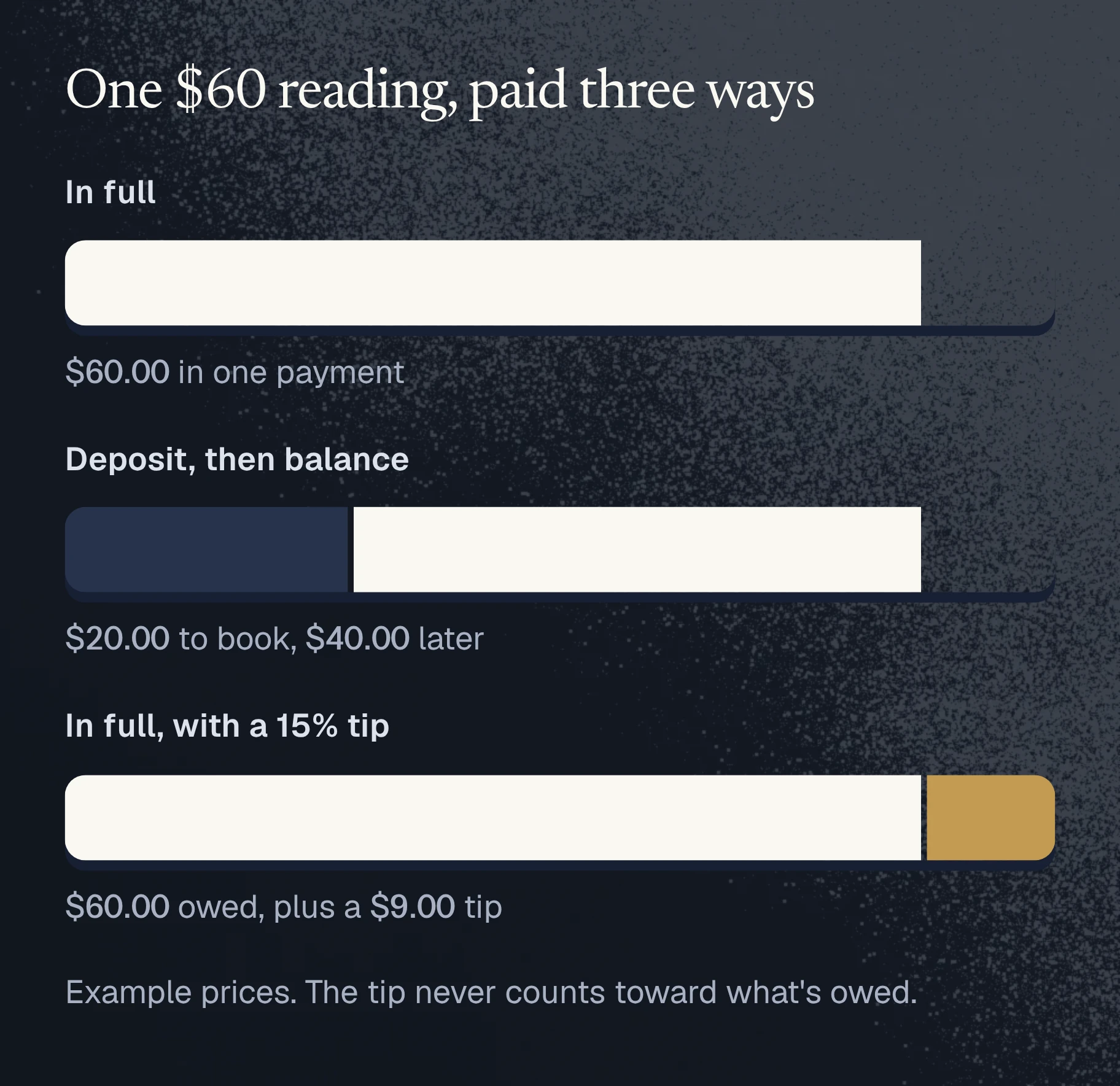
| A deposit and the balance | An invoice with part payments and a smallest first payment | $20.00 to book, $40.00 before the session |
| Extra minutes after a call | An invoice for the minutes used | Sent after the call, paid by the client |
| A monthly reading | A subscription billed by invoice; nothing is charged automatically | One $60.00 invoice each month, paid by the client |
A checkout page can also ask up to five questions of your own before payment, such as birth date, time and place for a chart, or the question the client wants answered. An invoice can let the client add a tip of 10, 15 or 20 percent or an amount of their own. A 15% tip on $60.00 is $9.00, and a tip is shown apart and never counts toward what's owed.
Why Railbed fits a reading practice
Railbed is card checkout for online merchants that mainstream processors turn away, with no underwriting and no application to pass. Sign-up needs an email, your website and a payout wallet. Clients pay by card through independent, licensed card providers, on the provider's own page. Each sale settles to a self-custody wallet you control, almost always as USDC on Polygon, and nothing is held back from your sales. The fees are a 1% network fee, Railbed's fee from 0.9% (shown in your dashboard before any payment starts) and the provider's own fee, which the client sees before paying.
It fits a reader who sells set sessions, packs, deposits and invoices online. Put your full terms and their acknowledgement on your own booking page, before the client is sent to pay: a checkout page's description holds up to 280 characters, and an invoice's terms, up to 2,000, print at its foot. The client's card statement shows the card provider they paid through; what buyers see on their statement explains it, and it belongs in your booking confirmation. Settled sales can't be pulled back from your wallet. Card disputes go to the provider that charged the card, which may contact you or decline future payments under its own terms. The terms and records above still matter.
Good to know:
- Minutes are sold in advance or invoiced. Railbed never stores a card, so nothing is charged automatically; sell minute packs, or invoice the minutes used after a call.
- It's for online sessions. Railbed is web checkout only, with no card reader.
- Refunds come from your wallet. There is no refund button. To refund a client, you send the money back from your wallet yourself.
- Payments start at about $2.00. Each payment must be at least about $2.00, the providers' minimum, and prices of about $10 or more give clients the widest choice.
- Bank deposits are one step. Sales arrive in your wallet, and moving them to a bank is your own step.
Our psychic and astrology industry page covers the rest for reading practices, from marketplace fees to fortune-telling laws in other countries.
FAQ
Does PayPal allow psychic readings?
PayPal's acceptable use policy, updated November 4, 2026, doesn't name psychic, tarot or astrology services. That is silence, not approval. Read the current policy, and PayPal's user agreement, before relying on it.
Is it legal to charge for psychic readings?
Readings are sold openly online, but some laws single out fortune telling. New York's Penal Law 165.35 makes fortune telling for a fee a class B misdemeanor, except "as part of a show or exhibition solely for the purpose of entertainment or amusement". The answer for your practice depends on where you and your clients are, so ask a lawyer.
How many people consult readings?
A Pew Research Center survey of 9,593 US adults in October 2024 found that 30% consult astrology, tarot cards or a fortune teller at least once a year. Astrology was the most common, at 28%, and 11% consult tarot cards. Most say they do it just for fun.
{"heading": "Set up a booking checkout for your readings", "description": "Create a checkout page for a session at its set price, or send an invoice with a deposit and your terms, and try both in Test mode first.", "buttons": [{"label": "Create your account", "url": "https://app.railbed.io/signup"}, {"label": "How invoices work", "url": "https://railbed.com/docs/user-guide/invoices/"}]}