What do buyers see on their card statement when a card provider charges for you?
The charge carries the provider's name, and some card issuers class it as a cash advance. What that costs on a $40 order, and what to tell buyers first.
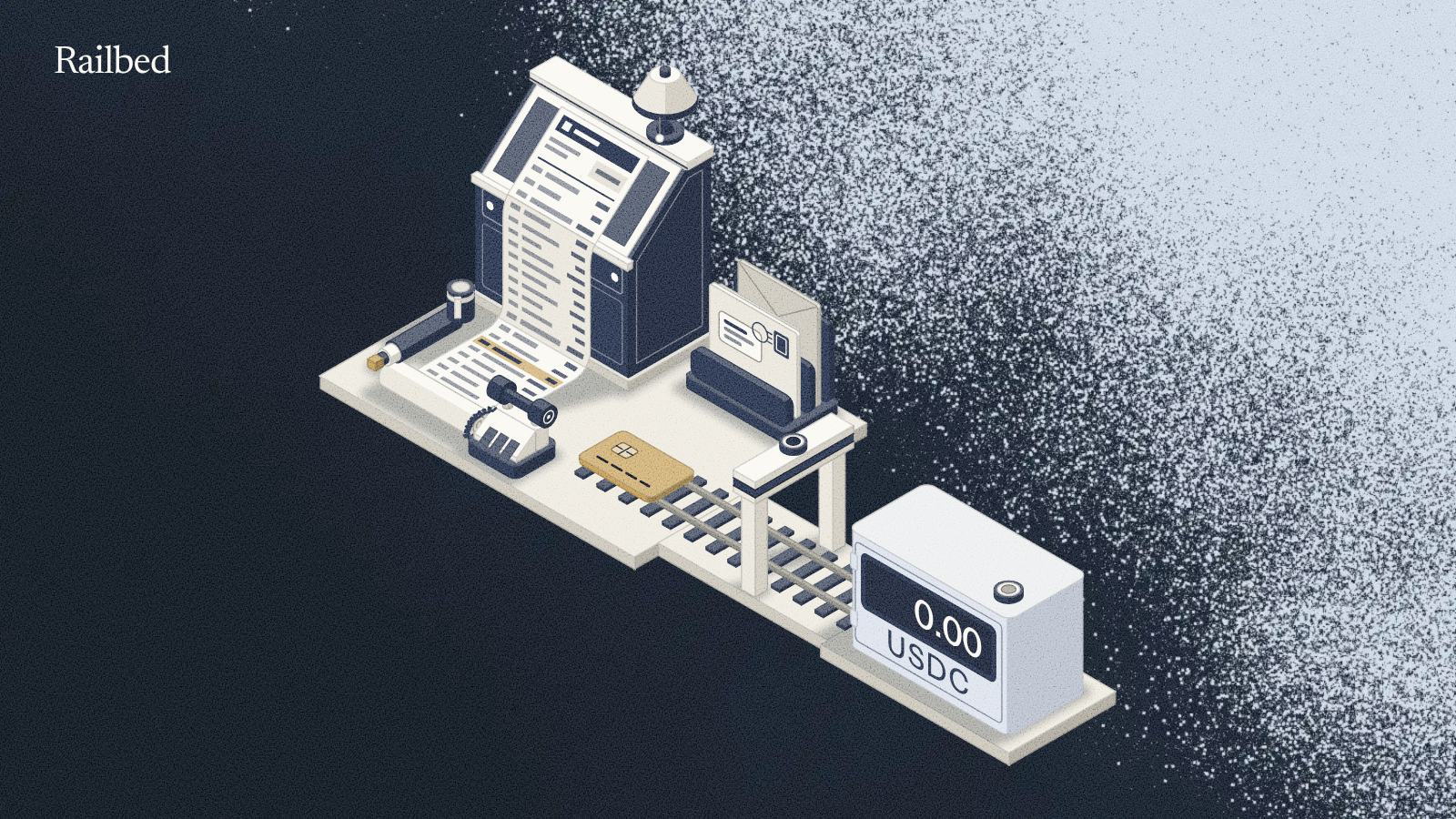
Press the card to run an example sale.
The buyer's card statement shows the name of the on-ramp provider that charged the card, not your store's name. Some credit card issuers can also treat that charge as a cash advance, with a fee and interest from the day of the charge, when it reaches them coded as a crypto purchase.
Whether a particular buyer's bank does that depends on two things neither you nor your checkout controls: how the provider's charge is coded, and the buyer's own card agreement. This page shows where the statement name comes from, what the card networks' rules say about coding a card purchase of crypto, what two published card agreements do with such a charge, what that costs on a $40.00 order, and what to tell buyers before they pay.
Whose name is on the statement
The name on the statement belongs to whoever charged the card, and on an on-ramp checkout that is the provider. Railbed's guide for adding checkout to an existing app puts it in one line: "The provider charges the card under its own terms and sets the statement descriptor, so the charge carries the provider's name." Railbed's terms say the same of every provider: "The provider handles receipts, card-statement descriptors, identity checks and card disputes."
The card networks' rules explain why. The Visa Core Rules (edition of October 24, 2026) require a merchant name to be "The name it primarily uses to identify itself to its customers", used the same way on the receipt, the authorization and the clearing record that posts to the statement (section 1.5.1.12). For a ramp provider, the company Visa's rules describe as converting card payments into crypto, for cardholders directly or for businesses it serves, section 5.3.5.2 sets what each record carries:
- in the authorization, the pending charge, "both the Ramp Provider identifier and the Conversion Affiliate identifier";
- in the clearing record, the posted charge, "only the Ramp Provider identifier".
Those identifiers are codes, not the words a buyer reads, but they show which business the posted record belongs to. Section 1.5.1.12 also lets the clearing name differ from the receipt "if abbreviations are required or supplementary data is used", which is why a statement line can look shorter or odder than the name on the provider's checkout page.
On Railbed the buyer sees the provider before paying, because the checkout lists the card providers that can take the payment and the provider's own page then opens, usually in a new tab (what buyers see at checkout). The provider can differ from one buyer to the next, so the statement name can too.
Why a bank might call it a cash advance
A credit card issuer decides between "purchase" and "cash advance" largely from the category code and data the network passes along with the charge. The published Chase agreement says so directly: "You agree that we may rely on information provided to us by merchants and the applicable payment network to categorize transactions as Purchases, Balance Transfers or Cash Advances."
The networks' rules give crypto purchases their own coding. The table shows what each network's public rulebook says.
| Network | How a card purchase of crypto is coded | Source |
|---|---|---|
| Visa | Category code 4829, 6012, 6540 or 6051, plus a "special condition indicator", which is 2 for "Stablecoin (fiat-backed)" | Visa rules, Table 7-9, section 7.4.14.1 |
| Visa | A purchase of goods "that involves a conversion from fiat currency to non-fiat currency accepted by the Merchant or retailer": the category code "that describes the primary business of the Merchant/retailer", with the same indicator | Same table, separate row |
| Mastercard | A "Cryptocurrency Transaction" is identified with "MCC 6051 (Quasi Cash: Merchant)" and, for "fully fiat-backed stablecoins", transaction type P76 | Mastercard Rules, June 2, 2026, definitions |
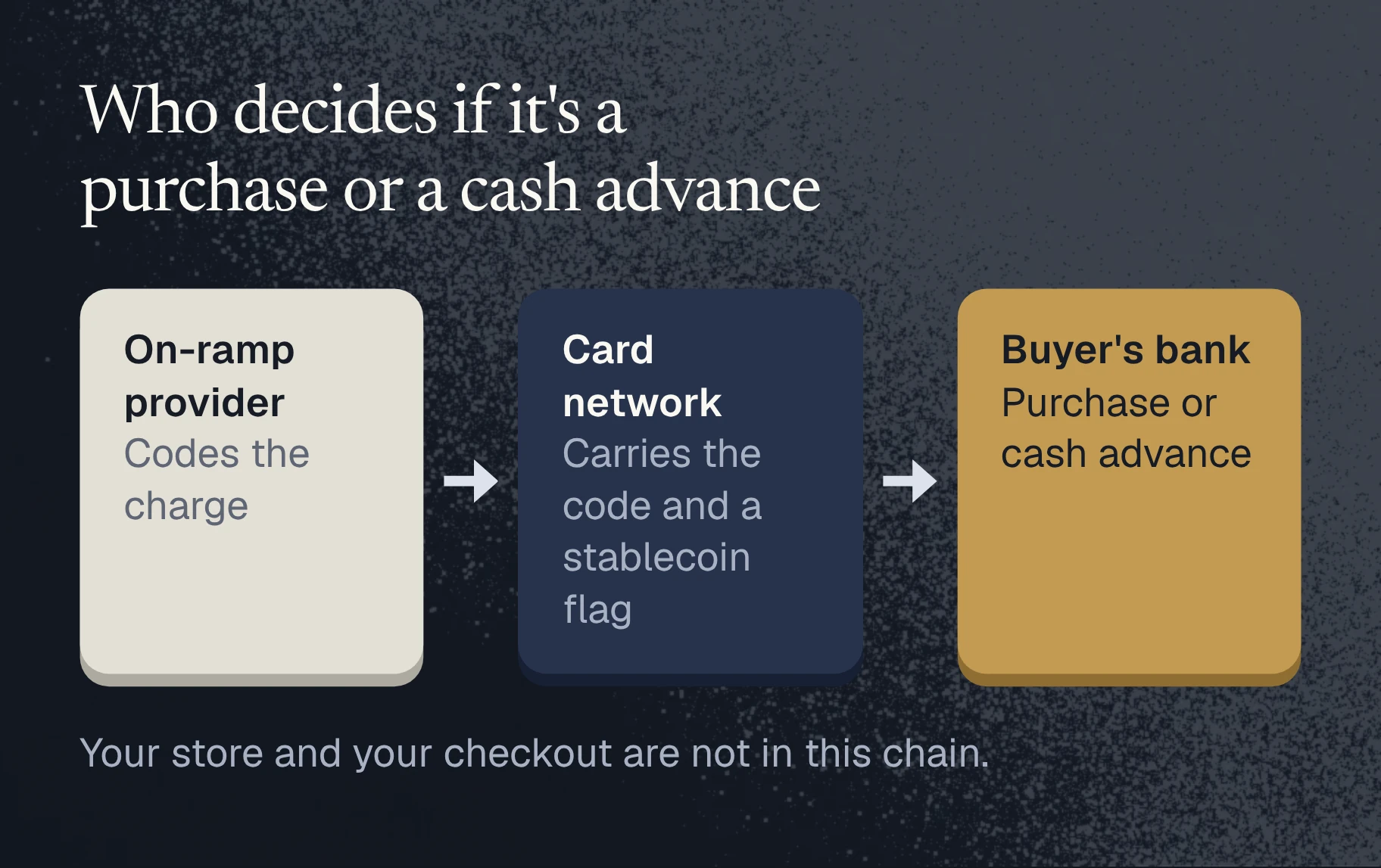
On the issuer side, card agreements then say what they do with crypto. The Chase cardmember agreement published on chase.com (rates based on the prime rate as of September 30, 2026) says: "Cash-like transactions will be treated as cash advances", and lists "purchasing travelers checks, foreign currency, money orders, wire transfers, cryptocurrency, other similar digital or virtual currency". Citi's card agreement guide defines a cash advance as use of the card "for what we consider a cash-like transaction", with "cryptocurrency or other similar digital or virtual currency" among its examples, and adds: "There's no grace period on Balance Transfers, Cash Advances, and Citi Flex Loans."
Those are two issuers' published terms, read in November 2026. Other banks write their own, and a cash advance is a credit card feature: the clauses above are about a credit line, not a debit card that draws on a bank account.
What a cash advance would cost the buyer on a $40.00 order
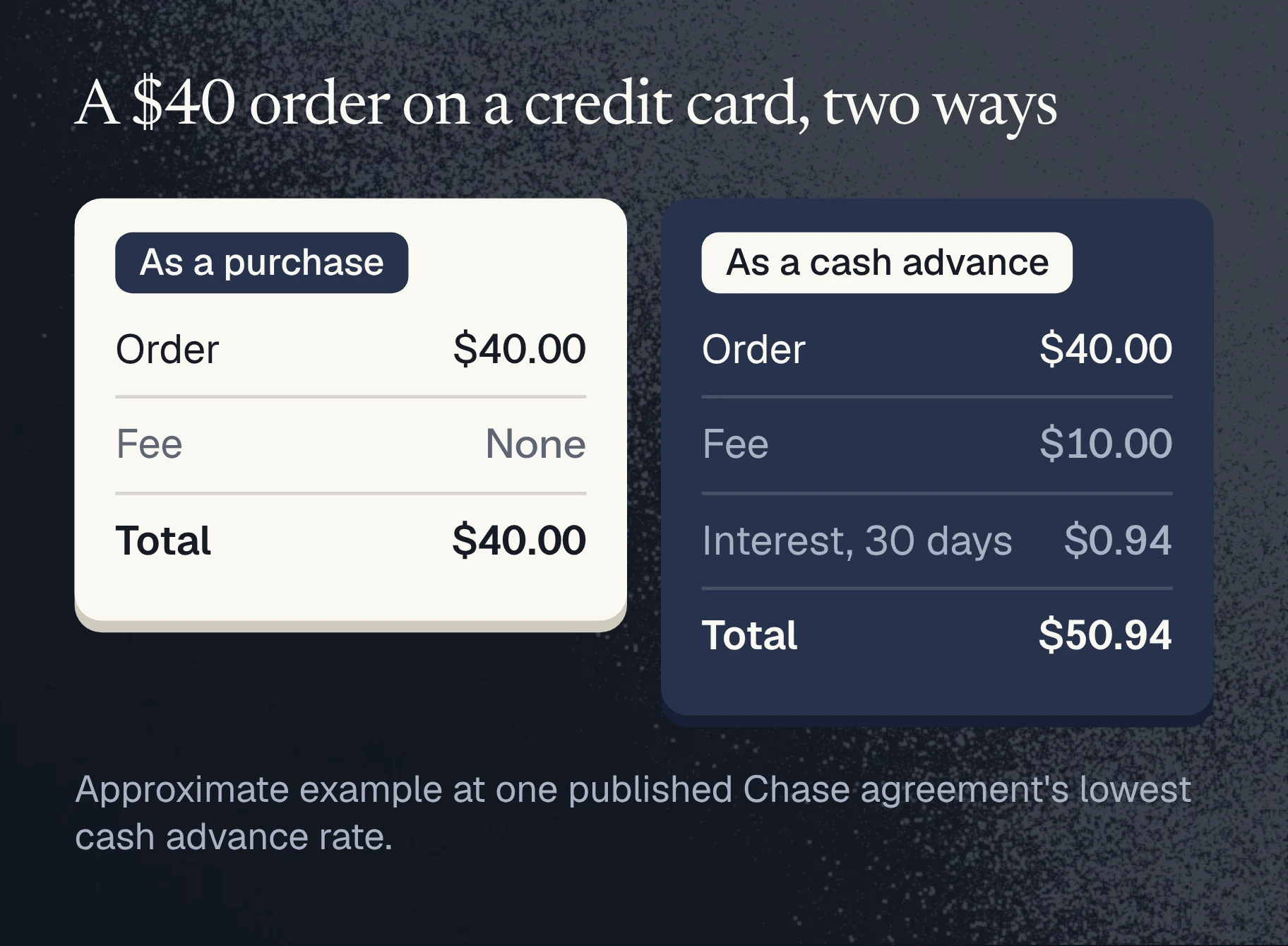
If the bank treats the charge as a cash advance, the buyer pays a fee on top of the order and interest from the first day. The table works a $40.00 order through the rates in the Chase agreement above, as a purchase and as a cash advance, assuming the buyer pays the bill 30 days later.
| As a purchase | As a cash advance | |
|---|---|---|
| Fee | None | $10.00: "Either $10 or 5% of the amount of each transaction, whichever is greater" |
| Interest | None if the balance is paid in full by the due date | From "the transaction date", at a daily periodic rate of 0.07874% (the lowest cash advance rate listed): about $0.94 on the $40.00 over 30 days |
| Total | $40.00 | About $50.94 |
The interest line is approximate: it leaves out interest on the fee itself and the agreement's own balance method. On a small order the flat minimum does most of the damage: $10.00 is a quarter of $40.00. On a $400.00 order the same agreement's fee would be $20.00, the 5% side of "whichever is greater". The fee is the bank's, not yours or the provider's, and it never reaches your wallet.
Will it happen on your checkout?
Nobody outside the provider and the buyer's bank can say in advance. The provider chooses its coding under its acquiring bank's rules, and Visa's table offers both a crypto row and a goods row; which one a given provider uses for a given checkout is not published in the rules, and this article assumes nothing about how any provider is registered or coded. The buyer's own agreement then decides what that coding means for them.
What a buyer can check, after the fact:
- The posted line, not the pending one. The pending authorization and the posted charge carry different data under Visa's rules, so read the line after it posts.
- Any fee posted beside it. A cash advance fee is charged by the bank, so look for a separate fee line, or a cash advance balance, on the statement or in the bank's app.
- The card agreement's definition of a cash advance. Search it for "cash-like" and "cryptocurrency", as in the two agreements quoted above.
A bank can also decline the charge outright. Banxa's own documentation lists "Bank or issuer decline" first among the common reasons orders fail; a buyer whose card is refused can try another card or another provider. Why that happens, and what helps, is covered in why card payments fail on on-ramp checkouts.
What to tell buyers before they pay
A buyer who sees a name they don't recognize, or a fee they didn't expect, has a reason to call their bank. Under Visa's rules, a buyer who says the crypto never arrived must first try to settle it with the merchant or the provider before the bank can open that dispute. Cheaper still is a buyer who knew what to expect. Three sample lines do most of the work. Adapt the wording and keep it true for your checkout.
| Where | Sample line |
|---|---|
| Beside the pay button | Payment is taken by an independent card provider that you'll see on the next step. Your card statement will show that provider's name, not ours. |
| On the checkout or help page, for credit cards | Some card issuers treat payments to crypto providers as cash advances, which can add a fee and interest. If you're not sure how your card treats them, check your card's terms or pay with a debit card. |
| In the order confirmation email | Your payment of [amount] for order [number] was charged by [provider] on [date]. If you don't recognize the line on your statement, reply to this email and we'll help. |
The second line matters most for small orders paid by credit card, where a $10.00 minimum fee, as in the Chase terms above, is a large share of the price.
Railbed's page for fan platforms gives the same advice in short form: "Say which name to expect beside the pay button and in the receipt you send." For one industry's detail, see what buyers see on an adult payment processor card statement. Who answers a dispute if one comes anyway is explained in if a buyer pays by card and you receive USDC, can the payment be charged back?
Where Railbed fits
On Railbed, an independent, licensed on-ramp provider charges the card on its own page, and the sale settles to a wallet you control, almost always as USDC on Polygon. As one of Railbed's industry pages puts it, the statement name "is the card provider's name, never your store's". The provider's own fee and exchange rate are shown to the buyer on the provider's page before they pay.
Railbed controls neither the provider's coding nor the buyer's bank, so it can't promise how any charge will appear or be classed. Smart Routing ranks providers by the buyer's country, the checkout currency, the amount, each provider's minimum and whether the provider is working today; how a bank classes the charge is not among them, and a card can still be declined on the provider's page. If your buyers mostly pay with credit cards and would be put off by a possible cash advance fee, weigh that before you switch; a merchant account in your own name, if you can get one, puts your business name on the statement, and Visa's rules have the acquirer assign the category code "that most accurately describes its business" (section 1.5.1.11). If the charges are already landing with an unfamiliar name, the three lines above are the first fix.
See exactly what your buyers see
Railbed's buyer guide walks through the checkout from the buyer's side, from the provider list to the provider's own page, so you can write your pay-button line with confidence.
Read the buyer experience guideCreate an account