Event ticketing merchant accounts: refunds, cancelled events and disputes
Why processors treat ticket sales as high risk, what the card rules and state laws say about cancelled events and refunds, and how to issue tickets from the paid webhook.

Press the card to run an example sale.
Processors treat an event ticketing merchant account as high risk because the buyer pays now for an event that may not happen as sold. When an event is cancelled, Maryland law and New York's resale law require a full refund, and Visa lets a buyer refuse a new date. Published refund terms and fast refunds are what keep those cases out of disputes.
This article is for promoters, venues and resellers. It quotes the card rules on events that don't happen and the federal and state rules on resale and refunds, then gives the terms that answer them and a way to sell an example $150 festival pass and issue the ticket from the paid webhook. Why ticket money is usually held until after the show, the dispute window and all-in pricing are covered on Railbed's event tickets page.
Why an event ticketing merchant account is hard to get
Processors treat ticket sales as high risk because a ticket is paid for months before it is delivered, and if the event doesn't happen the buyer can dispute the charge with their bank. That is why an event ticketing or ticket broker merchant account comes with more questions than most. Visa's Dispute Management Guide for Merchants describes its "Merchandise/Services Not Received" condition as one that "covers physical goods, digital goods, and services such as travel bookings, event access, lodging, or other future‑dated services."
Three lines in that guide explain most of a ticket seller's exposure:
- A new date doesn't settle it. "The cardholder is not required to accept an alternate date, time, or replacement service. If the original service was not provided as agreed, and the cardholder did not accept an alternative, the dispute may be valid."
- Selling ahead is a risk in itself. Among the guide's prevention steps: "Do not charge for services or goods you cannot yet deliver."
- Intermediaries answer for the event. A booking intermediary is "often considered the merchant of record" and is "responsible for making sure the service the cardholder paid for, like a flight, hotel stay, or event, is actually provided by your supplier".
The guide's "Cancelled Merchandise or Services" condition covers the other half: a buyer who says they cancelled "but were still charged or did not receive a refund they believe was due after cancellation", judged on "whether the cancellation was handled in accordance with the terms disclosed at the time of purchase, including eligibility, timing, and refund conditions." A ticket seller's refund terms, and how fast it keeps them, are what a processor is really pricing.
What the law says about refunds and resale
US ticket rules are mostly state law, beside the federal BOTS Act on how tickets are bought. As of November 2026, these are the rules quoted from the statutes and regulators themselves, for a few states; the event tickets page covers all-in pricing, New York's reseller license and the speculative-ticket bans in Maine, Vermont and North Carolina.
| Rule | What it says | Source |
|---|---|---|
| BOTS Act (federal) | Illegal "to bypass maximum ticket purchasing limits through technological means or by buying tickets under fake identities", and to sell tickets bought that way if you took part or "knew or should have known" | FTC, April 2025 |
| New York resale refund | A reseller "must guarantee… a full refund" if the event "is cancelled", if the ticket "does not grant the purchaser admission", or if it "fails to conform to its description as advertised" | NY Department of State |
| Maryland refunds and speculative tickets | Issuer, exchange or reseller refunds "the total amount paid, including the price of the ticket and any fees and taxes" if the ticket is counterfeit, the event "is canceled", or the ticket doesn't match its description; "A reseller may not sell or offer to sell speculative tickets" | Md. Code, Com. Law § 13-310.1 |
| Minnesota disclosures | A reseller with $5,000 or more in yearly sales must show its "refund policy", tell buyers they are "responsible for checking with the place of entertainment" for changes, and send proof of purchase "within 24 hours" | Minn. Stat. § 325F.676 |
Two details are easy to miss. New York lets a reseller keep "actual handling and delivery fees" on a cancelled event only if its "previously disclosed guarantee specifies that such fees will not be refunded". Maryland and Minnesota both restrict selling tickets you don't yet have: Maryland defines a speculative ticket as one "not in the actual or constructive possession of a reseller at the time of sale, advertisement, or listing", and Minnesota says a ticket may not be sold unless it is in the seller's "possession or constructive possession" or under "a written contract with the place of entertainment to obtain the ticket."
The FTC's enforcement shows what the BOTS Act is aimed at. Its August 18, 2025 complaint alleges that a broker operation used "thousands of Ticketmaster accounts" to buy "at least 379,776 tickets in just over a year… at a cost of nearly $57 million", and resold some "for approximately $64 million". Those are the FTC's allegations, not findings.
When an event goes wrong: what to do with the money
Each way an event can go wrong has a different answer, set by the law where you sell, the card rules and your own terms. The grid below sorts the four common cases; the paragraphs after it say what each means for a $150 pass.
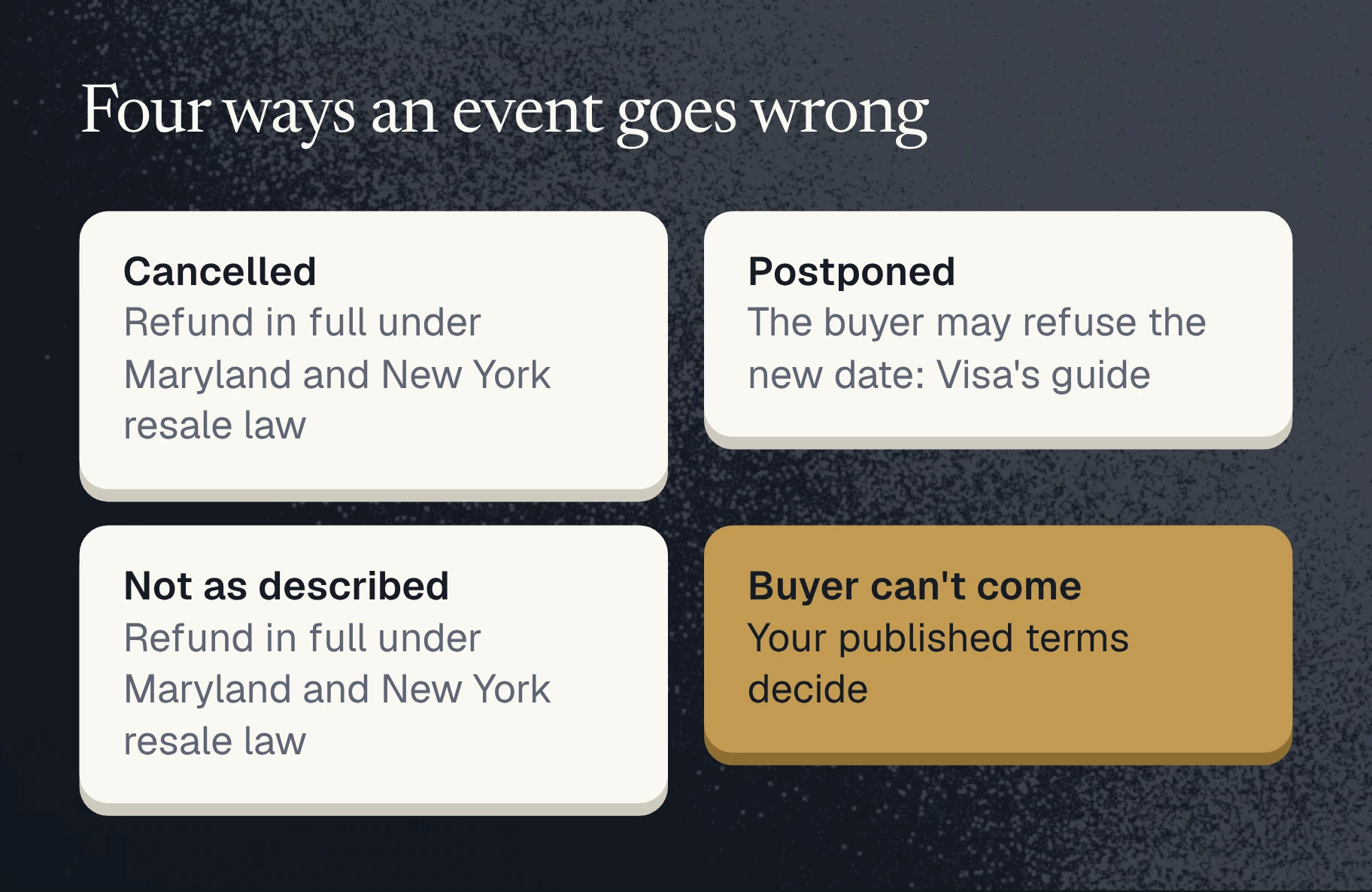
- Cancelled. Maryland's law and New York's resale law call for the full $150, fees included; New York lets a reseller keep disclosed handling and delivery fees. A refund sent before buyers go to their banks keeps the case out of disputes.
- Postponed or moved. Offer the new date and a refund, and record which each buyer chose. Visa says the buyer "is not required to accept" the alternative, and a buyer who didn't accept it and was refused a refund may have a valid dispute.
- Not as described. A different headliner, venue or seat section can be a refund case in New York and Maryland, whose laws cover a ticket that "fails to conform" to its description, and a dispute under Visa's not-received condition. Describe each tier exactly, and keep the listing as it was when the buyer paid.
- The buyer can't come. No rule above makes you refund a buyer who changes their mind about an event that happens as sold. Your published terms decide, and the cancelled-services condition holds you to them.
The refund and cancellation terms that cut disputes
The terms that cut disputes are the ones a buyer sees before paying and can check afterwards. Built from the rules above, a ticket's terms should say:
- What the ticket is. Event, date, venue, tier, seat or section, and what "general admission" includes.
- Cancellation. A full refund, and by when. If you keep a handling fee where the law allows it, say so in the same sentence.
- Postponement and changes. That the ticket carries over to a new date, and how a buyer asks for a refund instead, and by when.
- Changes of mind. Whether a buyer can get a refund, exchange or resell through you, and the last day to do it.
- How to reach you. An email that answers before the event, so a buyer asks you first and their bank second.
- For resellers. That you are a reseller, that the price may be above or below face value, and that the buyer should check the venue for changes, which is what Minnesota's law requires a reseller to show.
Show the terms on the checkout page, repeat them in the confirmation, and keep a dated copy of each version. Visa's guide asks for a confirmation with "key details (item, date, time, access method)" and to "Clearly communicate delays, reschedules, or cancellations as soon as possible and obtain cardholder's agreement."
Selling tickets with Railbed and issuing them from the paid webhook
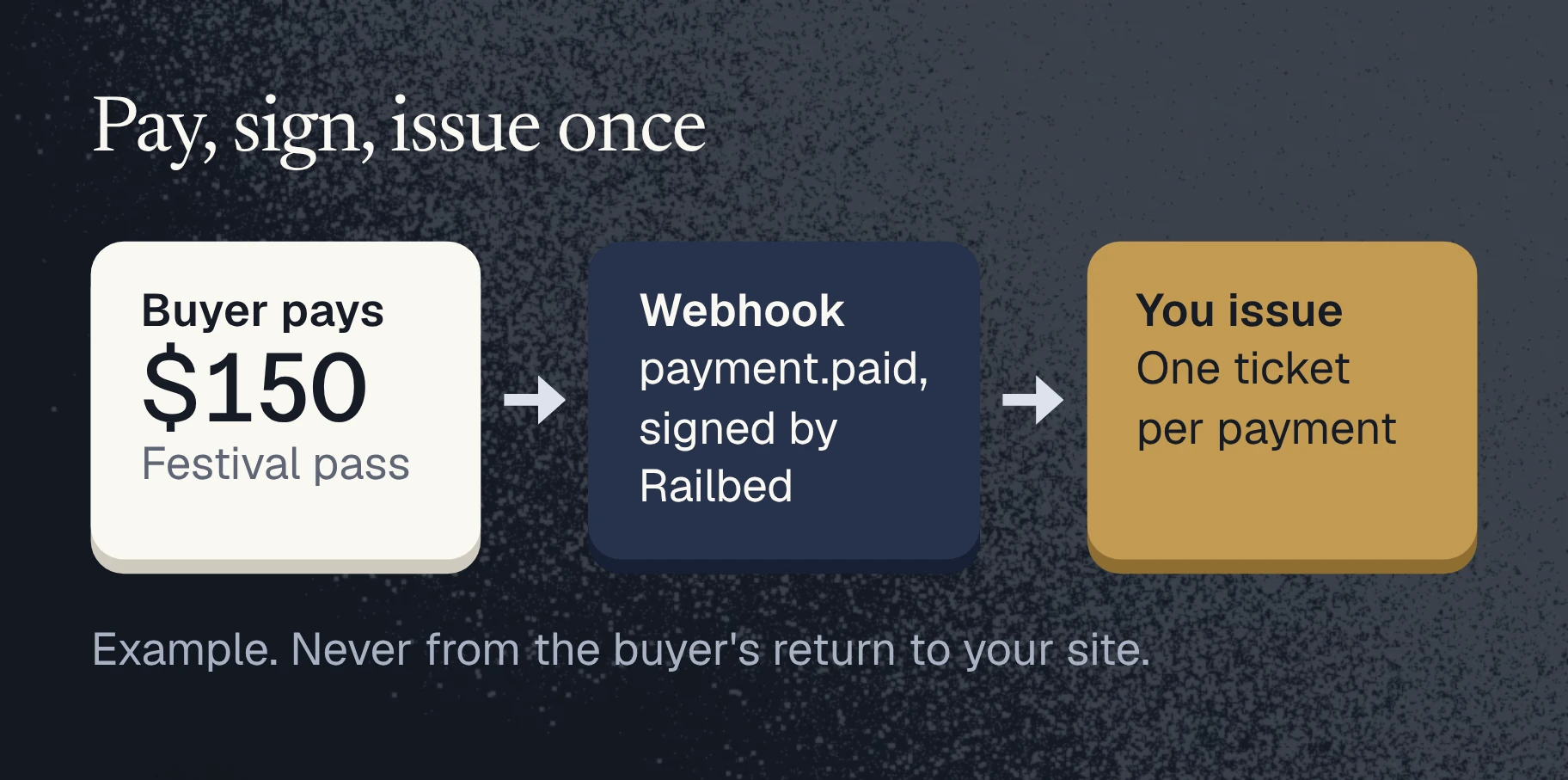
A promoter can sell each tier from a Railbed checkout page or pricing table and issue the ticket when a signed payment.paid webhook arrives. Railbed takes the payment; your ticketing system or your own code issues the ticket.
- Make the page. A checkout page sells one item at one price, for example "Festival pass, Saturday" at $150.00. For several tiers on one page, a pricing table shows up to four plans side by side, and every purchase is one payment. Put a short form of the ticket terms in the Description (up to 280 characters), with the full terms on your own site.
- Ask who is coming. A checkout page can ask for the buyer's name and phone and up to five questions of your own, such as "Name on the pass".
- Turn it off when it sells out. Railbed doesn't count tickets. When a tier's allocation is gone, Turn off checkout page: buyers who open the link see that it isn't available, and nothing can be paid. A promoter that needs exact inventory creates checkout sessions from its own site instead.
- Receive
payment.paid. Each webhook carriesRailbed-Signature: t=…,v1=…; verify the HMAC-SHA256 of{t}.{raw body}with your endpoint secret, and reject anything more than five minutes old (how to verify it and avoid double fulfilment). - Issue once. Delivery is at least once, with retries over about 21 hours, so record the ticket against the payment's
idwith a unique key. The payload'scheckoutIdand, for a pricing table,planLabeltell you which event and tier was bought.
// After the signature check passes:
const event = JSON.parse(rawBody);
if (event.type === 'payment.paid') {
  const p = event.data.payment;
  // unique index on payment_id: a repeated delivery changes nothing
  await db.tickets.insertIfAbsent({ payment_id: p.id, checkout: p.checkoutId, tier: p.planLabel, email: p.customerEmail });
}
When an event is cancelled, refunds come from you: Railbed can't reverse a settled payment, so to refund a buyer, send the funds back yourself, and cancel the ticket in your own system.
Why Railbed fits a promoter or reseller
Railbed fits a ticket seller that wants each sale's money in its own wallet as the sale settles, and is ready to run its own refunds. Buyers pay with the card they already have through independent, licensed card providers, and each sale settles to a wallet you control, with nothing held back as a reserve. Signing up takes an email, your website and a payout wallet, with no underwriting and no application to pass. Venues and planners selling packages rather than tickets will find their own case on the events and venues page.
Good to know:
- The price you set is the price charged. The card provider's fee, the 1% network fee and the Railbed fee, from 0.9%, come out of what you receive, so the buyer is charged the price you advertise.
- Refunds are yours. There is no refund button. Keep enough of each event's money to refund it until the event has happened.
- Disputes go to the provider. Settled sales can't be pulled back from your wallet; card disputes go to the provider that charged the card. A provider may contact you, decline future payments from a buyer or region, or take other action under its own terms. Against friendly fraud after a show that did happen, keep the scan record and the terms ready in case the provider asks.
- Prices and minimums. Each card provider has a minimum, the smallest about 2.00 USD; tickets of about $10 or more give buyers the widest choice. The statement shows the card provider's name, so say so in your confirmation.
- Group sales and deposits. A block of seats can go on an invoice paid in parts; a large booking deposit is covered in how to take a large deposit by card.
Put a festival pass on sale in Test mode
Make a $150 checkout page with your ticket terms, point a test webhook at your server, and watch a simulated payment.paid issue the ticket once.
Create an accountRead the webhooks guide