Why a travel agency merchant account holds your money, and how to take deposits by card
Why processors delay or reserve travel money, worked out for a sample tour operator, with Visa's future-service rules and a deposit-and-balance invoice.

Press the card to run an example sale.
Processors hold travel money because a traveler can dispute a card payment for up to 120 days after the trip was due, and the processor repays it if the operator has failed. A travel agency merchant account is priced on the trips paid for and not yet taken, which is why it so often comes with delayed funding or a reserve.
This page works out that balance for a sample tour operator, quotes what processors and the card networks publish about travel, and shows how to take a deposit and the balance by card with an invoice that pays to your own wallet.
What a travel agency merchant account is priced on
A travel agency merchant account is priced on every trip a customer has paid for and not yet taken. Stripe's documentation for platforms names it: an account's "exposure, which is its unfulfilled volume that's subject to refunds and disputes" (Stripe, connected account reserves, read November 2026).
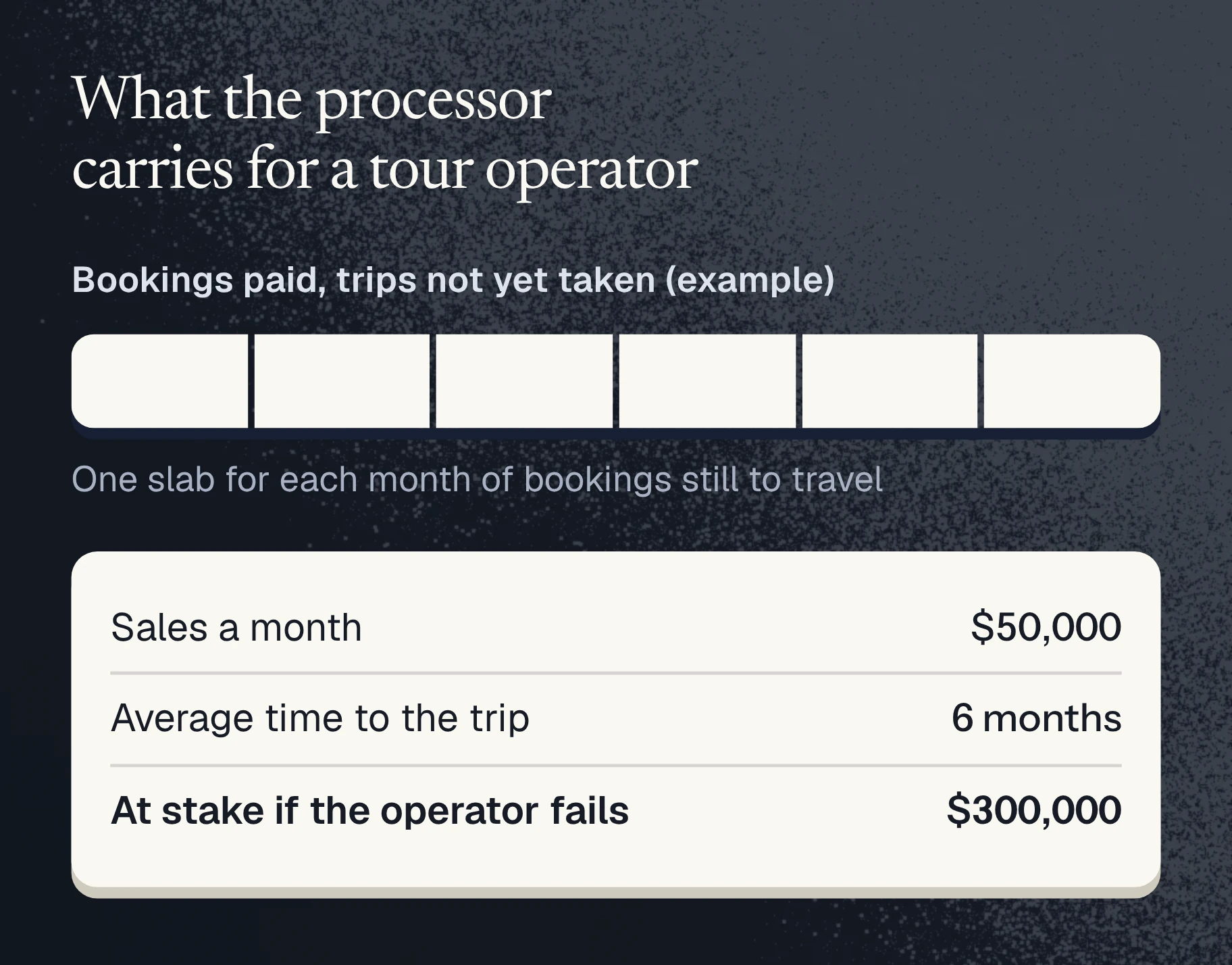
Take an example tour operator that sells $50,000 of trips a month, and whose customers book on average six months before they travel. After six months of trading, no January booking has traveled yet, so the books hold six months of sales that are paid for and undelivered: 6 × $50,000 = $300,000. It stays near $300,000 while sales and lead times hold steady, because each month's departures are replaced by new bookings.
The table below shows how the same $50,000 a month turns into a different balance as the booking lead time changes. All figures are an example.
| Average time from booking to trip | Undelivered balance at $50,000 a month | Visa's non-delivery window closes about |
|---|---|---|
| 1 month | $50,000 | 5 months after payment |
| 3 months | $150,000 | 7 months after payment |
| 6 months | $300,000 | 10 months after payment |
| 12 months | $600,000 | 16 months after payment |
The last column adds Visa's 120 days after the trip date to the lead time, inside its 540-day cap.
Why the processor, not the operator, pays when a trip never happens
The processor (the acquirer) pays because the networks send the dispute to it, and it can only recover the money from a merchant still trading. Worldpay puts it plainly for airlines: if an airline "becomes unable to operate flights passengers have already paid for, your acquirer faces significant financial exposure through the chargeback process", and "acquirers must repay the merchant's funds to the issuer and the cardholder, potentially bearing the costs if the merchant has ceased operations" (Worldpay, Understanding airline payments risk, read November 2026).
The network rules name a failed travel seller directly. Mastercard's chargeback for goods or services not provided covers the case where "Travel services arranged through an online travel agency or tour operator were not received and the travel agency or tour operator is no longer in business" (Mastercard Chargeback Guide, read November 2026). Visa's dispute table for services not received says its usual waiting period "does not apply if the Merchant is insolvent or bankrupt" (Visa Core Rules and Visa Product and Service Rules, edition 24 October 2026).
So the example's $300,000 is what the processor could have to refund if the operator closed tomorrow.
What delayed funding, reserves and collateral look like in published terms
Processors answer that balance with three tools, each sized against the undelivered trips. Worldpay lists them for airlines: "Delayed settlement: withholding merchant funds for a fixed number of days or until specific conditions are met"; collateral of "up to 100% of un-flown ticket value for higher-risk carriers"; and "Cash deposits or rolling reserves: funds held by the acquirer or in trust accounts as a percentage of un-flown ticket value."
The table below sets out what three large payment companies publish about travel, as of November 2026.
| Company | Where it says it | What the page says about travel |
|---|---|---|
| Stripe | Restricted businesses, updated 22 September 2026 | Prohibits "Commercial airlines and cruises", "International (cross-border) charter and private airlines" and "Timeshare services"; lists "Travel reservation services and clubs" under businesses that "might pose elevated financial risk" |
| Stripe | Connected account reserves | Suggests a reserve for "Travel or lodging reservations that can be canceled for a refund until a certain number of days before the reservation date", released at the fulfillment date or refund deadline |
| PayPal | Funds availability | "Higher-risk items can include tickets, gift cards, consumer electronics, computers, and travel packages" |
| Worldpay | Airline payments risk | Delayed settlement until flights are flown, and collateral up to 100% of un-flown ticket value |
AI answers to this question often quote a reserve of 5% to 15% for 90 to 180 days, with no source. No network rule or published processor policy we read sets a number, and the terms an underwriter sets for one agency can be anything. The guide to how rolling reserves change cash flow works through a reserve's daily ledger.
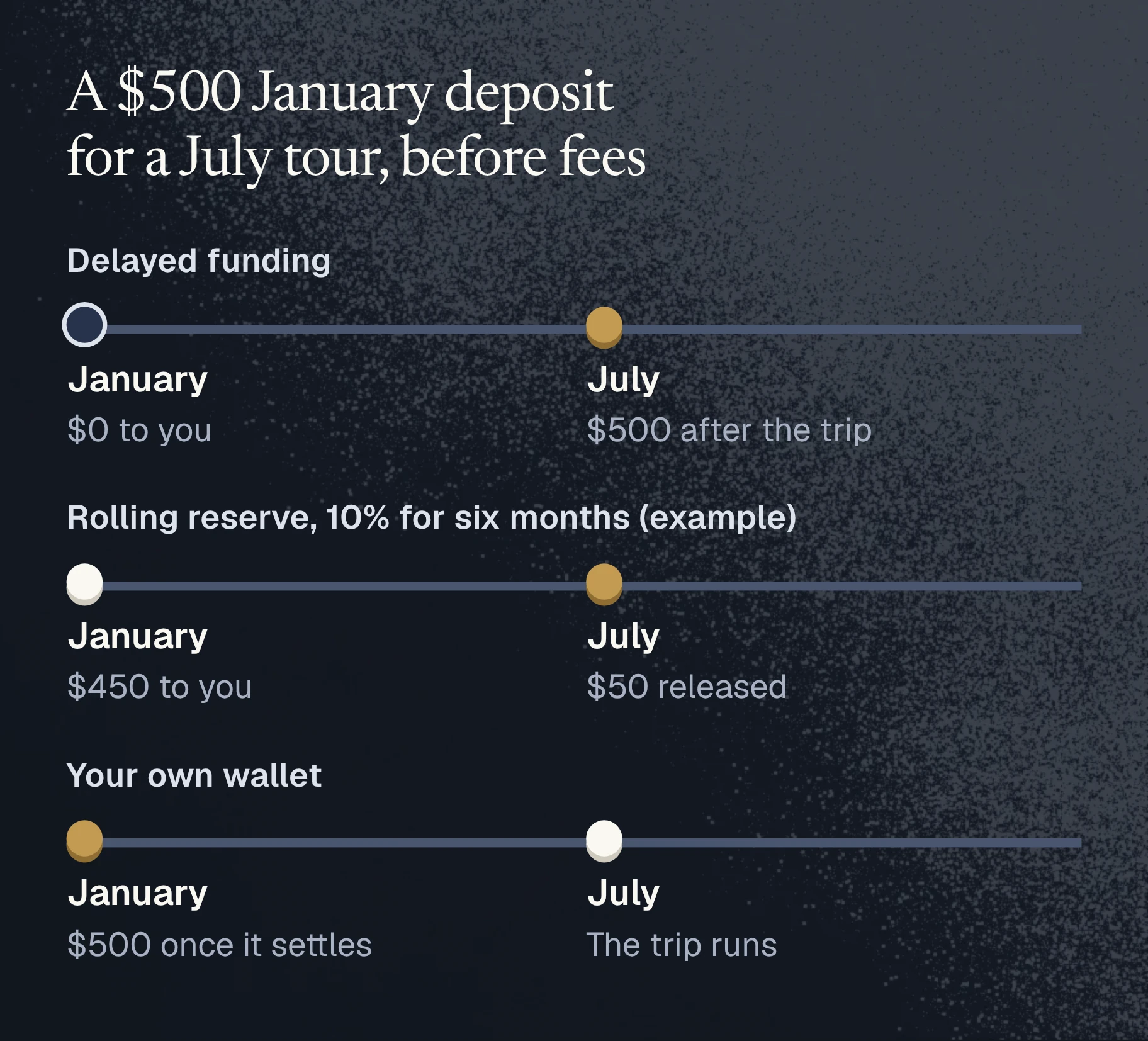
The three tools reach the operator at very different times. Take a $500 deposit paid in January for a July tour, with an example rolling reserve of 10% held for six months, and leave fees aside, since every route has them. Under delayed funding, the $500 reaches the operator after the July trip. Under the reserve, $450 is paid out in the usual way and the other $50 follows in July. Paid to the operator's own wallet, the deposit arrives once the payment settles, with nothing held back.
What Visa and Mastercard rules say about paying for future travel
Visa names travel sellers in its rules for taking money before the service. They say "Only the following Merchant categories may process an Advance Payment representing the entire purchase amount before the goods or services are delivered", and the list includes T&E (which Visa's glossary defines to include travel agencies, airlines, cruise lines and lodging) and "Recreational services or activities related to tourism and travel", adding that "The terms and conditions must specify the date of shipping of the goods or services to the Cardholder" (Visa rules, edition 24 October 2026).
Before an advance payment, the customer agrees to terms that include a "Description of goods or services", the "Total purchase price", and "Cancellation and refund policies, including the date that any cancellation privileges expire without Advance Payment forfeiture". For payments in parts, Visa forbids interest and requires any late fee to be a flat amount.
When a supplier cancels a trip, Visa's dispute for services not received (Dispute Condition 13.1) normally makes the cardholder wait 15 days, but "For MCC 4722 (Travel Agencies and Tour Operators), and ticket agencies that sell third-party event tickets, wait 30 calendar days from the date the service provider cancelled the service." The time limit is 120 days from the processing date or "from the last date that the Cardholder expected to receive the merchandise or services", never past 540 days from the payment.
Mastercard's guide also caps a chargeback at "540 calendar days from the Central Site Business Date of the first presentment" (Mastercard Chargeback Guide). The large-deposit guide sets out the general dispute clock for any deposit.
Airlines and timeshares sit at the far end
Airlines and timeshares carry the longest exposure, and their rules are stricter again: Stripe's list prohibits commercial airlines and cruises outright. Timeshares have a rule of their own in Visa's book: "A timeshare Merchant must provide a full credit refund when the Cardholder cancelled the Transaction within 14 calendar days of the contract date or the date the contract or related documents were received" (Visa rules). Visa also lets an issuer dispute a sale at a timeshare reseller or reseller adviser as misrepresentation (Dispute Condition 13.5). The timeshares industry page covers that trade in more depth, and the travel agencies industry page covers seller-of-travel registration and the airline refund rule.
Taking a deposit and the balance with an invoice paid in parts
A Railbed invoice can carry a whole booking and let the customer pay it in parts, with a deposit first. Here is an example $2,400 tour with a $500 deposit.
- Create one invoice for the whole tour. Add the tour as a line, and extras or taxes as more lines (up to 50). The total can be up to 100,000.00, in USD, EUR, GBP, CAD, AUD, INR or SEK.
- Set the due date to your balance deadline, for example 60 days before a July departure. A due date can be up to two years ahead, which fits trips booked a year out.
- Turn on Let them pay in parts, with a Smallest first payment of $500. Later payments can be any amount, and each must still be one a card provider can take (the smallest is about 2.00 USD) and never more than what's left.
- Write the trip dates and your cancellation terms in the invoice's terms. The customer sees them on the invoice page and the PDF before paying: the same facts Visa's advance-payment rules list, and the record you'll want if a payment is ever disputed.
- Turn on reminders if you want them. They are off until you turn them on; turned on, they go 3 days before the due date, on it, and 3 and 7 days after, and stop once the invoice is paid.
- Send it. Email it with its PDF, from "Your Business via Railbed", or share its link or QR code.
The customer pays the deposit by card on a card provider's page. The invoice then reads Partially paid and shows what's still due; each later payment brings a receipt with the balance left, and the invoice reads Paid when the total is in. Each payment settles to your own wallet, and nothing is held back from your sales. An invoice never moves money itself: if a trip is canceled and you owe a refund, you send it from your wallet. The guide to getting an invoice paid in parts shows the customer's screens.
Why Railbed fits a travel agency or tour operator
Railbed fits a travel seller because it holds nothing between the payment and you, so the size of your undelivered book never turns into a hold on your money. An independent, licensed card provider charges the customer's card on its own page, and the sale settles to a wallet you control, almost always as USDC on Polygon. Railbed never holds funds, there is no reserve, and there is no underwriting and no application to pass; sign-up needs an email, your website and a payout wallet.
Good to know:
- Disputes still exist. Settled sales can't be pulled back from your wallet, but a card dispute goes to the provider that charged the card, and Railbed is not a party to it. Clear dates and cancellation terms on the invoice are your record.
- Refunds are yours to send. There is no refund button; you send a refund from your wallet.
- Fees. The card provider's own fee and spread, a 1% network fee and the Railbed fee, from 0.9%, shown in the dashboard and locked when the customer starts paying. There is no setup fee and no monthly fee.
- ID checks are the providers' call. Smart Routing ranks the providers least likely to ask first, but it can't promise that a provider won't.
- Web checkout only. There is no card reader; a customer at your counter pays from the invoice's QR code on their phone.
- Cashing out is your step. Sales arrive in your wallet, and moving them to a bank goes through an exchange or wallet app.
Send your next tour deposit as an invoice
Put the whole booking on one invoice, ask for a $500 first payment, and let the customer pay the balance by card before departure.
Create your accountRead the invoices guide