How to take a refundable security deposit by credit card
When a card can't be held, a security or damage deposit is charged and refunded. The networks' hold limits, an example $300 deposit both ways, and the terms to write.
Press the card to run an example sale.
If the card can't be held, charge the security or damage deposit by credit card as an ordinary payment and refund it after the return. A hold only reserves the money for a set number of days and then lapses; a charged deposit is paid now and has to be sent back. Put the return date, and what you may keep, in terms the buyer sees before paying.
This guide is for deposits that come back when nothing goes wrong: a vacation rental, a car, boat or equipment rental, a studio booking. It quotes the networks' limits on holds, follows one example $300 deposit both ways, and ends with the terms to write. A deposit that becomes part of the price, such as a down payment on a car, is covered in how to take a large deposit by card.
A hold and a charged deposit are two different card tools
An authorization hold reserves part of the buyer's credit or balance without taking it. Visa's authorization guide for merchants puts it plainly: "With each successful authorization, available funds from cardholders are reduced to cover an approved authorization, commonly referred to as an authorization hold." Nothing reaches the business until it captures the hold, and if it never does, the hold falls away.
A charged deposit is a finished purchase. The money settles to the business like any sale, and getting it back to the buyer is a refund the business sends. A business that takes cards through a page that can't place a hold, or doesn't want a hold that may lapse mid-rental, charges the deposit instead.
How long a card hold lasts, by the networks' own rules
A hold lasts only as long as the card network's period for that kind of business, and that is shorter than many rentals. Visa's guide lists the maximum time "from a valid estimated authorization to processing"; Mastercard sets a protection period after which the issuer releases the hold. As of November 2026:
| Kind of authorization | How long | Source |
|---|---|---|
| Visa estimated: lodging, vehicle rental, cruise | 30 days | Visa |
| Visa estimated: other rental, and card-absent sales the cardholder starts | 10 days | Visa |
| Visa estimated: card present | 5 days | Visa |
| Mastercard preauthorization / final authorization | 30 / 7 calendar days | Mastercard |
Two of Visa's rules matter more for a damage deposit than the numbers do:
- No damage buffer. An estimated authorization "must be a genuine estimate", and "to prevent overauthorization, Visa requires that an estimated authorization must not contain incidental spend amounts such as tips or a buffer for damage." Estimated authorizations also "cannot be used for" advance payments, among other things.
- No extension. "Incremental authorizations do not extend the approval response validity timeframe." A rental that outlasts the period needs the authorization to "be reversed and a new authorization must be requested."
Mastercard's Transaction Processing Rules (section 2.8) say "The Issuer must release any hold placed on the Cardholder's Account after the expiration" of those periods, "at the latest", and that an expired authorization's approved amount "is deemed to be zero."
A processor's own default can be shorter still. Stripe's documentation says "Usually, an authorization for an online card payment is valid for 7 days", and "If the authorization expires before you capture the funds, the funds are released." Its extended authorizations reach 30 days on Visa, at an extra 0.08% outside hotel, lodging, vehicle rental and cruise, and "The exact extended authorization window for Visa is 29 days and 18 hours."
The same $300 deposit, two timelines
Take an example: a seven-night cabin booked online, with a $300 refundable damage deposit, inspected the day after checkout.
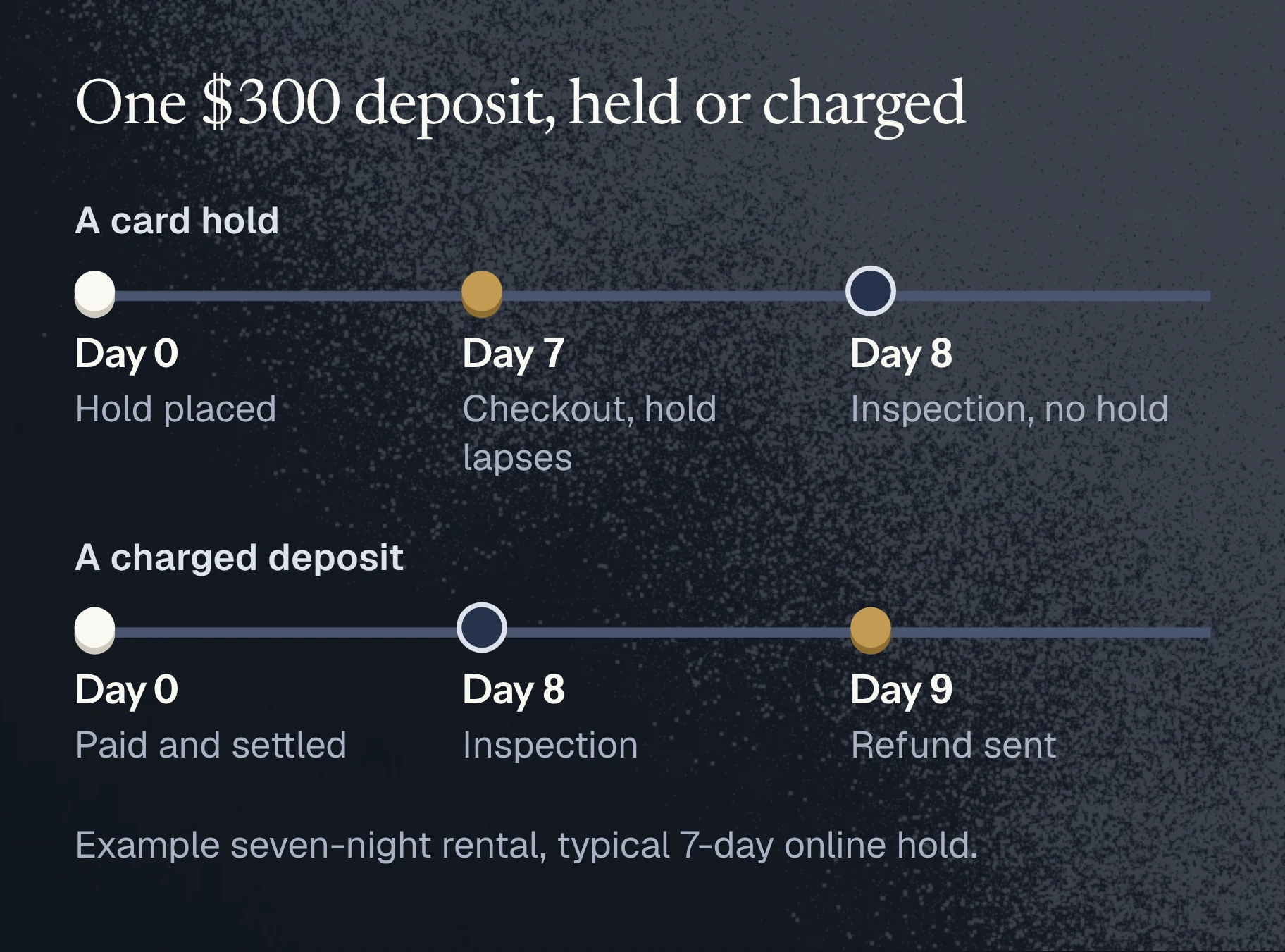
With a hold. On day 0 the owner places a $300 hold. The guest's available credit drops by $300, but nothing is paid. At Stripe's usual 7 days, the hold lapses on day 7, the day the guest leaves, one day before the inspection. A lodging merchant with Visa's 30-day period has time to inspect and capture what the damage costs, but the no-buffer rule above still applies, so ask your processor how its deposit holds are set up before relying on one.
With a charged deposit. On day 0 the guest pays $300 and it settles to the owner. Nothing lapses. On day 8 the owner inspects; on day 9 the owner sends the deposit back, or what's left of it with a list of what was kept and why. The guest is out $300 until the refund lands.
What each way costs the business and the buyer
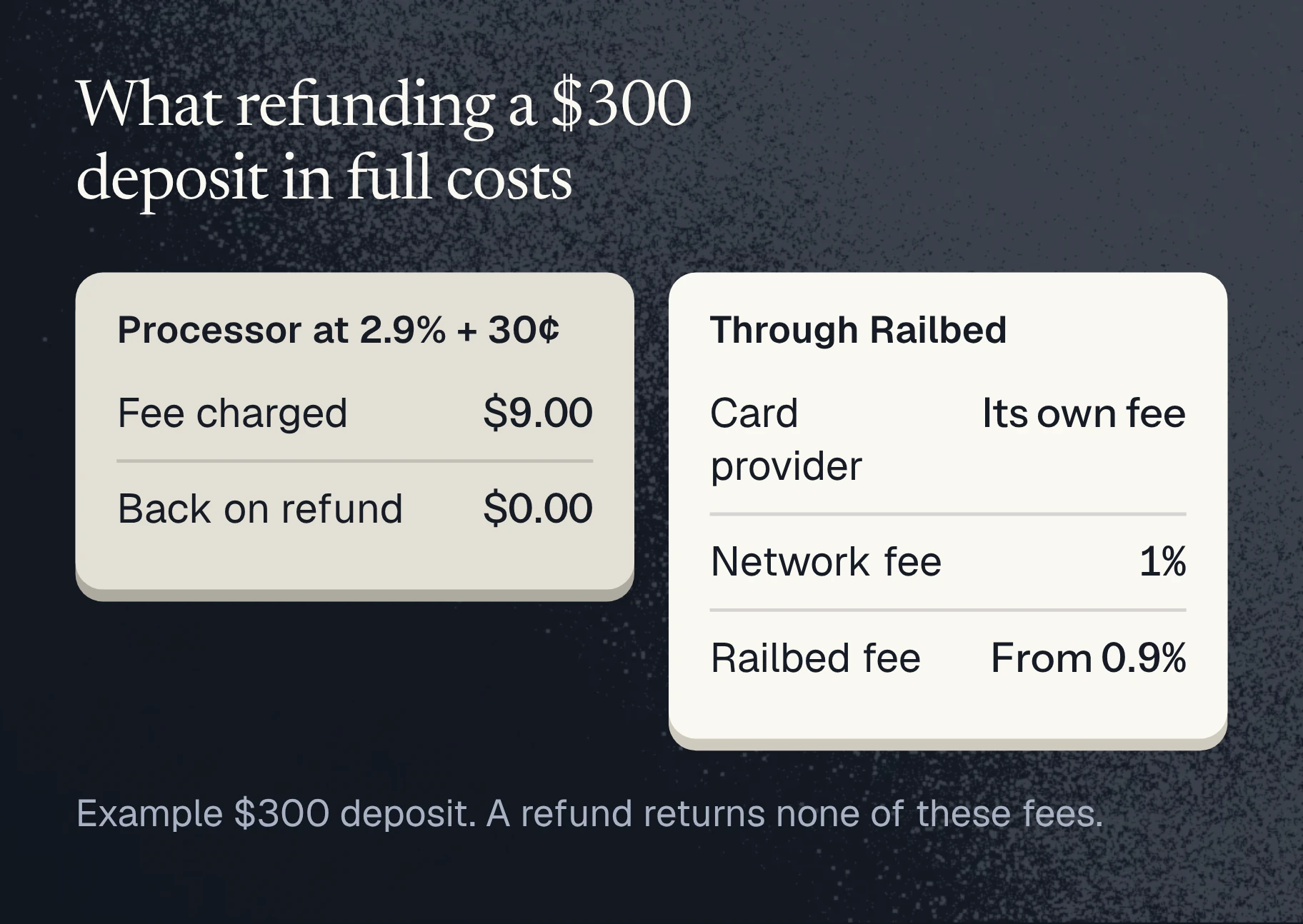
A hold costs the business little unless it is captured, and costs the buyer only spending room. A charged deposit costs the business card fees that a refund doesn't return, and costs the buyer the $300 for the length of the rental. The table uses the example $300 deposit refunded in full.
| Hold, released unused | Charged at Stripe, refunded | Charged through Railbed, refunded | |
|---|---|---|---|
| What the business pays | Authorization fees; Visa says to ask the acquirer about the cost "in addition to standard authorization processing fees" | $9.00 at 2.9% + 30¢, none of it returned | The card provider's own fee and exchange rate, a 1% network fee and the Railbed fee, from 0.9%; none returned |
| What the buyer gives up | $300 of available credit until release | $300 until the refund credit appears | $300 until you send it back |
| Can it lapse? | Yes, at the end of the period | No | No |
Stripe's pricing is "2.9% + 30¢ per successful transaction for domestic cards", and its refund page says "Stripe's processing fees from the original transaction aren't returned" and that the customer "sees the refund as a credit approximately 5-10 business days later, depending upon the bank." On $300 that is $8.70 plus $0.30, or $9.00, paid to hold money you then give back. Through Railbed, every fee comes out of what arrives, and Railbed shows the rate for your account in the dashboard before a payment starts.
The deposit terms to write
The deposit's terms should say what it covers, how you decide what to keep, and when and how the rest comes back, and the buyer should see them before paying. Visa's Dispute Management Guide describes the cancelled-services dispute (condition 13.7) as one where the cardholder "did not receive a refund they believe was due after cancellation", judged on "whether the cancellation was handled in accordance with the terms disclosed at the time of purchase, including eligibility, timing, and refund conditions." Its advice: "Ensure customers acknowledge your policies."
A checklist built from that:
- The amount, and that it is refundable. Show it apart from the rental price, so nobody reads it as part of the fee.
- What it covers. Damage, missing items, extra cleaning, a late return, each named. Say that ordinary wear isn't charged.
- How you decide. Check-in and check-out photos, an inventory, the date of the inspection.
- When it comes back. A number of days after the return, and the date on which an unclaimed deposit is returned in full.
- How it comes back, and how much. The method, and whether the full amount returns or the amount less card fees.
- What you send with a partial return. An itemized list of what was kept and why, with the photos.
- What happens on a cancellation. That a cancelled booking gets the whole deposit back, and by when.
Local law can set its own deadlines and limits on deposits, especially for housing, so have a local lawyer read the terms before you rely on keeping any part of one.
Taking a security deposit by credit card with a Railbed invoice
A business without card-present processing can take the deposit as its own Railbed invoice, paid by card, and return it from its wallet after the stay or rental. Railbed has no holds, so the deposit is a charged deposit from the start.
- Create the invoice. One line, "Damage deposit, refundable", $300.00. Put the booking number in Reference or PO number (up to 64 characters) and the checklist above in Terms (up to 2,000 characters, printed at the foot of the invoice). Keep the rental itself on a separate invoice, so the deposit is one amount to send back.
- Choose when it's due. Before the handover, so you never give out keys or gear against an unpaid deposit.
- Send it. Share its link or QR code, or email it with its PDF; the email comes from "Your Business via Railbed".
- The renter pays by card. They pay on an independent, licensed card provider's page, and the payment settles to a wallet you control. With receipts turned on, they get one in your name for the payment.
- Hand over when it reads Paid. The invoice changes to Paid once Railbed has checked that the money reached your wallet.
- Return it after the inspection. Railbed can't reverse a settled payment: to refund a buyer, send the funds back yourself, from your wallet or by another arrangement you agree with them. How to refund a card payment that settled to your wallet walks through it.
For the rental itself, getting an invoice paid by card in full or in parts covers a renter who pays the booking in installments.
Why Railbed fits a business that can't hold a card
Railbed suits a deposit that has to be in hand before the handover, from a buyer paying online. The deposit settles to your own wallet, nothing is held back from your sales, and signing up takes an email, your website and a payout wallet, with no underwriting and no application to pass. That is the same for a cabin or B&B, a rental platform, a tattoo studio, a salon or a dealership taking a refundable deposit.
Good to know:
- No holds, no saved card. Railbed has no authorizations and never stores a card, so it can't charge for damage after the return. A damage cost beyond the deposit is a new invoice the renter chooses to pay, with your photos and the repair quote.
- No refund button. You send the deposit back yourself. It arrived less its fees, so returning the full amount means you cover them, and sending from your wallet costs a small network fee of its own.
- Disputes go to the provider. Settled sales can't be pulled back from your wallet; card disputes go to the provider that charged the card. A provider may contact you, decline future payments from a buyer, or take other action under its own terms.
- Online only. Railbed is web checkout, not a card reader at the desk. The smallest card payment is about 2.00 USD, and an invoice can be up to 100,000.00.
Build a refundable deposit invoice in Test mode
Make a one-line damage deposit invoice with your return terms at its foot, pay it with simulated money, and see what a renter sees before you take a real one.
Create an accountRead the invoices guide