Why do cards get declined on gambling sites? MCC 7995 and what an operator can do
One casino deposit followed through the five checks that can refuse it, from the player's own gambling block to the operator's acquirer, and what the cashier can change.
Press the card to run an example sale.
Cards get declined on gambling sites because online gambling must be coded MCC 7995, and that code lets the player's bank refuse the payment: by its own policy, by a law such as Britain's credit card ban, or by the player's own gambling block. An operator controls its cashier, not the code.
This page follows one deposit through each point where it can be refused, using the card networks' own rules (Visa's Core Rules of 24 October 2026 and Visa's Merchant Data Standards Manual of October 2026), a regulator, two banks' help pages and a card issuer's agreement. It's written for the operator looking at a cashier full of declines.
How MCC 7995 marks every deposit
MCC 7995 is Visa's code for "Betting, including Lottery Tickets, Casino Gaming Chips, Off-Track Betting, Wagers at Race Tracks and games of chance to win prizes of monetary value." Visa's rules make it compulsory for online play: an online gambling merchant must "Have a valid license or other appropriate authority to operate its website and/or application" and identify each transaction with "MCC 7995 (Betting), even when gambling services are not the Merchant's primary business." In Asia Pacific, Canada, CEMEA, Latin America and the US, it must also carry the Quasi-Cash/Online Gambling Transaction indicator.
Mastercard does the same with its own fields. Its Quick Reference Booklet of 10 November 2026 defines 7995 as "Any transaction, other than an ATM transaction, involving the placing of a wager", and says an acquirer must register a merchant before acquiring "non-face-to-face gambling". US merchants licensed for a state lottery, online casino or racing use 7800, 7801 or 7802 instead.
The code follows the bet, whatever sits in between. Visa's manual gives the example of a player who buys a digital currency through a ramp provider in order to gamble: the provider "must use the MCC that best describes the Affiliate's primary business as the Cardholder is paying the Affiliate for goods/services (e.g., in this case MCC 7995)." In its rule on funds transfers used for gambling, Visa also requires acquirers to have processes to "identify and eliminate abuse" by any "Online Gambling Merchant that attempts to circumvent proper Transaction identification." Under these rules, a deposit is meant to read as gambling whichever checkout takes it. The full list of flagged codes is in high-risk MCC codes and what each one means.
Five points where a gambling deposit is declined
A card deposit passes five checks in roughly this order, and any one of them can end it. The first three act on the 7995 code.
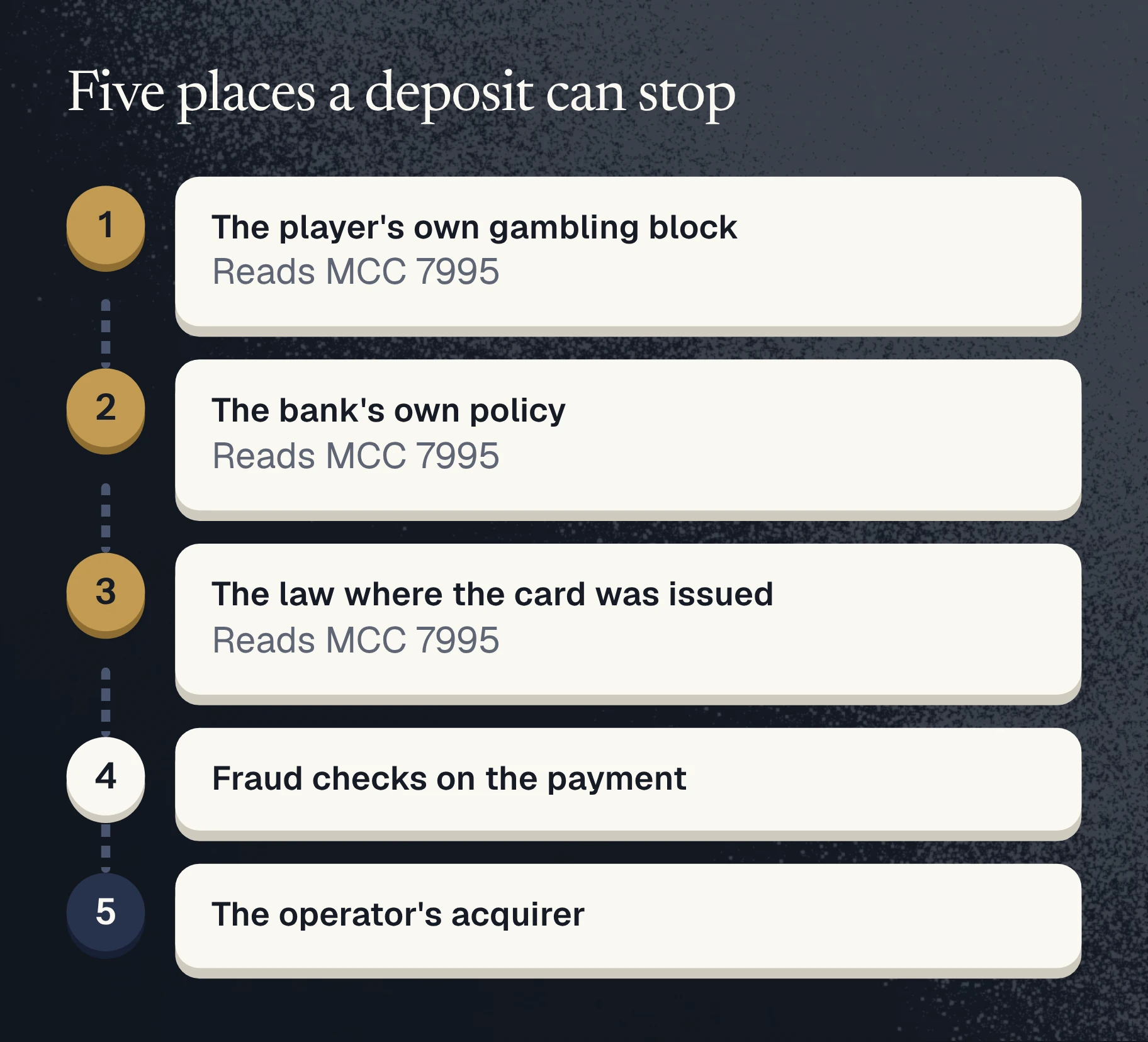
- The player's own block. Announcing Britain's credit card ban in January 2020, the UK's culture minister pointed to "the majority of major high street banks introducing measures to allow customers to switch off spending on gambling through mobile apps." Visa's rules say an issuer that lets cardholders limit card use "by Transaction type or Merchant Category Code (MCC)" must decline with response code 9G, "Blocked by cardholder/contact cardholder." HSBC UK keeps declining for 3 days after a customer turns its debit card block off, and Santander UK for 48 hours.
- The issuer's own policy. Some issuers refuse gambling on some cards outright: Santander UK says "If you have a Santander credit card, you won't be able to use this card for any gambling transactions," and HSBC UK says "If we believe a transaction on your credit card is for gambling, we'll block it automatically." Others accept it at a price, covered in the next section.
- The law where the card was issued. The UK Gambling Commission banned gambling on credit cards from 14 April 2020, for "all online and offline gambling products with the exception of non-remote lotteries." Its evaluation of November 2021 quotes a major bank seeing credit card gambling "to the gambling merchant code, MCC7995, reduce to a very low level after the ban." Visa's rules add that issuers must ensure cards issued in Norway "are not used for gambling Transactions outside of Norway." In the US, Regulation GG lists "a code system, such as transaction codes and merchant/business category codes" that lets the card system operator or issuer "reasonably identify and deny authorization" for a possibly restricted transaction among its examples of policies for card systems.
- Fraud checks on the payment. Mastercard's Security Rules of 4 August 2026 require acquirers of gambling and other specialty merchants to watch for "Simultaneous multiple Transactions using the same Account number". A player who retries the same card again and again can look like card testing; what card testing is and how to stop it covers that pattern.
- The operator's acquirer or processor. Since 1 May 2026, Mastercard requires its "express prior written consent" before an acquirer takes specialty merchants such as gambling sites, and some processors refuse the category outright: Stripe's prohibited and restricted businesses list names "internet gambling, casino games, sweepstakes and contests" among the businesses it prohibits. If the operator's own account can't take the deposit, no player's card will get through.
When the card goes through: the cash advance problem
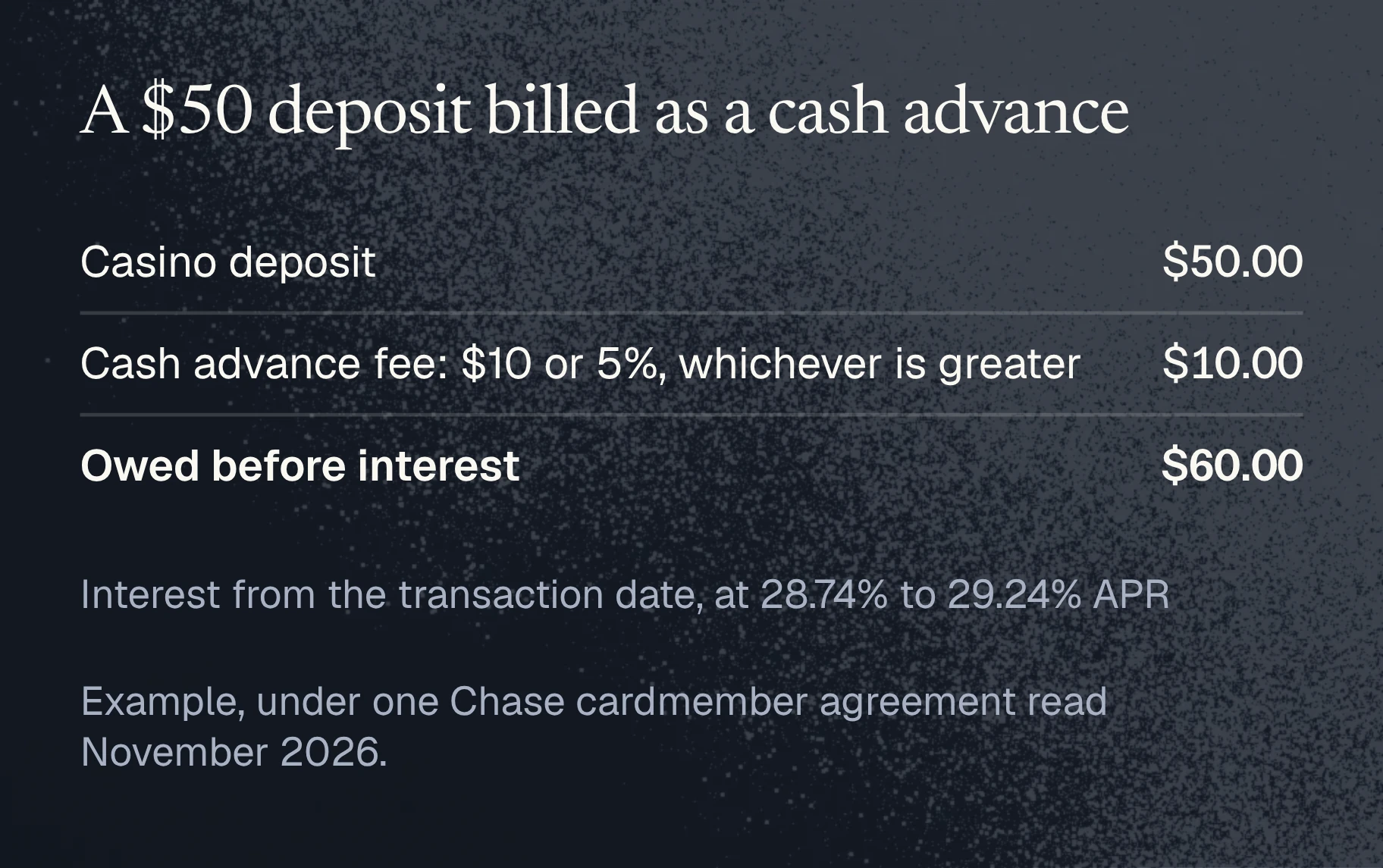
An approved deposit can still cost the player more than the deposit. The current Chase cardmember agreement, with rates set from the prime rate of 30 September 2026, says "Cash-like transactions will be treated as cash advances" and lists "purchasing predictive contracts, lottery tickets, casino gaming chips, race track wagers, and similar offline and online betting transactions." Its cash advance fee is "Either $10 or 5% of the amount of each transaction, whichever is greater," at a cash advance APR of 28.74% to 29.24%, and "We will begin charging interest on balance transfers and cash advances on the transaction date."
On a $50.00 casino deposit, that agreement's fee would be $10.00, a fifth of the deposit, so the player owes $60.00 before any interest (example).
Apple Pay and other phone wallets at a casino
Apple Pay doesn't change the merchant code or a bank's decision. The wallet pays with the underlying card, and HSBC UK lists "Digital Wallet transactions such as Apple Pay, Google Pay or Samsung Pay" among the payments its debit card gambling restriction won't authorise. A player whose debit card is refused at a casino should expect the same answer when that card is used from a phone.
What an operator can change in its cashier
The code and the player's bank are outside an operator's control; the cashier is not. This table lists changes that act on the five checkpoints without trying to disguise what the deposit is.
| Change | Checkpoint it helps | Why |
|---|---|---|
| Say which cards work before the player types | Law, issuer policy | In Great Britain credit cards are banned for gambling; say debit only for those players |
| Show a plain message on decline and pause retries | Fraud checks | Rapid repeat attempts on one card match the pattern acquirers must watch for |
| Show Visa's required statements on the homepage or payment page | Acquirer | Visa's Table 5-15 lists the illegality notice, the cardholder's responsibility, the under-age prohibition, rules of play and pay-out policies |
| Pay winnings the way Visa allows | Acquirer | "Only disburse gambling winnings to a Cardholder using an Original Credit Transaction" |
| Respect a 9G decline | Player's block | It's the player's own choice; ask them to contact their bank, never to find a way round it |
| Add a second way to take cards | Acquirer | Covers players and countries your current acquirer doesn't serve |
What doesn't belong on the list is anything that relabels a bet. Mastercard's booklet says its quasi-cash code 6051 "must not be used" for gambling, and Visa can disqualify a high integrity risk merchant that "Acts with the intent to circumvent Visa programs." For the wider set-up behind a cashier, see payment processing for online casinos, whether iGaming needs a dedicated acquiring bank and payment providers for iGaming.
FAQ
Is a casino deposit a cash advance? On some credit cards, yes. The Chase agreement quoted above treats "similar offline and online betting transactions" as cash advances, charged a fee and interest from the transaction date. Other issuers set their own terms in their cardmember agreements.
Will a debit card work where a credit card doesn't? Often, because several rules target credit only. Britain's ban covers credit cards, and Santander UK blocks gambling on its credit cards while its debit Mastercard block is the customer's choice. A debit card with the player's own gambling block on is still declined.
Can a casino see why a card was declined? Only as far as its acquirer passes on the decline response. Visa's rules require response code 9G when an issuer declines because of the cardholder's own block; for anything more, the player has to ask their bank.
Why Railbed fits a casino or sportsbook cashier
Railbed is card checkout for online merchants that mainstream processors turn away, iGaming included, and it can be that second way to take cards from the cashier table above: there's no underwriting and no application to pass, and sign-up needs an email, your website and a payout wallet. Players pay on an independent, licensed card provider's own page, and each deposit settles to a wallet you control, almost always as USDC on Polygon. Nothing is held back from your sales; fees are Railbed's, from 0.9%, a 1% network fee and the provider's own fee and exchange rate. The iGaming page shows the cashier flow.
Good to know:
- Railbed doesn't change how a payment is coded. Routing doesn't lift a block a player has set with their bank, or a bank's own policy.
- A card can still be declined on the provider's page. Smart Routing ranks providers by the player's country, currency and amount, but Best match is a recommendation, not an approval guarantee, and Railbed gets no decline signal in Live.
- Disputes go to the provider. Settled deposits can't be pulled back from your wallet; a player's dispute is raised with the provider that charged the card.
- Credit from the webhook. Credit a balance on the signed
payment.paidwebhook, never on the player returning to your site.
Add a second way to take player deposits
No underwriting and no application to pass. Players pay on a licensed card provider's page, and each deposit settles to a wallet you control.
See the iGaming pageCreate an account