Can a merchant use MoonPay, Transak or Ramp as its checkout?
Whose wallet the money may go to, who the buyer buys from, and the six things a merchant would still build around one of these widgets, from each company's terms.
Press the card to run an example sale.
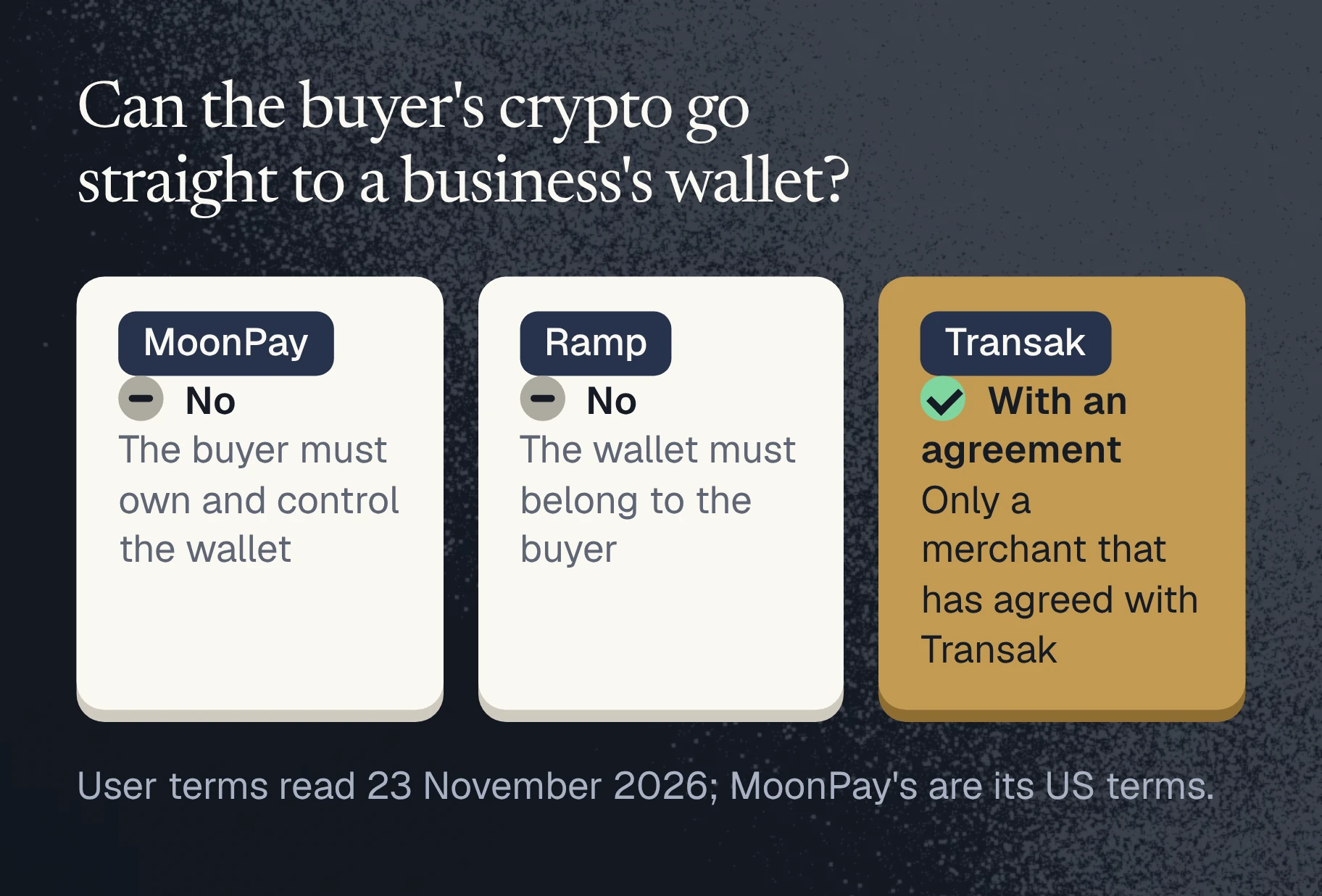
Not as a plain widget. MoonPay's and Ramp's user terms say buyers must send the crypto they buy to a wallet they own, and Transak allows a business's wallet only when that business has its own agreement with Transak. A merchant needs that agreement, or a checkout built for paying a business.
An on-ramp already charges cards and delivers USDC, so why not point it at your wallet and sell a $199.00 course through it? This page reads what the three companies publish today, then lists what you would still have to build and how the alternatives differ.
What do MoonPay, Transak and Ramp's own terms say about paying a business?
All three companies sell crypto to the person holding the card, and their terms say where that crypto may be sent. The table sets out what each one published, as read on 23 November 2026.
| MoonPay | Transak | Ramp | |
|---|---|---|---|
| Where the crypto may go | A wallet the buyer owns and controls (US terms) | The buyer's own wallet, or a merchant's wallet if that merchant has agreed with Transak (Rest of World terms) | Not "a Wallet Address that does not belong to you" |
| Who the buyer buys from | MoonPay, "the merchant of record" | Transak ("buy Digital Assets from Us") | Ramp ("you buy from and sell to Ramp Network") |
| Before live orders | Business verification (KYB), then API keys | KYB before the production API key | A production API key, requested by form |
| Card fee as published | "a variable fee is applied for every transaction" | Cards outside the euro: 5.5% plus 1 EUR, and a spread of 0% to 2.5% | Visa or Mastercard in USD, EUR or GBP: up to 3.9%, minimum up to €2.49 |
MoonPay. Its US terms of use (effective 6 August 2026) say: "By providing us with the address to send purchased Digital Assets, you represent and warrant that you own and control the Wallet." Its on-ramp overview describes the flow as a purchase that ends with "MoonPay sends the crypto to the user", and states that "as the merchant of record MoonPay assumes full responsibility for all fraud disputes and chargebacks." API keys arrive "once you've completed the KYB process".
Transak. Its terms of service (the Rest of World version, last updated 29 October 2026) define a Designated Wallet as one "which may be your wallet or the wallet of a Merchant", and a Merchant as "a business which has agreed with us to accept payments in Digital Assets from us on Your behalf for the provision of goods or services from them to You." Section 11.4 reads: "You must own and control your Designated Wallet address unless it is a Merchant wallet." Its partner docs require KYB before a production API key, and its fee page gives the card rates in the table; a partner may add up to 5% on top.
Ramp. Its terms of service (last updated 24 September 2026) say you "will use the Services only for yourself as the sole Account owner" and must not "act on behalf of another third party"; the use restrictions include "use a Wallet Address that does not belong to you, allow a third party to use your Wallet Address". Its pricing policy says Ramp "acts as the counterparty in every transaction" and that it "performs KYC (Know Your Customer) on all transactions". Its developer docs warn that "the widget won't work without an active production API key".
Who is the seller when an on-ramp charges the card?
When a buyer pays an on-ramp, the on-ramp is selling crypto, and that is the only sale on the card. Your $199.00 course is a second, separate sale that happens when the crypto reaches you.
So the card charge belongs to the on-ramp, a dispute goes to the on-ramp, whose records show crypto sold and delivered, and the on-ramp's protections and refund process cover the crypto, not the course.
Visa's rules describe the same split. In the edition dated 24 October 2026, a retailer paid through a ramp provider is a "Conversion Affiliate", and Table 1-10 says to "Only submit a Deposit for a Transaction between a Cardholder and a Conversion Affiliate that has an agreement with the Ramp Provider". Visa's rules and Transak's terms point the same way: a business paid through an on-ramp is expected to have its own agreement with it. This is Visa's general framework, not a description of how any company named here is registered, and Mastercard's equivalent was not checked. Who does what between a gateway, a processor, an acquirer and an on-ramp sets out the other roles.
What would you have to build around an on-ramp widget?
Suppose you get that agreement, through Transak's merchant route or a custom deal with another on-ramp. The widget then charges the card, and everything that makes it a checkout is yours to build.
- A partner account and business verification. KYB comes first, as the table shows, and the on-ramp checks your build: MoonPay's going-live criteria "are verified by MoonPay before going live."
- A fixed destination. You pass your wallet address and stop the buyer editing it; Transak's FAQ points to its
disableWalletAddressFormparameter for this. The token and network must match your wallet, or the money can be lost. - An amount that lands whole. On-ramps take their fee out of what the buyer pays. Ramp's pricing policy puts it as: a user buying €100 of crypto "will always pay €100 with the total fees subtracted from this amount." To receive $199.00, you must ask the on-ramp for more, and Transak warns that "the final cryptocurrency amount the user receives is calculated when the fiat payment is settled." You need a rule for when slightly less arrives.
- Order matching. Transak lets you pass a
partnerOrderIdand look the order up by it. MoonPay's webhooks are "at-least-once and unordered: duplicates can occur and events can arrive out of order, so handlers must be idempotent." Confirm the transfer on the blockchain before you grant access to the course. - The on-ramp's quote and disclosures. MoonPay's criteria require a quote summary where "You Pay" must "exactly match the amount charged", and fee rows labelled exactly "Network Fee", "Ecosystem Fee" and "MoonPay Fee". Its table marks both as yours to show ("You render") even when you use its widget.
- Your own refunds. An on-ramp refunds its own failed orders; Transak's FAQ says "Refunds are handled by the support team." Refunding the course is a separate transfer you send back from your wallet, as refunding a card payment that settled as USDC explains.
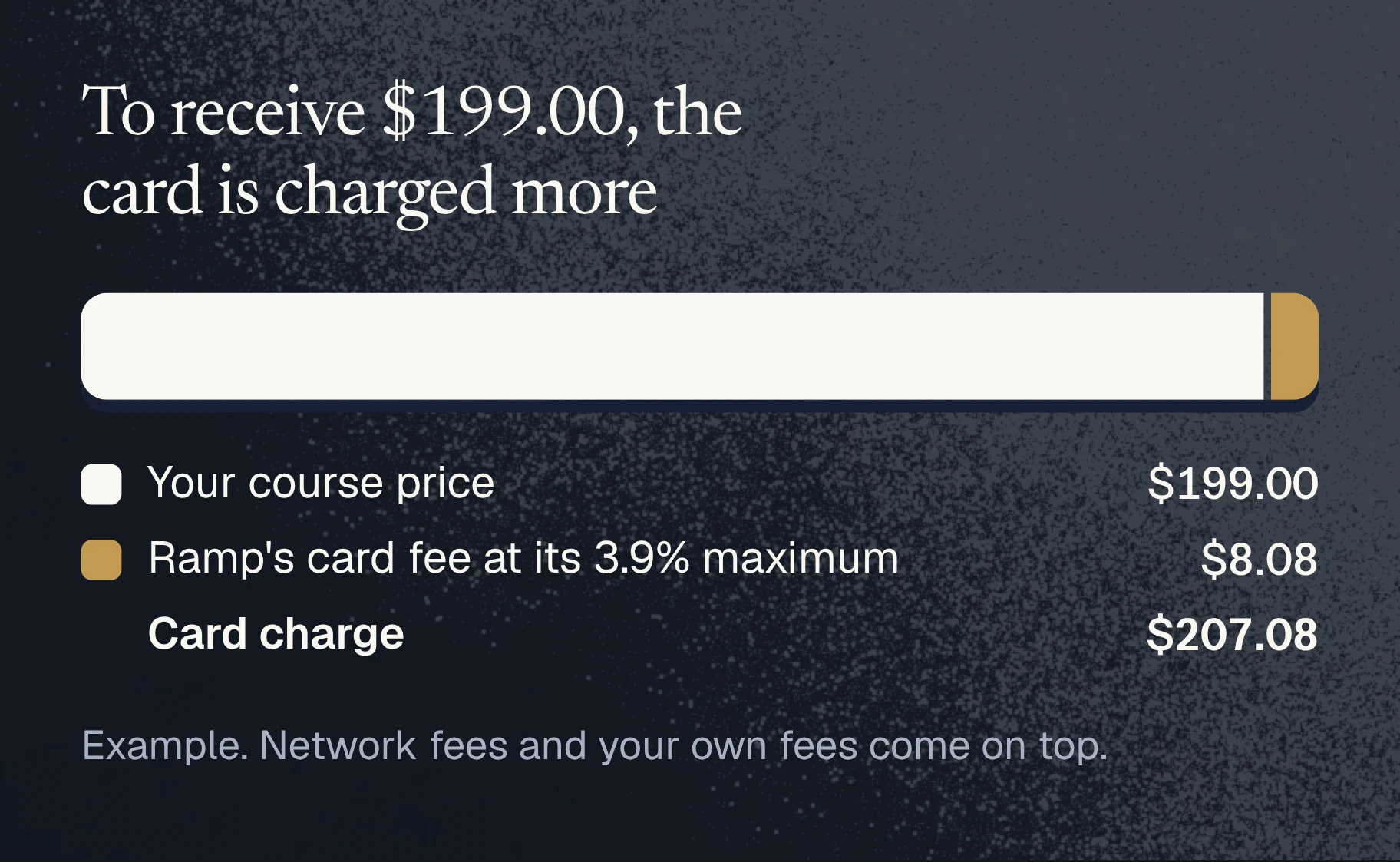
Here is the arithmetic for item 3, as an example. At Ramp's published maximum of 3.9% for a card in US dollars, landing $199.00 means charging the buyer $207.08, of which $8.08 is Ramp's fee, before the network fee and any fee of your own. Ramp's 3.9% is a ceiling ("up to"), so a real quote can come in lower.
One provider also means one set of buyers. MoonPay lists countries it doesn't serve. Transak's KYC levels put a $199.00 purchase inside its Simple KYC range of "$10 to $200", with no ID photo, but "Some countries are not eligible for Simple KYC" and its risk engine "prompts Standard KYC when initial checks are not satisfied", which asks for an ID and a live selfie.
How do aggregators, merchant products and gateways differ?
Three kinds of product sit between you and the on-ramps, and they solve different problems. The table compares them with a single on-ramp's widget.
| Option | Built for | What you sign up for | Where the crypto goes | Who matches it to your order |
|---|---|---|---|---|
| One on-ramp's widget | Wallets, exchanges and apps whose users buy crypto | A partner account and KYB with that on-ramp | The buyer's own wallet, unless the on-ramp agrees otherwise | You |
| An on-ramp aggregator | The same | An account with the aggregator | Each on-ramp's terms still apply | You |
| An on-ramp's merchant product | Merchants taking crypto payments | The product's own account and verification | The buyer's wallet in the checkout first, then paid to you | The product |
| A card-to-crypto gateway | Merchants selling by card | Railbed: an email, your website and a wallet address | A one-time address that forwards your share to your wallet | The gateway, before it marks the payment paid |
An aggregator such as Onramper "brings together over 30 on-ramp providers in a single platform you can integrate into your wallet, exchange, or dApp", according to its getting-started page. Its FAQ says you don't need contracts with each on-ramp: "Onramper works straight out of the box." It widens coverage and routes buyers, but the buyer still buys from one on-ramp under that on-ramp's terms.
An on-ramp's merchant product changes the shape of the sale. MoonPay Commerce's terms give funding "an Embedded Wallet within the Checkout Widget" as the onramp's example use, after which the buyer's payment "is a direct peer-to-peer transfer from you to the Merchant." Its pricing is a 2% standard transaction fee, with "a minimum rate of 2%" for high-risk platforms. How to accept credit cards and get paid in USDC to your own wallet compares this route with the other two.
A card-to-crypto gateway puts the order first. On Railbed, the buyer pays your order on Railbed's checkout and picks from the card providers that can take them, ranked by Smart Routing with those least likely to ask for ID first; the providers decide. The provider "runs its own card checkout and any identity check it requires, then buys USDC with the card payment and sends it to the payment's deposit address", and the payment network forwards your share to your wallet (how it works). Railbed marks the payment paid only when at least 85% of the order's value in dollars reached the right wallet, so matching and the shortfall rule are done for you; you deliver when it reads Paid. There is no underwriting and no application to pass. What a card-to-crypto payment gateway is follows one payment through.
A gateway sits on top of licensed on-ramp providers; it does not replace them. Settled sales can't be pulled back from your wallet; card disputes go to the provider that charged the card. Fees come out of the USDC that arrives: the provider's own fee and spread, a 1% network fee, and the Railbed fee, from 0.9%, shown in the dashboard when the payment starts.
When does integrating an on-ramp directly make sense?
A direct integration fits a business whose customers want crypto for themselves: a wallet, an exchange, a game with an on-chain economy, or an app whose users must hold a token. It can also fit a merchant with the volume to win its own agreement, the time to build the six pieces above, and buyers in the countries one on-ramp serves; Transak's merchant definition shows that path exists.
For a business that sells courses, memberships or digital goods by card and was turned away by a processor, a gateway is usually the shorter route. Know its limits too: buyers leave your page to pay on the provider's page and may be asked for ID there, very small prices have few providers, and refunds are transfers you send yourself.
Questions merchants ask
Can I put my own wallet address in an on-ramp widget's settings? The widgets accept a destination address so that apps can prefill the user's own wallet; MoonPay's FAQ lists "the destination wallet address" among its parameters. That doesn't change the buyer's terms: under MoonPay's and Ramp's, the wallet must be the buyer's. Only an agreement with the on-ramp, such as Transak's merchant wallet, makes a business's address a permitted destination.
Sell the course, let the providers sell the crypto
Railbed puts your order in front of several licensed card providers, and your share arrives in your own wallet. Try a checkout in Test mode first.
Create an accountHow a payment works