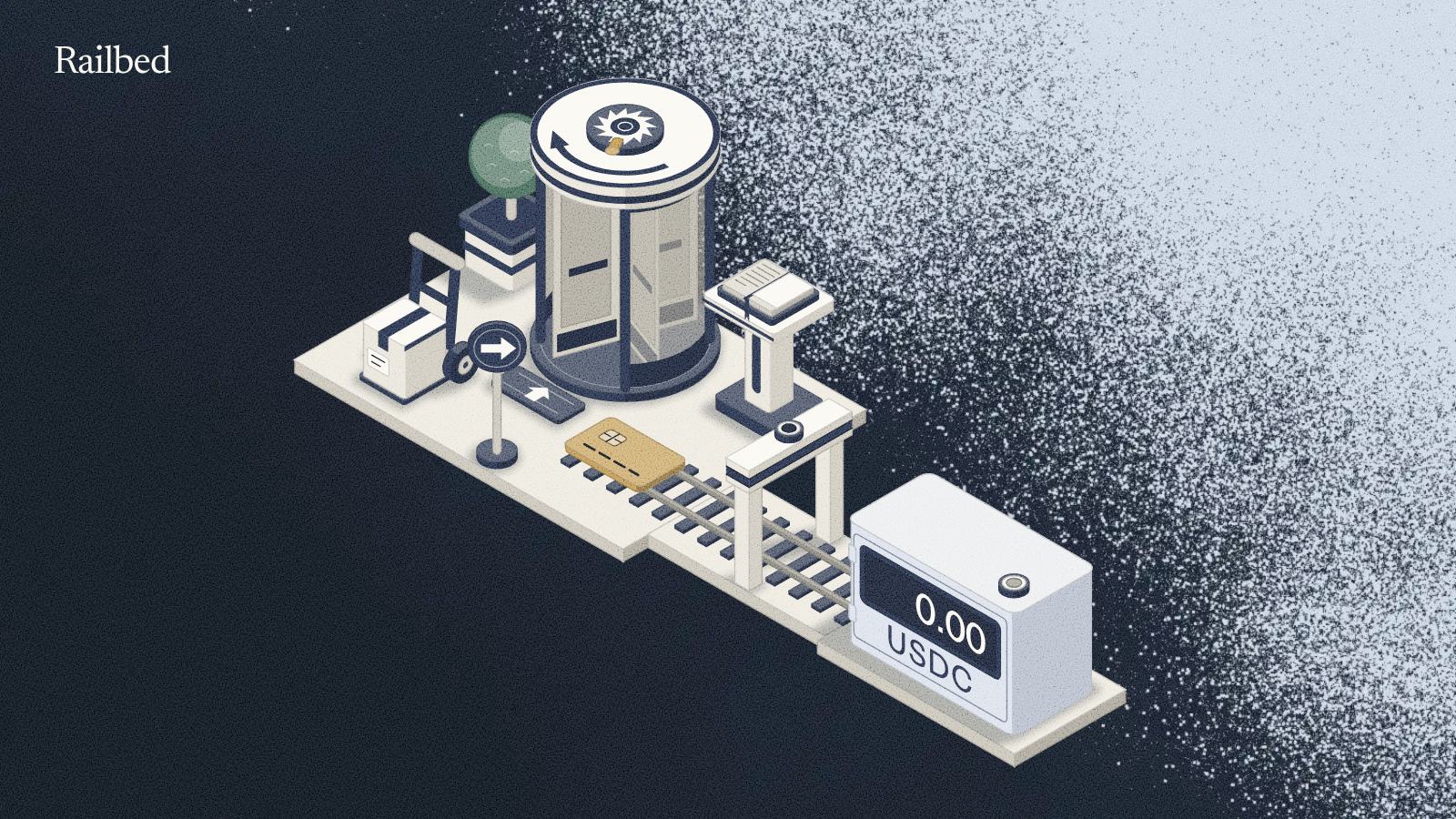
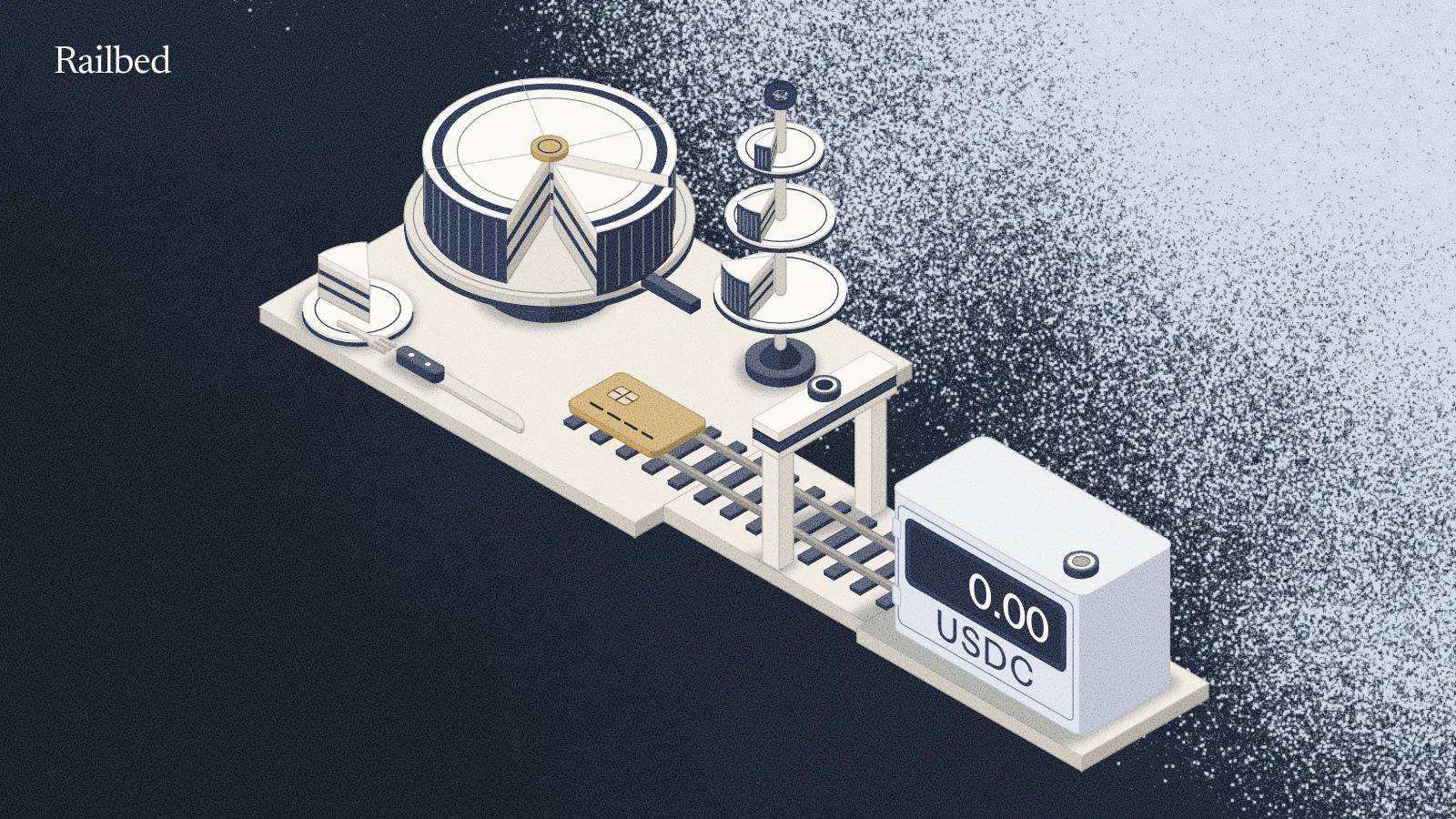
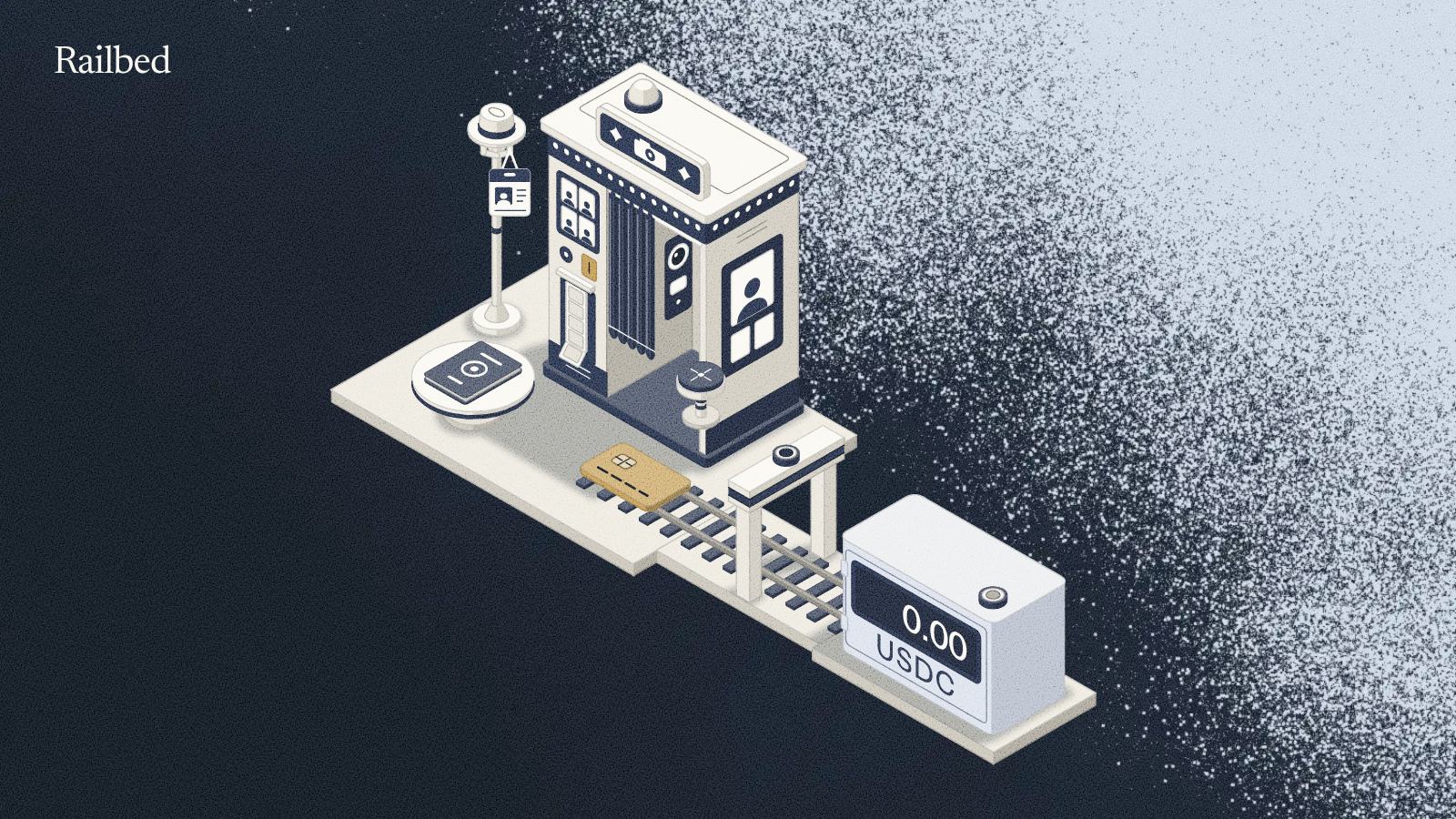
What is a card checkout that pays to your own wallet, and how does it work for a merchant?
The buyer pays by card, a licensed provider charges it, and the money lands in your wallet as dollar coins. One payment followed step by step, with who does what.
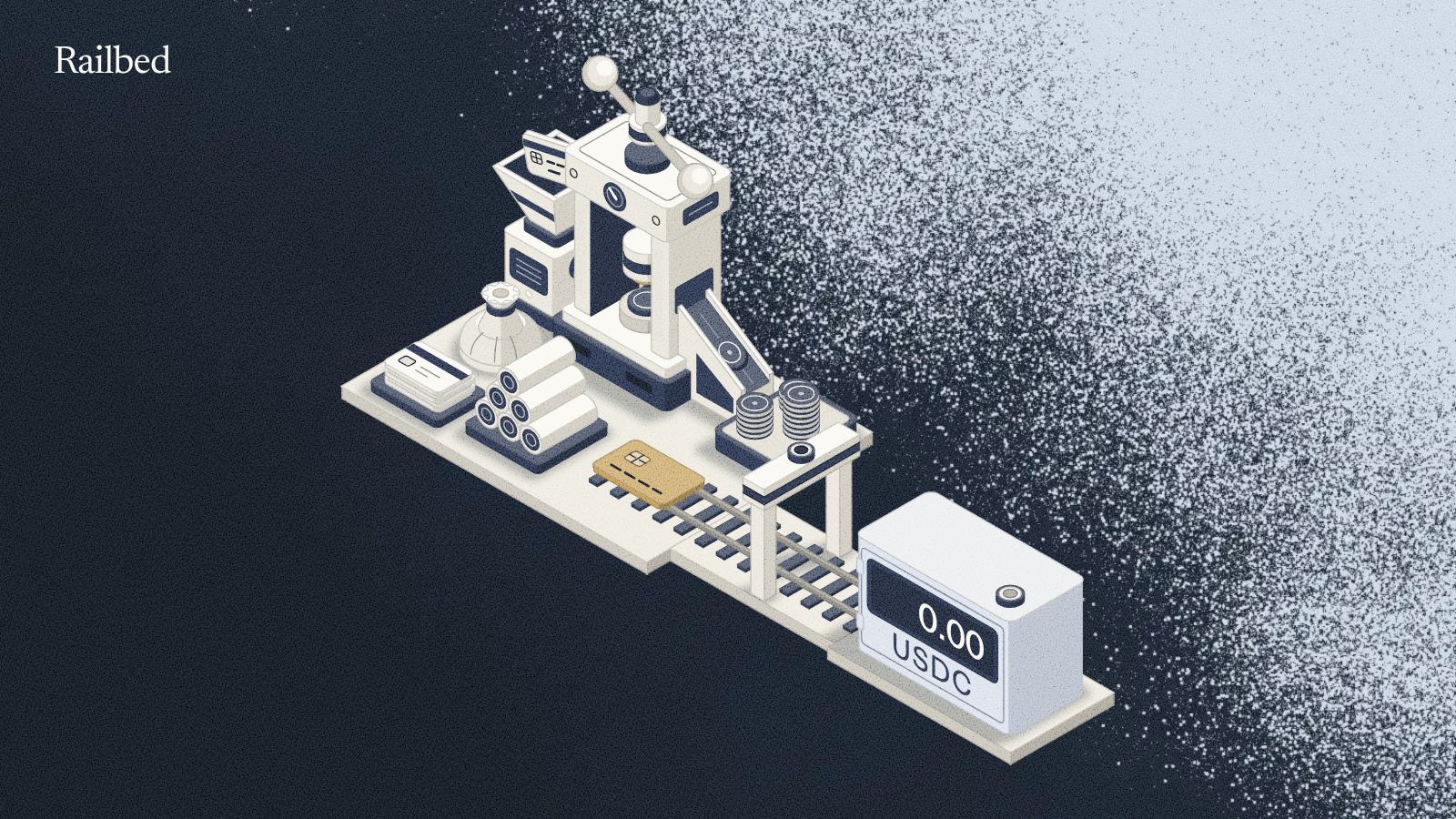
Press the card to run an example sale.
A card-to-crypto payment gateway is a checkout where the buyer pays with an ordinary card and the merchant receives a stablecoin, usually USDC, in a wallet. A licensed on-ramp provider charges the card and buys the stablecoin with it; the gateway ties that purchase to your order and confirms the money arrived.
The walk-through below uses Railbed's published flow, because Railbed is a gateway of this kind; other gateways differ in details such as who holds funds in transit.
What does "card-to-crypto payment gateway" mean?
A card-to-crypto payment gateway is checkout software that sits in front of an on-ramp, a company whose business is selling crypto for ordinary money. Visa's rulebook calls such a company a Ramp Provider and defines it as a third party agent "that provides payment services to convert Transactions from a fiat currency to a non-fiat currency (for example: cryptocurrency), or vice versa".
The on-ramp is the party the card system deals with. Stripe's documentation for its own on-ramp says "Stripe acts as the merchant of record for these onramp transactions and assumes full liability for all fraud and disputes", and that it handles identity checks and sanctions screening. Banxa's partner documentation says of its checkout: "For card payments Banxa is the merchant of record". Both pages were read on 23 November 2026.
The gateway is everything around that purchase: the page the buyer starts on, the choice of providers, the address the stablecoin lands at, the check that the right amount arrived, and the record your systems read. The same product is also sold as a fiat-to-crypto payment gateway or an on-ramp checkout.
Which products get called the same thing?
Three different products are described as card payments meeting crypto, and only one of them takes a card from the buyer and delivers a stablecoin to the merchant.
| Product | Buyer pays with | Merchant receives |
|---|---|---|
| Card-to-crypto gateway | A card | A stablecoin in the merchant's wallet |
| Crypto checkout | Crypto from the buyer's own wallet | Crypto, or bank money after conversion |
| Stablecoin settlement between banks and a card network | A card | Whatever the merchant's processor already pays out |
Crypto checkout runs the other way round: the buyer must already own crypto. Stripe's stablecoin payments feature is one example. The customer connects a crypto wallet, and "completed payments settle in your Stripe balance in your local currency", as of November 2026.
Stablecoin settlement between banks is plumbing a merchant never touches. On 16 December 2025 Visa announced that "U.S. issuer and acquirer partners can settle with Visa in Circle's USDC", "without any change to the consumer card experience". Nothing in the announcement changes what a merchant is paid in.
How does one payment work, step by step?
One card-to-crypto payment passes through your checkout, the buyer, a provider, a one-time deposit address and your wallet, in that order. The five steps below are Railbed's documented payment journey, with the status you would see in the dashboard or the API at each point.
- You create the payment. Your server opens a checkout session, or the buyer opens an invoice, a checkout page or your store's checkout. Nothing is charged and nothing is reserved. The status is
open, and the money is still on the buyer's card. - The buyer starts on the gateway's page. They enter an email address and see the card providers that can take this payment in their country, in your saved order or ranked by Smart Routing. Starting assigns the payment its one-time deposit address and locks the fee and the order's value in US dollars. The status is still
open. - The provider charges the card. The provider's page opens in a new tab, and the status becomes
pending. The buyer types card details there, never on your site or the gateway's, and completes any identity check the provider requires. The provider then buys USDC with the card payment and sends it to the deposit address. - Your share is forwarded to your wallet. The payment network that created the deposit address forwards your share to your payout wallet after deducting the fees, on the network the provider paid on: Polygon for almost every provider. Railbed never holds the money.
- The gateway checks the settlement. Before calling the payment paid, Railbed checks that the right amount reached the right wallet and that the transaction has not been counted before. The status becomes
paid, and your webhook endpoint and the API report it.
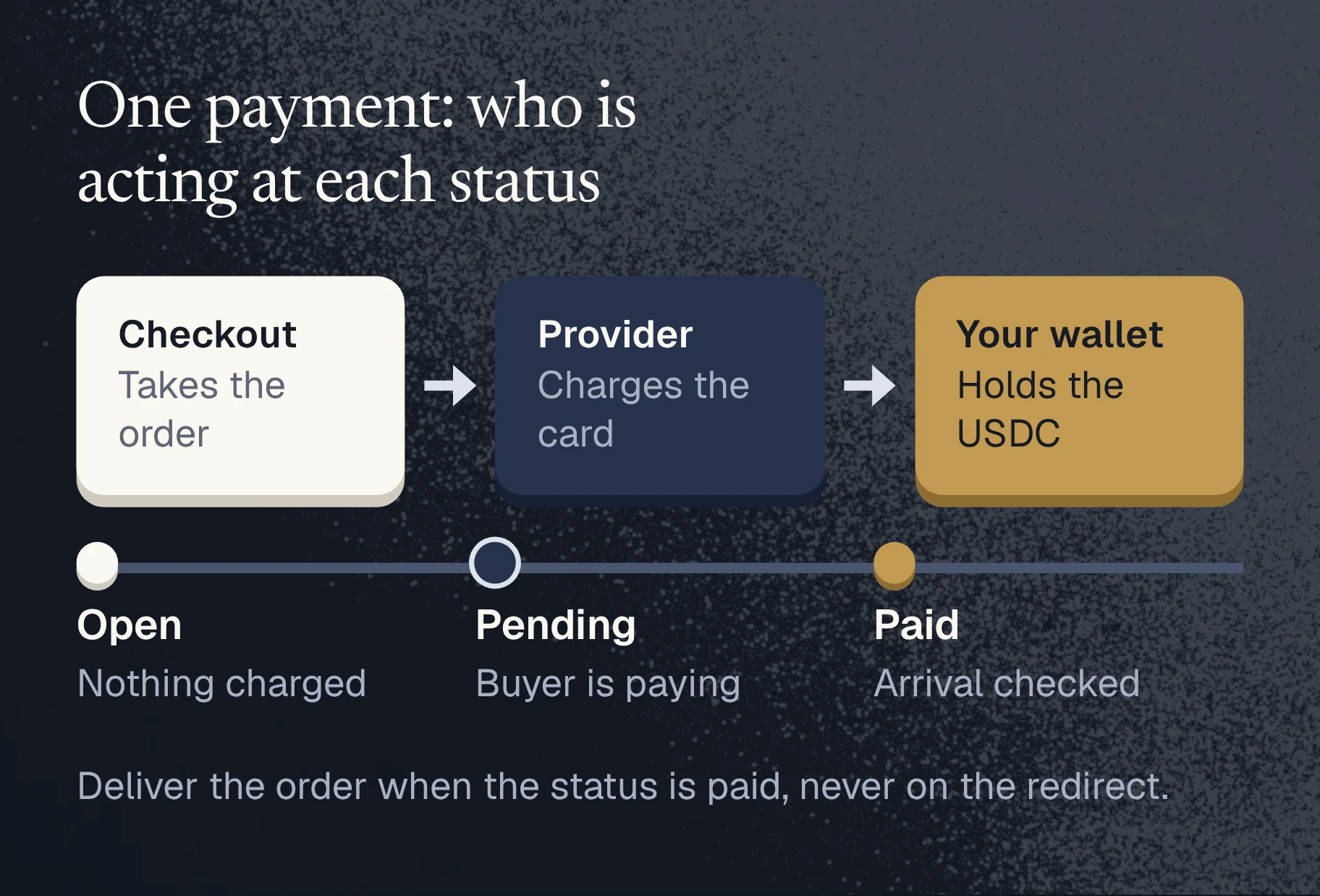
Meanwhile the buyer's checkout tab waits, then shows the result or sends the buyer to your success URL. Providers do not send buyers back to the merchant on their own, so an order should be delivered when the webhook or the API says paid, never when a browser lands on a thank-you page.
On timing, Railbed's documentation gives "a few minutes" for the card payment on the provider's page. Settlement follows as soon as the forwarding is reported, and if that report is late, Railbed checks unsettled payments on a schedule for up to two days.
Who does what in a card-to-crypto payment?
Four parties each do one job in a card-to-crypto payment. The table lists what each does and one thing it does not do.
| Party | Does | Does not |
|---|---|---|
| You, the merchant | Set the price, deliver the order, send refunds, keep the wallet's keys | See or store card details |
| The gateway | Hosts the checkout, routes to providers, checks settlement, sends webhooks | Charge the card |
| The on-ramp provider | Charges the card, runs any ID check, sells the USDC, handles card disputes | Send the buyer back to your site |
| The buyer's card issuer | Approves or declines the charge, opens a dispute if the cardholder asks | Reach USDC already in your wallet |
One thing varies by product: whether the gateway holds your money on the way through. Railbed does not, at any step. A gateway that collects the stablecoin first and pays you out later is a custodial design, and its terms should say how long it may keep a balance.
Why is one payment really two transactions?
A card-to-crypto payment is a card purchase and a blockchain transfer joined at the deposit address, and each half follows its own rules. Knowing which half a problem sits in tells you who can act on it.
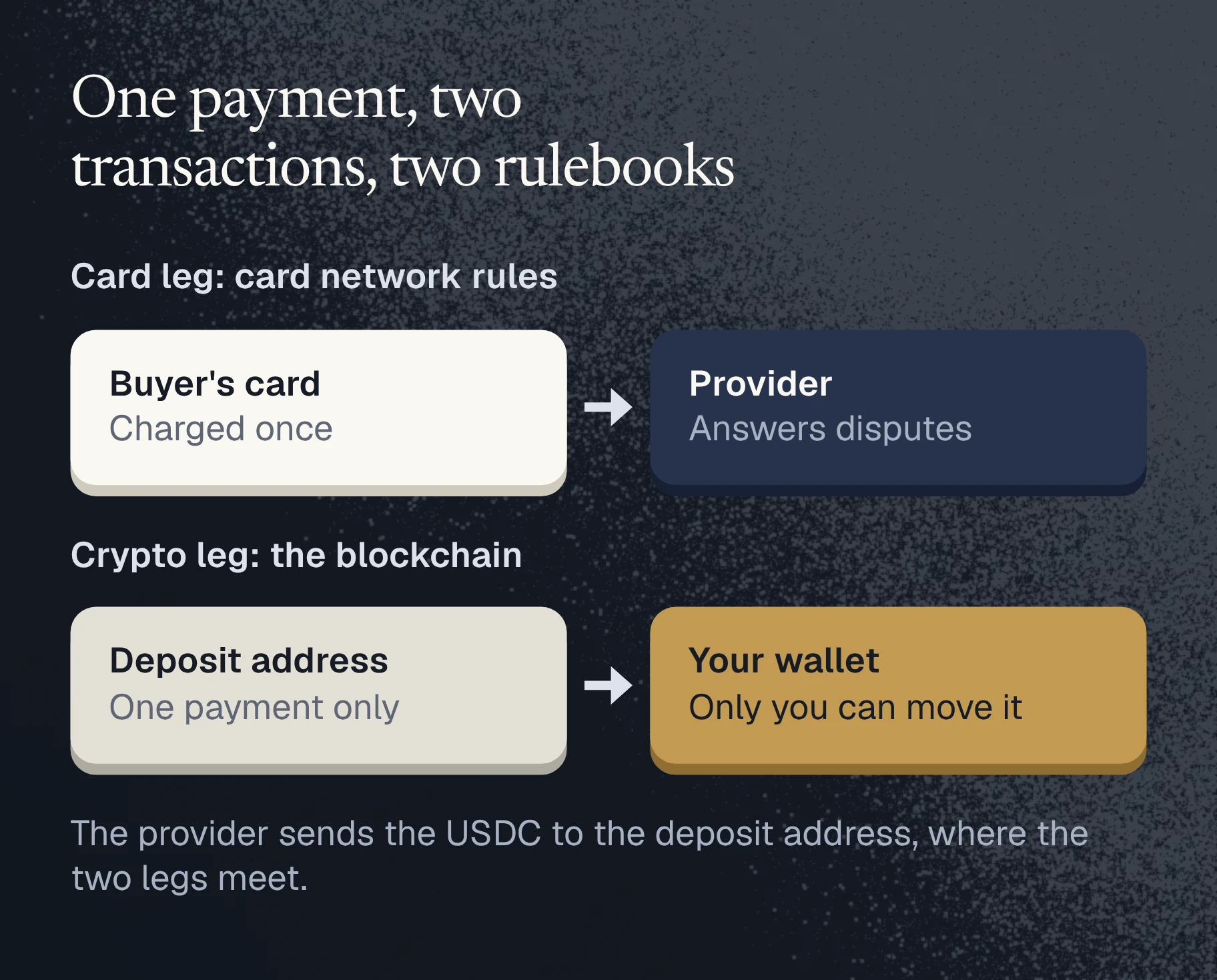
The card leg follows card network rules. The buyer's issuer can still open a dispute on the card charge, and the dispute goes to the provider that made it. Visa's rules (section 5.3.5.1, edition dated 24 October 2026) require an acquirer's agreement with a ramp provider to make the provider liable for "Cardholder disputes" caused by the businesses it serves under contract. That is Visa's general framework, not a statement about how any particular provider is registered.
The crypto leg follows the blockchain. Once USDC reaches a wallet only you control, nobody else can move it. With Railbed, settled sales can't be pulled back from your wallet; card disputes go to the provider that charged the card. That does not make disputes vanish for the merchant: Railbed's terms say a provider "may contact you, decline future payments from a buyer or region, or take other action under its own terms". A separate article covers whether a card payment that settles as USDC can be charged back.
What arrives in your wallet, and on which network?
The merchant receives a stablecoin on a public blockchain, and less of it than the checkout price. With Railbed the asset is almost always USDC on Polygon. A few providers pay on another network to the same wallet address: Apple Pay, as a provider of its own, pays USDC or USDT on Ethereum, and Cash App pays USDT on BNB Chain.
Three deductions come out before the money lands:
- The provider's fee and exchange rate. The provider shows both to the buyer on its own page before they pay, and they vary by provider, amount and country.
- A 1% network fee, for creating each payment's forwarding address and delivering the USDC.
- The gateway's fee. Railbed's starts from 0.9% of each sale, is set per account, and is locked when the buyer starts paying.
Providers publish their own pricing. MoonPay's pricing disclosure for its MoonPay Rails offerings, as one example of an on-ramp's published terms, says a buyer referred by a partner pays a MoonPay fee of "up to 4.5%", with "a minimum MoonPay fee of up to $4.50" below a minimum order size, plus a spread in the asset price (read 23 November 2026). A fixed minimum takes a larger share of a small order, which is one reason cheap items suit this model badly. Railbed's smallest card payment is about 2.00 USD, a floor set by the providers, and prices of about $10 or more give buyers the widest choice of provider.
Because the amount that arrives varies, a gateway needs a rule for how much counts as paid. Railbed counts a payment as paid when what arrived is at least 85% of the order's value in US dollars, its current setting. Anything less is not marked paid: the dashboard shows it as "Needs your decision", or "Not received" when it can't be accepted. For the arithmetic on a whole order, see what a card-to-crypto gateway costs on a $100 order.
What does the merchant still do alone?
Three jobs stay with the merchant in a non-custodial gateway, because the gateway never has the money.
- Refunds. Railbed has no refund button. A settled payment is already in your wallet, so refunding a buyer means sending the funds back yourself.
- Bookkeeping. Every sale has two numbers: the price the customer agreed to and the smaller amount your wallet received. Your books need both.
- Cashing out. USDC becomes bank money only after you sell it, through an exchange account in your name or a wallet app's sell feature. Railbed's guide to moving money to your bank has the steps.
The wallet is also yours to protect: the gateway needs only its public address, so a lost recovery phrase is not something it can fix.
When does this model fit, and when does it not?
A card-to-crypto gateway fits an online business that cannot get or keep a conventional merchant account and is content to be paid in USDC. Railbed has no underwriting and no application to pass: sign-up needs an email, your website and a payout wallet, with no setup fee, no monthly fee and no reserve.
A conventional merchant account is the better tool when a mainstream processor accepts your business and you want payouts in your bank's currency, refunds from a dashboard button or a card reader on a counter. Railbed is web checkout only and never stores a card, so nothing is charged automatically. Buyers also leave your page to pay and may be asked for identification by the provider. The full comparison is in card-to-crypto gateway or high-risk merchant account.
Neighboring questions have their own pages: how to set one up and take a first sale paid in USDC, whether you can skip the gateway and use an on-ramp directly as your checkout, and what buyers see on their card statement.
Watch one payment go through in Test mode
Create a checkout, pay it with simulated money and follow each status on the payment's timeline. No card is charged, and no money moves.
Create an accountRead how a payment works