Payment gateway vs processor vs merchant account vs acquirer vs PayFac: who does what, and who holds the money?
Six payment roles defined from Visa's rules and the OCC's handbook, with one $42 order traced through each model: who holds the money, and who a chargeback lands on.
Press the card to run an example sale.
The acquirer holds the money: it is the bank that signs the merchant, receives each card sale and pays the buyer's bank if the merchant can't cover a chargeback. A merchant account is your account there, a processor runs its transactions, and a gateway only carries card data. A PayFac or an on-ramp stands between you and the acquirer.
That last sentence decides who can hold back your sales, and most explanations skip it. Below, each role is defined from Visa's published rules and the US bank regulator's handbook, then one $42.00 order is traced through four ways of taking cards: who has the money at each moment, and who answers when the buyer disputes it.
The six roles side by side
The table answers three questions for each role: what it does, whether your sales pass through its hands, and who carries a buyer's dispute. The definitions are from the Visa Core Rules (edition of 24 October 2026) and the OCC's Merchant Processing handbook (version 1.0, August 2014), the guide US bank examiners use.
| Role | What it does | Holds your sales? | Carries a chargeback |
|---|---|---|---|
| Acquirer | Bank that signs merchants and receives card settlement | Yes, until it pays you | You first; the acquirer if you can't pay |
| Merchant account | Your account at the acquirer | It is where they land | Debited from it |
| Processor or ISO | Runs transactions or sells accounts for an acquirer | Not as a rule | Per its contract with the acquirer |
| Gateway | Carries card data from your checkout to the processor | No | No |
| PayFac | Signs you as a sub-merchant under its own acquirer | Yes, then pays you out | The PayFac, then the acquirer |
| On-ramp provider | Sells crypto to the buyer, who pays by card | It holds the card payment until it sends the crypto | The on-ramp |
Visa's glossary has no entry for "payment gateway" or a plain "payment processor". It uses "Acquirer Processor" and "VisaNet Processor", and the trade uses "gateway" for the software in front. Where a company's own page is the only definition, this page says so.
Acquirer: the bank whose name is on the risk
An acquirer is the card network member that signs a merchant and puts its transactions into the network. Visa's glossary defines it as "A Member that signs a Merchant or Payment Facilitator ... and directly or indirectly enters a Transaction into Interchange", and only financial institutions can be members, as the OCC handbook notes.
The acquirer is the one that loses money when a merchant fails. The OCC puts it plainly: "If a merchant or ISO/MSP cannot honor its charge-backs, the acquiring bank must pay the card-issuing bank," and that exposure "can span several months of the merchant's sales volume because of the cardholder's rights to dispute the charge." That is the reason acquirers underwrite, and the reason for reserves: the same handbook says many acquirers "establish merchant reserve accounts or holdback reserves", funded "by setting aside a lump sum or by withholding a portion of each day's proceeds." For how those holds play out, see how rolling reserves change your cash flow.
Merchant account: your seat at the acquirer
A merchant account is the account through which an acquirer pays a business for its card sales. The OCC's glossary calls it "A bank account opened by a merchant through a bank or other financial institution that is a member of a major card network." Authorize.net's pricing FAQ (read 23 November 2026) describes it from the merchant's side: "the bank account that holds your funds after a transaction is approved, before they transfer to your business bank account."
Getting one means passing underwriting: the same FAQ says the underwriter "will look at your industry, your processing history (if any), your personal credit, your business' creditworthiness, and other factors." The account is yours alone, which separates it from the PayFac model below.
Processor and ISO: the acquirer's contractors
A processor is the company that actually moves authorization and settlement messages, often on an acquirer's behalf. Visa defines an "Acquirer Processor" as "A non-Member agent or processor that a Member has engaged to support its Visa acquiring business." An ISO (independent sales organization) sells and services merchant accounts for an acquirer: the OCC lists "processing merchant applications and charge-backs, detecting fraud, servicing merchant customers" among its jobs, and says the acquirer must register every ISO with the card networks and stays liable for what it does.
One company often wears several hats: Authorize.net is a gateway, and its pricing page says it "is a registered ISO of PNC Bank, N.A." When a provider calls itself your "processor", ask which bank is the acquirer behind it.
Gateway: the pipe, not the vault
A payment gateway is software that carries card data from your checkout to the processor and brings the answer back. Authorize.net's FAQ defines it as "the technology that securely transmits payment data between a customer, your website or terminal, and the payment networks."
A gateway never holds your sales. Authorize.net sells a "Gateway Only" plan for businesses that already have a merchant account, and its FAQ says "in order to accept credit cards, you must have a merchant account." A gateway can't freeze funds it never receives, but the merchant account behind it can.
PayFac: you become someone else's sub-merchant
A payment facilitator signs many small businesses under its own relationship with an acquirer. Visa defines it as "An entity that contracts with an Acquirer to deposit Transactions, receive settlement from, or contract with an Acquirer on behalf of a Sponsored Merchant." Stripe's guide to payfacs adds that sub-merchants' transactions "are aggregated under the payfac's master MID" and "The payfac directly handles paying out funds to sub-merchants."
Because the PayFac receives your sales first, it decides when you get them. Visa's rule 5.3.1.1 makes the PayFac "responsible and financially liable for each Transaction processed on behalf of the Sponsored Merchant", so it protects itself with delays and reserves; Stripe's guide lists "processing caps, delayed funding, or reserves" among a payfac's risk tools. From the merchant's side, Stripe's payout documentation shows what that looks like: sales land in a Stripe balance, the first payout "typically" completes "within 7–14 days", and if refunds or disputes push the balance below zero, "Stripe creates a payout that debits your bank account."
Visa also limits how large a sponsored merchant can grow before the acquirer must sign it directly. Under rule 5.3.1.4, the acquirer "must enter into a direct Merchant Agreement with a Sponsored Merchant that exceeds USD 1 million in annual Transaction volume", within two years for an existing one, with exceptions listed in that rule.
On-ramp provider: the buyer is buying crypto
An on-ramp provider sells cryptocurrency for card payments, so the card payment is made to the on-ramp, not to the business the buyer meant to pay. Visa's glossary defines a "Ramp Provider" as a third party agent "that provides payment services to convert Transactions from a fiat currency to a non-fiat currency (for example: cryptocurrency)", and its rule 5.3.5.1 says the ramp provider "Is liable for all acts, omissions, Cardholder disputes" caused by the businesses it serves, and "Must not transfer ... its financial liability by asking or requiring Cardholders to waive their dispute rights."
Visa's rule 5.3.2.2, which sets out who counts as the merchant and who is classed as a ramp provider instead, is covered in merchant of record explained. Each provider describes its own role in its own terms, so read the one you rely on; what a buyer can dispute, and how two providers describe their liability, is in can a card payment that settles as USDC be charged back.
The on-ramp holds the buyer's card payment, not your sale. It keeps its fee and spread and sends crypto to an address. Once that crypto reaches a wallet you control, no acquirer, PayFac or on-ramp has a balance of yours to hold back.
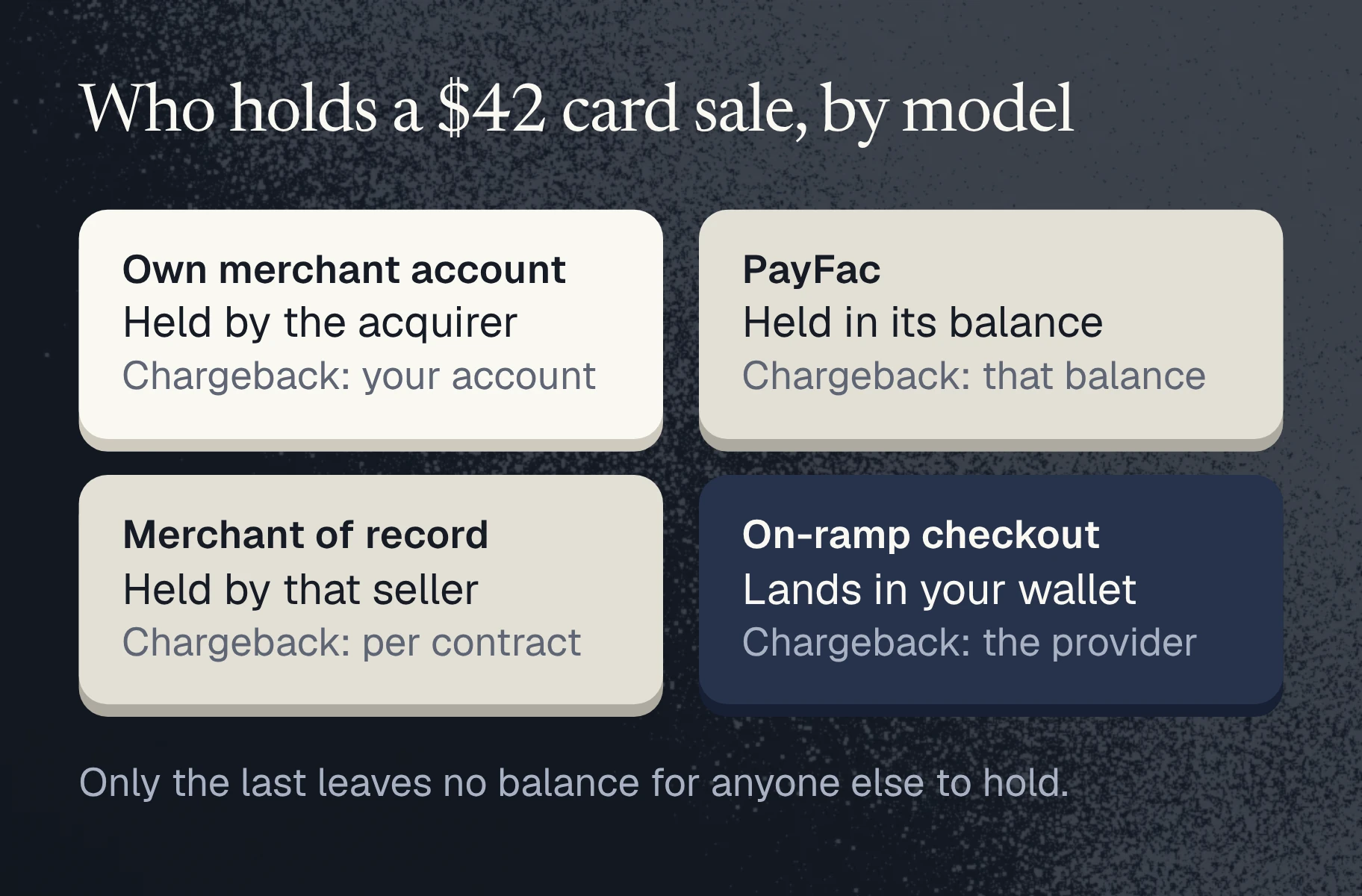
One $42.00 order, four ways
The same $42.00 order moves through different hands depending on the model. The table follows it from the buyer's card to your account, using only each company's published terms for timing.
| Model | Where the $42.00 waits | Who can hold it back | A chargeback is taken from |
|---|---|---|---|
| Your own merchant account | Acquirer, then your merchant account; Authorize.net puts the industry average at "three to five business days" | The acquirer, under your merchant agreement | Your merchant account |
| PayFac or all-in-one provider | The PayFac's balance, then your bank on its payout schedule | The PayFac | Your balance with the PayFac, or your bank if it runs negative |
| Merchant of record | The merchant of record, which sold to the buyer and pays you under your contract | The merchant of record | The merchant of record; your contract says what it passes back |
| On-ramp checkout | The on-ramp until it delivers USDC; then your own wallet | Nobody, once it has arrived | The on-ramp provider |
A merchant of record differs from a PayFac in that it is the seller the buyer deals with, named on the statement; merchant of record explained covers that model on its own.
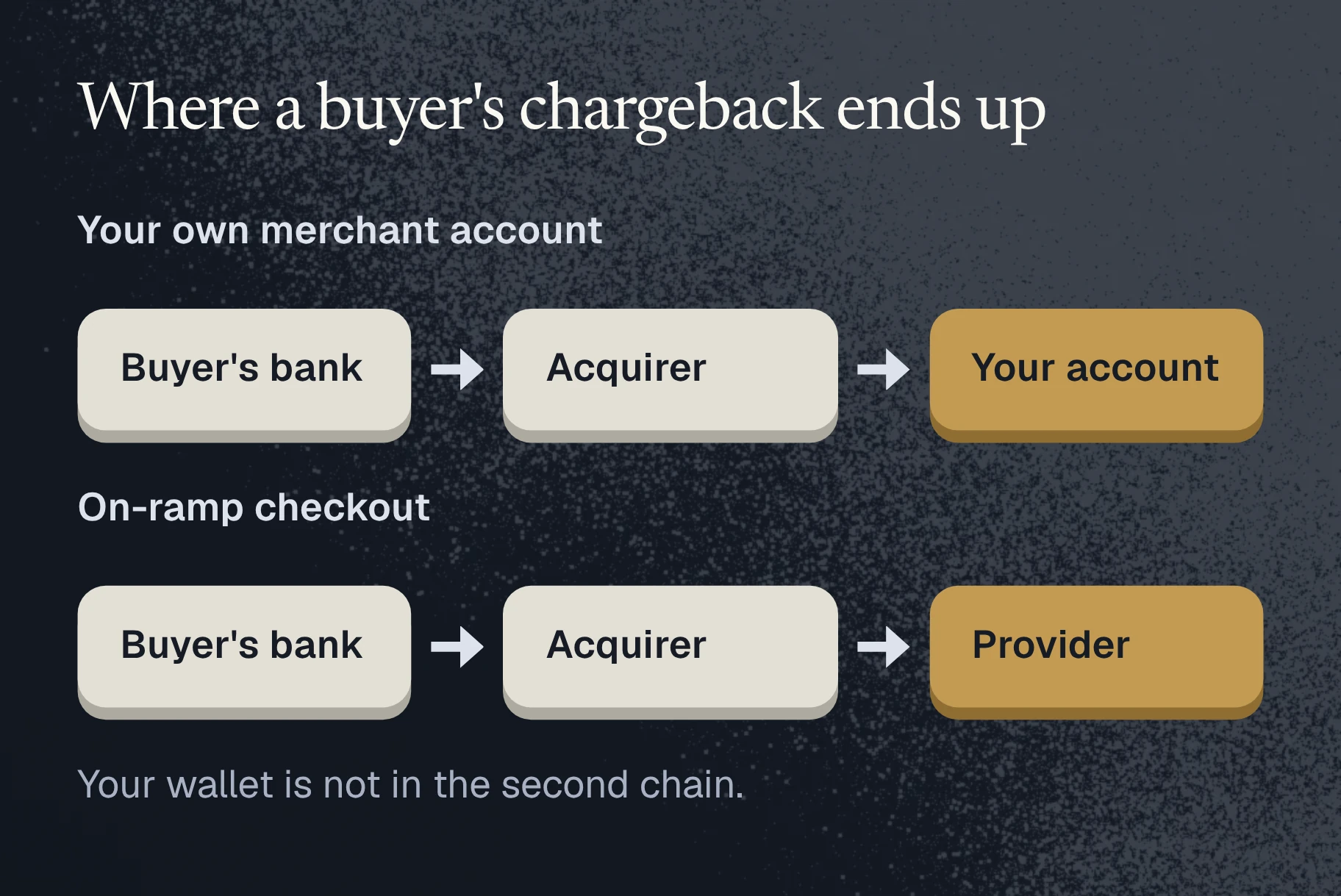
Where a checkout such as Railbed sits
Railbed is software in front of the on-ramp, not one of the six roles. Railbed says it is "not a bank, a money transmitter, a payment processor or an exchange", and its terms add that it does not charge cards. A buyer pays on Railbed's checkout page, an independent, licensed on-ramp provider charges the card on its own page, and the provider buys USDC and sends it to a one-time deposit address. The payment network forwards the merchant's share to the merchant's wallet, almost always as USDC on Polygon, and Railbed never holds it. The full sequence is in how payments work.
In the table's terms, the provider is the one that charges the card: settled sales can't be pulled back from your wallet, and card disputes go to the provider that charged the card. Railbed's Smart Routing picks which provider a buyer sees (what it reads and what it can't do). There is no underwriting and no application to pass, and nothing is held back from your sales.
The limits come with the model. A card can still be declined on the provider's page, and Railbed receives no decline signal in Live. Refunds are yours to send from your wallet. Sales arrive as USDC, so getting dollars into a bank is your own step through an exchange or wallet app. Fees come out of the USDC that arrives: the on-ramp provider's own fee and spread, a 1% network fee, and the Railbed fee, from 0.9%, shown in the dashboard when the payment starts.
Which model fits your business
The right model depends on whether a bank will take your risk and what you will trade for speed.
- Your own merchant account suits a business that can pass underwriting and has the volume to negotiate; Authorize.net's FAQ says a gateway-only setup lets you "negotiate Interchange-Plus pricing".
- A PayFac suits a business that wants to start quickly in a category the PayFac accepts, and can live with its payout timing.
- A merchant of record suits a seller who wants someone else to be the legal seller and accepts that seller's rules on what may be sold.
- An on-ramp checkout suits a business the first three turn away that is willing to receive sales as USDC in its own wallet. It does not suit one that needs a card reader or money paid straight to a bank.
FAQ
Is a Stripe account the same as a merchant account?
Stripe's payout documentation describes card sales landing in your Stripe balance, which Stripe pays out to your bank on a schedule, much like the aggregated model in Stripe's own payfac guide. Until a payout, the sales sit in a balance the provider controls. If the difference matters to you, ask any provider which bank acquires your sales and under whose agreement.
Is a payment service provider (PSP) the same as a PayFac?
In card network terms, nearly. The OCC handbook, written in 2014, says Mastercard's "payment facilitator" and what Visa then called a "payment service provider" "are operationally similar", and "In both cases, the acquirer is responsible for the actions of its PSP and the PSP's sponsored merchants." Visa's current rules use "Payment Facilitator" instead.
Can I use more than one of these at once?
Yes. A business can keep a merchant account or PayFac for the sales it accepts and add a second route, such as an on-ramp checkout, for the rest. Describe your business truthfully to each one; each route keeps its own rules on holds and disputes, so track them separately.
{"heading": "See the on-ramp model with your own prices", "description": "Create a Test checkout, pay it as a buyer and watch where the money would go, before any real card is charged.", "buttons": [{"label": "Read how payments work", "url": "https://railbed.com/docs/how-it-works/"}, {"label": "Start in Test mode", "url": "https://app.railbed.io/signup"}]}