Why an extended warranty merchant account is hard to get, and how sellers take cards
Why processors shy away from service contract sellers, the Visa disputes they face, a canceled $1,200 contract worked out, and a down payment taken by invoice.

Press the card to run an example sale.
An extended warranty merchant account is hard to get because the trade carries a telemarketing record: Stripe prohibits extended warranties in the United States, the FTC has sued their telemarketers, and Visa lets the buyer of an outbound telemarketing sale dispute it as misrepresentation. Processors that do take the trade build that risk into their terms.
This page is for sellers of vehicle service contracts, extended warranties and protection plans who sell online or through dealers, where the customer reads the contract and pays on a checkout page. It explains the processors' caution, maps the card disputes these sellers face to the terms that answer them, works a cancellation on a part-paid $1,200 contract, and shows how to take a down payment and the balance with an invoice. It is a reading of published rules, not legal advice.
Why an extended warranty merchant account is hard to get
Stripe lists the trade by name. Its restricted businesses list, updated 22 September 2026, names "Extended warranties" among businesses prohibited in the United States, and "Telemarketing" among the unfair, deceptive or abusive practices it prohibits everywhere (Stripe restricted businesses).
The card networks give these sales a dispute right of their own. Visa's misrepresentation dispute, Dispute Condition 13.5, applies when "The Cardholder claims that the terms of sale were misrepresented by the Merchant", and Visa lists "A Transaction at an outbound telemarketing Merchant" among the sales it covers. The cardholder has 120 days from the processing date or from receiving the services, never past 540 days from the payment (Visa Core Rules and Visa Product and Service Rules, edition 24 October 2026).
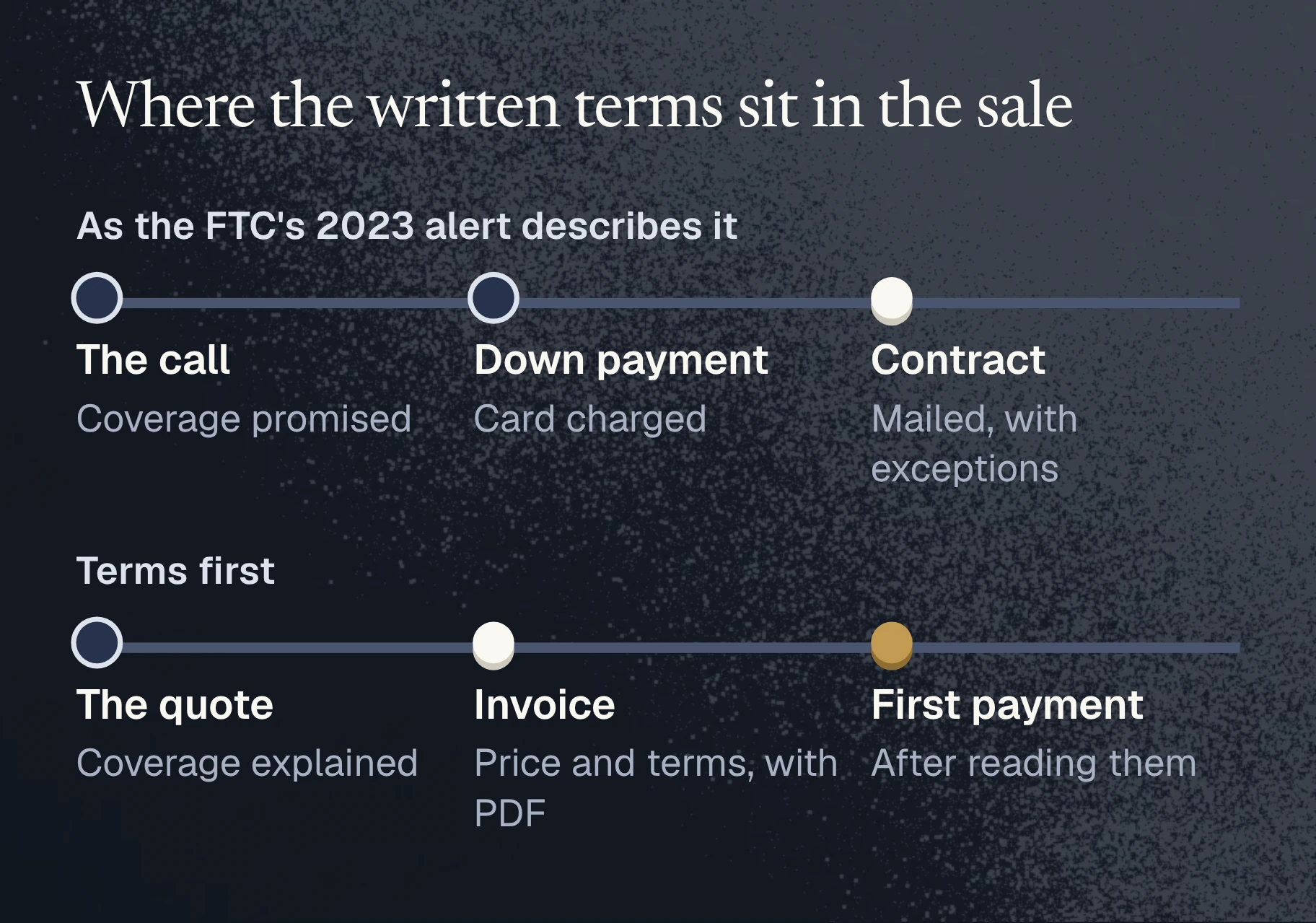
The FTC's enforcement record is the third reason. In February 2022 the FTC sued American Vehicle Protection, alleging that the company "falsely claimed that consumers can get a full refund of their down payment or full payment within 30 days of buying the warranty if they are not happy with it" (FTC, 9 February 2022). The FTC's consumer alert on the settlement says the written contract, "which they would only send after you paid a down payment", listed "lots of exceptions" (FTC consumer alert, 24 March 2023). To settle the charges the defendants agreed to a lifetime ban from outbound telemarketing and from extended auto warranty sales, and in October 2024 the FTC sent refunds to 18,255 consumers (FTC, October 2024).
The rule behind those cases also reaches people other than the seller. The Telemarketing Sales Rule makes it a violation "to provide substantial assistance or support to any seller or telemarketer when that person knows or consciously avoids knowing" that the seller breaks the rule (16 CFR 310.3(b)). A processor that does take the trade prices that in; the checklist for a high-risk processor contract shows where reserve and termination clauses sit.
What the Telemarketing Sales Rule asks of a phone sale
The Telemarketing Sales Rule's core payment duty for a phone sale is disclosure before consent. Section 310.3(a)(1) makes it deceptive, "Before a customer consents to pay for goods or services offered", to fail "to disclose truthfully, in a clear and conspicuous manner" a list of facts (16 CFR 310.3, eCFR as of 20 November 2026). The table below sets out the provisions most relevant to service contracts, in the rule's own words.
| Provision | What the rule says | What it covers for a service contract |
|---|---|---|
| 310.3(a)(1)(i) | "The total costs to purchase, receive, or use, and the quantity of, any goods or services" | The contract price and term |
| 310.3(a)(1)(ii) | "All material restrictions, limitations, or conditions to purchase, receive, or use" | Exclusions, waiting period, mileage and wear limits |
| 310.3(a)(1)(iii) | A no-refund policy, or "a statement of all material terms and conditions" of any refund or cancellation policy the seller mentions | Cancellation and refund terms, including any fee |
| 310.3(a)(1)(vii) | For a negative option, that "the customer's account will be charged unless the customer takes an affirmative action" | Any automatic renewal |
| 310.4(a)(7) | The seller "must obtain the express informed consent of the customer or donor to be charged for the goods or services … and to be charged using the identified account" | A clear yes to this price |
| 310.5(a) | Records kept "for a period of 5 years", including records of consent | Call records, scripts, consent and contracts |
The rule exempts many calls a customer places in response to an advertisement, but under 310.6(b)(5) the exemption does not cover "Any instances of upselling included in such telephone calls" (16 CFR 310.6). The FTC's own advice to buyers is the same rule seen from the other side: "Get the coverage in writing before you pay" (FTC consumer alert). The industry page on extended warranties covers calling hours, robocall consent and the state service contract laws.
The card disputes warranty sellers see, and the terms that answer them
Two Visa dispute conditions speak most directly to service contracts, and each turns on what the seller wrote down before the sale. The table below pairs each dispute with the record that answers it.
| Visa dispute | What the cardholder says | The term or record that answers it |
|---|---|---|
| 13.5 Misrepresentation | "the terms of sale were misrepresented"; it covers outbound telemarketing sales | Coverage, exclusions and price in writing before payment |
| 13.7 Canceled services | They canceled, no credit was processed, and the merchant "did not properly disclose or did disclose, but did not apply, a limited return or cancellation policy" | A cancellation policy shown before payment, applied as written, and the refund sent |
Visa limits a canceled-services dispute to "The value of the unused portion of the cancelled service" (Visa rules). That makes the cancellation arithmetic worth writing into the contract, because it is the number a dispute is measured against.
A cancellation on a part-paid $1,200 contract
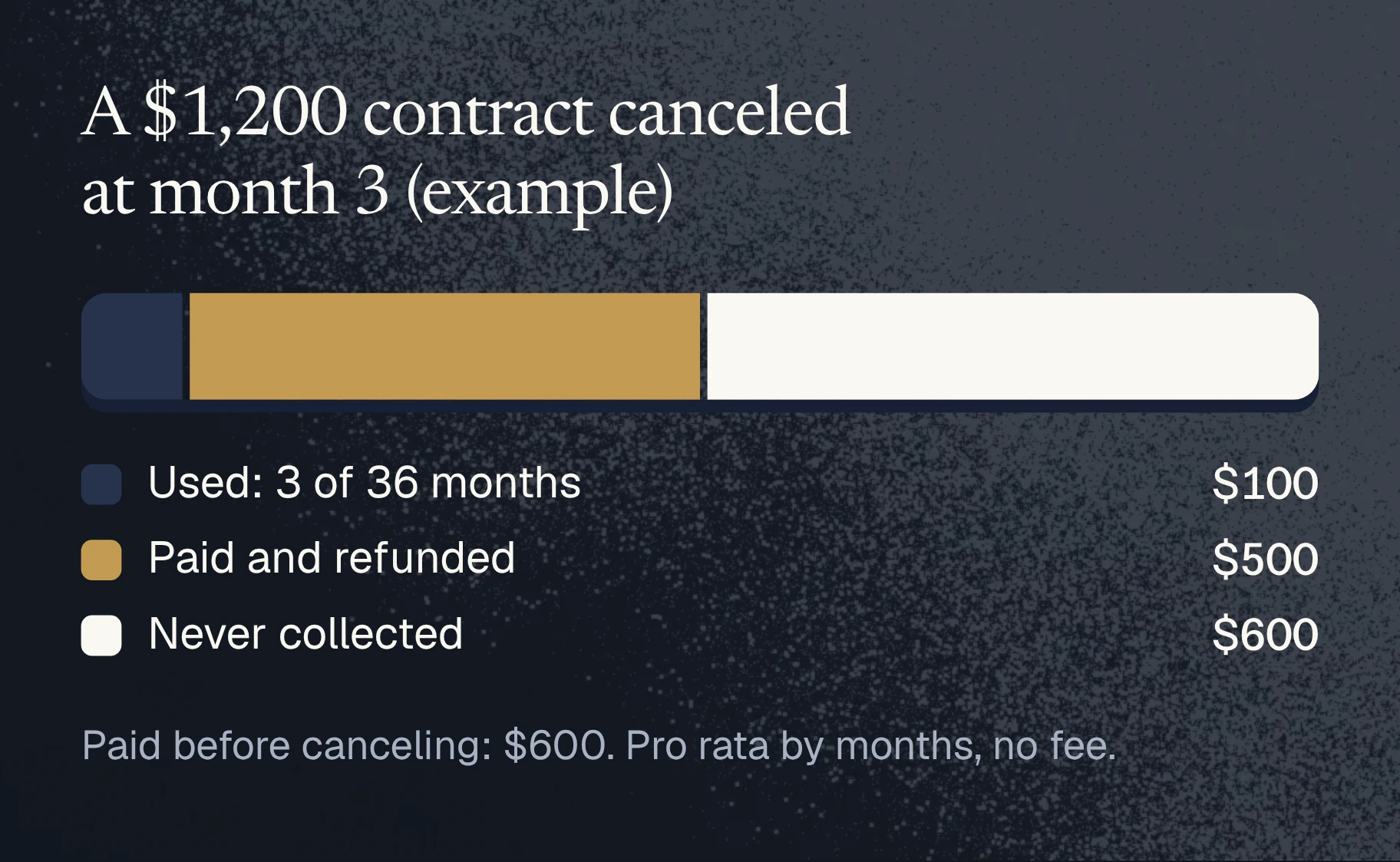
Here is a worked example with example terms: a 36-month contract for $1,200, a $200 down payment, and the balance paid in parts. The example refund rule is pro rata by months with no cancellation fee; your state's service contract law and your contract set the real rule.
The customer pays $200 down and two more parts of $200, so $600 has been paid when they cancel at the end of month 3. Three months of 36 is used: 3 ÷ 36 × $1,200 = $100. The seller refunds what was paid less what was used, $600 − $100 = $500, and the unpaid $600 is never collected.
The industry page works California's version: a full refund in the first 60 days if no claim was made, then a pro-rata refund less a fee of no more than 10% of the price or $25, whichever is less. Whatever the rule, the customer should be able to read it before the first payment, and the refund should go out the way it says.
Taking a down payment and the balance with an invoice
A Railbed invoice can carry the whole contract, show its terms before the customer pays, and let them pay a down payment and the rest in parts. For the $1,200 example:
- Create one invoice for the contract. One line, "Vehicle service contract, 36 months", $1,200. Add tax if your state charges it.
- Write the terms in the invoice's Terms field. It takes up to 2,000 characters, printed at the foot of the invoice: when coverage starts, the waiting period, the main exclusions, how to cancel and how the refund is worked out.
- Turn on Let them pay in parts, with a Smallest first payment of $200. Later parts can be any amount a card provider can take, never more than what's left.
- Set the due date for the balance, five months out in this example, and turn on reminders if you want them. They are off until you turn them on.
- Email it before the customer pays. The email comes from "Your Business via Railbed" with the invoice's PDF attached, so the terms are in the customer's hands before any money moves. You can also share its link or QR code.
The customer opens the invoice, reads it, and pays on a card provider's page with their own card. The invoice reads Partially paid and shows what's still due, each part brings a receipt with what's left, and the invoice reads Paid when the $1,200 is in. Nothing is charged automatically: each part is a payment the customer chooses to make, so a contract paid this way should say what happens to coverage while it is part paid. A seller who prefers fixed monthly amounts can send a new invoice each month, or use a subscription billed by invoice, where each period's invoice is still paid by the customer. The guide to getting an invoice paid in parts shows the customer's screens.
Why Railbed fits a service contract seller
Railbed fits a seller who sells online or through dealers because the contract's terms sit on an invoice the customer reads before paying, the customer pays the down payment and each later part by card on the checkout page, and each payment settles to the seller's own wallet with nothing held back. An independent, licensed card provider charges the customer's card on its own page, and the sale settles to a wallet you control, almost always as USDC on Polygon. There is no underwriting and no application to pass; sign-up needs an email, your website and a payout wallet.
Good to know:
- Your sales rules stay yours. State service contract laws and the federal rules on how you market apply to the way you sell, and meeting them is your job.
- Disputes go to the card provider. Settled sales can't be pulled back from your wallet, but a card dispute goes to the provider that charged the card, and Railbed is not a party to it. Keep each contract, invoice and receipt together.
- Refunds are yours to send. A cancellation refund goes from your wallet; there is no refund button.
- Fees. The card provider's own fee and spread, a 1% network fee and the Railbed fee, from 0.9%, shown in the dashboard and locked when the customer starts paying. No setup fee, no monthly fee, no reserve.
- Limits. The smallest card payment is about 2.00 USD, and an invoice can total up to 100,000.00.
- ID checks are the providers' call. Smart Routing ranks the providers least likely to ask first, but it can't promise that a provider won't.
FAQ
How long can a customer dispute a service contract payment? Under Visa's misrepresentation dispute, 120 days from the processing date or from the date the cardholder received the services, never past 540 days from the payment. On a part-paid contract, each payment is its own transaction with its own processing date.
Can I offer a free-look period with an invoice? A free-look or cancellation period is a contract term, so write it in the invoice's terms and honor it with a refund from your wallet. State service contract laws can set a minimum: the industry page quotes California's 60-day window and the NAIC model act's free look of at least 20 days by mail.
Send your next service contract as an invoice
Put the price and terms in writing, ask for a $200 down payment, and let the customer pay the balance by card in parts.
Create your accountRead the invoices guide