Account selling payment processor: card payments for game accounts, boosting and cheats
What game publishers' terms and processors' lists say about selling accounts, boosting and cheats, why bans turn into chargebacks, and the delivery records that answer them.
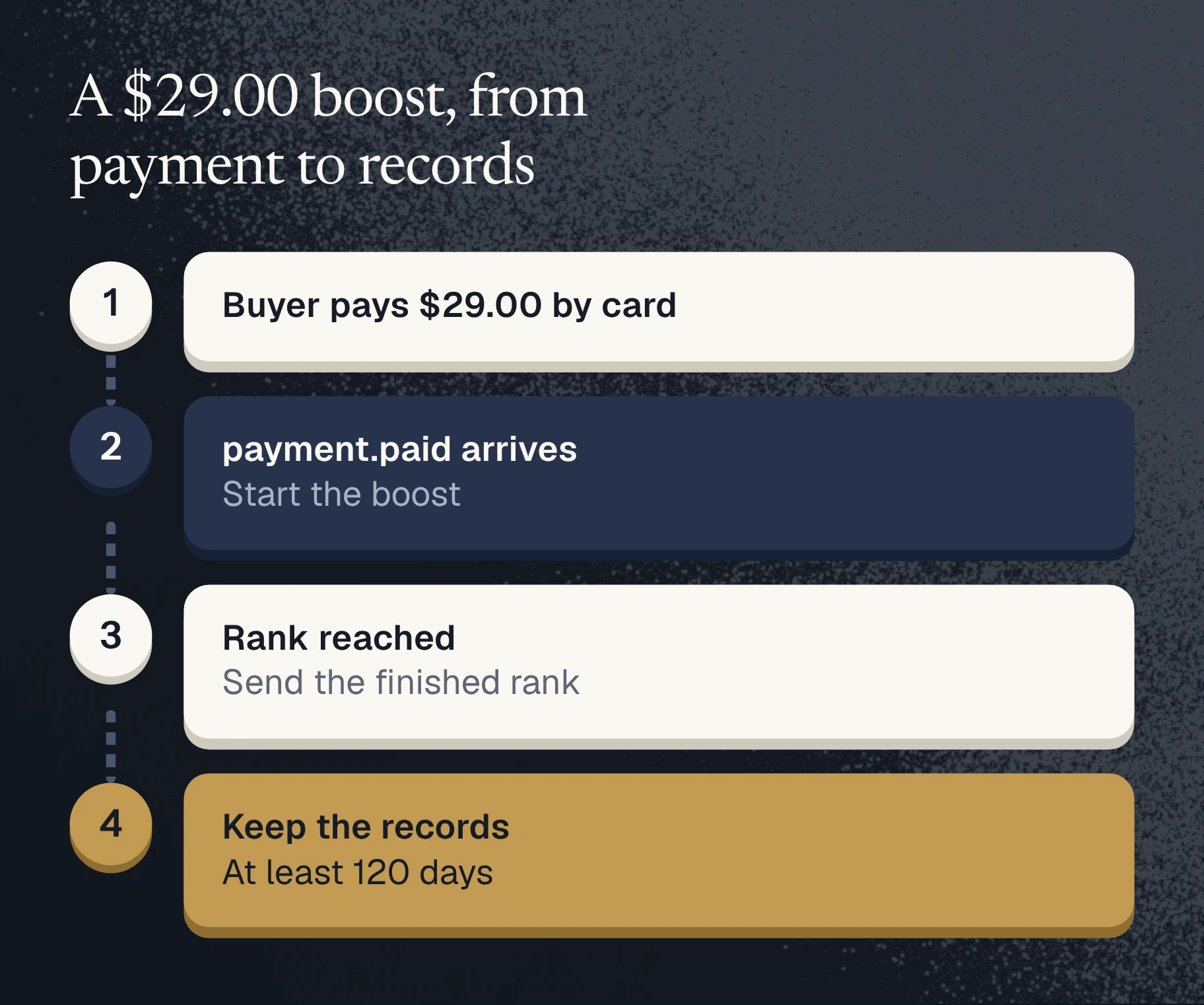
Press the card to run an example sale.
Sellers of game accounts, boosting and cheats lose card processors for the same two reasons: each trade breaks a game publisher's terms, and a buyer the publisher later bans can dispute the charge. Finding an account selling payment processor means a checkout that takes the trade and delivery records that answer those disputes.
Three trades, three sets of publisher rules
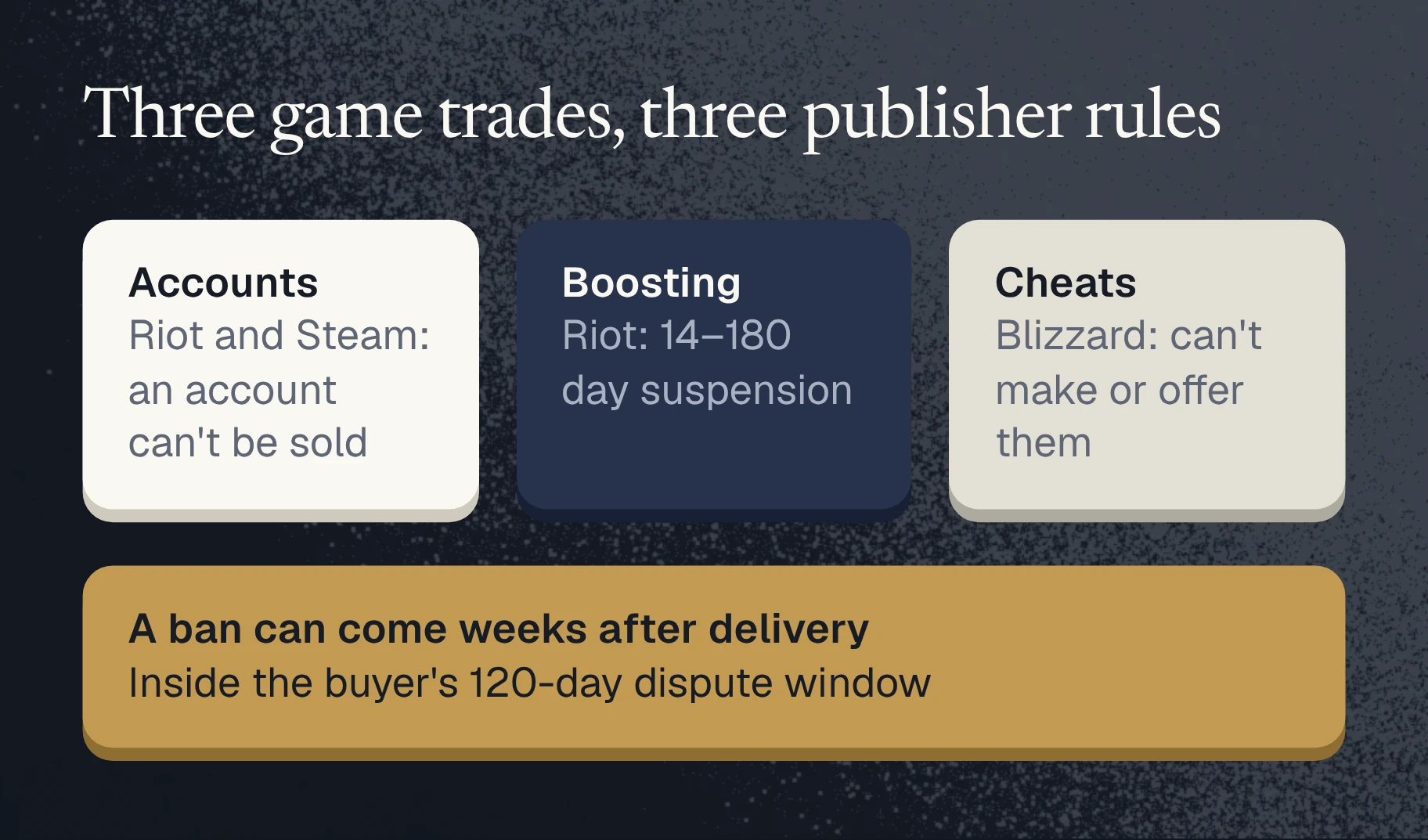
Each of these trades is defined by the publisher rule it runs into. The table puts the three side by side, quoting the publishers' own pages as of November 2026.
| Trade | What the publisher says | Where |
|---|---|---|
| Game accounts | "You can't sell, transfer or allow any other person to access your account" | Riot Terms of Service, last modified December 1, 2024 |
| Game accounts | "You may therefore not sell or charge others for the right to use your Account" | Steam Subscriber Agreement, updated September 10, 2026 |
| Boosting | "performing in-game services including, without limitation, account boosting or power-leveling, in exchange for payment" is a prohibited commercial use | Blizzard EULA, revised March 21, 2024 |
| Cheats | Users may not "Create, use, offer, promote, advertise, make available and/or distribute" cheats, bots or hacks | Blizzard EULA |
Riot spells out what happens to a boosted League of Legends account. Its boosting policy says "any ranked game played by someone that is not the original creator of the account may be considered Boosting", and that both booster and boostee face a "14–180 day Account Suspension", with "Second time offenders" banned permanently.
Why an account selling payment processor is hard to find
Stripe's and PayPal's published lists don't name these trades, but each has lines that sit close to them. Stripe's prohibited and restricted businesses list (last updated 2026-09-22) puts "Sale of in-game currency or game items, unless the business is the operator of the virtual world" among the restricted businesses that need Stripe's extra due diligence. PayPal's acceptable use policy (updated November 4, 2026) rules out transactions involving "stolen goods including digital and virtual goods" and "items that infringe or violate any copyright, trademark, right of publicity or privacy or any other proprietary right".
The law adds weight in some places. South Korea's Game Industry Promotion Act, amended in December 2018, bars the business of "scoring points or attaining achievements, etc. in game products instead of players by means not approved" by the game's operator (Article 32), and Article 45 sets the penalty at "imprisonment with labor for not more than two years or by a fine not exceeding 20 million won" (the Korea Legislation Research Institute's English translation; GamesIndustry.biz reported the change in 2018). In the US, the federal court for the Central District of California granted Activision a default judgment of "$14,465,600 in statutory damages" against EngineOwning, a maker of Call of Duty cheats, on May 28, 2024 (the court's order; GamesIndustry.biz). These are the rules and cases as published; what applies to a given seller depends on where it and its buyers are, so check your own position.
The game accounts, game boosting and game cheats industry pages cover each trade's rules in more depth.
The dispute pattern: chargebacks after a ban
The dispute these trades invite comes after delivery, not before it. The buyer receives the account, the finished boost or the working cheat, then the publisher suspends or bans the account, and the buyer asks their bank for the money back.
The timing works against the seller. Under the Visa Core Rules (24 October 2026 edition), a "not as described" dispute (Condition 13.3) can be raised within 120 days of the date the buyer "received the merchandise or services", and a card-absent fraud dispute (Condition 10.4) within "120 calendar days from the Transaction Processing Date". A Riot suspension that starts a few weeks after a $29.00 boost lands well inside either window.
A buyer who has lost the account may tell the bank the service wasn't what they paid for, or that they never made the purchase. The seller's answer is the record of what was promised and what was delivered, which is why the policies below matter more in these trades than in most.
Delivery and refund policies, trade by trade
Each trade delivers something different, so each needs its own release point and its own record. The table sets them out.
| Trade | What the buyer receives | Release it when | Keep for at least 120 days |
|---|---|---|---|
| Game accounts | Login details for a named account | The payment is paid | The account as described at sale, the delivery time, any handover messages |
| Boosting | A rank or result on the buyer's account | The payment is paid, then on completion | The starting and finished rank, dates, progress messages |
| Cheats | A license key or download | The payment is paid | The key issued, its first use, the version sold |
Four policies apply to all three:
- Write the refund policy before the sale and show it at checkout. Say what happens if a boost isn't finished, a key doesn't work, or an account isn't as listed.
- Describe the product exactly. A listing that matches what was delivered is the answer to a "not as described" claim.
- Tell the buyer what the publisher's terms say. A buyer who knew the publisher forbids account sales or boosting before paying is harder to cast as misled.
- Answer fast. Visa requires the buyer to try to settle a not-received claim with the seller first; a seller who replies the same day gets the first chance.
When a digital goods store should release a paid order covers release timing for keys and codes in more detail, and the digital goods industry page covers keys, codes and other downloads sold beside these trades.
Why Railbed fits game account, boosting and cheat sellers
Railbed fits these trades because it adds no underwriting and no application to pass, and its acceptable use policy forbids only three things: child sexual abuse material and other sexual content involving minors or people who did not consent, money laundering or terrorist financing (including splitting one purchase into smaller payments to stay under a provider's identity check or reporting threshold), and payments involving people, businesses or countries under sanctions. Buyers pay by card through independent, licensed card providers, and each sale settles to a wallet the seller controls, almost always as USDC on Polygon. Railbed never holds funds, so nothing is held back from your sales.
Releasing orders works the same way for all three trades. A payment counts as paid when at least 85% of the order's value has arrived (Railbed's current setting), and Railbed then sends the signed payment.paid webhook. Release the login, start the boost or issue the key on that event, never on the buyer's return from the card page, and record the event ID, because webhooks can arrive more than once. A checkout page can ask the buyer up to five questions of your own, such as the game, region and account name a boost needs.
Good to know:
- Disputes. Settled sales can't be pulled back from your wallet; card disputes go to the provider that charged the card, and Railbed is not a party. A provider may contact you, decline future payments from a buyer or region, or take other action under its own terms, so the records above still matter.
- Refunds are yours to send from the wallet; Railbed can't reverse a settled payment.
- ID checks are the providers' decision. Smart Routing ranks the providers least likely to ask first, but it can't promise that a provider won't.
- Amounts. The smallest payment is about $2; from about $10 buyers get the widest choice of providers, which suits a $29.00 boost.
- Fees are the card provider's own fee and spread, a 1% network fee and the Railbed fee, from 0.9%, with no setup or monthly fee. Getting started takes an email, your website and a payout wallet.
Take cards for game services
Sell accounts, boosts or license keys by card, with each sale settling to your own wallet and every order released on the paid webhook.
Create an accountRead about webhook events