Game top-up payment gateway: how to take cards for in-game currency
What MCC 5816 covers, why publishers' terms and stolen cards make processors refuse top-up resellers, and one $9.99 gem order followed from checkout to a single credit.
Press the card to run an example sale.
A game top-up payment gateway takes a player's card for in-game currency, such as 1,000 gems for $9.99, which Visa's code list puts under merchant category code 5816, digital goods: games. Processors such as Stripe still restrict top-up resellers, because publishers forbid selling their currency off their own platforms and instant delivery leaves nothing to take back from a stolen card.
This page reads the card networks' code definitions (Visa's Merchant Data Standards Manual of October 2026 and Mastercard's Quick Reference Booklet of 10 November 2026), two publishers' terms and one processor's list, then follows a single gem order from checkout to credit.
What MCC 5816 covers, and the codes next to it
Visa defines 5816 as merchants that "sell games (including games of skill but excluding games of chance) that are delivered in electronic format, including in-app purchases in games." Mastercard's definition starts from the maker: "Merchants that develop video or electronic games", whose games "may provide platforms to make 'in-application' purchases of electronic or virtual items for use during play, including but not limited to game pieces, tokens, points, or other forms of game-specific value."
A games business can meet four codes in those two documents. This table sets them side by side.
| MCC | Visa's name | Fits a games business that |
|---|---|---|
| 5816 | Digital Goods – Games | Sells games or in-game purchases delivered electronically |
| 5817 | Digital Goods – Applications (Excludes Games) | Sells software that isn't a game |
| 7994 | Video Game Arcades/Establishments | Runs skill games Mastercard registers under this code |
| 7995 | Betting | Offers games of chance for money prizes |
The seller doesn't pick the code. Mastercard's booklet says an accurate MCC is the one that "most reasonably and fairly describes the merchant's primary business," and Visa's manual leaves the choice to the acquirer. Because Mastercard's wording describes the game's developer, a reseller that doesn't make the game may be coded 5816 or something else, at its acquirer's judgment. High-risk MCC codes and what each one means lists the codes the networks flag.
Plain 5816 is not on Visa's list of high integrity risk codes. The manual names it only "for Transactions involving skilled game wagering (for example: daily fantasy sports)". Mastercard's Security Rules of 4 August 2026 make acquirers register "Skill games Merchants" under MCC 7994, and 5816 isn't among the codes that need that registration. Mobile airtime and eSIM top-ups are a separate trade, covered on the prepaid top-ups page.
Why processors refuse top-up and currency resellers
The code alone doesn't explain the refusals. Two things about the product do: who owns the currency, and how fast it leaves the store.
The publisher owns the currency
Publishers write resale out of their terms. Epic's terms of service, last updated 10 September 2026, say: "You are expressly forbidden from engaging in off-platform sales or exchanges of such In-Game Content, such as at eBay or other auction sites." They add: "You are prohibited from converting Credits or other In-Game Content into a unit of value outside of the Licensed Product where it was acquired, such as actual currency or actual goods."
Riot's terms, last modified 1 December 2024, say "Virtual Content has no monetary value" and "If we allow you to sell or transfer your right to access certain Game Content or Virtual Content, it may only be conducted via services approved or provided by us, if any."
Stripe's restricted businesses list, updated 22 September 2026, draws the same line from the payment side: the "sale of in-game currency or game items, unless the business is the operator of the virtual world." The operator sells its own currency; anyone else is a reseller of something the operator controls. What a reseller may sell for a given game is set by that publisher's terms and any reseller program it runs, so read those before you list it. Accounts, boosting and cheats have their own publisher rules, covered in card payments for game accounts, boosting and cheats.
Stolen cards and instant delivery
Gems are delivered in seconds, so by the time a stolen card is reported there is nothing to take back. Publishers' own terms show how they treat fraud on their payments. Riot may "suspend or terminate your account" if "we have to refund someone due to unauthorized use of a payment made from your account." Epic says "if we have reasons to suspect Fraud, we have the right to correct credit balances or revoke access to your Epic Games Account."
A seller with its own merchant account fights a fraud dispute with evidence. Visa's Core Rules of 24 October 2026 (Table 11-7, item 4) accept, for an online sale of digital goods, "a description of the merchandise or services, the date merchandise or services were provided, and 2 or more of the following":
- IP address
- Device ID number
- Purchaser's name and email address linked to the customer profile held by the merchant
- Evidence that the purchaser accessed the profile they set up and the merchant verified it before the transaction date
- Evidence that the site or app was accessed by the cardholder on or after the transaction date
- Evidence that the same device and card were used in an undisputed transaction
A store that records none of these at delivery has little to answer with.
Rules that follow the code
Two more Visa rules attach to 5816 itself. In Hong Kong, Macau and Singapore, Visa's Table 5-16 requires acquirers there to make 5816 merchants process online sales "using Visa Secure with EMV 3DS". And from 24 October 2026, Visa's Age Validate and Birthdate Validate services may not be used under MCC 5816, so a game store coded there can't rely on them to check a buyer's age.
Release rules for a game top-up payment gateway
Every top-up store has one job after the card is charged: credit the right player once, and only for a payment that is really paid. Here is one order of 1,000 gems for $9.99 (example), as it runs through Railbed's checkout and webhooks.
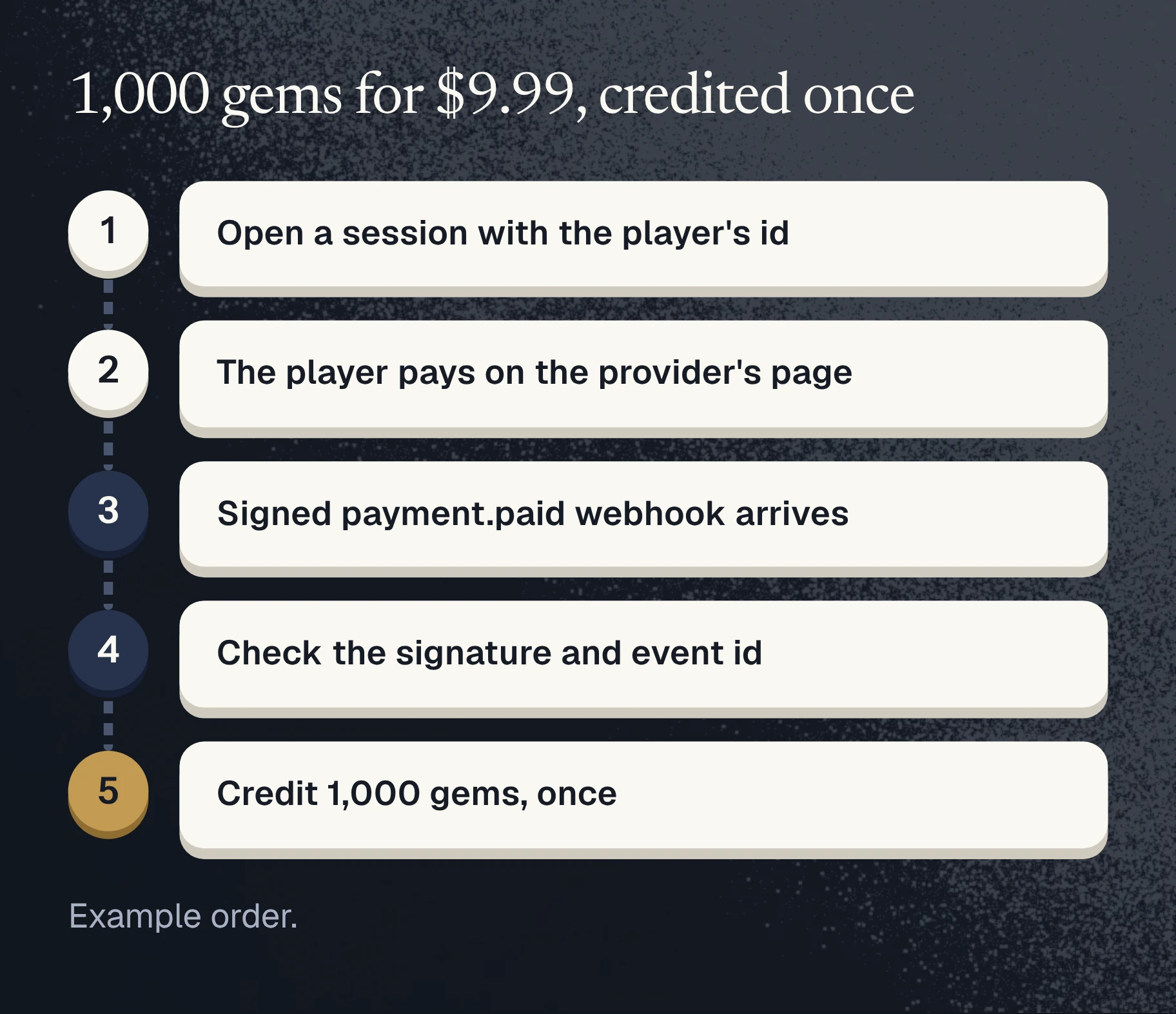
- Your server opens a checkout session for the signed-in player, with your order id as
referenceand the player's id inmetadata. Railbed's API docs say both come back "on the payment and every webhook". - The player pays on the card provider's page. Providers don't send buyers back on their own, so the return page never decides anything.
- A signed
payment.paidwebhook reaches your server. A payment counts as paid when at least 85% of the order's value arrives; less, or a failed check, is held, andpayment.paidfollows only if you accept it. - Your server checks the signature and the event id. Webhooks "are delivered at least once," so Railbed's webhook guide says to store each event id with a unique constraint, in the same transaction as the credit, and to grant each order once per payment id.
- The player gets 1,000 gems, once. A repeat of the same event is acknowledged and ignored.
The same rules, as a checklist:
| Rule | Why |
|---|---|
| Tie the order to a player before payment | The credit has to land in one account, and the webhook carries your ids back |
| Credit on the signed webhook, never the return page | Buyers don't come back from the provider's page on their own |
| Store the event id with a unique constraint | The same event can arrive twice, after a retry or a resend |
| Don't credit a held payment | Less than 85% of the order's value arrived, or a check failed |
| Keep the player's IP and device with each credit | They help you spot a player who keeps buying with new cards |
When should a digital-goods store release a paid order covers the release decision in more depth, how to prevent duplicate crediting shows the database side of step 4, and high-risk payment processors for digital goods sellers covers the wider set-up.
FAQ
Is MCC 5816 a high-risk code? Not on Visa's own list, except for skilled game wagering such as daily fantasy sports. Processors keep their own lists, though, and Stripe restricts in-game currency sold by anyone other than the game's operator.
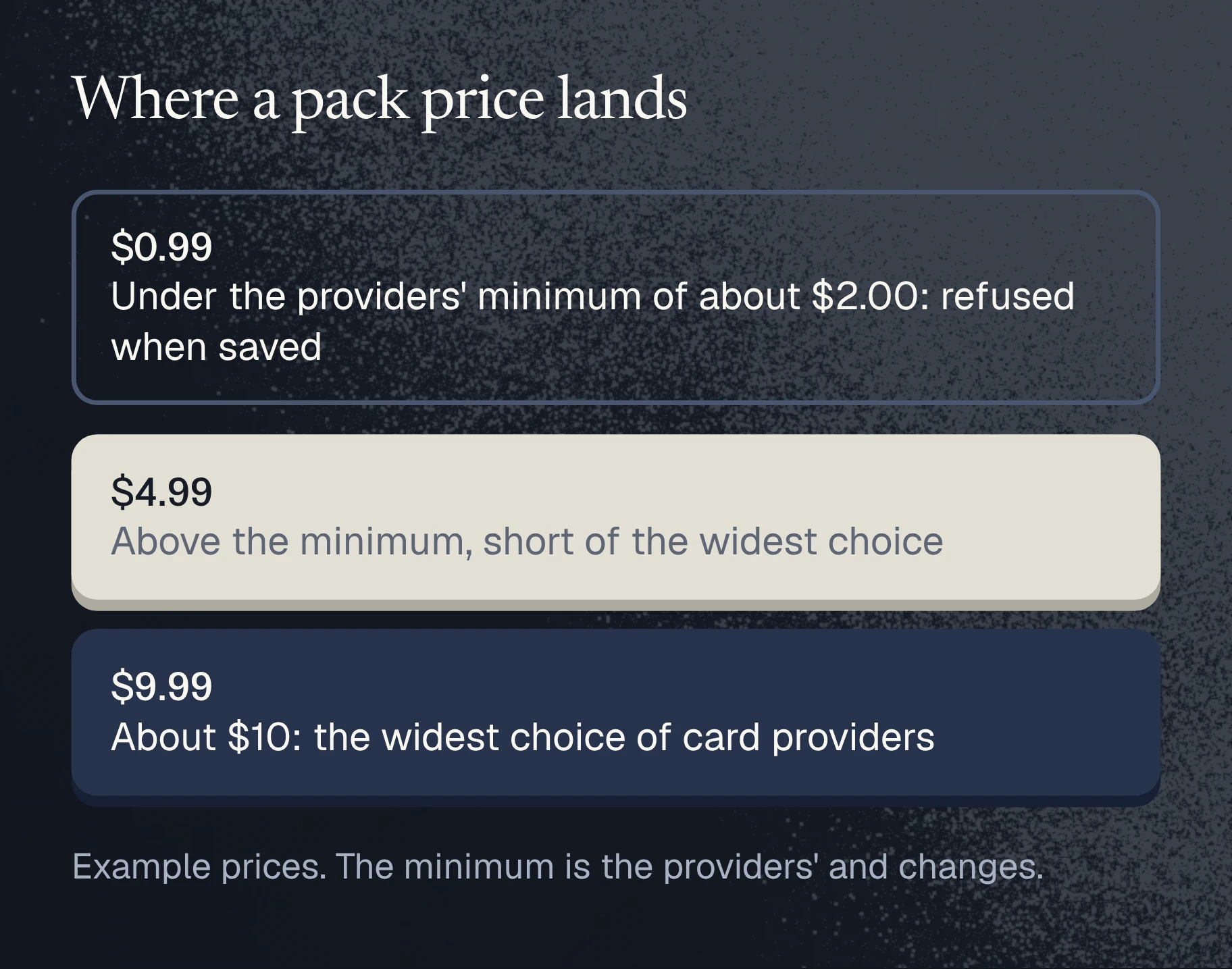
Can a top-up store sell a $0.99 pack by card? Not on its own through Railbed, because the card providers' minimum is about $2.00. Packs priced near $10 give buyers the most providers to choose from.
Who handles a chargeback on a gem order paid through Railbed? The provider that charged the card. Railbed isn't a party to the dispute, and a settled sale can't be pulled back from your wallet.
Why Railbed fits a game top-up store
Railbed is card checkout for online merchants that mainstream processors turn away, digital goods and game top-ups among them. There's no underwriting and no application to pass: sign-up needs an email, your website and a payout wallet. Players pay on an independent, licensed card provider's own page, and each sale settles to a wallet you control, almost always as USDC on Polygon. Nothing is held back from your sales and there's no reserve. Fees are Railbed's, from 0.9%, a 1% network fee and the provider's own fee and exchange rate. The digital goods page shows a top-up checkout.
Price your packs with the providers' minimum in mind. The smallest card payment is about $2.00, which is the providers' minimum rather than Railbed's and changes over time, and an amount under every provider's minimum is refused when you save it. Prices of about $10 or more give buyers the widest choice of providers. So at example prices, a $0.99 pack can't be saved on its own, a $4.99 pack clears the minimum, and a $9.99 pack of 1,000 gems sits at about $10. Smart Routing ranks providers by the buyer's country, the checkout currency, the amount, each provider's minimum and whether it's working today.
Good to know:
- Disputes go to the provider. Settled sales can't be pulled back from your wallet; card disputes go to the provider that charged the card.
- Refunds come from your wallet. There's no refund button: to refund a player, you send the money back yourself.
- A card can still be declined. Best match is a recommendation, not an approval guarantee, and a card can be declined on the provider's page.
- The publisher's terms still apply. Taking cards doesn't change what a game's publisher lets a reseller sell.
- Test it first. Test mode simulates a paid, underpaid or declined payment, and its webhooks are real requests to your server.
Sell game top-ups by card
No underwriting and no application to pass. Players pay on a licensed card provider's page, and each sale settles to a wallet you control.
See the digital goods pageCreate an account