Skill gaming and fantasy sports payment processing: what networks and states ask
The federal skill test, Visa's 5816 and Mastercard's 7994 registration, Stripe's and PayPal's policies, eleven state regulators' fantasy rules, and a $20 entry fee taken by card.

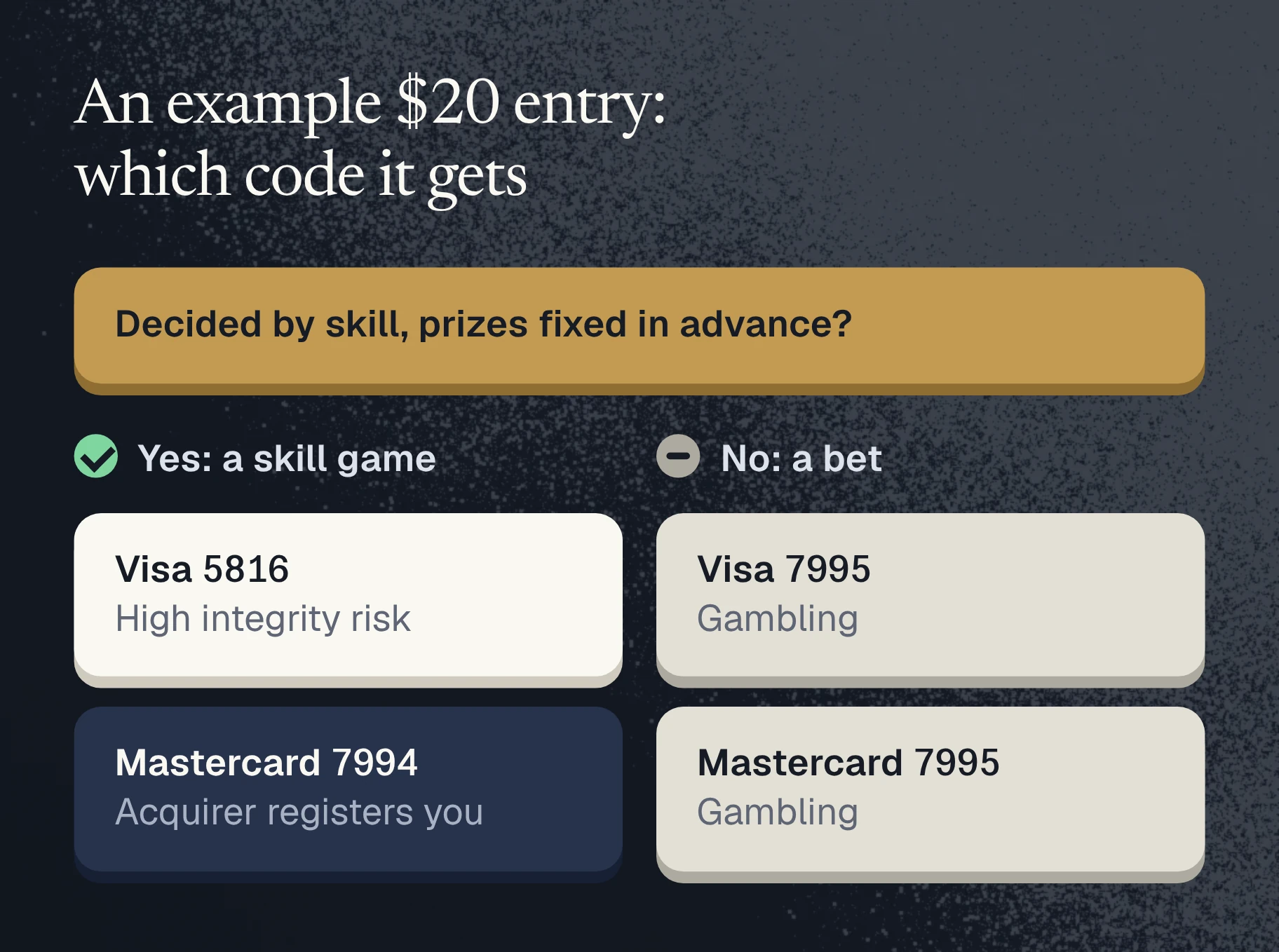
Press the card to run an example sale.
Skill gaming and fantasy sports payment processing sits close to gambling for the card networks: Visa puts daily fantasy under high integrity risk code 5816, and Mastercard has the acquirer register the operator. Many states add their own registration or license before the first entry fee.
This page is for operators of daily and season-long fantasy, esports tournaments and other contests where players pay to enter and win on skill. It covers the test federal law and Mastercard both use, how each network codes a contest, what the biggest processors' policies say, which states' regulators register or license fantasy operators, and how a $20 entry fee can be taken by card through Railbed.
The test that separates a fantasy contest from a bet
The line between a fantasy contest and a wager is drawn in federal law, and Mastercard's rulebook copies it almost word for word. The Unlawful Internet Gambling Enforcement Act leaves out of "bet or wager" a fantasy or educational contest that meets three conditions (31 U.S.C. 5362(1)(E)(ix)):
- Prizes are fixed in advance. "All prizes and awards offered to winning participants are established and made known to the participants in advance of the game or contest and their value is not determined by the number of participants or the amount of any fees paid by those participants."
- Skill and statistics decide. Winning outcomes "reflect the relative knowledge and skill of the participants and are determined predominantly by accumulated statistical results of the performance of individuals... in multiple real-world sporting or other events."
- No single game or team decides. No winning outcome rests on "the score, point-spread, or any performance or performances of any single real-world team," or "solely on any single performance of an individual athlete in any single real-world sporting or other event."
Mastercard's Security Rules and Procedures, section 9.4.5, defines "fantasy sports" with the same three conditions and calls it "a subcategory of skill games," where "the outcome of the game is determined by the skill of the participants rather than by chance." The federal definition settles what counts as a wager under that one federal law; it doesn't decide what each state allows, and Mastercard's own text notes the definition "may vary by jurisdiction."
How Visa and Mastercard code a paid-entry contest
Visa and Mastercard put the same contest under different codes, and both treat it as a special case. A $20 entry to a daily fantasy contest is the clearest example:
- Visa puts games of skill under MCC 5816 (Digital Goods – Games), which covers "games (including games of skill but excluding games of chance) that are delivered in electronic format," with "Fantasy Sports (in jurisdictions where they not considered gambling)" as an example, in its Merchant Data Standards Manual (October 2026). The same manual lists 5816 among its high integrity risk codes for card-absent "Transactions involving skilled game wagering (for example: daily fantasy sports)."
- Mastercard lets an acquirer use MCC 7994 (Video Game Arcades/Establishments) for skill games run by a US merchant, or by a merchant abroad that takes payment from US cardholders, and says the acquirer "must register the Merchant... with Mastercard." The registration needs a copy of the operator's license from the state or tribal authority "that expressly authorizes the Merchant to conduct the particular type of skill game(s)," the operator's own attestation that its skill games are legal, and an independent third party to certify that the operator's systems "are reasonably designed to ensure that the Merchant's skill games business will remain within legal limits," and certifications from "interested parties (such as the Acquirer, ISOs, the Merchant...)" don't count. The acquirer must also notify Mastercard of changes "in applicable law, Merchant activities, and Merchant systems."
A contest decided by chance, or a bet on a result, falls under the gambling code instead. Visa's MCC 7995 covers "games of chance to win prizes of monetary value or betting establishments," which is also where esports betting sits: a wager on who wins a match is a bet, while a tournament where players pay to compete is a skill game.
The table puts the three common contest types beside the code Visa's manual and Mastercard's section 9.4.5 give them.
| Contest | Decided by | Visa | Mastercard |
|---|---|---|---|
| Daily or season-long fantasy meeting the three conditions | Skill and accumulated statistics | 5816, high integrity risk | 7994, registered |
| Esports or game tournament with an entry fee | Players' own skill | 5816 | 7994, registered |
| Betting on a match, a score or a single player | A result the player doesn't control | 7995 | 7995 |
What payment processors' policies say about skill games and fantasy sports
The largest payment processors' own policies put paid-entry skill contests and fantasy sports off limits or behind approval. Stripe's restricted businesses list, updated September 22, 2026, lists among its prohibited businesses "Games of skill including video game and mobile game tournaments or competitions, darts, card games, and board games with a monetary or material prize," "fantasy sports leagues with a monetary or material prize," and "Payments of an entry or player fee that promise the entrant or player will win a prize of value."
PayPal's acceptable use policy, updated November 4, 2026, lists "fantasy sports" and "games of skill (whether or not legally defined as gambling)" under activities where "PayPal requires pre-approval," and only "if the operator and customers are located exclusively in jurisdictions where such activities are permitted by law." The words in parentheses mean PayPal applies the rule whether or not a state calls the contest gambling. Why so many contest operators end up on such lists is covered in what makes a business high risk to card processors.
States that register or license fantasy contest operators
Many states regulate paid fantasy contests through a regulator that registers or licenses operators before they take entries. The table is built from eleven regulators' own pages, read in November 2026; it is a skim for you and your lawyer, not a full list of states, and fees and rules change.
| State | Regulator | What its page says operators need | Fee or tax shown |
|---|---|---|---|
| Alabama | Attorney General | Registration under the Fantasy Contests Act | $1,000 initial; $85,000 renewal above $10 million |
| Colorado | Division of Gaming | License above 7,500 customers, registration below | $15,000 license; $350 registration |
| Indiana | Gaming Commission rule 68 IAC 26 | A game operator license, temporary then permanent | Set by statute, paid with the application |
| Maine | Gambling Control Unit | Licensing of fantasy contest operators | Not shown on the page |
| Maryland | Lottery and Gaming | Registration | 15% operator tax (keeps 85% of proceeds) |
| Massachusetts | Gaming Commission | Registration | 15% monthly tax on adjusted receipts |
| Michigan | Gaming Control Board | A license to offer fantasy contests | Not shown on the page |
| New York | Gaming Commission | Registration | 15% of in-state revenue, plus 0.5% capped at $50,000 a year |
| Pennsylvania | Gaming Control Board | A Fantasy Contest Operator license | In a separate fee schedule |
| Tennessee | Sports Wagering Council | License and registration under the Fantasy Sports Act | Not shown on the page |
| Virginia | VDACS, moving to the Virginia Lottery | A permit from the Virginia Lottery after July 1, 2026; existing registrations continue meanwhile | Not shown on the page |
Virginia's page is worth reading in full: it says that from July 1, 2026, VDACS "will no longer have statutory authority to administer the Virginia Fantasy Contests Act," and that VDACS-registered operators may continue until the Virginia Lottery "has rendered a decision on the operator's permit application." Railbed's fantasy sports industry page covers the wider picture.
Taking a $20 entry fee by card through Railbed
On Railbed, each contest entry is one card payment that settles to the operator's own wallet, and the entry is confirmed when the payment is. The steps below assume your platform already knows the player and the contest:
- Create a checkout session per entry. Your server creates a checkout session for $20.00 with the entry's id in
referenceand the contest and player ids inmetadata, and sends anIdempotency-Keyso a retry never makes a second payment. - The player pays by card on a licensed card provider's page, chosen by Smart Routing for their country, currency and amount. Railbed's tab waits while the provider's page is open.
- Confirm the entry on
payment.paid. Verify the webhook'sRailbed-Signature, match the payment to the entry, and record it once, keyed on the payment id. Never confirm an entry from the player's return to your site. The guide to releasing a paid order explains the timing. - Lock entries before the contest starts. A payment that is still
pendingat lock time hasn't paid; decide in your own rules whether a late payment joins the next contest or is refunded. - Refunds and prizes are yours. Railbed has no payout feature: a canceled contest's refunds and every prize are sent by you, for example from your wallet balance as in paying suppliers and contractors from your wallet.
The checkout can ask for a date of birth with a minimum age of 18 or 21, which stops a younger player before anything is charged; it records what the player says and is not an ID check. Location checks, where a state's rules ask for them, stay in your own platform. The esports and skill games industry page has more on tournament entry fees.
Why Railbed fits a fantasy or skill contest operator
Railbed is card checkout for online merchants that mainstream processors turn away, and it takes contest entry fees without a fantasy sports merchant account in your name, with no underwriting and no application to pass. Sign-up needs an email, your website and a payout wallet. Each entry is charged by an independent, licensed card provider and settles to a wallet you control, almost always as USDC on Polygon. Railbed never holds funds, so nothing is held back from your sales and there is no balance to freeze between contests.
Good to know:
- Fees: from 0.9% of each sale, plus a 1% network fee, plus the card provider's own fee and exchange rate, shown to the player before they pay. No setup fee, no monthly fee, no reserve.
- A $20 entry is above the smallest card payment, about 2.00 USD, and above the roughly $10 at which players get the widest choice of providers.
- An entry counts as paid when at least 85% of its value in USD arrived; less waits as "Needs your decision."
- Settled sales can't be pulled back from your wallet; card disputes go to the provider that charged the card.
- State registration, age and location rules and tax are yours: Railbed doesn't check them for you, and it doesn't pay out prizes or refunds.
- Providers decide whether to check a player's identity; Smart Routing ranks the providers least likely to ask first. A card can still be declined on the provider's page.
FAQ
Is daily fantasy treated differently from season-long fantasy by the card networks? Not by name. Visa's high integrity risk entry gives daily fantasy sports as its example of "skilled game wagering" under 5816, and Mastercard's section 9.4.5 covers fantasy sports of any length that meet its three conditions. What changes the code is whether the contest meets the skill test, not its length.
Does the federal fantasy exemption mean a contest is fine in every state? No. The UIGEA clause only says such a contest is not a "bet or wager" for that federal law. States regulate fantasy contests on their own terms, through the registrations and licenses in the table above and their own gambling laws, so check each state where your players are.
Is esports betting a skill game? A wager on the result of a match someone else plays is betting, which Visa's manual places under MCC 7995 with other wagers. A tournament where the players themselves pay to compete and win on their own play is the skill game Mastercard's section 9.4.5 describes. Taking bets is a sportsbook's business, covered in payment processing for sportsbooks.
Take contest entry fees by card, paid to your own wallet
Create one checkout session per entry, confirm entries from the signed webhook, and test paid, underpaid and declined entries in Test mode before your first contest.
Create your accountRead the checkout sessions API